Moonwalker
New member
- Joined
- Jul 6, 2008
- Messages
- 1,197
- Reaction score
- 0
- Points
- 0



An absolutely electrical based control gives me the creeps.
With no alternate analog instruments and manual control, an electrical failure means certain doom, if you ask me.
A330 has three independents electrical systems, with emergence RAT. It's highly improbable that a simple electrical failure has pulled down this aircraft.
Additionally, it should be said that the real tough work is still done by hydraulics. What changed is the "command" - in the past, you had mechanical systems (hydraulics, mechanics) to move the valves of the power actuators, now you have electrical or sometimes even fiber-optical systems.
The RAT on the Airbus does provide hydraulic pressure just like on any other plane. It is no full electric plane. I have the specifics of a A330 somewhere on my HD, so I can do more research on the topic, especially if more information about the last anomaly is known.
In the worst case, years will pass until the wreck and the flight recorders are found.

Yes you are right but pilot and co-pilot sticks are not connected directly to hydraulic actuators, only FCC are direct control of them.
In case of a catastrophic electrical failure, with engines out and batteries dead or damaged, RAT can provide essential electrical energy (using hydraulics pressure) to run FCC in direct mode, and then pilot could control all (or almost all) control surfaces without any FCC interference. But signals have to pass through FCC anyway, so if three FCC computers are out, only mechanical backup is available.

Yes, but that is a big IF. The FCC computers have a much longer MTBF than many following hydraulic components.
An Airbus doesn't just have three computers. It has at least 20 for controlling multiple flight surfaces. the changes of a string of computer failures is next to zero.

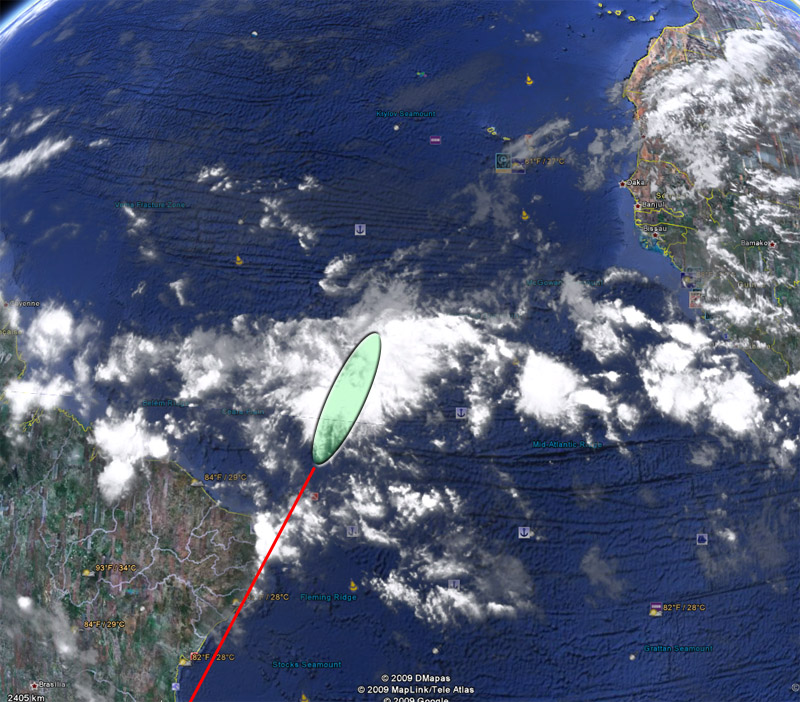

an automatic alarm was send by the plane to the Air France Center (by sat).

At this day we know that the last contact was at 02:14 GMT at 560km of the brasilian coast.
In the last comm with the pilot, he said that the turbulence was great because the plane acrossed a big storm. After, an automatic alarm was send by the plane to the Air France Center (by sat). This alarm signaled an electric failure but we dont' know if the alarm is the source of the crash or if it's the consequence of a breaking structure (decompression).
We are very pessimistic about the chances to find somes debris of the planes because the weather is very bad on the site (storm) and the sea is very rough.
the research area is long about 1000km


