News ROSAT falls from the sky

It is a 1:2000 chance that a single human between 53° North and 53° South is hit by debris. About 5 billion people together bring 1:2,000.

Does that take into account differences in population density over the potential impact area?
 
Does that take into account differences in population density over the potential impact area?

Why should it? It is too early to exclude place from the region so ALL people between 53°N and 53°S are included. It is 1:2000 that a single person of all these people is hit. Regardless if he lives alone in a cave (ok, maybe he has a better chance) or lives in a big city.
 
Got a picture of ROSAT last summer (completely by chance) when it did an unpredicted flare in the sky:

http://www.flickr.com/photos/georgekristiansen/5309957517/

Sent it to a Max-Planck-Institut scientist and he did some analysis and got this:

rflare_.jpg


...so it was tumbling quite a bit even in August 2010. It'll be interesting to see what it does now - there are a few good passes over the UK in the coming weeks.
 
Simple: First, a nuke has the much simpler trajectory. It flies only 25 minutes, and generally tries to aim for a point 90° around Earth from its launch site, so the errors are further minimized.

Next, it has an aerodynamically defined and stable shape with its spinning reentry vessel, while the satellite is complex and tumbling.

This is both also augmented by the fact, that the reentry angle of the satellite is close to zero, while a nuclear warhead reenters at more than 9°, which means the warhead has approximately a straight line during its ballistic reentry from entry interface to impact (Since it never again reaches a place where gravity dominates over aerodynamic forces).

Also, Nukes are actively steered all the way down to the ground by the on-board controls.
 
A 1.7 t mirror? Wow, that's seven years of major bad luck to whomever it falls onto, and gets broken on.

Not quite...

It's not a typical mirror that you'd see in an optical telescope - ball or parabolic shape. X-rays have the unfortunate quality of passing right though everything, so you can only refract them if you do so at very low angles. The technique is called grazing.

grazing2D-72.gif
 
RisingFury brought up an idea for such an X-ray mirror as a radiation shield for HVIPS. :hmm:


If I remember correctly, he also squashed the idea with some maths... :lol:
 
Would have been too heavy.

The best idea for shielding I still have is bending of light. If you pass light through two slits, you get places where light is intensified and in other places where the interference is destructive and light cancels out. If you play with the geometry enough, you can put your crew into one of those shadows.
 
Nice! Practical useage of the double slit experiment FTW.

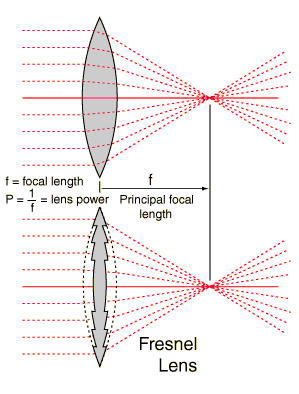
One of my favorite versions is the so called Fresnel bending lens.

fresnel.gif

1.jpg


Instead of the slits being straight, they're circular. The light (waves) focus into a point and into circles around the point.

I didn't do the experiment with x-rays, but I did do it with ultrasound. It was lots of fun.
 
Back
Top