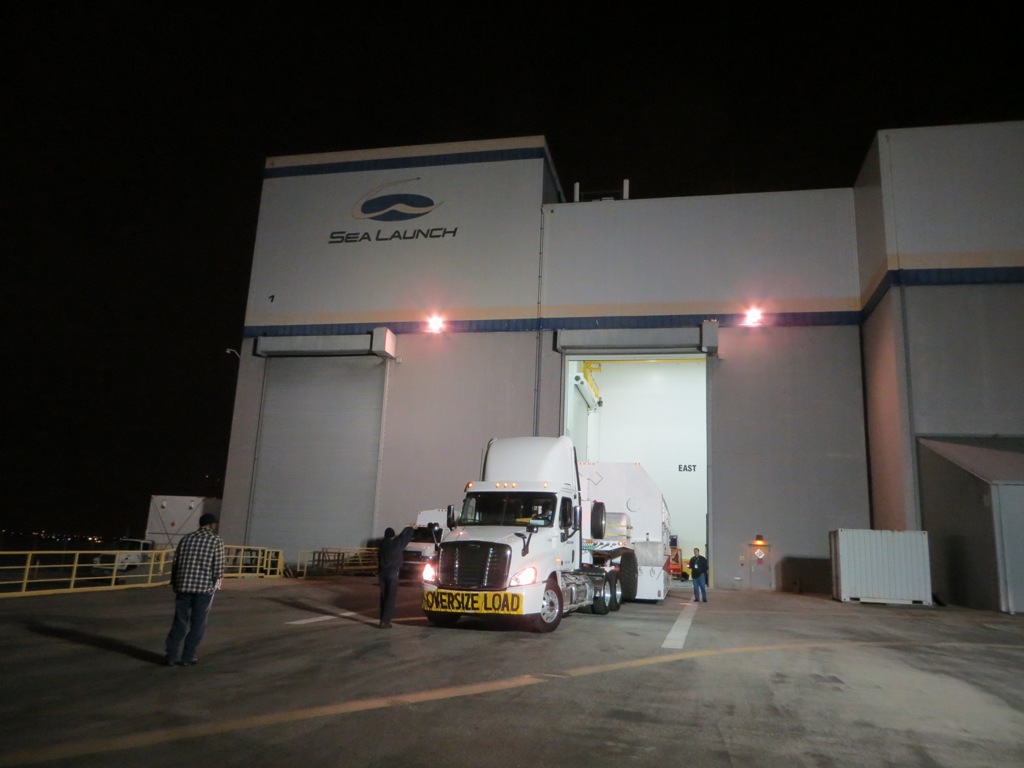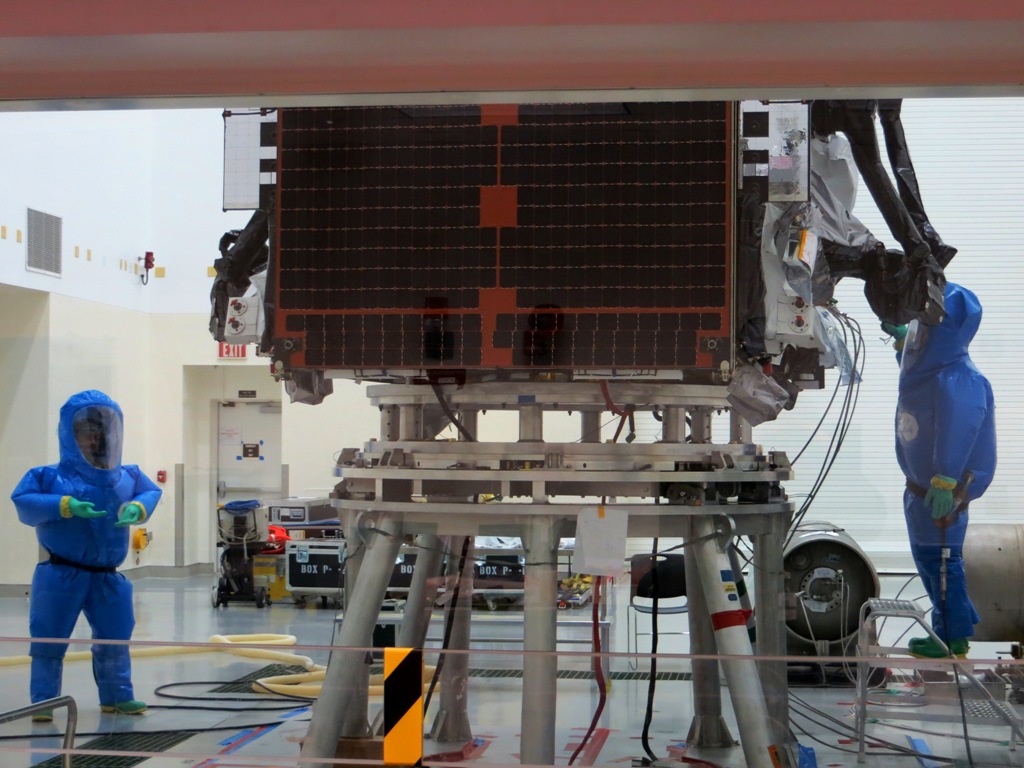


It's already mind boggling to have rocket engines from the same producer to power three orbital launches within 48 hours. It's even more mind boggling to know that it comes from the same engine family and that it was used by three different launch organizations around the world! Yet this is exactly happening right now, as we got a Zenit rocket out on the Pacific waiting to launch a communication satellite for the largest commercial satellite operator of the world, Intelsat. This comes after the two launches yesterday, which all uses a variant of the RD-170 engine family first used on the boosters of the mighty Energia rocket, made by NPO Energomash of Russia.
Launch location:
Odyssey Launch Platform, located at 0°N, 154°W
Launch dates and times:
[table="head"]{colsp=5}Launch times
Time Zone
|
Local / UTC-10
| Universal / UTC
| Los Angeles / PST
| Moscow / UTC+4/
Launch time (Primary):
|20:55:59
|06:55:59
|22:55:59
|10:55:59
on:
|Jan. 31, 2013
|Feb. 1, 2013
|Jan. 31, 2013
|Feb. 1, 2013
{colsp=5}
[highlight][eventTimer]2013-02-01 06:55:59?before|after;%dd% Days %hh% Hours %mm% Minutes %ss% Seconds %c%[/eventTimer] Intelsat 27 Launch[/highlight]
[/table]
Live Coverage Of The Launch:
- Sea Launch Video Streams: http://www.sea-launch.com/current_index_webcast.html - coverage will begin at 06:42 UTC / 22:42 PST
PAYLOAD
Intelsat 27 communication satellite:

Spacecraft Overview
Four Boeing-built geostationary satellites - called Intelsat 21, Intelsat 22, Intelsat 27 and Intelsat 29e - will refresh and add new telecommunications capacity to Intelsat's global satellite fleet.
The new spacecraft feature C- and Ku-band capacity optimized to distribute video, network and voice services from Asia and Africa to the Americas and Europe.
Intelsat 27 will carry a UHF hosted payload and offer 20 25-KHz UHF channels capable of serving the U.S. government and other Intelsat General clients around the world. The satellite is expected to launch in early 2013 and will be positioned over the Atlantic Ocean region as a replacement for the Intelsat 805 satellite.
The Intelsat satellites incorporate low-risk, proven technologies based on the Boeing 702HP satellite. The payload is powered by two solar wings, each with three to four panels of ultra triple-junction gallium arsenide solar cells.
Intelsat's new satellites will utilize Boeing Lean manufacturing, which streamlines manufacturing and test through reduced assembly steps, more efficient operational layout and an enhanced supplier management philosophy based on a product line rather than program approach. Because of the modular design, common manufacturing processes such as pulse line and manufacturing line production can be leveraged to accelerate the manufacturing cycle, leading to a faster delivery for the customer.
The 702MP satellite represents the first major evolution since the introduction of the Boeing 702HP in 1999.
Boeing introduced the 702MP spacecraft in 2009 to meet the needs of customers seeking satellites in the middle-level power ranges. Its flexible design supports payloads that range in power from six to 12 kilowatts. The 702MP provides the high-capability features inherent in the flight-proven Boeing 702HP satellite model, but with a substantially updated satellite bus structure and simplified propulsion system.
Designed to provide 15 or more years of satellite service, the 702MP platform is able to accommodate hosted payloads (such as sensors, UHF and Ka-band) for additional flexibility in customer business planning. The Boeing 702MP is compatible with the Atlas, Ariane, Proton and Sea Launch launch vehicles.
The 702MP satellite is designed and built at The Boeing Company's satellite integration and test complex in El Segundo, Calif.
[table="head"]{colsp=2}Summary
Parameter|Value
Working Orbit:
|GEOOrbital Location:
|55.5° WestCoverage:
|North/Central/South America, Western EuropeApA at separation:
|35275 kmPeA at separation:
|200 kmInc at separation:
|0°[/table]
[table="head"]Characteristics|
Intelsat 27
Customer:
|- Intelsat

Prime contractor:
|- Boeing

Platform:
|- BSS-702MP
Mass at Separation:
|- 6215 kg
Dry Mass:
|- ?
Stabilization:
|- 3 axis stabilized
Dimensions:
|- 36.85 x 7.4 x 9.25 m
Power at end-of-life:
|- 8.4 kW
Primary Payload:
|- 20 Ku-band transponders
- 20 C-band transponders
- 20 UHF-band transponders
Coverage area:
|
|

|

|

Life time:
|- 15+ years
|

Launch Vehicle:
[table="head"]{colsp=2}Characteristics
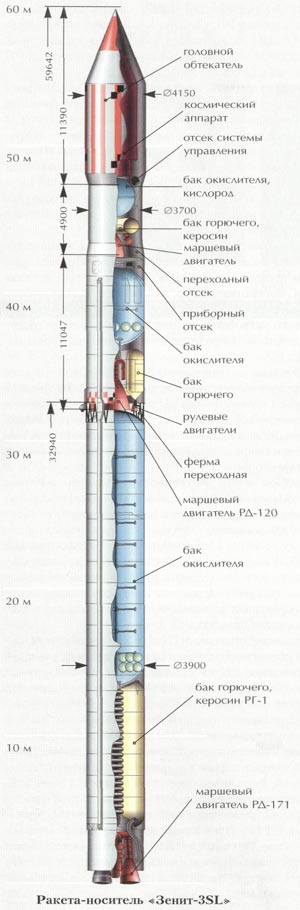
Zenit-3SL / Blok DM-SL
Prime contractor:
|- Yuzhmash (A.M. Makarov Yuzhny Machine-Building Plant) - Ukraine

GRAU Index:
|- 11K77
Height:
| 58.7 m with upper stage and payload fairing Diameter:
| max 4.1 mLiftoff mass:
| 473 metric tonnes Payload mass:
| ~6 tonnes at GTO1st stage:
|- 1 X RD-171 engine
- Empty 33.9 tonnes
- Propellants 318.8 tonnes (RG-1 Kerosene and LOX)
- Thrust in vacuum 7 908 kN
- Thrust at sea level 7 259 kN
2nd stage:
|- 1 X RD-120 engine + 1 X RD-8 vernier engine
- Empty 9.3 tonnes
- Propellants 80.6 tonnes (RG-1 Kerosene and LOX)
- Thrust in vacuum 834 + 78 kN
Upper Stage:
|
- GRAU Index: - 11S861
- Common Name: Block DM-SL
- Designer: Designer: RKK Energia
- Manufacturer: "Krasmash" Krasnoyarsk Machine Building Plant
- Dimensions: Length 5.5 m, Diameter 4.1 m
- Empty Mass: 2.2 tonnes
- Propellants load: 15.095 tonnes (RP-1/LOX)
- Main Engine: 1 X RD-58M
- Thrust in vacuum 8.67 tonnes of force
- ISP 352 s
Payload Fairing:
|- Diameter 4.1 m
- Length 10.4 m
[/table]
[/table]
The vehicle's reliability statistics according to http://www.spacelaunchreport.com/log2013.html#rate:
For Zenit-3SL,
Code:
================================================================
Vehicle     Successes/Tries Realzd Pred  Consc. Last     Dates
                             Rate  Rate* Succes Fail
================================================================
Zenit 3SL/DMSL   31    34    .91  .89     10    1/30/07  1999-
Intelsat 27 Ascent Profile

[TABLE="head"]Orbit #|Orbit Nature|Perigee h, km|Apogee H, km|Inclination
1|2nd stage separation|-2280|182|0°
2|GEO-transfer|196|35450|0°
3|Target GTO|200|35275|0°
[/TABLE]
Intelsat 27 Ascent Timeline


[TABLE="head"]Event|Time UTC|Comment
Lift-off|06:55:59|
1st Stage Separation|06:58:29|
Payload fairing Separation|06:59:51|
2nd/upper Stage Separation|07:04:30|
1st Burn Ignition|07:04:40|
1st Burn Shutdown|07:16:19|1st Burn's Duration 00:11:39
Spacecraft Separation|07:26:09|
[/TABLE]
Photos of preparations of the launch will come soon.
References
http://www.sea-launch.com
http://www.yuzhmash.com
http://www.yuzhnoye.com
http://forum.nasaspaceflight.com
http://www.novosti-kosmonavtiki.ru
http://space.skyrocket.de/doc_sdat/intelsat-27.htm
http://www.spacelaunchreport.com
http://www.intelsat.com/_files/resources/satellites/IS-27-factsheet.pdf
http://www.boeing.com/defense-space/space/bss/factsheets/702/intelsat/intelsat.html
http://www.intelsat.com/network/satellite/
http://blog.intelsat.com/2013_01_01_archive.html
Last edited: