News French plane lost over Atlantic

Yes, it looks very bad. Sudden loss of communications can only mean a catastrophic event. Odd that a lightning strike could down a plane that way, however. I immediately thought about a bomb.
 
What disturbs me is the news of a short circuit in one of the subsystems shortly before loss of communications.

Has really become a rare event, that a plane got lost over the Atlantic Ocean.
 
An absolutely electrical based control gives me the creeps.
With no alternate analog instruments and manual control, an electrical failure means certain doom, if you ask me.
 
The very first thing that came into my mind was Swissair Flight 111.
 
An absolutely electrical based control gives me the creeps.
With no alternate analog instruments and manual control, an electrical failure means certain doom, if you ask me.

All Airbus aircraft have a mechanical backup, not complete though, only elevator trim and rudder pedals I think.

A330 has three independents electrical systems, with emergence RAT. It's highly improbable that a simple electrical failure has pulled down this aircraft.

Regards!!
 
A330 has three independents electrical systems, with emergence RAT. It's highly improbable that a simple electrical failure has pulled down this aircraft.

Additionally, it should be said that the real tough work is still done by hydraulics. What changed is the "command" - in the past, you had mechanical systems (hydraulics, mechanics) to move the valves of the power actuators, now you have electrical or sometimes even fiber-optical systems.

The RAT on the Airbus does provide hydraulic pressure just like on any other plane. It is no full electric plane. I have the specifics of a A330 somewhere on my HD, so I can do more research on the topic, especially if more information about the last anomaly is known.

In the worst case, years will pass until the wreck and the flight recorders are found.
 
You can bet someone will take credit for bringing it down, regardless.
 
Well, in flight the A330 has two engine driven generators, the APU of course and two batteries. The RAT often is called to be a part of the electrical system which is not quite correct. The RAT of the A330 is a part of the hydraulic system backup that mainly pressurizes the green hydraulic system for aileron, elevator and spoiler servo control. The green hydraulic circuit drives an emergency generator in case the two engine driven generators and the APU fail.

A full electrical loss is unlikely, but not impossible.

As for the analog instruments: the A330 has an analog airspeed indicator, analog attitude direction indicator, analog pressure altimeter and a mechanical radio distance magentic indicator. But even on a "conventional" flight deck you get loss of information i.e. red flags on the gauges in case of a power loss. If I take Concorde as an example, it loses any indication, even the variometer since it had been replaced by a digital one including the TCAS system. The only thing that continues to work, as usual, is the standby horizon, standby airspeed indicator standby altimeter and the magnetic compass. Anything else requires electrical power, no matter if you have a complex analog cockpit or glass cockpit.

Those few standby instruments do not help anyway if there are serious malfunctions combined with a crew that becomes rather stressed and confused, as incidences have demonstrated sadly. Loss of orientation during night / haze has already caused total losses with full power and full indications availabe.
 
Additionally, it should be said that the real tough work is still done by hydraulics. What changed is the "command" - in the past, you had mechanical systems (hydraulics, mechanics) to move the valves of the power actuators, now you have electrical or sometimes even fiber-optical systems.

The RAT on the Airbus does provide hydraulic pressure just like on any other plane. It is no full electric plane. I have the specifics of a A330 somewhere on my HD, so I can do more research on the topic, especially if more information about the last anomaly is known.

In the worst case, years will pass until the wreck and the flight recorders are found.

Yes you are right but pilot and co-pilot sticks are not connected directly to hydraulic actuators, only FCC are direct control of them.

In case of a catastrophic electrical failure, with engines out and batteries dead or damaged, RAT can provide essential electrical energy (using hydraulics pressure) to run FCC in direct mode, and then pilot could control all (or almost all) control surfaces without any FCC interference. But signals have to pass through FCC anyway, so if three FCC computers are out, only mechanical backup is available.

Regards!!
 
Oh dear, I have to fly across the Atlantic in about 4 weeks. Now I'm all nervous.
 
Yes you are right but pilot and co-pilot sticks are not connected directly to hydraulic actuators, only FCC are direct control of them.

Yes, but you should never forget what the FCCs replace - mechanical or hydraulic control systems. And the mechanical systems had been far more failure prone in the past than all digital FCCs.

In case of a catastrophic electrical failure, with engines out and batteries dead or damaged, RAT can provide essential electrical energy (using hydraulics pressure) to run FCC in direct mode, and then pilot could control all (or almost all) control surfaces without any FCC interference. But signals have to pass through FCC anyway, so if three FCC computers are out, only mechanical backup is available.


Yes, but that is a big IF. The FCC computers have a much longer MTBF than many following hydraulic components.
 
Yes, but that is a big IF. The FCC computers have a much longer MTBF than many following hydraulic components.

An Airbus doesn't just have three computers. It has at least 20 for controlling multiple flight surfaces. the changes of a string of computer failures is next to zero.
 
An Airbus doesn't just have three computers. It has at least 20 for controlling multiple flight surfaces. the changes of a string of computer failures is next to zero.

No. The A330 has 5 flight control computers, three primary and two secondary.

It should be mentioned that a single secondary computer can provide complete aircraft control in direct law (aileron and elevator deflection corresponds to side stick deflection).

Mechanical control only is available for the stabilizer trim and rudder.
 
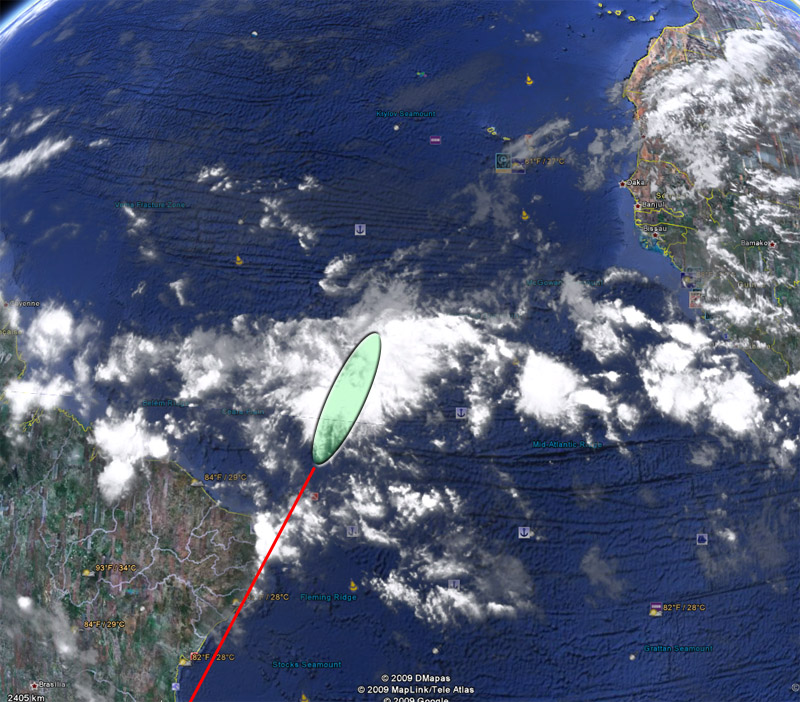
At this day we know that the last contact was at 02:14 GMT at 560km of the brasilian coast.
In the last comm with the pilot, he said that the turbulence was great because the plane acrossed a big storm. After, an automatic alarm was send by the plane to the Air France Center (by sat). This alarm signaled an electric failure but we dont' know if the alarm is the source of the crash or if it's the consequence of a breaking structure (decompression).

We are very pessimistic about the chances to find somes debris of the planes because the weather is very bad on the site (storm) and the sea is very rough.


the research area is long about 1000km
temp124.jpg
 
Last edited:
Below is the airplane that is missing (F-GZCP). The photo is from February 22, 2009 and shows F-GZCP during arrival at Chicago - O'Hare International.

1490136.jpg


More information on Flight AF 447:

http://news.bbc.co.uk/2/hi/americas/8077304.stm

---------- Post added at 05:36 PM ---------- Previous post was at 05:16 PM ----------

an automatic alarm was send by the plane to the Air France Center (by sat).

More specifically, the state of the flight, performance and maintenance related messages are sent via ACARS (Aircraft Communications Addressing and Reporting System) mostly on modern aircraft equipped with flight management computers.

For those who are interested: http://en.wikipedia.org/wiki/Aircraft_Communication_Addressing_and_Reporting_System
 
At this day we know that the last contact was at 02:14 GMT at 560km of the brasilian coast.
In the last comm with the pilot, he said that the turbulence was great because the plane acrossed a big storm. After, an automatic alarm was send by the plane to the Air France Center (by sat). This alarm signaled an electric failure but we dont' know if the alarm is the source of the crash or if it's the consequence of a breaking structure (decompression).

We are very pessimistic about the chances to find somes debris of the planes because the weather is very bad on the site (storm) and the sea is very rough.


the research area is long about 1000km
temp124.jpg


Flight was lost in a Cape Verde Tropical Wave. NHC's stats on it.
...TROPICAL WAVES...

A TROPICAL WAVE IS LOCATED ALONG 29W FROM 03N TO 09N AND IS
MOVING W ABOUT 10 KT. SCATTERED MODERATE TO STRONG CONVECTION IS
LOCATED WITHIN 90 NM EITHER SIDE OF A LINE FROM 05N28W TO
01N33W. THE WAVE HAS LITTLE AMPLITUDE AND SHOULD REMAIN S OF
ABOUT 10N AS IT CROSSES THE ATLANTIC OVER THE NEXT COUPLE OF
DAYS.
 
I will just add that I want to express my deepest sympathies for anyone who knew people on board.
 
Last edited by a moderator:
I thought Airbus was completely electric.
Short circuit alert does not make sense to me.
A good electrical design should open shorted circuits.

Also, if I am correct, an airplane should be fine in case of lightning, since electricity should pass across the hull and the interior should be protected.
Or is the lightning capable of work like an EMP inside the hull?
If such is the case, why airplanes fly across an unsafe path that may involve lightnings?
 
Back
Top
