Project Orbiter Galaxy

It's a spherical or torroidal core, and the heat from the reaction will spread spherically. I don't see how the core walling could be arranged in a maner to collect less heat. Allthough I'm not an engineer, granted.

I was actually suggesting more in terms of IC fusion than MC fusion, similar to that proposed for [ame="http://en.wikipedia.org/wiki/Project_Daedalus"]Project Daedalus - Wikipedia, the free encyclopedia[/ame].

There might also be the possibility of fusion via colliding particle beams.

Only for very short pulses, after which it has the opportunity to cool down again until the next. It's quite a different problem.

Perhaps the answer could then be pulsed power, then.

Anyway, enough thread hijacking. Good news on custom systems. :)
 
hmmm, tough question. I'd say somewhere between 200 and 300 lightyears would be good for a longest range, maybe less, but not more, but that's pure gut feeling.

OK, one thing to keep in mind though: I'll pretty much be working blind. I'm thinking of starting by taking the upper limit on the highest mass class down a bit, but there's only one star in my data set that would be in the new mass class, and nothing in any others I would add, so if I won't know if the new mass classes have connections all over the place, or none at all (we of course want something in-between).

The problem is that if you want to attain high (ie relativistic) velocities, you're going to have to expend enormous amounts of energy regardless.

"high performance" drive concepts usually use nuclear fission or fusion, or remotely, antimatter. Admittedly remote power generation is attractive in that you don't have to lug the powerplant along with you, but it doesn't mean the problem of power generation goes away.

Not only do you not have to lug the powerplant with you, but restrictions on size and mass go away, and you can use one powerplant (or at least one per system) for multiple ships.

Even modern chemical launchers store a large amount of energy...

Fair enough, but it's still an engineering challenge, albeit a difficult one, and nowhere near arranging stellar masses of as-of-yet wholly hypothetical matter in terms of implausibility.

I'd be willing to bet that if the arrangement of the engine components was engineered correctly, they could escape a large portion of the waste heat. And there are systems like Orion, which apparently dealt with their waste heat just fine...

Orion was never built, and, while plausible, is probably near the maximum that one could build. Higher tech could probably make the ride less bumpy, less objectionable to Greenpeace, and so forth, but Orion probably is pretty near the ISP limit for such high acceleration.
 
Orion probably is pretty near the ISP limit for such high acceleration.

It also happened to have a pretty high ISP, although the theoretical maximum is a good deal above what could be achieved.

There is also the deathspewer, which can be considered a continuously detonating Orion... :uhh:
 
OK, one thing to keep in mind though: I'll pretty much be working blind.

I know. I could write up an analising algorithm that goes numbercrunching through in a certain part of the galaxy to give us some data to go on. Allthough it might be nice to have a complete table as starting values, that might cut the iterations down by a few millions. But it'd basically be writing up the algorithm and then letting it crack for a few hours, and get several optimised tables back to choose from. It's not exactly on my priority list currently, since I don't plan to implement the jumplinks for version 0.6 already, but it shouldn't be too much hassle for the next one.
 
It also happened to have a pretty high ISP, although the theoretical maximum is a good deal above what could be achieved.

There is also the deathspewer, which can be considered a continuously detonating Orion... :uhh:

Yeahhhh... Uh... Good luck getting one built... I'll be hiding behind Saturn while you launch it...
 
Had a lot on my hands lately, progress has been slow.

Architecture for custom systems is fully implemented, but I didn't finish the full config file for sol yet. With all those parameters, it's a lot more work than I've expected. Of course one doesn't have to specify all the parameters, but I don't want to ship this baby with a half-baked config file. It's supposed to be an example, after all...

I have plans to add more flexibility to the custom systems later on (mostly providing the option to use the generator to help out with filling in unimportant planets and stuff like that). It will also be possible to merely alter the properties of a star, and let the system be auto-generated, If some people don't like mass or age of certain stars.

But that has to wait, because it's way too boring currently. I'll come back to it later. For now I'm turning my attention to getting a vector view in the MFD that points the right direction to a star... That should be a lot more interesting :)
 
Rewrote the scenario export routine from scratch, the old function was merely for testing purposes and didn't really store any properties of the vessel except the state vectors. The new function should save all the properties of custom vessels.

Also the first jumps back to sol have been concluded, but don't work quite flawless yet. For some weird reason, when jumping back to sol the vessel arrives there with completely screwed up rotation, spinning like mad. That problem doesn't show up in the generated systems, and currently I'm completely baffeled about the cause...

---------- Post added at 03:23 PM ---------- Previous post was at 11:51 AM ----------

Found the cause. Currently I don't specify the name of the central body in the config file, because it's possible that it's not the same as the star's, so there's just Status Orbiting. I assumed that would automaticaly aply to the sun, but no, it aplies to whatever body's SOI you're in... and the rotation parameters are global. So when jumping back to sol I came out pretty close to earth, and the rotational parameters where aplied relative to the earth. Looks like I have to introduce an additional parameter with the central bodies name...

---------- Post added at 07:09 PM ---------- Previous post was at 03:23 PM ----------

Crap, that doesn't help either. Looks like we have to live with the danger of jumping too close to planets... shouldn't happen too often though. The chances aren't too high, after all.

This, and several bugs fixed that came up during this developement (involved a light change in the architecture too), and apart from the wildly spinning thingy when coming out too close to a planet everything seems to work A-ok. Now it's definitaley time for that vector display...

 
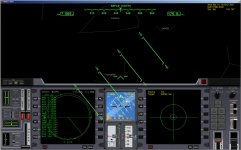
The long and enerving battle with Leonhardt Eulers Transformations and Orbiters global coordinate system has finally been won! The vector MFD is allmost finished, and can point you to any star in the sky, existing or generated.

However, this throws up another problem, with which I haven't bothered yet: The generated systems will need an ecliptic alignement to the galaxy (average planetary plane, for lack of a better reference). I have no clue yet how to implement that realistically. Are there any rules on the direction planets usually orbit a star relative to the galaxy, or is this just random?
 
AFAIK inclination of planetary orbits to the galactic plane is more-or-less random.
 
Actually depends on the rotation of the star and that is completely random. Some planets will orbit retrograde relative to the star. Wasp-17b is an example of a retrograde orbit.
 
Yap, that's Eta Casiopeiae dead on. Vector MFD works flawlessly now, majorly thanks to Face and Martin who helped a lot with rotating the galaxy in place, and Jarmonik, who provided the code for the actual vector display. It would have taken some more time if it wouldn't have been for his code.
Not quite fnished yet, there will also be distance to the target and distance from the source, but that'll be trivial to implement. For now, I'm turning my attention to the shiny stuff... TEXTORZZZ! Artlav sent me a first version of his procedural texture library about a week ago, and I already started to implement it. I have to expand my chemtables a bit to confomr to his atmosphere types, but that was planed anyways...
 

Attachments

  • VectorMFD.jpg
    VectorMFD.jpg
    204.6 KB · Views: 48
Not yet I'm afraid. The implementation of the texture library seems like the last big chunk, but there's a whole lot of small stuff that needs implementing or fixing, documentation to be written etc. Plus there's a good possibility for some unexpected problems to suddenly jump out behind a corner that could introduce severe delays. I can pretty much promise you that it will be this year, though, and as it looks currently probably a good deal earlier than that.

---------- Post added at 07:55 PM ---------- Previous post was at 06:15 AM ----------

A thing I've been thinking about on and off is the actual colors of stars... I mean, our Sun is technically "Yellow", however, seen from space it's white. All the stars in the sky apear to our eyes as white as well. What would other spectral classes look like when seen from a closer vicinity? Would they still apear white, or would they show shades? Would an M9 still look white, or would it be a bit redish to the naked eye? also, would an O0 look white, or would it look bluish? (the main question here is, of course: do I have to make some other sun sprites with different colors, or can I just leave the dafault one for all spectral classes?)
 
What an interesting project this is! Is it just me or is Orbiter dev really skyrocketing these days?

Thanks for all this effort! I will install this when I get the chance.
 
Is it just me or is Orbiter dev really skyrocketing these days?
Well, skyrocketing might be the wrong word. There was a lot of discussion in the thread after the demo of the galaxy generator has been released, so it might have seemed like it, allthough most of it was talk for the future, not for the present. Then I got an unexpected push by Face who solved one of my main problems, and since there developement towards version 0.6 has been pretty steady, and I hope I can keep it that way for a while.

Thanks for all this effort! I will install this when I get the chance.

Well, the only thing you can get currently is the demo of the galaxy generator that isn't yet linked with Orbiter. Take a look at the first post in this thread to get an overview of the project.
 
Well I meant overall based on looking at the addon discussion forum. I will admit my interests were elseware for a long while and I have not been active in the community so it has been quite a shock to see the level of active development lately.
 
Hmph... Just ran into a slight problem with Stargens undocumented gas table. I can't make sense of some parameters. While some are completely clear (like boiling point and stuff) some parameter abreviations don't have much meaning for someone that's not too fit with his chemistry.

Those parameters are "ABUNDe", "ABUNDs", and "Rea".

ABUND... certainly has got something to do with abundance, but what's ABUNDe and ABUNDs?

Anyways, here's what the table says about hydrogen and oxygen, maybe that helps in determining what those abreviations mean:

Hydrogen: ABUNDe 0.00125893, ABUNDs 27925.4, Rea 1

Oxygen: ABUNDe 0.501187, ABUNDs 23.8232, Rea 10 (Rea seems to be 0 or 1 for most gases...?)

Anybody got an Idea what these parameters could stand for?
 
However, this throws up another problem, with which I haven't bothered yet: The generated systems will need an ecliptic alignement to the galaxy (average planetary plane, for lack of a better reference). I have no clue yet how to implement that realistically. Are there any rules on the direction planets usually orbit a star relative to the galaxy, or is this just random?
I was under the impression that most known bodies orbited their parents counterclockwise relative to the galaxy, with Galactic North being taken from Earth North (ie which way looks like 'up' on our local ecliptic.)
 
with Galactic North being taken from Earth North
Nope, the galactic north is on the axis that intersects the sun and is perpendicular to the galactic plane. basicaly, the Z+ direction in the Orbiter Galaxy Map...

Polaris is nowhere near the galactic north pole, the closest star is Beta Coma Berenices, which lies only a few degrees above the ecliptic.

Also, "counter clockwise relative to the galaxy" is a bit of a problem, since for example the Ecliptic of our solar system is almost at a right angle to the plane, so where's counter clockwise?

Most stuff I found so far seem to indicate that current formation theories predict that the ecliptic planes are roughly aligned with the galactic center in one way or the other (which would be about right for our solar system, our ecliptic is about 5 and something degrees off), but I'm not sure yet if I understood that right.

Currently I'm more concerned with my chemtables... :dry: I identified "Rea" as something to do with reactivity, but I still have no Idea what the two different abundances are...
 
Sorry, that was another instance of me not realising there was a whole other page of comments.

Apparently, I know very little about the galaxy...:uhh:
 
Back
Top