Flight Question Re-entry: getting an accurate deorbit position

Grover

Saturn V Misfire
Addon Developer
Donator
Joined
Oct 3, 2010
Messages
1,466
Reaction score
0
Points
0
Location
Ascension Island
if you read my last post, right now youre probably thinking "this guy again? :facepalm:", but please, bear with me.

ive been practicing (or rather trying) re-entries, and it is definitely as hard as it seems. my main problem is the de-orbit burn, and where to do it. ive tried programming the basesync MFD, but it gives me a position that puts me closer to brazil than the cape. ive tried experimenting, but the numbers just dont work.

could someone tell me how to program the deorbit part of the basesync MFD so that it will give me a good position where i can reenter at around 0.7* using the DGIVs (full) auto reentry AP.

*and as long as it works, i dont mind changing the re-entry angle

thanks
-=Grover=-
 
Are you sure you set the "TGT" in the MFD to Cape Canaveral? Sometimes I forget to change it from it's default target "Surface." Surface uses coordinates so it's probably targeting default coordinates at the equator, like at Brazil.
 
not quite

thats not the problem, ive got the right target, AoA set to 0.7*, alt to 40k, Ant to about 3*. what am i missing?

i have had some success recently though. on my last 2 attempts ive managed to reenter almost close enough for an unpowered glide home and without burning, although both times ive come so close to burning ive had to increase AoA to 60* (and Gs to ~9.0 :-() and its knocked my crew unconcious. i think the temperature of my last try actually hit 2300*C before it started to drop.

due to this, i bounced back up to ~50-60k Alt and had to glide back into the denser air.

is my problem the deorbit burn? logic tells me that to fix it, i should burn earlier and/or from a lower altitude to decrease my re-entry angle to around 0.5 so:
A) is this sensible logic?
B) i still need to know how to configure base sync to give an accurate de-orbit burn position (my current lousy method involves using 180* from target and PeA of ~60K, these are bound to change if i move the de-orbit burn)
C) if im completely wrong here, what do i do instead.

im close to sucess, but not close enough it seems. i doubt my passengers are happy about 9G :(

thanks
-=Grover=-
 
This is learn from trial-and-error, and reading here on the forums. Here's what i do in the DGIV:

First you need [ame="http://www.orbithangar.com/searchid.php?ID=2139"]Aerobrake MFD[/ame] and Basesync MFD.

In MFD1, open Basesync; enter base under "TGT"; and make sure your in the 'closest approach' page of the MFD. The closest pass to the base should at least be under 100k. Coast until last orbit before closest approach.

On the last orbit before closest approach, open Aerobrake MFD in MFD2. Enter the same base in Aerobrake, and press 'PRJ' and 'PG' until you get to a map of the earth, and a little grid in the corner. You should see your current orbit on the map, and a line through the grid part.(This is your pass over the base in relation to it, your base is at the center of the grid.)

De-Orbit burn should be half an orbit before closest approach. Make sure you're pointed RETROGRADE, and burn until (on Aerobrake MFD) you see a little square near the center of the grid. (This little square is the point where you're orbit will hit the ground. This INCLUDES atmosperic drag.) Once burn is complete, point PROGRADE and coast until about 120k altitude. You don't need Basesync anymore, so open MapMFD and "TGT" the same base.

Oce at about 120k alt., open the DGIV computer and input PRO104SPEC35 to start with. (PRO104 is a Reentry Program, but you control AOA and Bank. AOA equaling the SPEC part of the program.) Use the numpad to control AOA and bank and ensure the same green square is being held at the very center of the grid. Keep doing this until a cross shows in the grid. (This is your ship). Keep holding AOA and BAnk until distance to base in MapMFD is about 2-4k away. Now you can disengage the reentry program.

Now just land like an airplane!

Hope this helps!:thumbup:

P.S.: PRACTICE, PRACTICE, PRACTICE!!! And tweak until it suits you.
 
Alt is the altitude of re-entry interface, which is the point where the atmosphere begins to have an effect on your trajectory. This is quite a bit above 40k. The standard for Earth is 120k, but can be set as low as 90k. Ant is anticipation, which is the expected angular distance you will travel AFTER crossing re-entry interface. If you have Alt = 120k, this will be closer to 60, perhaps as much as 90. Since I don't use the full auto re-entry AP, I can't be certain - you will have to experiment a bit to find out.

Even then, this will only be repeatable if you always de-orbit at the same altitude. If you de-orbit from a higher altitude, your velocity will be higher and the Ant will need to be increased a bit. It also varies with vessel mass (ie, fuel load, payload, etc), more mass requires more Ant.

If your temps get too high, you need to LOWER your AoA, not increase it. Lowering the AoA will provide more lift, thus slowing your descent rate. The secret to managing heat is to manage the descent rate (VS in SurfaceMFD). You want a descent rate of about -80m/s below 65k alt. When you increased your AoA to 60 degrees and temps went down, that means you had already reduced your velocity enough to be below max heat flux, OR your VS was well above -80m/s. Lowering the AoA can cause a temporary spike in upper hull temps so don't wait until the last moment to lower the AoA.

If you de-orbit 180 degrees from target, you will want a PeA of about 50k after the burn, coming in from the ISS (about 375k alt) this will give you a ReA of about 0.8 degrees. Your AoA will usually vary between 35 and 40 degrees, and you will "bounce" up and down a bit - but won't overheat. De-orbiting about 17.5M from the target will reduce the "bouncing", but you'll need to watch the heat more.

I recommend checking this tutorial out:
[ame="http://www.orbithangar.com/searchid.php?ID=3428"]Tutorial: Concepts for atmospheric reentry[/ame]

This will help you understand what's going on so you can anticipate the re-entry better.

Make sure you're pointed RETROGRADE, and burn until (on Aerobrake MFD) you see a little square near the center of the grid. (This little square is the point where you're orbit will hit the ground. This INCLUDES atmosperic drag.)

Actually, at this point, aerodynamic drag is NOT considered, and this is a purely ballistic prediction. Atmospheric effects (drag and lift) aren't considered until the vessel is below 200k alt (at least this was the case in Orbiter 2006, this may have changed with the new atmo model in 2010. Even if it is, it's calculating this based on your current AoA of -180 degrees and bank of 90 degrees, and won't be accurate.) Just burn until your PeA is about 50k, you'll be fine.

 
so, if i read correctly:

alt should read 120k, for the point of entry to the atmosphere.

ant should be set to around 60* (ill try this out to find some certain values) is there a way to mathematically work out a rough idea of this based on projected entry speed and angle of attack etc. a rough one could use simple velocity if i could work out the average deceleration due to entry, or simply use a guide of my average descent speed. (possible use trig to calculate from entry speed, using AoE to calculate) if theres any mathematicians here, im sure theres a way to do it.

and if all that is done properly and input, my deorbit position should be accurate :D

a few more questions though (as always:P)
what is a suitable altitude to start from (i would establish a circular orbit at this alt before deorbiting), should i continue to practice from ISS alt?

what is a sensible AoA to keep to (only roughly), i use 40* at the moment, and this seems quite sensible (untill i hit 40k and my temperature shoots up), but when i tried 35, i heated up even quicker. does this mean i should lower my AoA at around 60k to increase braking by lowering VS

this is all complicated still, but im confident that ill get it eventually

thanks guys
-=Grover=-
 
I like (if possible) to de-orbit in a series of step changes. For example if I begin at 350Km (and mostly circular orbit) I will "step" down to 275 (or so), circularize orbit and step down again 20 just above 200Km.

I haven't recovered at the Cape in quite a while, I've been "working" out of Wideawake International. But the concepts are the same...

Have you watched this?
http://orbiter-forum.com/showthread.php?t=8425

It helped me tremendously, I haven't missed a runway yet since I watched it.
 
yea, ive seen that vid before, doesnt answer my question about workin out the deorbit position, and if i try that approach, i usually overheat my hull and have to do a very hard aerobrake (about 9g peak :( )

i think ive found a solution though in the post above yours. although i think that an alt ref of ~90k is better than 120. although i think that my ant should be around the region of 45*-50*, it seems that this is more accurate.

next stage is to work out which value to concentrate on stabilising, temp, glideslope or Vs, or a compromise. after sorting out my deorbit, my next attempt overshot by ~25k (i was able to do some slightly powered flying and bring it in to a nice hover landing), and my attempt before that undershot by ~15k, leading into a completely instrument flown hover landing (seriously, try it, its harder than you think (so it without lowering the VC panel or using ext views))

i hope to perfect my technique (or at least get it accurate enough) to post a thread on how to gain an accurate deorbit position, then reenter keeping on the aerobrake path to minimise dist. i already know the type of maths that i'll need, but i need to work out the relationship between reentnry speed and distance covered (or the average deceleration over the entire re-entry phase, down to ~20k alt)

im now diving into a world of problems, wish me luck!

-=Grover=-
 
That's the video i got my ideas from!

Except i prefer to approach the runway from a MUCH lower angle...

also, practice, practice, practice makes you better at reentry.

EDIT: 100th post! Yay!
 
Last edited:
thats not the problem, ive got the right target, AoA set to 0.7*, alt to 40k, Ant to about 3*. what am i missing?

AOA stands for Angle Of Attack and it needs to be around 40°. That's the angle that your nose is pointing up, relative to the airstream.

Your *reentry angle* has to be around 0.7° (or 0.5°). That's the angle between your velocity and the plane of the surface under you.

If you set your AOA to 0.7, then you'll just bounce off the atmosphere, then enter again and bounce off and again and again... and you'll fly around the world like that.
 
Attempting to calculate an exact de-orbit position using average descent or decelleration rates is a waste of time. At the velocities and distances involved, even a variance as small as 0.1 m/s will result in a difference of hundreds of miles by the time you get down to 20k alt. In real life, landing on target is a matter of managing the re-entry, not precise de-orbit tming.

Any winged vessel has a "range", I can de-orbit a DGIV anywhere from over the target (with a full orbit before landing) to 6.5M from target - and make a "deadstick" landing on the runway.

Re-entry involves a High Angle of Attack flight profile. For our purposes, "High AoA" refers to any AoA higher than 18 degrees (this is the AoA where the DGIV generates maximum lift.) In High AoA flight, INCREASED AoA means DECREASED lift. When you see hell temps increasing when you lower your AoA to 35 degrees this is TEMPORARY, and affects the upper hull more than the nose or lower hull,etc.

Thermal management is accomplished by managing the descent rate. The higher the descent rate, the higher the temps. This won't always show as an immediate result, you absolutely have to fly "ahead" of yourself by at least a minute. By the time the hull temps change, the chance to adjust has already passed.

There is a delay between any action you take, and the resulting hull temps. This delay can be anywhere from 10 seconds to a few minutes - depending on current speed and altitude.

Look at it this way - you have no direct control over hull temps. You control hull temps by adjusting the descent rate (VS).

You have no direct control over your descent rate (VS). You control Vertical Speed by controlling the Vertical Acceleration (VACC).

You have no direct control over VACC. You control VACC by adjusting AoA and bank.

There is a whole chain of causes and effects, and it takes time for a change to flow through the chain.

For any given re-entry, there is a maximum sustainable descent rate that is survivable. This varies with vessel type, velocity, and deccelleration rate (which in turn varies with vessel mass, altitude, and AoA). For a DGIV at it's max recommended re-entry mass in a high AoA configuration, a descent rate of 80 m/s (VS = -80 m/s) is a safe rate. The "full auto re-entry AP" functions by maintaining a descent rate of 80 m/s - and doesn't pay any attention to temps.

At orbital velocities ( <= about 8k m/s) a DGIV will NOT burn up at any AoA unless it is under 65k altitude. So by the time you reach 65k, you want to have slowed your descent rate to 80 m/s or less. Keep it at 80 m/s or less from there on down to about 25k alt / 2k m/s velocity, and you WILL NOT burn up. A DGIV's manual re-entry AP only adjusts in 5 degree increments. Find the "boundry" where VACC goes from positive to negative. For instance, often 35 degrees AoA will have a positive VACC, and 40 degrees AoA will have a negative VACC. You will alternate between the two to keep the VS between 60 m/s and 80 m/s throughout the re-entry (below 65k alt).

A vessel will also have a minimum sustainable descent rate determined by the vessels aerodynamic lift and deccelleration rate. As you lose velocity, you lose lift, and will sink down until the atmosphere is thick enough to provide enough lift (at that velocity) to maintain altitude.

There is a LOT of room between minimum and maximum. A successful, survivable "on-target" re-entry is a matter of staying in this middle area. It's easier and safer to de-orbit sooner - a late de-orbit will result in overshooting or burning up. An "early" de-orbit results in a slightly longer glide. This is why many people like to de-orbit 180 degrees from target - with a ReA (Re-entry Angle) of about 0.8. The extended glide allows you to simply hold an AoA throughout the re-entry, without any real concern for descent rate (in this re-entry profile, descent rate will vary - even go into ascent sometimes) and without worry about temps.

In this type of "fixed AoA" re-entry you will be using AerobrakeMFD (It's VERY difficult to land on target using ANY re-entry method without AerobrakeMFD - it's a must have for winged re-entries.). Again, there will be a "boundry". Let's say that 35 degrees AoA will have you overshoot, and 40 degrees AoA will leave you short. Start with the 40 degree AoA (and keep an eye on VACC, VS, and temps) - it's easier to extend a glide than it is to shorten one without burning. As you loose velocity, the difference in landing positions will diminish, and you'll be able to drop to the 35 degree AoA.

If you have the XR-2, you can check out the Home Direct tutorial, which includes an annotated flight recording of an XR-2 re-entering from directly from a Moon - earth transfer. Since the velocities there are above orbital velocity (around 10.3k m/s) the first part of the re-entry is flown up-side down. After orbital velocity is reached, the vessel turns up-right and the rest of the re-entry is the same as re-entry from LEO.

[ame="http://www.orbithangar.com/searchid.php?ID=3660"]Home Direct[/ame]

In summation, precise de-orbiting isn't needed, the slightest change in mass or starting altitude will change everything. Also, no pilot is so perfect that they can consistently fly the EXACT same profile every time, and thee slightest variation will change the landing point by dozens, even hundreds of miles. De-orbit a bit before you really need to, and use AerobrakeMFD to manage the descent. Keep the VACC as small as possible, and anticipate - by the time the temps hit yellow it's too late to fix it without pulling high G's and large changes to the AoA. Avoid large changes to the AoA - you should only have to vary the AoA by 5 degrees throughout the re-entry. If you need larger changes - you aren't anticipating far enough in advance.
 
i think i understand most concepts now, and i can reenter ok and do some powered flight back to base. itts clear now that its almost impossoble to predict where to de-orbit for specific angles due to the huge amount of variables involved. i guess it really is a case of trial and error untill you can develop your own technique.

if anyone is reading this trying to work out how to do your reentry, then heres some advice:
when you start, stick to the simplest rules you can, deorbit at just before 180* from target, wait for ~120k alt, then manage descent rate for ~80M/s. once you can reenter without temperatures getting above ~1600*C, use the aerobrake MFD to make an accurate reentry, then you just need to practice landing (whether runway or hover, its your choice, i prefer hover, simply because its cooler and i usually have plenty of reserve fuel left over ;) )

im off to start practicing, thanks for the help guys!
-=Grover=-
 
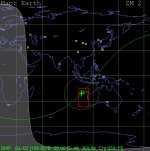
Check out my screen shot below. If I want to land at KSC and I'm in the delta glider or any XR vessels, then I do my retrograde burn inside of the red box I marked on that screen shot. This assumes your current orbit altitude is anywhere from 400k to 350k. With that altitude range I can burn retrograde inside the area I marked and bring PeA down to 57k. This leads to a perfect reentry for me every time landing at KSC. If you're in the space shuttle then you'll need to de-orbit just a little sooner since the engines are not as powerful.

A little Buck Rogers flying, but it works every time and is a good (rough) visual reference. :thumbup:
 

Attachments

  • ksc-deorbit.jpg
    ksc-deorbit.jpg
    137.5 KB · Views: 63
thats all well and good, but i prefer to use the deorbit section of basesync. ive worked out that if i set the ANT to ~50*, ang to 0.7 and alt to 90, it gives a good position for any starting altitude. it may not be the best reentry around (usually its a little early so i have to "skip" the upper atmosphere for 2-3 steps to extend the glideslope to my target) but ive never missed a runway, and im getting closer to powerless landings.

in terms of landings, all i need to do now is start my approach at the right time so that i dont lose too much speed at the runway threshold and stall into a crash (havent done that yet, but ive dropped down to 120 m/s before the engines bumped the speed up to 150 for landing, a very tense landing indeed)

when i work out a good procedure i might post it up here ssomewhere, because it is quite easy once you know what youre doing. once i find a good speed where i can go from a constant descent rate into a step profile that goes right over the target, without doing too many Gs and keeping the temperature low without the need to change the AoA to reduce such dangers.

thanks for the help everyone, id still be a burning wreck without you
-=Grover=-
 
One of the tricks to an unpowered landing is learning how to "offset" the "landing point" in AerobrakeMFD. The "center" of KSC is a few kilometers from the runway, so if your "landing point" is right on the crosshair, you'll end up in a rather poor position for an unpowered landing.

First, I plan on pitching down for "normal" flight at about 20k altitude, and somewhere between 800m/s and 1.5km/s. The actual unpowered approach is the hardest part, and it will take some practice to learn how to manage the velocity correctly. keep in mind that the velocity will drop rapidly once the gear is deployed, so I tend to maintain more speed than I think I should, then use airbrakes if needed during final approach.

You will usually be approaching your target from the northwest or the southwest, occasionally from the direct west. If I'm coming in from the Northwest, I'll set the "landing point" about 50k to the East-North-East of the center, and then turn toward the runway when it's getting near 140 degrees, during the approach your heading should be 150 degrees.

If I'm coming in from the Southwest, I try to cross the runway's line about 20k south of the runway with about 800m/s velocity at 20k. Just after crossing the runway line, I turn AWAY from the runway and try to keep the G-force constant (around 1.5 to 2.5G, the important part is to keep it fairly constant). I'll also widen the FOV so the runway comes on screen sooner, then reduce it for more accuracy as I get lined up. The constant G turn will tighten as you go around and lose speed, so it spirals in and you'll end up making a 270 degree turn that ends up fairly aligned with the runway. This is called a HAC (heading alignment cylinder) manuever, and is useful when coming in crosswise to the runway. An example of this can be found in the "Home Direct" tutorial I mentioned.

You'll want to know what the "neutral glide slope" (the glide slope where your vessel maintains it's speed) is for your vessel. It will vary with mass, but is about 20 degrees for a DGIV - as low as 15 degrees for an XR-2. By the time you are down to 15k alt, you should be lined up with the runway, and the 20 degree (or whatever) line on the surface HUD (and the velocity ball) should be a bit short of the runway. I try to have a velocity of around 180m/s during this part. Once you get low enough (around 1 k alt), start a "pre-flare", gently pitching up to move the velocity ball towards the end of the runway and reducing the descent rate. velocity will start to drop, and if you've done it right you'll flare at around a hundred meters altitude and settle down to the runway with a velocity of 120 - 150 m/s and a VS of less than 3m/s.

This is probably the hardest thing to do in Orbiter, and requires a fair amount of "seat of the pant's" flying skill. I can do it pretty consistently, but it's never exactly "easy".

Good luck, and happy flying.
 
Back
Top