

Record to Set: The most satellites lifted in a single launch = 104 satellites
[ame="https://www.youtube.com/watch?v=vYnVJ_JQY-k"]ISRO to launch world record 100 satellites in the PSLV C37 mission - YouTube[/ame]
ISRO:http://dos.gov.in/launcher/pslv-c37-cartosat-2-series-satellite
Brochure: http://dos.gov.in/sites/default/files/pslv_c37-final.pdf
Satellites:
Cartosat-2 Series Satellite
Launch Mass|714 kg
Type of Satellite|Earth Observation
Manufacturer|ISRO
Owner|ISRO
Application| Earth Observation
Orbit Type|SSPO
ISRO Nano Satellites-INS-1A and INS 1B
INS-1A
Overall Size:
Launch Mass|8.4 kg
Mission Life|6 months
Type of Satellite|Experimental
Manufacturer|ISRO
Owner|ISRO
Application|Experimental
Orbit Type|SSPO
INS-1B
Overall Size:
Launch Mass|9.7 kg
Mission Life|6 months
Type of Satellite|Experimental
Manufacturer|ISRO
Owner|ISRO
Application|Experimental
Orbit Type|SSPO
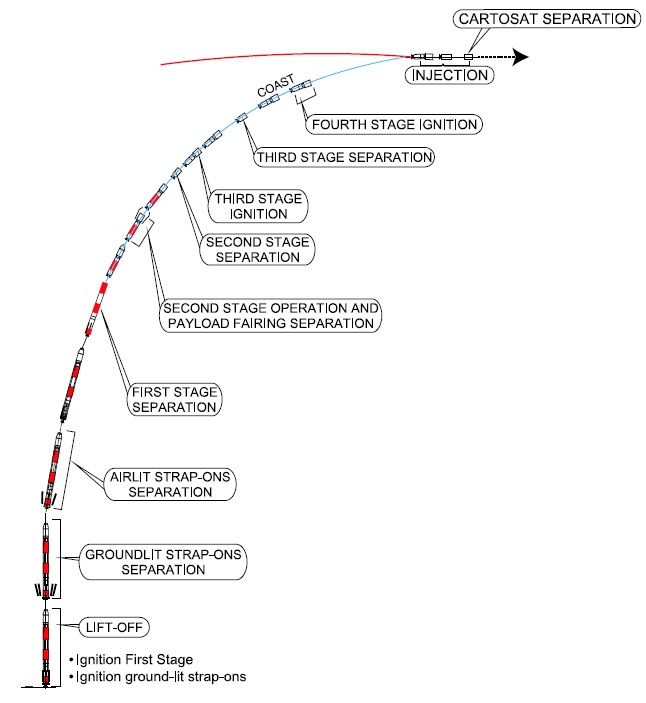
Flight Profile:
Gallery:


[ame="https://www.youtube.com/watch?v=vYnVJ_JQY-k"]ISRO to launch world record 100 satellites in the PSLV C37 mission - YouTube[/ame]
ISRO:http://dos.gov.in/launcher/pslv-c37-cartosat-2-series-satellite
Brochure: http://dos.gov.in/sites/default/files/pslv_c37-final.pdf
PSLV-C37 / Cartosat -2 Series Satellite
India's Polar Satellite Launch Vehicle, in its thirty ninth flight (PSLV-C37), will launch the 714 kg Cartosat-2 series satellite for earth observation and 103 co-passenger satellites together weighing about 664 kg at lift-off into a 505 km polar Sun Synchronous Orbit (SSO). PSLV-C37 will be launched from the First Launch Pad (FLP) of Satish Dhawan Space Centre (SDSC) SHAR, Sriharikota. It will be the sixteenth flight of PSLV in 'XL' configuration (with the use of solid strap-on motors).
The co-passenger satellites comprise 101 nano satellites, one each from Israel, Kazakhstan, The Netherlands, Switzerland, United Arab Emirates (UAE) and 96 from United States of America (USA), as well as two Nano satellites from India. The total weight of all the satellites carried onboard PSLV-C37 is about 1378 kg.
PSLV-C37 also carries two ISRO Nano satellites (INS-1A and INS-1B), as co-passenger satellites. These two satellites carry a total of four different payloads from Space Applications Centre (SAC) and Laboratory for Electro Optics Systems (LEOS) of ISRO for conducting various experiments.
The 101 International customer Nano satellites are being launched as part of the commercial arrangements between Antrix Corporation Limited (Antrix), a Government of India company under Department of Space (DOS), the commercial arm of ISRO and the International customers.
Satellites:
Cartosat-2 Series Satellite
The Cartosat-2 series satellite is the primary satellite carried by PSLV-C37. This satellite is similar to the earlier four satellites of the Cartosat-2 series. After its injection into a 505 km polar Sun Synchronous Orbit by PSLV-C37, the satellite will be brought to operational configuration following which it will begin providing regular remote sensing services using its Panchromatic and Multi-spectral cameras.
The imageries from Cartosat-2 series satellite will be useful for cartographic applications, urban and rural applications, coastal land use and regulation, utility management like road network monitoring, water distribution, creation of land use maps, change detection to bring out geographical and manmade features and various other Land Information System (LIS) and Geographical Information System (GIS) applications.
Type of Satellite|Earth Observation
Manufacturer|ISRO
Owner|ISRO
Application| Earth Observation
Orbit Type|SSPO
ISRO Nano Satellites-INS-1A and INS 1B
PSLV-C37 also carries two ISRO Nano Satellites – INS-1A and INS-1B. ISRO Nano Satellite (INS) is a versatile and modular Nano satellite bus system envisioned for future science and experimental payloads. The INS system is developed as a co-passenger satellite to accompany bigger satellites on PSLV.
The primary objectives of INS system are to:
- Design and develop a low cost modular Nano satellite in the weight range of 10 kg capable of carrying payloads up to a weight of 5 kg
- Provide an opportunity for ISRO technology demonstration payloads
- Provide a standard bus for launch on demand services
- Provide an opportunity to carry innovative payloads for Universities / R&D laboratories
INS-1A
Overall Size:
- 304 x 246 x 364.3 mm3 (stowed)
- 304 x 670 x 364.3 mm3 (deployed)
Payloads:
Surface Bidirectional Reflectance Distribution Function Radiometer (SBR) payload from Space Applications Centre (SAC), Ahmedabad measures the BRDF (Bidirectional Reflectance Distribution Function) of the Earth surface and will take readings of the reflectance of different surface features due to Sun albedo.
Single Event Upset Monitor (SEUM) payload from SAC monitors Single Event Upsets occurring due to high energy radiation in the space environment.
Mission Life|6 months
Type of Satellite|Experimental
Manufacturer|ISRO
Owner|ISRO
Application|Experimental
Orbit Type|SSPO
INS-1B
Overall Size:
- 304 x 246 x 510 mm3 (stowed)
- 304 x 670 x 510 mm3 (deployed)
Payloads:
Earth Exosphere Lyman Alpha Analyser (EELA) payload from Laboratory for Electro-Optics Systems (LEOS), Bengaluru Registers terrestrial exospheric line-of-sight neutral atomic hydrogen Lyman Alpha flux. Besides, it will estimate the interplanetary hydrogen Lyman-alpha background flux by means of deep space observations.
Origami Camera payload from SAC is a Remote Sensing Colour camera with a novel lens assembly for optical realisation in a small package. There is scope for its future scalability and utilisation in regular satellites.
Mission Life|6 months
Type of Satellite|Experimental
Manufacturer|ISRO
Owner|ISRO
Application|Experimental
Orbit Type|SSPO
Flight Profile:
Gallery:
PSLV-C37 Vehicle being integrated at Mobile Service Tower
PSLV-C37 Liquid Stage at Stage Processing Facility
PSLV-C37 First Stage integrated at Vehicle Assembly Building
Core Stage of PSLV-C37 integrated on to Launch Pedestal
Hoisting of Nozzel End Segment of PSLV-C37 Core Stage during Vehicle Integration
Fuel filling of Cartosat-2 Series Satellite in progress at SDSC SHAR
Cartosat-2 Series Satellite in a clean room at the launch centre
Spacecraft undergoing Dynamic Balancing Test
Cartosat-2 Series Satellite undergoing Panel Deployment Test
Spacecraft undergoing Solar Panel Illumination Test


