Sun-Synchronous Orbit = no eclipse period for satellites?

beamrider

New member
Joined
Aug 17, 2010
Messages
8
Reaction score
0
Points
0
Does a cubesat satellite in a Sun-Synchronous Orbit always see the Sun and never get into the shadow of the Earth?

Currently I am working at a CubeSat picosatelitte (school project)
I have asked the question above on a site specialized in CubeSats but they are slow and I do not expect an answer too soon from them.
http://cubesat.ifastnet.com/forum/viewtopic.php?f=15&t=26
In the meantime I have found your forum and I decided to put the same question here.
In is not quite clear for me what Sun Synchronous orbits really are?
How is it possible a satellite in LEO (Low Orbit - about 500 km) always sees the Sun and never gets into Earth shadow?
 
Last edited:
A sun-synchronous orbit exploits the precession of nodes due to the latitudinal perturbation in the Earth's gravitational field. By choosing the orbit inclination right, the propagation rate of the nodes can be synchronised with the sun's node propagation (about 1 degree/day). If you have Orbiter, you can find details in Doc\Technotes\gravity.pdf.
 
In layman's terms, yes.

A sun-synchronous orbit is always over the solar terminator, as it precesses around the Earth at roughly 1 degree per day (think about it: 360 degrees in a circle, ~365 days in a sidereal year). So the Sun will appear low over the horizon, but will never dip below it.

Wikipedia puts it nicely:
http://en.wikipedia.org/wiki/Sun-synchronous_orbit
 
I always wondered if it were possible to be in a sun-synchronous orbit but not at the terminator?
 
I always wondered if it were possible to be in a sun-synchronous orbit but not at the terminator?
Yes, a sun-synchronous orbit can have any LAN. The important thing is to get the inclination and orbit height such that the orbital plane precesses at a sun-synchronous rate. Imaging sats are often in "morning" of "afternoon" sun synchronous orbits so that the images they return have some significant shadows to help with depth perception. IIRC, MRO is in a sun-synchronous orbit around Mars with the LAN set to a local solar time of around 2pm.

EDIT: In answer to the original post, you can have a terminator orbit around Earth so that the satellite can always see the sun.
 
In answer to the original post, you can have a terminator orbit around Earth so that the satellite can always see the sun.
I should add that there may be periods of time around the solstices where your satellite will move into Earth's shadow for a small portion of the orbit. I don't know whether or not that would be a problem for you or not, depending on the orbit height, time of year launched, mission duration, etc.
 
If you have Orbiter, you can find details in Doc\Technotes\gravity.pdf.
Thank you for the information.
Also, that article from Wikipedia was very instructive.
It looks like a Sun Syncronous Orbit means, in general, that the satellite passes above the same parallel, always, at the same solar local time.
A particular type of sun synchronous orbit would be when the satellite rides the border between day and night which means it flies overhead exactly when the Sun sets (or rises depending of the hemisphere).
I downloaded Orbitron and I saw how the border between day and night moves in time on a flat map. However, most of the satellites which Orbitron tracks, do not ride it.
I wander if a CubeSat with no means of propulsion on board, can really keep the terminal line for a few months or a year?
 
Do you have doubts about the mechanism of sun-synchronous orbits in general, or are you just concerned about station-keeping details?

If it's the former, you might want to re-read some of the articles mentioned above. Did you understand the relationship between orbit altitude, inclination and the regression of nodes in the presence of a deformed gravitational field?

If it's the latter, then it is conceivable that without any form of correction, long term drifts due to perturbations or drag can move the satellite out of its desired configuration over time. But even so a sun-synchronous orbit should be good for a few months at least.

Since you are posting in an orbiter forum, I am assuming that you are prepared to try this for yourself. Run the following scenario and see what happens. The node offset drifts a bit over time (could probably be improved with a bit of trial and error), but when I tested it, it still kept the sun above the horizon at all times after 4 months.

Code:
BEGIN_DESC
Contains the latest simulation state.
END_DESC

BEGIN_ENVIRONMENT
  System Sol
  Date MJD 53651.5381879918
END_ENVIRONMENT

BEGIN_FOCUS
  Ship GL-01
END_FOCUS

BEGIN_CAMERA
  TARGET GL-01
  MODE Cockpit
  FOV 50.00
END_CAMERA

BEGIN_HUD
  TYPE Orbit
  REF AUTO
END_HUD

BEGIN_MFD Left
  TYPE Orbit
  PROJ Ship
  FRAME Equator
  ALT
  REF Earth
END_MFD

BEGIN_MFD Right
  TYPE Map
  REF Earth
  ZOOM 32
END_MFD

BEGIN_SHIPS
GL-01:DeltaGlider
  STATUS Orbiting Earth
  RPOS -1726327.20 -2722690.49 6293324.56
  RVEL 1029.779 -6924.503 -2713.279
  AROT -80.19 -5.77 -1.53
  AFCMODE 7
  PRPLEVEL 0:0.553000 1:0.898000
  NAVFREQ 0 0 0 0
  XPDR 0
  AAP 0:0 0:0 0:0
END
END_SHIPS
(Tip: you may want to run this scenario in the server without graphics, and set a step interval of 10 seconds or so. Also make sure that nonspherical gravity is enabled, or it won't work).
 
Do you have doubts about the mechanism of sun-synchronous orbits in general, or are you just concerned about station-keeping details?
1) I am mostly concerned about keeping a cubesat as long as possible in a Sun Syncronous Polar Dusk/Dawn orbit. If I understand well this is the only Sun Syncronous orbit that keeps the satellite always in the path of the Sun light.

2) I reached your forum simply by searching the internet using the keywords "orbital mechanics forum". I had no idea before about the existence of Orbiter Software and you (its creator).
Did you understand the relationship between orbit altitude, inclination and the regression of nodes in the presence of a deformed gravitational field?
3) Frankly speaking I do not understand why the orbital plane of a Satellite, its nodes, precess if the satellite gravitates around a hypothetical static, non rotating, isolated in space and surrounded by a symmetric non spherical gravitational field Planet. I have to learn more physics and mathematics.
Run the following scenario and see what happens. The node offset drifts a bit over time (could probably be improved with a bit of trial and error), but when I tested it, it still kept the sun above the horizon at all times after 4 months.
4) I will run that scenario.
 
Last edited:
2) I reached your forum simply by searching the internet using the keywords "orbital mechanics forum". I had no idea before about the existence of Orbiter Software and you (its creator).

Great intro to the community. Welcome to the forum, beamrider, and to the world of Orbiter! :tiphat:

Kiss the next few weeks of your social life goodbye once you get hooked on this sim. Many members of this forum have flown historical space missions from beginning to end, and created many add-ons to simulate real missions. You stumbled onto a gold mine of good space know-how and good people.
 
1) I am mostly concerned about keeping a cubesat as long as possible in a Sun Syncronous Polar Dusk/Dawn orbit. If I understand well this is the only Sun Syncronous orbit that keeps the satellite always in the path of the Sun light.
What are your constraints:
1. Do you know what your orbit constraints are with respect to the booster?
2. Do you need constant solar illumination or are you just trying to maximise it?
3. How long will your mission last? A high altitude and high inclination orbit with the nodes correctly aligned will keep the sun constantly illuminated until the Earth moves into line with the nodes.
4. Can you get to Lagrange point 1? No end of sun there ;)

2) I reached your forum simply by searching the internet using the keywords "orbital mechanics forum". I had no idea before about the existence of Orbiter Software and you (its creator).
Welcome to Orbiter :cheers:

3) Frankly speaking I do not understand why the orbital plane of a Satellite, its nodes, precess if the satellite gravitates around a hypothetical static, non rotating, isolated in space and surrounded by a symmetric non spherical gravitational field Planet. I have to learn more physics and mathematics.
Doing some graphics to help explain this - I'll come back later.
 
OK, hopefully this makes sense - at least it did when I wrote it... :dry:

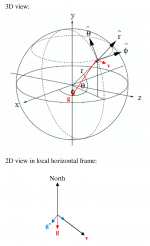
See the attached graphic. The top half shows an extract from gravity.pdf showing the direction of the gravity (or weight) vector and a velocity vector for some randomly selected inclined prograde orbit. Notice that the gravity vector does not point to the centre of the body because more of the mass of the body is in the opposite hemisphere from the vessel for an oblate spheroid (eg, Earth).

The bottom half shows the same thing in the local horizontal frame. The view is looking down towards the centre of the body (ie, looking down the radius vector). In this view, the gravity vector can be decomposed into three components - one aligned with the radius vector (not visible in this view), one aligned with the velocity vector, and one aligned normal to the velocity vector and radius vector (shown as g'). Because this g' component of the gravity vector that is normal to the orbital plane, this rotates the velocity vector and hence rotates the orbital plane. In the northern hemisphere this rotation is clockwise (because the weight vector has a southerly component), in the southern hemisphere is anticlockwise (because the weight vector has a northerly component). The effect of this is that the longitude of the ascending node of the orbital plane is moved in the same direction whether the vessel is in the southern or northern hemisphere. For a prograde orbit, the LAN moves west (this the example shown on the attached). For a retrograde orbit (eg, a sun-synchronous orbit) the LAN moves east (at the same rate that as the right ascension of the sun).
 

Attachments

  • non-spherical_gravity.png
    non-spherical_gravity.png
    104.8 KB · Views: 20
1. Do you know what your orbit constraints are with respect to the booster?
2. Do you need constant solar illumination or are you just trying to maximise it?
3. How long will your mission last? A high altitude and high inclination orbit with the nodes correctly aligned will keep the sun constantly illuminated until the Earth moves into line with the nodes.
4. Can you get to Lagrange point 1? No end of sun there
1. I know that the cubesat together with other picosats will be launched as secondary payloads from a main sun synchronous satellite using something like a spring powered cannon (see This) that can accelerate the the picosat to a relative speed no greater than 1 m/s.
2. I am trying to maximize the solar illumination because all the power I have on board is 600 cm2 of solar panels (100 cm2 of photovoltaic arrays for each side, face, of the cube). The cubesat also spins about a hard to predict rotation axis. It is desirable the cubesat stays as long as possible in sun light.
If it passes, for instance, over the location where I have the UHF-VHF antennas, at noon, next time it will pass during the night when having no power it will be unable to communicate with me. On the other side communication windows (supposing the satellite has some rechargeable batteries on board) late in the night would not be extremely comfortable. Communication opportunities at dawn and dusk are the best.
3. The mission should last at least three years.
4. Definitely, the cubesat can not go to Earth-Sun Lagrange 1. The picosat is barely capable of streaming data at 1200 bps from a 6-800 km LEO. From 1.5 million km (L1) I will receive nothing.
the gravity vector can be decomposed into three components - one aligned with the radius vector (not visible in this view), one aligned with the velocity vector, and one aligned normal to the velocity vector and radius vector (shown as g'). Because this g' component of the gravity vector that is normal to the orbital plane, this rotates the velocity vector and hence rotates the orbital plane.
Good explanation. So instead of having only one downward g component as in the case of a spherical gravitational field, there are three: an ordinary g, a g parallel to the speed of the satellite that accelerate and decelerate it periodically and a g perpendicular to the orbital plane that rotates the plane.
The existence of this perpendicular g appears to accelerate continuously the rotation speed of the orbital plane. It appears that the orbital plane will rotate faster and faster?!

 
1. I know that the cubesat together with other picosats will be launched as secondary payloads from a main sun synchronous satellite using something like a spring powered cannon (see This) that can accelerate the the picosat to a relative speed no greater than 1 m/s.
This sounds to me like the orbit will be decided for you. Do you know the parameters of the main satellite orbit? Perhaps you can use that to do some estimates of how long and when you will have power.

On the other side communication windows (supposing the satellite has some rechargeable batteries on board) late in the night would not be extremely comfortable.
Galileo (and countless others) suffered for their science. I'm sure your school teachers would understand if you started falling asleep in class ;)

The existence of this perpendicular g appears to accelerate continuously the rotation speed of the orbital plane.
No, you are thinking like g' is a torque applied to the orbital plane. The orbital plane is not a rigid object, it is just a consequence of the velocity vector. The direction of the velocity vector changes because of g', at a rate proportional to g'. If g' were constant (its not because it changes with latitude) then the direction of the velocity vector would change at a constant rate also, not accelerate like you have posited.

Here's an alternative way of describing the same thing. Tie a ball to a string and swing it in a circle above your head. There is a constant force on the ball (from the tension in the string) accelerating it towards the centre of the circle. The direction of the ball's velocity does not change at an increasing rate, it changes at a constant rate. A plane passing through the ball and perpendicular to the string will therefore also rotate at a constant rate.
 
Back
Top