
I'll let Orbitnauts weigh in on this: would the Challenger accident have been survivable had the crew worn ACES suits and had the pole escape system been avaliable? According to the accident report, the crew survived the explosion but lost consciousness due to depressurization. The crew cabin traveled upward to about 60,000 ft before traveling towards the ground. Could the crew have baled out near the top?

You are using an out of date browser. It may not display this or other websites correctly.
You should upgrade or use an alternative browser.
You should upgrade or use an alternative browser.
Surviving an O-ring failure
- Thread starter redrover
- Start date
I thought crews closed and locked their visors during launch, assuming they were under full pressure, just in case of an emergency. Plus, I thought the crew survived until impact. I guess they could have bailed out if they could've survived the free fall.
I think that the crew had emergency oxygen, but they only wore blue flight suits.
And they might have been able to survive freefall. http://en.wikipedia.org/wiki/Project_Excelsior
And they might have been able to survive freefall. http://en.wikipedia.org/wiki/Project_Excelsior
SlyCoopersButt
New member
- Joined
- Jun 11, 2008
- Messages
- 425
- Reaction score
- 0
- Points
- 0
I really think they could. The suits of today are designed for loss of atmospheric pressure and they have parachutes. http://www.nasa.gov/mission_pages/shuttle/behindscenes/spacesuitdemo.html This article is a good read about those suits.
(Who wouldn't love to have one of those?)
(Who wouldn't love to have one of those?)
James.Denholm
Addon ponderer
I'm sure the Challenger crew would have loved to have them.
Linguofreak
Well-known member
I'm sure the Columbia crew would have loved to have them.
The Challenger crew would have. The Columbia crew was screwed. (AFAIK, they still don't have suits that can survive re-entry).
Challenger would have been surviveable for most other angles that the O-ring could have leaked at, and also probably would have been much more surviveable with a tower-and-capsule style launcher rather than the shuttle setup.
James.Denholm
Addon ponderer
The Challenger crew would have. The Columbia crew was screwed. (AFAIK, they still don't have suits that can survive re-entry).
Yeah, I know. I edited it accordingly.

zerofay32
Buckeye
The systems listed in the first post wouldn't have saved the Challenger crew. The bail-out pole can only be used in a controlled glide. And the modern pumpkin suits would have allowed the crew to remain conscious after the breakup, but with the crew cabin in the uncontrolled freefall there would be nothing the crew could do.
Zerofay32
Edit: It was shear luck that Challenger didn't explode on the pad. An earlier Columbia flight had the same issue and almost the same outcome. It didn't explode on the pad because Aluminum Slag from the solid fuel plugged up the o-ring, only on Challenger the slag was shaken loose by a strong jet stream.
Zerofay32
Edit: It was shear luck that Challenger didn't explode on the pad. An earlier Columbia flight had the same issue and almost the same outcome. It didn't explode on the pad because Aluminum Slag from the solid fuel plugged up the o-ring, only on Challenger the slag was shaken loose by a strong jet stream.
Last edited:

No, they would have been unconsious to use any escape system, they barley had enough time to switch on their airlocks, now, if there was an Ejection Seat that was active, then yes Challenger would have survived.
Columbia, there was no helping them, Perhaps maybe tilting the Wing away might have helped buy you a minute.
Columbia, there was no helping them, Perhaps maybe tilting the Wing away might have helped buy you a minute.
zerofay32
Buckeye
...if there was an Ejection Seat that was active, then yes Challenger would have survived.
Only Columbia had ejector seats, and even then, they can only be used in the first 100 seconds of the ascent. Challenger broke up at 73 seconds but after that the crew cabin was in a tumbling freefall.
Zerofay32
EDIT: And for future knowlege, neither vehical exploded, they were torn apart by
aerodynamic forces.
Challenger had ejection seats, but they were also deactivated.
So they wore helmets but not for pressurization. :huh: I always thought it was a pressure suit otherwise what was the purpose of the helmets. Why would they ask them to close and lock the visors all that seemed negligible. I know the current orange suits aren't as adequate as a spacewalk suit, but I thought all Space Shuttle crews flight suits would save them in an emergency.
Lets say the Orbiter itself survived the explosion then an abort using the pole would be impossible, they didn't even have parachutes? So they basically launched in regular clothes with just helmets.
Lets say the Orbiter itself survived the explosion then an abort using the pole would be impossible, they didn't even have parachutes? So they basically launched in regular clothes with just helmets.

ryan
That guy
- Joined
- Feb 23, 2008
- Messages
- 1,603
- Reaction score
- 4
- Points
- 0
- Location
- Brisbane, Queensland, Australia
I hate it when subjects fall into this sort of stuff.

- Joined
- Feb 6, 2008
- Messages
- 38,965
- Reaction score
- 3,937
- Points
- 203
- Location
- Wolfsburg
- Preferred Pronouns
- Sire
I'll let Orbitnauts weigh in on this: would the Challenger accident have been survivable had the crew worn ACES suits and had the pole escape system been avaliable? According to the accident report, the crew survived the explosion but lost consciousness due to depressurization. The crew cabin traveled upward to about 60,000 ft before traveling towards the ground. Could the crew have baled out near the top?
No. Even with the current safety systems in the Orbiter, the same accident as Challenger would have been impossible to survive. You can't bail out of a crew section, when it is tumbling.
You can only do a fast separation before the tank explodes, but that would require you to know that the SRB is developing a hot jet. A fast separation would also mean that you loose the Orbiter, but the crew could get saved. Around Max-Q, like the explosion of the Challenger, this maneuver is is suicide, as the aerodynamic forces would rip the orbiter into pieces - just like it did after the external tank collapsed and the orbiter got released.
They actually did already add safety measures to prevent a second challenger - they changed the field joints of the SRBs. Now, they have more O-Rings and the O-Rings get heated before launch, so they can't loose their elasticity by low temperatures.
Challenger had ejection seats, but they were also deactivated.
Wrong. Columbia had ejection seats, Challenger never had them. They got also removed on Columbia at the first occasion.
Moonwalker
New member
- Joined
- Jul 6, 2008
- Messages
- 1,197
- Reaction score
- 0
- Points
- 0
I agree with Urwumpe.
Also, beside the thesis of NASA that the cabin probably didn't brake until impact on the Atlantic Ocean, it's still hard to believe that the crew was conscious all the way down. In my point of view, even if the cabin didn't brake, the crew passed out when the ET broke because almost the complete Orbiter broke down (and honestly, although experts claim to be able to I can't really identify the cabin on the recordings).
I didn't remember quite correctly but I think that NASA mentioned that although the cabin probably didn't brake the chance that the crew remained conscious is rather small. I have a 90 minute NASA video which shows the research of the accident but I didn't watch it for almost 10 years now.
So I think that no way a crew would survive such an accident today too. I also think that the Challenger crew wasn't even able to realize what was going on before they passed out.
Also, beside the thesis of NASA that the cabin probably didn't brake until impact on the Atlantic Ocean, it's still hard to believe that the crew was conscious all the way down. In my point of view, even if the cabin didn't brake, the crew passed out when the ET broke because almost the complete Orbiter broke down (and honestly, although experts claim to be able to I can't really identify the cabin on the recordings).
I didn't remember quite correctly but I think that NASA mentioned that although the cabin probably didn't brake the chance that the crew remained conscious is rather small. I have a 90 minute NASA video which shows the research of the accident but I didn't watch it for almost 10 years now.
So I think that no way a crew would survive such an accident today too. I also think that the Challenger crew wasn't even able to realize what was going on before they passed out.
ar81
Active member
- Joined
- Jun 19, 2008
- Messages
- 2,357
- Reaction score
- 8
- Points
- 38
- Location
- Costa Rica
- Website
- www.orbithangar.com
If you know the basics of statistics, you may see that you need at least 5 occurences to estimate a probability. So you might need 5 accidents to estimate probability.
Since there was no previous accident, assuming there was no risk seems to be a daredevil decision, since USAF rockets with similar design at Vandenberg had similar problems with low temperature by that time.
I just wonder what are the chances that a bureaucrat could survive the press now, after a poor decision like letting the shuttle to take off.
Since there was no previous accident, assuming there was no risk seems to be a daredevil decision, since USAF rockets with similar design at Vandenberg had similar problems with low temperature by that time.
I just wonder what are the chances that a bureaucrat could survive the press now, after a poor decision like letting the shuttle to take off.
- Joined
- Feb 4, 2008
- Messages
- 9,753
- Reaction score
- 1,024
- Points
- 203
Oh, yes you can see the left wing fully intact along with the forward fuselage and aft engine compartment the SSMEs still firing!complete Orbiter broke down (and honestly, although experts claim to be able to I can't really identify the cabin on the recordings).
Look up the Roger's Commission report and it should have blown up photos identifying the various elements.
- Joined
- Feb 6, 2008
- Messages
- 38,965
- Reaction score
- 3,937
- Points
- 203
- Location
- Wolfsburg
- Preferred Pronouns
- Sire
Also, beside the thesis of NASA that the cabin probably didn't brake until impact on the Atlantic Ocean, it's still hard to believe that the crew was conscious all the way down. In my point of view, even if the cabin didn't brake, the crew passed out when the ET broke because almost the complete Orbiter broke down
They must have been mostly conscious, as except one astronaut, all had opened the valves of their emergency O2 supply. It would be possible that only one conscious astronaut on each deck opened the emergency supply valves for the others, but still, not too bad.
What does still not mean, that they had been conscious all the way down. While pressure was very likely maintained, the cabin was tumbling with high rotation rates - that alone is enough for making even trained astronauts pass out. And if the cabin got damaged, the old emergency O2 supply was not capable of keeping pressure - rapid decompression was still possible with it.
(and honestly, although experts claim to be able to I can't really identify the cabin on the recordings).
I remember a photograph and video sequence, which really made it possible to identify the cabin in the initial debris field, as well as one almost intact wing.
I didn't remember quite correctly but I think that NASA mentioned that although the cabin probably didn't brake the chance that the crew remained conscious is rather small. I have a 90 minute NASA video which shows the research of the accident but I didn't watch it for almost 10 years now.
See above about the spinning... you are very likely right on that.
So I think that no way a crew would survive such an accident today too. I also think that the Challenger crew wasn't even able to realize what was going on before they passed out.
The accelerations on the cabin had been survivable with 20G for a very short instant, also the cabin was pretty robust and most of the destructive energy got already absorbed when wings, payload bay, aft compartment with still spinning engines and the nose section of the shuttle got severed.
As the spinning of the cabin does also not make the astronauts immediately unconscious, you can expect them to have been witnesses of the destruction around them. The loss of power when the payload bay broke away was very likely the most critical aspect of all - the shuttle does only have batteries in some subsystems for keeping memory contents. If the events and noise form outside would have been not enough indication, the darkness should have been a good second clue.
Also, RCS fuel from the nose section combusted in the first moments of destruction, it is pretty likely that this did not happen unnoticed.
Also, if I remember correctly, the last message from the crew ("Uh-oh") could have been caused by two indications: The MPS fuel manifold pressure dropping rapidly or the SRB getting released from its struts and damaging the right wing before hitting the intertank structure.
If the cabin did not get damaged when the parts around it got ripped loose (which is possible), the crew was alive until impact. If even a small hole got ripped into the pressure hull by shrapnel the crew was only conscious for maybe 10 seconds, depending on how fast the atmosphere vented.
It is very very possible that the astronauts got bombarded with all kinds of stuff during the first seconds until reaching free fall. 20G should be enough for tearing the panels out of the cockpit walls and turn checklists into mortal projectiles.

- Joined
- Feb 4, 2008
- Messages
- 9,753
- Reaction score
- 1,024
- Points
- 203
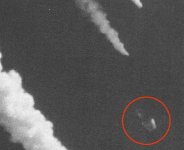
Black&White photo of Challenger crew module. Shape of the upper crew module is evident as is the missing RCC nosecap and FRCS module:
Edit:
The air packs that the crew had was so called Personal Egress Air Packs(PEAPs) that only supplied unpressurized air. They were for use on the ground when visibility was near zero and the the air was not breathable.
Edit:
The air packs that the crew had was so called Personal Egress Air Packs(PEAPs) that only supplied unpressurized air. They were for use on the ground when visibility was near zero and the the air was not breathable.
Attachments
Similar threads


- Replies
- 12
- Views
- 16K

