Are there situations where pi is not equal to 3.14blahblahblah?

My, that IS geeky! I got lost somewhere after "I once wrote a program..." ;)

You can now do the same in Java with a few lines of code...

I am not sure, but I think Java 2 1.6 even has an algorithm to generate Pi with as many digits as you want to... it is not really as complex as calculating a strong prime number - and that job is part of Javas standard library, that part I know sure. If you look for a good way to slow a Java VM down... letting it calculate a strong prime number is great for that.


Time had been more cool, when you didn't hear the words "Nice... but why don't you use the standard function for that?" all the time.
 
No, Pi comes from mathematics, not from physics.
cjp has the nub of the matter here. The entire field of mathematics is the result of the application of logic to a (very) few base assumptions (axioms). You don't need the universe, gravitation or relativity get to the derivation of Pi, therefore it cannot affect its value.

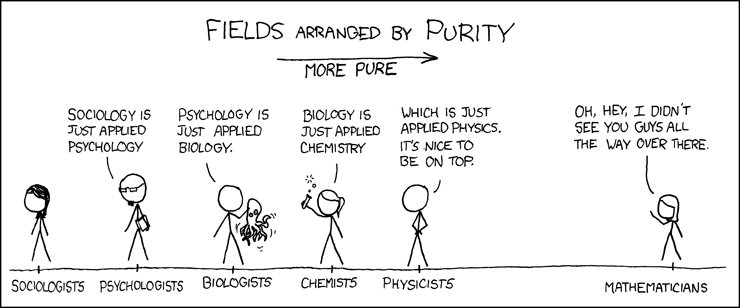
XKCD said it this way:
purity.png


An equally valid definition of pi is the sum of the taylor expansion 4*(1 - 1/3 + 1/5 - 1/7 + 1/9 - ...). How would it be possible for the shape or location of the universe to alter the result of a sum, regardless of what this value can represent? Working from this as a definition, you can prove that pi is the value of the circumference of a circle divided by its radius, but this is still just a 'consequence' in our use of pi.
 
Right, but my solution pre-dates Java (and maybe even C++, come to think of it). It was written in Modula-2, a probably now forgotten Pascal variant.

Hey! I still have some Modula-2 manuals in my shelf. :P A great programming language, just a bit too special even at it's better times... now, Java and C++ just use the concepts of Modula-2 without credit.

In my final years at school, I had written an assembler module for Turbo-Pascal 7.0... allowing Gourand-shaded texture mapped triangles in VESA display modes. Was done only a few months before the first Voodoo cards in the shops made such software obsolete...

Today, you just throw the stuff into your favorite API and let a GPU deal with the mess... about 250,000 times faster as in the good old DOS days...
 
cjp has the nub of the matter here. The entire field of mathematics is the result of the application of logic to a (very) few base assumptions (axioms). You don't need the universe, gravitation or relativity get to the derivation of Pi, therefore it cannot affect its value.

An equally valid definition of pi is the sum of the taylor expansion 4*(1 - 1/3 + 1/5 - 1/7 + 1/9 - ...). How would it be possible for the shape or location of the universe to alter the result of a sum, regardless of what this value can represent? Working from this as a definition, you can prove that pi is the value of the circumference of a circle divided by its radius, but this is still just a 'consequence' in our use of pi.

Sorry to be boring, but I said it first in my crude and unlearned manner:

"Mathematics is mathematics; reality is reality"
 
Sorry to be boring, but I said it first in my crude and unlearned manner:

"Mathematics is mathematics; reality is reality"

Yup, that's in fact a kind of the basic of my argument. I just worked it out a bit more in what I thought could be a more complete and enlightening explanation, by describing a bit how physics, mathematics and pi are related.

About the XKCD comic: I don't think mathematics belongs in the same line. Mathematics is about thinking; in that sense it shares a common field with philosophy. Physics, chemistry etc. are about describing and predicting reality. In this area, the extreme side of physics is to describe the most elementary parts of (material) reality. In the other extreme (sociologists in the comic), the entirety of a huge complex system is described. One one side you have the very exact and abstract description of the elementary parts (particles you can say); on the other side you have the vague, but more close-to-life description of the entire system.

The connection with mathematics is that on the physics side of the scale, the mathematical way of thinking allows for a very accurate description of reality. Of course, this is the case because mathematics was partially "designed" to be usable in physics. But on a metaphysical level it remains interesting that reality can be described in such an exact way at all.

BTW, talking about geekiness: I'm currently developing a new programming language ( part of a larger "hobby" project). Based on this thread, I'm considering using a pi calculating program as the first non-trivial test program. I'm not yet sure whether floating point numbers will be an elementary data type. I'm planning of using the language for artificial intelligence purposes, so the main question is whether it will be useful in that field (maybe it is for fuzzy logic, or for describing physical reality). OTOH, I might make the language such that elementary data types are runtime-configurable. I can already do the same for basic constructs like "if" and "while".
 
I just worked it out a bit more in what I thought could be a more complete and enlightening explanation, by describing a bit how physics, mathematics and pi are related...

You sure did, and I understood it too. I wish my maths teachers in school had been like you, perhaps I wouldn't be locked in innumeracy today. Mathematics is the big hole in my knowledge, but every time I try to study it, I get lost in terminology or symbols I just don't understand.
 
Back
Top