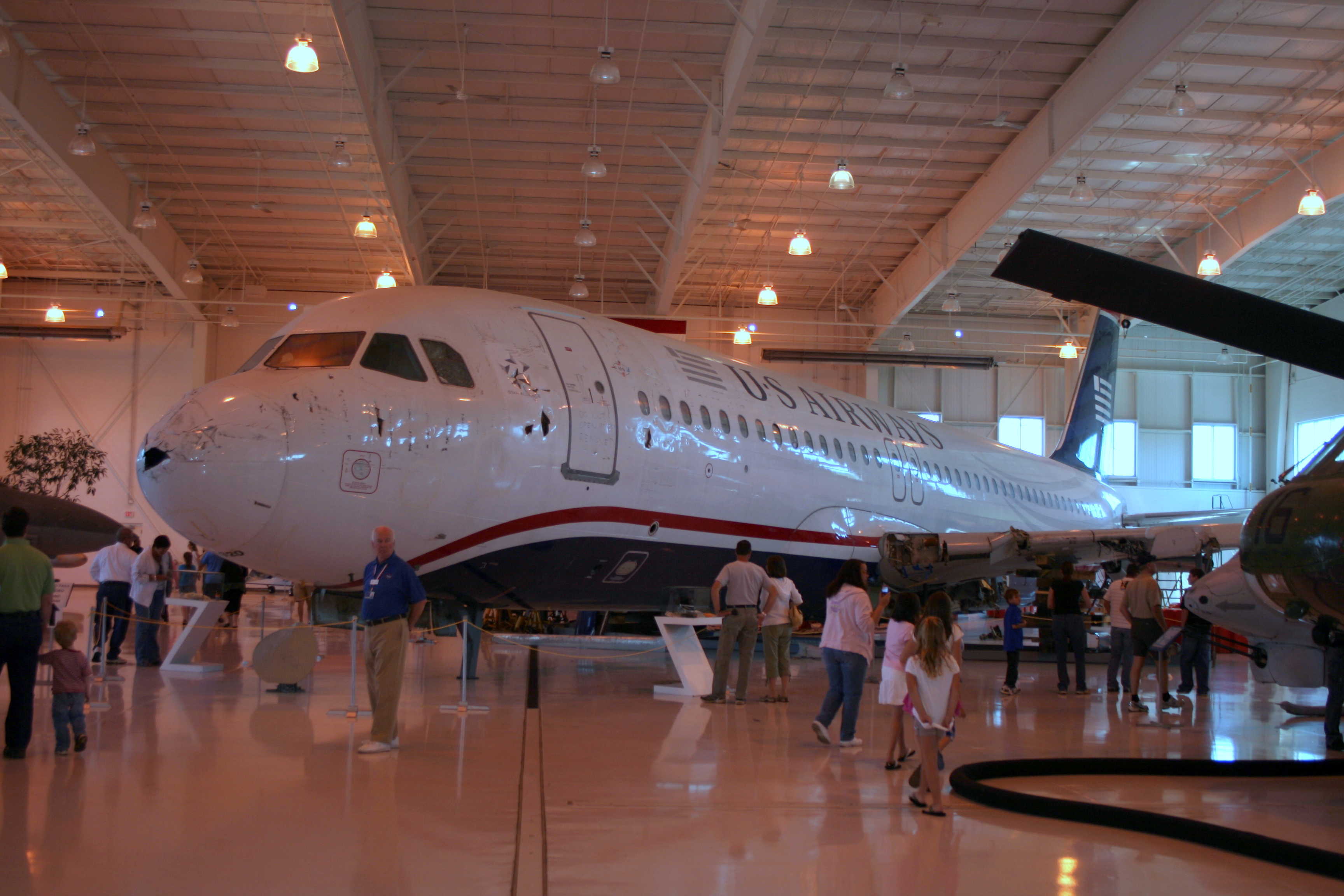
US Airways Jet crashes in Hudson River

But how many people will be saved that way? If you are catapulted out of the plane, you are very likely already in a bad situation. It would be better if vests would inflate automatically in case of water contact, but I can understand a manual solution.

True, but how many planes stay (partially) intact after ditching? Statistics could probably give us an answer, but IMHO you just make a choice, and live (or die) with the consequence.
I doubt an automatic inflation gizmo would result in a better survival rate. Even with all it's shortcomings, the best gizmo for these decisions is the one between our ears.:cheers:
 
True, but how many planes stay (partially) intact after ditching? Statistics could probably give us an answer, but IMHO you just make a choice, and live (or die) with the consequence.
I doubt an automatic inflation gizmo would result in a better survival rate. Even with all it's shortcomings, the best gizmo for these decisions is the one between our ears.:cheers:

Yeah, you are right.

The number of planes which stay intact after ditching seems to be closer to zero, but that is not bad. Important are the sections of the plane, which stay intact and which allow passengers to survive the impact and the following hail of small stuff.

It is mostly impossible to save them all, but saving every one you can save is a good goal for the start.
 
Automatic inflation is probably a bad idea. Normally when a large plane hits the water, it breaks apart, and fills with water within seconds, with everybody still in their seats. If your vest is inflated, you will likely be trapped inside the aircraft, unable to escape, and drown. This is exactly what happened with many of the passengers on Ethiopian Airlines Flight 961 (that's the one that was hijacked and ran out of fuel).
 
Yeah, you are right.

The number of planes which stay intact after ditching seems to be closer to zero, but that is not bad. Important are the sections of the plane, which stay intact and which allow passengers to survive the impact and the following hail of small stuff.

It is mostly impossible to save them all, but saving every one you can save is a good goal for the start.

Exactly! People have been trying to make emergency procedures for over a century, but you can't "standardize" accidents.

Some studies suggest that most accident victims don't die on impact, but by fire, exposure or drowning. If we could provide better protection of the legs, the survival rate could improve.

PS: I just noticed that the "Bomb on board" check list contains the mandatory "Seat and trays in the full upright position" :rofl:
 
Some studies suggest that most accident victims don't die on impact, but by fire, exposure or drowning.

Yes. That's actually even uncontroversial. On the whole, about 80% of deaths in aviation accidents are caused either by smoke/fire/drowning after the crash.
 
Yes. That's actually even uncontroversial. On the whole, about 80% of deaths in aviation accidents are caused either by smoke/fire/drowning after the crash.

Is also no miracle regarding the fact that humans can survive impacts much better as fire or drowning or that only few aircraft accidents are really steep high velocity impacts or collisions.
 
Yes. That's actually even uncontroversial. On the whole, about 80% of deaths in aviation accidents are caused either by smoke/fire/drowning after the crash.

Why not give the passengers oxygen masks to prevent drowning/smoke inhalation?
We already need oxygen for decompression at altitude.
 
You can't use an oxygen mask like the ones you see in jetliner cabins to prevent drowning. For starters, the supply comes from the stricken aircraft, so as soon as you move from your seat you're out of luck. Second, they aren't designed for scuba diving. They won't provide regulated pressure to counter the water pressure. Finally, they would encourage you to stay in your seat longer, and thus doom yourself. The idea is to get everyone out of the jet as soon as possible. Carrying individual O2 bottles is also expensive, and dangerous without training. If you don't know anything about scuba diving, the little pony bottles won't do you much good.

For heaven's sake, DO NOT inflate your vest until you are clear of the cabin structure. Even if the fuselage breaks open, chances are that the way out will not be directly above your seat, and the life vest will just pin you into some corner of the structure and drown you as the plane sinks. It will also endanger those seated near you.
 
I was thinking of an oxygen cylinder with a mask, not like the current designs that use chemicals to produce the oxygen, but you make a valid point about not being able to operate it.

Concerning lifevests, often, when flying from Johannesburg (up in the center of the country) to Cape Town (down on the west coast) the crew informs the passengers that part of the flight will be above water. In fact, 99% is over land, only a small portion of the flight is over water, just before landing. And then, if you survive the plane crash and
escape the wreckage, you'll be eaten by sharks. :suicide:
 
Oxygen cylinders including special masks for each passenger individually would mean the end of economic air travel. This would also be the case if there was parachutes for each passenger individually for example, which is also an idea I heard from a lot of people already.

Safety actually is something that does not exist the way many humans think about. Nothing is safe, not even life itself. But air travel already is optimitzed and highly reliable. I don't think that oxygen cylinders would decrease the number of deaths. It would just make people feel safe and make them pay a lot more money for their tickets because of the extra weight and reduced number of passengers.

If people are unconscious after a crash and badly injured, oxygen cylinders do not help too. A fatal crash or very bad crash landing always will remain a serious threat. There is nothing you can do, just hope/pray.
 
Offshore oil rig workers travel by heli to the rigs a lot, and they have small breathing aids. They give the person just enough air to get out of a sinking craft.
But you need to be trained to use stuff like this. I don't think many air travelers would sign up for the required level of training.
And the price would would push fares up by a significant amount.
 
Just a thought. Given how many deaths come from fire/smoke/drowning, you could sacrifice quite a bit of impact survivability on airliners and still come out ahead if it improved the fire/water survivability.
 
Just a thought. Given how many deaths come from fire/smoke/drowning, you could sacrifice quite a bit of impact survivability on airliners and still come out ahead if it improved the fire/water survivability.

How would they improve water survivability? Turn the airplane into a flying submarine? or tank... ;)

Adding weight to it means that airplanes wouldn't be very fuel efficient, besides that, there are huge numbers of airplanes in stock already, the airline companies aren't going to replace the entire inventory, especially with the way the economy is now.
 
The only thing you can economically improve, is fire survivability. fire resistant materials, better ventilation.

You can even improve the resistance against small bombs, if you include ways into the design and structure, to dissipate shock waves created by explosives out of the plane, instead of reflecting it back and forth.
 
It really is.
The alternative video they link to at the end might be more interesting for flight enthusiasts.
 
Wow, really interesting. Amazing how cool everyone involved was, both controller and crew. I like when Sully asks Skiles "Got any ideas?" and Skiles' reply, "Actually, not." right before they splash in.
 
So in an epic necropost, I chose this thread to say that I just saw the movie "Sully" tonight, starring Tom Hanks as Capt. Sullenberger and Aaron Eckhart as 1st Officer Skiles.

A few observations:

1. Clint Eastwood, as usual, has made a really good movie. It takes a skillful film maker to make an interesting and captivating feature film about an incident that lasted only 208 seconds and resulted in no fatalities.

2. Tom Hanks to me is a bit overexposed, which is not his fault; yet he delivered a very strong performance as Sullenberger, and uncannily looks like him, even. Eckhart actually looks like Skiles to some degree as well.

3. The primary drama in the film comes from the perception that the NTSB was trying to frame the investigation to make it look like Sullenberger made an error in judgement and needlessly endangered the lives of the crew and passengers by choosing a water landing instead of turning for La Guardia or Teterboro, all of which seems to me to be a bit overdone. The implication is that the airline and aircraft manufacturer were pressuring the NTSB to make the pilot a scapegoat, which makes for a good movie but seems a bit far fetched.

4. We take our airline captains and crews for granted. Most of us step aboard jetliners and rarely think about that person with four stripes in the cockpit and how important it is that they be competent, well-trained, experienced and cool-headed. During the credits there was footage of a reunion between Sullenberger, his crew, and many of the passengers in a hangar or a museum of some sort with the aircraft in question, and the love the passengers show for this guy is immense.

For us today in the modern world, a good airline captain is as important as a good doctor and we count on them to not only protect us when things go wrong, but to always be there to calm us on a daily basis so we can book travel without having to really think about it.

---------- Post added at 10:41 PM ---------- Previous post was at 10:26 PM ----------

Found the aircraft. It's in the Carolinas Aviation Museum:

N106US_aviation_museum.jpg
 
Last edited:
Back
Top