
You are using an out of date browser. It may not display this or other websites correctly.
You should upgrade or use an alternative browser.
You should upgrade or use an alternative browser.
New atmospheric model for Earth
- Thread starter martins
- Start date

Ok, I think I have finally worked out the details for the new model. Took a bit longer than I thought, because I had to work out a computationally efficient way of obtaining one of the parameters (the molecular weight of the atmospheric gas mixture) in order to calculate pressure from density and temperature.
I've written up a technical note with the details of the new model:
http://orbit.medphys.ucl.ac.uk/beta/earth_atm.pdf
Before I start on the actual implementation, it would be good if people could have a look at this to see if they spot any obvious errors or problems.
Once it has been reviewed, the implementation itself shouldn't take very long, so I hope to have a new beta out in the next few days.
I've written up a technical note with the details of the new model:
http://orbit.medphys.ucl.ac.uk/beta/earth_atm.pdf
Before I start on the actual implementation, it would be good if people could have a look at this to see if they spot any obvious errors or problems.
Once it has been reviewed, the implementation itself shouldn't take very long, so I hope to have a new beta out in the next few days.

- Joined
- Feb 6, 2008
- Messages
- 38,938
- Reaction score
- 3,937
- Points
- 203
- Location
- Wolfsburg
- Preferred Pronouns
- Sire
Looking at the plots, they look good, but I am not sure if the transition between low and high atmosphere is a good idea...
EDIT: Never mind, after reading the passage again, I found out you talk about the current orbiter atmosphere model. Without a transition halfway, and as it is very similar to the MSIS model, I have little to complain.
EDIT: Never mind, after reading the passage again, I found out you talk about the current orbiter atmosphere model. Without a transition halfway, and as it is very similar to the MSIS model, I have little to complain.
I could implement the MSIS model as well (just found some C code for a NRLMSISE-00 model released in 2002), but I suspect that it may be more computationally expensive and probably overkill for orbiter. And since the accuracy of all these models in orbiter is limited by the fact that I can't really use current observation data for magnetic activity and solar flux, it may not matter very much in the end. Still, if there is demand for MSIS, I could provide it as an option.
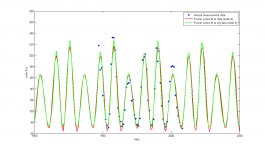
Another question: I am currently assuming a constant solar flux value of 140, but maybe I could do at least slightly better than that, and fit a sine to the solar cycle (say between 70 and 250, with an 11-year period). Of course, this would probably diverge into the past and future, beyond the range for which we have measurements, but maybe it would provide a more lively model (in relative terms ) than a constant value.
Another question: I am currently assuming a constant solar flux value of 140, but maybe I could do at least slightly better than that, and fit a sine to the solar cycle (say between 70 and 250, with an 11-year period). Of course, this would probably diverge into the past and future, beyond the range for which we have measurements, but maybe it would provide a more lively model (in relative terms
) than a constant value.
- Joined
- Feb 6, 2008
- Messages
- 38,938
- Reaction score
- 3,937
- Points
- 203
- Location
- Wolfsburg
- Preferred Pronouns
- Sire
I could implement the MSIS model as well (just found some C code for a NRLMSISE-00 model released in 2002), but I suspect that it may be more computationally expensive and probably overkill for orbiter. And since the accuracy of all these models in orbiter is limited by the fact that I can't really use current observation data for magnetic activity and solar flux, it may not matter very much in the end. Still, if there is demand for MSIS, I could provide it as an option.
A full MSIS would be overkill, I think only real experts will notice the difference, but maybe it is possible to get good results by interpolating between a small number of points.
Another question: I am currently assuming a constant solar flux value of 140, but maybe I could do at least slightly better than that, and fit a sine to the solar cycle (say between 70 and 250, with an 11-year period). Of course, this would probably diverge into the past and future, beyond the range for which we have measurements, but maybe it would provide a more lively model (in relative terms
What about using a FFT on the known activity data and use the first three-four terms for calculating the flux? I would sure like to have a API-Function for solar flux, as it affects also solar sails and solar arrays.
I hear you. What about this? Shows a Fourier series fit of 4th order (red) to the measured annual flux data (blue stars). I also tried a fit to the log of the flux data (green), which seems to give slightly better results.What about using a FFT on the known activity data and use the first three-four terms for calculating the flux? I would sure like to have a API-Function for solar flux, as it affects also solar sails and solar arrays.
Attachments
- Joined
- Feb 6, 2008
- Messages
- 38,938
- Reaction score
- 3,937
- Points
- 203
- Location
- Wolfsburg
- Preferred Pronouns
- Sire
I hear you. What about this? Shows a Fourier series fit of 4th order (red) to the measured annual flux data (blue stars). I also tried a fit to the log of the flux data (green), which seems to give slightly better results.
Yes, the log flux looks better, though I suspect one of the first four terms is pretty minimal and one of the remainder terms is responsible for the exceptional strong years.
Well, if we would have a working prediction for solar activity in Orbiter, we would have what NASA is still searching for :rofl:

This will make LEO missions more fun and realistic, but I will selfishly throw in my vote for a switch of some sort to revert to the 200 km cutoff model, for those long deep space missions where you want to return and find your station waiting for you in LEO, and where flying multiple vehicles is an annoyance.
That is the plan (although the more elegant option would be to equip all those stations with robust orbit boost autopilots that keep them afloat while you are away).
That is the plan (although the more elegant option would be to equip all those stations with robust orbit boost autopilots that keep them afloat while you are away).
Or for more realism, hire a few hundred engineers to monitor all the space vehicles 24 hrs a day!

- Joined
- Feb 6, 2008
- Messages
- 38,938
- Reaction score
- 3,937
- Points
- 203
- Location
- Wolfsburg
- Preferred Pronouns
- Sire
That is the plan (although the more elegant option would be to equip all those stations with robust orbit boost autopilots that keep them afloat while you are away).
Would it be hard to make some vehicles immune against exosphere drag by configuration file option?
Would be a possible transition, but I fear, then nobody will ever use reboosts.

Most of the concerns here seem to be regarding long term stability orbits within the (now expanded) outer limits of the atmosphere. The only way I see that this will become an issue is at high time accelerations. Orbiter already uses orbit stabilization to prevent degradation of orbits under high time accelerations. All that needs to be done is to ignore atmospheric drag as part of the update of state vectors while orbit stabilization is in effect. If you depart from a station in LEO, fly to Mars and back, it is safe to assume that efforts to maintain the orbit of the LEO station will have gone on in your absence and that is the effect that this will produce.

I am not sure if anyone else does this, but I tend to run the sim at 10x over night sometimes to 'put some miles' on my objects in LEO. I do not push it to 100x because I am not sure how accurate the sim will move my station for example with all the realism settings turned on. How useful would this new atmosphere model be for high accelerations say 10-100x speed
James.Denholm
Addon ponderer
Awesome work, Doc! Very well done!

- Joined
- Feb 9, 2008
- Messages
- 285
- Reaction score
- 0
- Points
- 16
- Location
- Salt Lake City
- Website
- www.myspace.com
I like both the re-boost for real time operations like the one(s) I continuously run.. and the Drag-imuno-time-lapsy for time accelerated flights... switching when from real to accel time, with a caveat;
If you plow lower than 190km (Earth) or 30km (mars) on time accel... you DIE...
If you plow lower than 190km (Earth) or 30km (mars) on time accel... you DIE...

RSWingman
New member
- Joined
- Feb 28, 2009
- Messages
- 37
- Reaction score
- 0
- Points
- 0
Oh wow. Wonder how this will affect slingshots. Wonder if things like the Cassini Mission will become impossible due to not being able to get close enough. Next time I try, I'll have to try & stay above 200k to find out.

- Joined
- Feb 11, 2008
- Messages
- 2,601
- Reaction score
- 31
- Points
- 63
Or for more realism, hire a few hundred engineers to monitor all the space vehicles 24 hrs a day!
How expensive will that be at 10K time compression?
- Joined
- May 30, 2008
- Messages
- 5,579
- Reaction score
- 2
- Points
- 0
Assuming that the engineers are in real time, it will cost 1/10th as much per mission-hourHow expensive will that be at 10K time compression?


If this is still actual - a small feature request:
Can you please implement also oxygen and moisture content in the air? The first is crucial for jet engine modelling, the second - will just add for the future.
Can you please implement also oxygen and moisture content in the air? The first is crucial for jet engine modelling, the second - will just add for the future.
Would it be possible to implement the Mars-GRAM 2005 atmosphere model in the next version of Orbiter? Also, according to this page, Global Reference Atmosphere Models (GRAMs) exist for other bodies, like Titan, Neptune, and Venus, though I can't find any description pages for them, much less where/how to download them.
Last edited:
Similar threads

- Replies
- 8
- Views
- 4K


- Replies
- 1
- Views
- 1K


