- Joined
- Feb 4, 2008
- Messages
- 9,753
- Reaction score
- 1,024
- Points
- 203
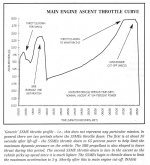
It's clearly G's. I'll see if I can't get the diagram scanned and uploaded.Really G's or better vacuum and effective thrust, with throttle level in %RPL?

It's clearly G's. I'll see if I can't get the diagram scanned and uploaded.Really G's or better vacuum and effective thrust, with throttle level in %RPL?

It's clearly G's. I'll see if I can't get the diagram scanned and uploaded.
Don't know. The diagram in question is on page 417 of The Jenkin's "Space Shuttle" book. He does credit to NASA so it is likely accurate. I'm currently having some problem installing my scanner so I can't scan it.Axial G's as measured by AAs?
Yes. Should be interesting to see just how closely SSU compares to that chart. Given that we do a guidance commanded MECO a whopping 45 seconds early, I think we're going to find that several events occur way to early and we're burning hot for some reason(s).Ok, that data can be exported. Looks like it measures only acceleration, not apparent gravity, since it starts at zero. Pretty much like the acceleration sensors.
Yes. Should be interesting to see just how closely SSU compares to that chart. Given that we do a guidance commanded MECO a whopping 45 seconds early, I think we're going to find that several events occur way to early and we're burning hot for some reason(s).
I think the fact that we can haul a fully loaded Centaur G Prime with the CISS and payload into orbit with only 104% on the SSMEs is a sign of that.

Which one will be easiest translated into a similar chart? If it is the ODF format then we should go for that.I can tackle that, I'll also allow recording some SSME performance data along the way. Is it enough if I record from T-0:30 to T+10:00? And do you want output as text file or is a ODF standard compliant output preferred for the data?
That would explain why the STS-61G payload mass could be put into orbit. How about we put it back to nominal 104.5%?In SSME::Realize, the SSME max thrust is set to FPL_THRUST. If the SSMEs are set to thrust level = 1, they would be running at 109%. That's probably it...
Which one will be easiest translated into a similar chart? If it is the ODF format then we should go for that.
That would explain why the STS-61G payload mass could be put into orbit. How about we put it back to nominal 104.5%?
Thanks. How long have been running the SSMEs at FPL? Is it present in the 1.25 release version as well?replace "FPL_THRUST" with "FPL_THRUST/1.09" in SSME::Realize()... that should do it for now
replace "FPL_THRUST" with "FPL_THRUST/1.09" in SSME::Realize()... that should do it for now
I think we should instead use a lower throttle setting, making 1.0 = 109% RPL.
Great! Maybe we should make it a mission file setting? So that for the Centaur missions we have the 109% capability and for the OFT missions and STS-5 we only have 100% on the SSMEs.I'll change the throttling code so 1.00 (in Orbiter) corresponds to 109% thrust.
Great! Maybe we should make it a mission file setting? So that for the Centaur missions we have the 109% capability and for the OFT missions and STS-5 we only have 100% on the SSMEs.
No. That was just a crazy proposal during the Shuttle C studies. Given the problems they had getting 109% without blowing the engines up on the test-stand back then, it was shelved.Sounds like a good idea. Haven't there been even a test for 129% RPL SSMEs one day?
No. That was just a crazy proposal during the Shuttle C studies. Given the problems they had getting 109% without blowing the engines up on the test-stand back then, it was shelved.
Hmm, seems like we're still MECO'ing early, even with GLS' change, this time at 8:05 MET. Maybe we should also include a vehicle dry mass parameter in the mission file?
Have any changes been made? I'm still working on the mission file entry, so nothings been checked in yet.No. That was just a crazy proposal during the Shuttle C studies. Given the problems they had getting 109% without blowing the engines up on the test-stand back then, it was shelved.
Hmm, seems like we're still MECO'ing early, even with GLS' change, this time at 8:05 MET. Maybe we should also include a vehicle dry mass parameter in the mission file?