Good stable orbit?! (HELP)

ben bradford

Member
Joined
Sep 13, 2009
Messages
32
Reaction score
0
Points
6
Location
Low Jovian Orbit
Hi everone,
Does anyone no how to get a perfect orbit without decreasing and increasing altitude. A bit like the ones on tutorials. Thats what im talkin about. Mine are all over the place, any ideas?
BB
 
What do you mean "without increasing or decreasing altitude?"
Can you clarify your question please? Doesn't make sense.
 
It sounds like you want an orbit with extremely low eccentricity.

Firstly, a perfectly circular orbit is not possible, but you can come close. However, tidal forces from the Sun, Moon and planets will increase the eccentricity over time, leading to a slightly more eccentric orbit.
 
Right, say when you've got an ideal orbit like in the tutorials, the alttitude stays the same throughout one full orbit. If the orbit is all of balance say over australia, the altitude starts to increase until it starts dropping all the way back down to a normal low earth orbit.
Hope this helps.
 
The difference between your apogee (highest point of an earth orbit) and your perigee (lowest point) is expresses as eccentricity in the orbitMFD.
Burn prograde at apogee to raise your perigee and retrograde at perigee to lower your apogee until both are the same. Throughout this process, you will see that the eccentricity will fall.
If you have non-circular gravity on, your orbit will always wobble a bit.

Happy Orbiting
 
Right, say when you've got an ideal orbit like in the tutorials, the alttitude stays the same throughout one full orbit. If the orbit is all of balance say over australia, the altitude starts to increase until it starts dropping all the way back down to a normal low earth orbit.
Hope this helps.

Do you have nonspherical gravity sources checked?

OOp TS beat me to it ;)

nonspherical gravity sources will make your orbiter shift slightly but not enough to cause re-entry.
 
Just curious, is the "nonspherical gravity sources" effect realistic in how the NASA orbiter and ISS orbit the earth?
 
Just curious, is the "nonspherical gravity sources" effect realistic in how the NASA orbiter and ISS orbit the earth?

Yes.

Try this. Turn off non-speherical gravity sources and then see how often the ISS launch window comes around. You'll see it is just a minute or two earlier. That's not like in real life where the perturbation of the sun causes the orbit to precess.
 
I sometimes wait until I'm half way between the highest and lowest points of the orbit. Then, using the Orbit mode on the HUD, I point the ship to 0 degrees of pitch, and 90 degrees of yaw, then I fire up the main engine.
What you are describing is a plane change burn. The OP was about circularising an orbit.

Oh, and don't go full throttle. If you do, the ship will "jump out" on you and you might loose control.
"Jump out"? What does that mean? And in what vessel? No vessel I know of has any trouble burning its engines at full throttle in space.
 
"Jump out"? What does that mean?

You know, that thing next to the thingie mcjig where you turn the thingie mcbob. You know.. the Jump out. :lol:;):P
 
What you are describing is a plane change burn. The OP was about circularising an orbit.

I'm not sure but as he describes it it might be an orbit inward/orbit outward burn. You can kind of rotate your orbit that way and make the Perigree or Apogee move to your current position so you can then do a prograde or retrograde burn to circularize.
 
Yes that would be what i know as an "orbit inward" burn.. and you're right it would also lower the eccentricity when you are on the ascending part towards apogee. I'm just not sure if the perfect spot for burning would really be exactly the middle point between perigree and apogee altitude. After all you'll have to do the burn at exactly the altitude that the ideal circular orbit of the same energy as your eccentric one would have.

The same thing would work with an orbit outward burn when you are on the descending part of your orbit from apogee to perigree.
 
I'm describing an eccentricity change burn.
I see now. I am too used to working in a frame of reference where yaw is an angle out of the orbital plane (that is the way it is defined in the ISS and STS programs, for example). I had forgotten that the Orbit HUD actually shows the pitch ladder in that direction instead.

By the term "jump out", I use that term to describe how the HUD indicators respond to the engine burn when modifying your orbit in the way I described. If you do it too fast, then when you increase the amount of rotation to maintain 90 yaw, you could easily loose control.
Yes, the HUD indcators are quite sensitive to small changes in spacecraft attitude near the singularity point where the lines of constant yaw converge. Still, pointing your vessel at yaw=270 and firing at full throttle is no different to pointing it at yaw=0 and firing at full throttle with regard to spacecraft stability. It is just that the common small excursions in spacecraft attitude look more extreme at yaw=270.
 
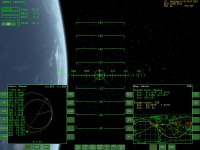
Wait a minute, not workin anymore! I've followed all your advice(THANKS) but it keeps comin up with this orbit:
 

Attachments

  • orbiter 2009-09-17 18-21-35-51.jpg
    orbiter 2009-09-17 18-21-35-51.jpg
    72.5 KB · Views: 21
Back
Top