News ATK & Astrium Liberty™ Launch Vehicle

orb

New member
News Reporter
Joined
Oct 30, 2009
Messages
14,019
Reaction score
4
Points
0
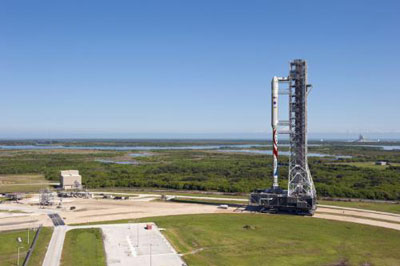
Solid-rocket manufacturer Alliant Techsystems Inc. and a unit of European Aeronautic Space & Defence Co. are teaming up to propose development of a 300 ft (90 m) tall rocket, that both companies envision as a potential game-changer for the U.S. government's space ambitions.

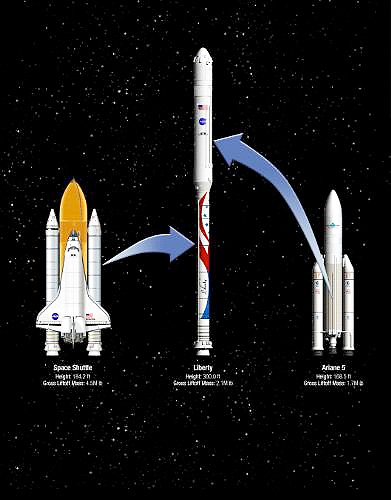
The new rocket, named Liberty, would be much cheaper than the Ares I, because the unfinished NASA-designed upper stage of the Ares I would be replaced with the first stage of the Ariane 5, which has been launched successfully 41 consecutive times. The lower stage of the Liberty, a longer version of the shuttle booster built by ATK, would be almost unchanged from the Ares I.

A first flight test in late 2013 would be followed by another in 2014 and the rocket would be operational in 2015 - the same time commercial space taxis are expected to start flying. An initial crew of 300 would be employed at KSC.

ATK and Astrium, the company that builds the liquid-fueled core stage of European Ariane 5 rockets, are pitching the 33-story rocket to NASA. The pair is vying for part of $200 million in seed money NASA intends to award next month as part of its effort to accelerate development of commercial space taxi services.

Dubbed Liberty, the launcher looks similar to the Ares I rocket that was being developed for NASA's Project Constellation, which was cancelled by the Obama Administration.

For its first stage it employs the same advanced, five-segment version of the shuttle's solid rocket booster. But in a move that significantly lowers development costs, the second stage of the rocket is based on the flight-proven core stage of Europe's Ariane 5 rocket.

The launcher would be 90 m (300 ft) tall, 5.40m (18 ft) in diameter, it is advertised at a price of $180 million per launch and it could carry a payload of 44,500 lb (20140 kg) to Low Earth Orbit.



Links:
 
A unit of EADS is pretty much underestimation, EADS Astrium is THE space unit of EADS.

But looks like a good plan, I just fear it will suffer from the same problems as Ares I, namely the strong SRB vibrations. Also the engine of the EPC is not air-start capable yet, that would also be a major task...and require some new hardware in Lampoldshausen (The best European Engine Test Center, they already evaluated the RD-0120 of the Energia in a research project there.)

But looks promising, would maybe make a nice addition to the Ultra namespace.
 
Last edited:
Er. This is probably a stupid question, but the payload lift of the proposed vehicle isn't out of the range of the existing Ariane 5 stack which was designed with the intent of man rating. So what benefit (other than political) is there from lopping off its boosters and perching it on top of a SRB?
 
Er. This is probably a stupid question, but the payload lift of the proposed vehicle isn't out of the range of the existing Ariane 5 stack which was designed with the intent of man rating. So what benefit (other than political) is there from lopping off its boosters and perching it on top of a SRB?
Launching from KSC without many changes to the infrastructure?

This stack is designed for manned launches from KSC, unlike the Ariane 5, which is launching from French Guiana. Launching Ariane 5 from KSC would likely need more redesign of the infrastructure than for a rocket similar to Ares 1, which demo already launched from the LC-39B, and the fixed towers are being removed anyway from there (and at some point they will be removed from the pad A as well). My guess is that to launch an unmodified Ariane 5 from the LC-39, there would be needed something more than just a clean pad.
 
A little Velcro-Rocket-ish to my taste, but if it works, why not ? ... Wait & see... ;)
 
Only 20 tons to LEO? Why? You have the whole Ariane-5 core stage used as an upper stage and a very powerful 5-segment SRB underneath. It should do much better than that.

Anyway, I don't think this will succeed. It would mean funding a French rocket (that's how the US congress will see it and it won't like it one bit).
 
Ariane was a french project at its beginnings, but now it is the result of an european partnership. Germany & Sweden (Volvo Aero) developped the engines, and many countries contribute to the program.

Also know that the EPC (Ariane V core stage) weight more than 160 tons. SRBs are powerful but have their limits !
 
Only 20 tons to LEO? Why? You have the whole Ariane-5 core stage used as an upper stage and a very powerful 5-segment SRB underneath. It should do much better than that.

Not automatically - the Ariane-5 core is ignited in the air, the SRB does just replace the Ariane 5 boosters.

Also it has no upper stage then, so the performance is still slightly better than a Ariane-5 without upper stage.
 
Ares 1 could lift roughly the same amount as this new Liberty proposal, between 20 and 25mT

The Saturn 1B could lift 20mT into orbit, so there shouldn't be many problems? Especially as the capsule atop that looks to be a Boeing CST-100.
 
Video: ATK Liberty Launch Vehicle.​
It's cool that it can be configured to launch almost every CCDev proposal thus far (CST-100, Dream Chaser, Orbital's lifting body).
 
Ariane was a french project at its beginnings, but now it is the result of an european partnership. Germany & Sweden (Volvo Aero) developped the engines, and many countries contribute to the program.

I know, but it doesn't really matter to the American congress. In the latest proposals by the House of Reps, the money for commercial space has already been substantially reduced (although I generally don't like the Obama's plan for NASA, at least he wanted to increase the funding for commercial space development). And here we're talking about American companies. How likely do you think they are to fund an international rocket?

Also know that the EPC (Ariane V core stage) weight more than 160 tons. SRBs are powerful but have their limits !

A Shuttle SRB's thrust is roughly comparable to the two Ariane-5 boosters (slightly better, actually). The 5-segment SRB should have a slightly longer burn time, so it delivers more overall delta-v. Vulcain-2 has a similar thrust to the proposed J-2X engine that was to be used on Ares-1's upper stage, and the Ariane-5's main cryogenic stage holds 155 tons of propellant, which is more compared to Ares-1's upper stage that was supposed to hold 135 tons (if Wikipedia is to be believed).

I am not a rocket scientist so I am very probably missing something, but it seems to me that this rocket should outperform even the Ares-1, which I think was supposed to lift ~25 tonnes to LEO.

(BTW, you know what would be cool? If the upper stage could be modified to remain in low-Earth orbit, we could use it as a space station module (with many further modifications, of course). Something like that has been proposed for the Space Shuttle External tanks...)

Not automatically - the Ariane-5 core is ignited in the air, the SRB does just replace the Ariane 5 boosters.

Also it has no upper stage then, so the performance is still slightly better than a Ariane-5 without upper stage.

On the other hand, the EPC burn takes place in near vacuum, which increases performance. Also as I said above, the 5-segment SRB burns longer than the Ariane-5 boosters and has a slightly bigger thrust.

Under these circumstances, 20 tonnes to LEO is pretty modest, I think. It would basically be an Ares-1 lite, which would make even less sense than the cancelled Ares-1 proper.
 
Last edited:
Spaceflight Now :

Liberty rocket emerges from shadow of defunct Ares 1

08liberty_400266.jpg


ATK and Astrium are joining the growing crowd of companies competing for a $200 million pot of NASA seed money to build a commercial vehicle to haul astronauts and cargo to space, proposing to combine proven U.S. and European rockets into a 300-foot-tall behemoth named Liberty.
 
Under these circumstances, 20 tonnes to LEO is pretty modest, I think. It would basically be an Ares-1 lite, which would make even less sense than the cancelled Ares-1 proper.

I think it is simply pairing two not really optimal stages (in terms of mass ratio, which then means less performance as the optimal) for the sake of using existing stages.

EDIT: And as another performance limiting factor:

Astrium would also beef up the thickness of the stage's skin for potential Liberty rocket flights, Rominger said.

So a higher dry mass of the rocket stage.
 
Last edited:
I think it is simply pairing two not really optimal stages (in terms of mass ratio, which then means less performance as the optimal) for the sake of using existing stages.

EDIT: And as another performance limiting factor:

So a higher dry mass of the rocket stage.

Hm, yes, that could be it. And maybe they chose a different, less effective ascent profile to make the rocket safer, but less capable.
 
Hm, yes, that could be it. And maybe they chose a different, less effective ascent profile to make the rocket safer, but less capable.

Yeah, but generally, all isn't a really bad idea. They could get a good start ahead with minimal funding, even without the NASA money, and it would have for both companies a number of advantages. ATK would stay well in business and wouldn't be hit hard by the changes (leaving mostly the military programs for them), and EADS would get another foot into the US market.

There is an open source Ariane 5 somewhere, that I could use for a small experiment... take the Ares I-X code, blow up the performance, add an interstage and the Ariane 5 core from this add-on, add a fairing and get a good set of autopilot waypoints for the first stage flight.
 
Read the thread about this rocket on the nasaspaceflight forum. People there are pretty hostile to this idea.

Basically, some claim that this is ATK's bid to squirrel money away from other companies to keep their 5-seg SRB alive until they can pull their political strings and make these SRB's a mandatory part of the future heavy-lift rocket that NASA's supposed to develop by 2016. Others say that ATK counts on Constellation hardliners in NASA to pick their rocket out of spite, in order to be able to say "see, our Ares-1 was a good idea." And if the rocket never lifts off the ground, they'll be able to say "look at that, commercial space is bollocks."

Supposedly, Astrium is just trying to sabotage the emerging private space launch sector in the US which could seriously undermine Arianespace's pre-eminence in the space launch business.

They also say it is far from easy to use Ariane-5's core as an upper stage. It would require a substantial redesign (for example, the oxygen tanks is on top, whereas if EPC was used as an upper stage, it should be placed at the bottom. Also, the EPC is designed to withstand stresses coming from side-mounted SRBs on Ariane-5, not vertical stresses from a SRB mounted underneath.

Oh and they also say that ~20 tonnes to LEO is way too little for this to be a serious competitor. Which isn't needed anyway.

Etc.
 
Wouldn't say that squirrelling money is a bad concept for an aerospace company :P
 
Supposedly, Astrium is just trying to sabotage the emerging private space launch sector in the US which could seriously undermine Arianespace's pre-eminence in the space launch business.

Was a good time, when taking part in a market was not considered sabotage. :lol:
 
Was a good time, when taking part in a market was not considered sabotage. :lol:

Well, they think that the rocket isn't really intended to fly - it's there just to siphon money from the commercial development programme and thus make it harder for others to compete.

I don't know how true is that, I am just re-phrasing what I read there.
 
Back
Top