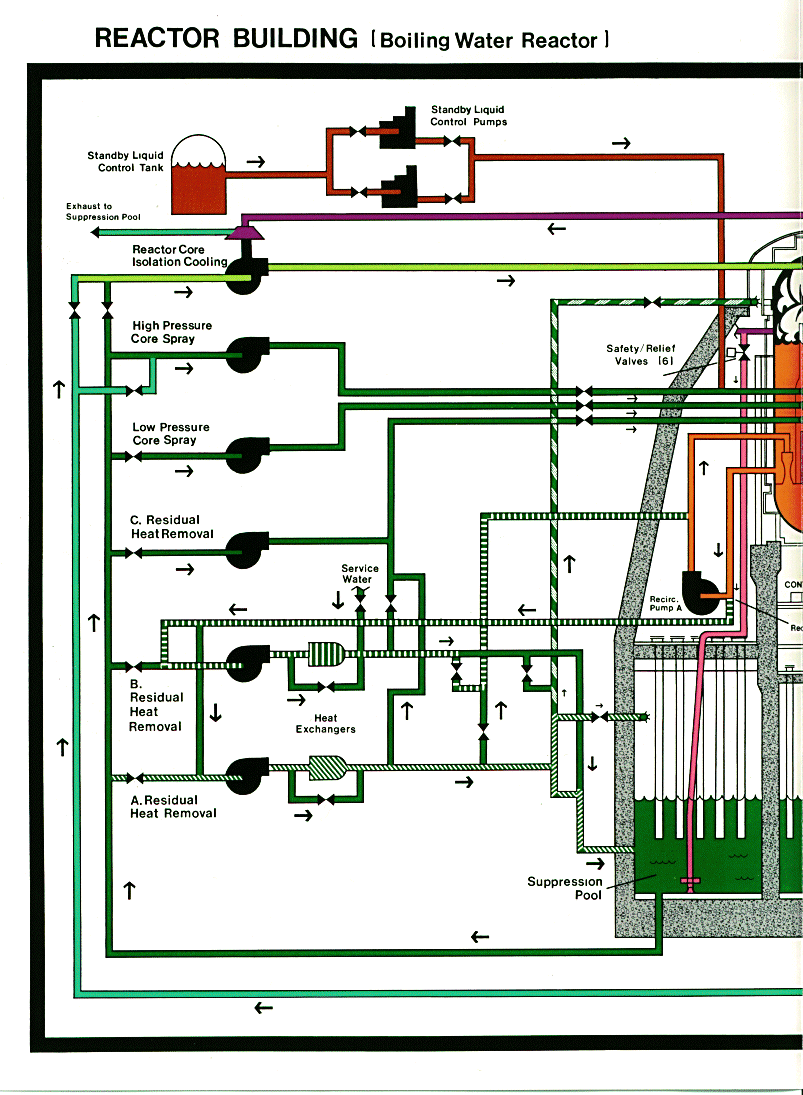
You mean that that vapour is harmless?
No, it just means that the biggest danger is directly to the plant. It also contains a lot of nasty gases, which last longer. A turbine of a BWR is always a pretty radioactive place, but the first hour after shutdown is the really dangerous phase then.
How bad the meldown can be?
What's worse? A pressure vessel failure would pulverise the already present content and leave the open gap for the worse stuff that would follow the imminent meltdown.
Preventing the breach could cause a meltdown, which would, as far as i understand, merely destroy the plant. Or is there a chance of america syndrome there?
A meltdown would be essentially an unstoppable heating of the fuel elements until the fuel leaves the fuel cladding and turns into a blob of molten metal and slag. Once the melt down starts, it is very hard to stop it. A small local damage to the fuel elements is easily contained, but if your cooling system failed completely, the heating by the residual nuclear reactions will take much longer to cool down, especially if the fuel left the controlled fuel elements and becomes a hot mass. It won't become supercritical and explode, but simply just slowly melt through everything until the radioactivity dropped low enough.
There are some phases that you have to expect in a meltdown, according to a properly sourced article on wikipedia:
- Core uncovery. In the event of a transient, upset, emergency, or limiting fault, LWRs are designed to automatically SCRAM (a SCRAM being the immediate and full insertion of all control rods) and spin up the ECCS. This greatly reduces reactor thermal power (but does not remove it completely); this delays core "uncovery", which is defined as the point when the fuel rods are no longer covered by coolant and can begin to heat up. As Kuan states: "In a small-break LOCA with no emergency core coolant injection, core uncovery generally begins approximately an hour after the initiation of the break. If the reactor coolant pumps are not running, the upper part of the core will be exposed to a steam environment and heatup of the core will begin. However, if the coolant pumps are running, the core will be cooled by a two-phase mixture of steam and water, and heatup of the fuel rods will be delayed until almost all of the water in the two-phase mixture is vaporized. The TMI-2 accident showed that operation of reactor coolant pumps may be sustained for up to approximately two hours to deliver a two phase mixture that can prevent core heatup."[6]
- Pre-damage heat up. "In the absence of a two-phase mixture going through the core or of water addition to the core to compensate water boiloff, the fuel rods in a steam environment will heatup at a rate between 0.3 K/s and 1 K/s (3)."[6]
- Fuel ballooning and bursting. "In less than half an hour, the peak core temperature would reach 1100 K. At this temperature, the zircaloy cladding of the fuel rods may balloon and burst. This is the first stage of core damage. Cladding ballooning may block a substantial portion of the flow area of the core and restrict the flow of coolant. However complete blockage of the core is unlikely because not all fuel rods balloon at the same axial location. In this case, sufficient water addition can cool the core and stop core damage progression."[6]
- Rapid oxidation. "The next stage of core damage, beginning at approximately 1500 K, is the rapid oxidation of the Zircaloy by steam. In the oxidation process, hydrogen is produced and a large amount of heat is released. Above 1500 K, the power from oxidation exceeds that from decay heat (4,5) unless the oxidation rate is limited by the supply of either zircaloy or steam."[6]
- Debris bed formation. "When the temperature in the core reaches about 1700 K, molten control materials [1,6] will flow to and solidify in the space between the lower parts of the fuel rods where the temperature is comparatively low. Above 1700 K, the core temperature may escalate in a few minutes to the melting point of zircaloy (2150 K) due to increased oxidation rate. When the oxidized cladding breaks, the molten zircaloy, along with dissolved UO2 [1,7] would flow downward and freeze in the cooler, lower region of the core. Together with solidified control materials from earlier down-flows, the relocated zircaloy and UO2 would form the lower crust of a developing cohesive debris bed."[6]
- (Corium) Relocation to the lower plenum. "In scenarios of small-break LOCAs, there is generally. a pool of water in the lower plenum of the vessel at the time of core relocation. Release of molten core materials into water always generates large amounts of steam. If the molten stream of core materials breaks up rapidly in water, there is also a possibility of a steam explosion. During relocation, any unoxidized zirconium in the molten material may also be oxidized by steam, and in the process hydrogen is produced. Recriticality also may be a concern if the control materials are left behind in the core and the relocated material breaks up in unborated water in the lower plenum."[6]
No america syndrome as the image paints, but rather that the pressure vessel will be destroyed and the containment building becoming a nuclear ruin by structural integrity of the pressure vessel being reduced. Usually, there are special catch basins below the pressure vessel for that case, that are meant to permit the molten mass to spread out over a larger surface and cool down faster without leaving the building.
In the best case of a full meltdown, you get something like that:
The nuclear core is completely destroyed, but the pressure vessel intact.
During Chernobyl, stalagmites of corium formed at damaged pipes below the reactor.
[ame="http://en.wikipedia.org/wiki/Nuclear_meltdown"]Nuclear meltdown - Wikipedia, the free encyclopedia[/ame]
http://en.wikipedia.org/wiki/Corium_(nuclear_reactor)
Kind of makes me happy that I work at a PWR.
I wonder if they have that goofy rod insertion/extration method that our BWR at Browns Ferry use. Their rods are beneith the reactor, whereas ours are above (gravity is our friend in a worst-case).
Yes, exactly that one. Also it is one of those old reactors without fine control over the rods.
As far as I can tell, a BWR can't have the rods insert from above at all.