Project H-10-K Enterprises Gateway Station

Capt_hensley

Captain, USS Pabilli
Donator
Joined
Oct 20, 2010
Messages
832
Reaction score
1
Points
16
Location
Alamogordo
Website
www.h-10-k.com
This is the beginning of a Space Station Project.
The station and Add-on will be called "Gateway Station"

I have already built a mesh for the station. It is merely a visual model to be used in my Masters Thesis.
Anyway
There were three objectives for the project:
1. Be built with current/near technology(5 years) in a 5 year construction period beginning 2017 through 2021
2. Once constructed, have the ability to maintain currently orbiting objects of any size that would fit in the interior of an STS External Tank including it own modules
3. Have a 50 year shelf life

There were several features the station would have

1. Have an AG wheel for a habitat/living space(1 g)
2. Fuel storage for on orbit refueling activities
3. Use only international docking standards of CBM or LIDS( I guess we would need to make a PMA or docking adapter for the DG fleet)
4. Recycle the HST, and Space Labs as permanent attachments
5. Have a GEO stationary orbit for platform stability, and debris avoidance
6. Have the capacity to permit the construction of the Mars direct program of interplanetary vehicles.
7. Have sufficient internal space to continue space science studies aboard
8. Have 4 independent environmental/atmospheric systems
9. Use modern electrical generation and storage techniques (solar/nuclear)

Anyway more to follow, along with a link to some renders...
 
it should also have the ability to dock an Arrow Freighter... perhaps not specifically (since its time era is before the Arrow) but at least have the ability
 
I remember some of the pictures you'vre shown of the mesh in progress, I'll be keeping my eye on this.
 
it should also have the ability to dock an Arrow Freighter... perhaps not specifically (since its time era is before the Arrow) but at least have the ability

OK Another PMA with the proper docking adapter/interface

Since this is a add-on and not a true practical Space Station(just real close) I thought I migh add docking capacity to the station on the left and right sides by adding a node to each CBM. That should provide adequate CBMs available to whatever needs to dock, as well as providing places to create fleet type interfaces like for the DG and Arrow Freighter. So stand by for preliminary renders of those mods...

---------- Post added at 09:01 PM ---------- Previous post was at 08:55 PM ----------

In 5 years? This sounds mighty expensive...

Cracking idea though. Be nice to have a realistic station other than the ISS/Mir.

Yes this station is purely, technicaly feasable. It's derivitive in nature directly from the ISS, but it has a far more practical layout, it's symetrical, and I tried to think of the improvments that we need to make the MARS trips a reality. As well as trying to recycle some space junk. Most of which is up there and broke only because it's out of fuel. I wanted a permanent home for Hubble, the last MPLM, and Spacelab. I wanted it to be very modular, yet fairly practical. I also wanted to use some ET's because noone in NASA is serious about making them work. Even if NASA were to refuse the ET's, it would still be a very practical design.

And no Bigalow blow-up dolls! Were not ready yet, even if he is getting some maturity out of the ground models.

Yes expensive, my preliminary estimates are at about 1 trillion dollars. For what you might ask?
well to summerize
Three stations have to be built:
One orbital object
One training object
One simulation object

Don't forget all the infrastructure that has to be re-built since NASA told everyone to breakdown the tooling for the current ISS modules.

I have made estimates about the ISS costs. ISS grand total was about 300 Billion. I figred 3 times that for Gateway was about right, since many of the modules are to be built en'mass, and there are 26(now 28) nodes that get cheaper as you build more of them.

PS Gateway Fact: Gateway station is 6 times larger by volume and size than ISS.
 
Last edited:
I remember some of the pictures you'vre shown of the mesh in progress, I'll be keeping my eye on this.

Speaking of renders, they are way too big to post here, so you have to go to my site to see them, Here's the link again...

The gateway directory with all the images in it
http://www.h-10-k.com/pics/darren.hensley/gateway

A single perspective from the top
http://www.h-10-k.com/pics/darren.hensley/gateway/station_top_pers.png
and a bottom perspective
http://www.h-10-k.com/pics/darren.hensley/gateway/station_bot_pers.png

My skill set includes use of C++, Visual basic, and moderate use of AI CS4, and 3DS Max. I still have lots to learn.

:hailprobe:Now before everybody freaks out, I fully intend to give credit to those items that are highly recognizable, in the meshes you will see here. I'm working on a full credit database so please please be patient. I have redrawn several items just so I can learn how to use 3DS Max. So resemblance is what I go for in a mesh.:hailprobe:

Heres a few credits to help smooth things a bit:
David413, Thorton, Sputnik, Well&Nomatter, Donamy, Urwumpe. Just to name a few.Thank you!:thumbup:

Permission requests will go out as I have a good idea of what we need to use, that we cannot replicate. Don't be surprised if something turns out as well as or better than your work. As this project progresses I hope to acquire the outstanding skills I've seen here.
I took allot of inspiration from the ISS, so naturally my model has many features from the ISS models found in Orbiter Hangar. I also used several Google 3D Warehouse models, and I was able to get some public original 3DS models directly from the sources including NASA.

I do intend to make my own textures for all the modules and nodes, but this model gives everyone the idea I'm planning to put into play.

I intend to redraw a great many of these modules, and spacecraft, so while they will resemble what others have made here, I want to assure everyone, I won't use your model or objects if I can avoid it. This model is just to prove that this is a viable project, and that I'm serious about putting it together.

I'm going to have lots of questions, I hope I get responses, and I hope you will enjoy this project as much I have while I'm putting it together.

My Gateway reference guide is still in draft and will be for some time but I want to post it to answer some of your questions concerning operations and the like. Please be patient.

I've attached a copy of a very old mission requirements document, it was the basic outline of my thesis paper. It will give you an idea of where the idea started, and it's basic roots. Hope you enjoy the reading.

Three words, Feedback, feedback, feedback. Projects like this one fail because everyone has comments, but fail to make them known. I gotta know what you think otherwise I will press forward and we will get a very buggy product. Nobody wants a buggy product.

Thanks for the opportunity.
 

Attachments

Last edited:
Looks neat. Though I have a bone to pick with the design. I don't think one could modify an ET to have that hanger-door thingy you show it as having in the renders from your site. Modifying it prior to launch could put a serious question mark on the safety of the flight. Modifying it in space has all the dangers of construction work amplified by the microgravity environment. I don't see how it could be done.

Then again, I'm the only one saying this, and I don't have any qualifications of note; it might just be me:P.
 
Looks neat. Though I have a bone to pick with the design. I don't think one could modify an ET to have that hanger-door thingy you show it as having in the renders from your site. Modifying it prior to launch could put a serious question mark on the safety of the flight. Modifying it in space has all the dangers of construction work amplified by the microgravity environment. I don't see how it could be done.

Then again, I'm the only one saying this, and I don't have any qualifications of note; it might just be me:P.

I for one am glad you asked the question. As I am no structural engineer, I too pondered if it could be done safely. Luckily I was an Airframe Structural Maintenance Technician in the USAF for 20 years. I've seen how it could be done in smaller scale. And as I have noted in my reference guide, It will come at a cost.

Several issues come up.
First to have a safe pressure vessel having discarded the flight hardware(fuel liner and fuel pumps) is to make sure the shell of the ET is sound for use over 50 years. It will take away from the lightweight factor by adding ribs, stringers and longerons and huge hinges.
Next you must strengthen the doors to prevent torsional stresses
In addition to strengthen everything, the doors must be able to seal for gaseous pressures up to 17PSI. This means pretesting the shell on earth to take 31 PSI in a vacuum chamber
Having completed pressure vessel modifications and adding up to 1/3 the original weight of the tank, you have to include the accessory mounts and environmental equipment to make the vessel a workable shop. Tool mounts, zero G tethers for everything, braces, and foot pads, fixtures and the like of which we have not yet seen with Shuttle or ISS, and so on. But this is easy.
The bulk of the atmo, and gas handling equipment will be modular and installed externally to the tank after it is place on orbit. This will enable replacement if necessary.
Any time you work with such big doors you will need a hydraulic system or gearing mechanism to handle opening and closing, and latch systems that will hold them closed. Part of the solution to get the tanks into orbit will be to install disposable fasteners on the doors for the up flight. They will no longer be needed after the tank is on orbit. But the latching system will provide the added closure forces needed to keep the tank pressurized for upflight. These pressures are greater than the orbital gas pressures of 14.7 PSI for normal environmental atmo.

In reality if the tank is properly re-engineered it will take far greater stresses just getting into orbit than it will ever encounter after orbital insertion.

The hard part will be an EVA to remove upflight only hardware to make room for the orbital operations.
The tank liner, Turbo pumps, Cryogenic systems, some minor plumbing and electrical all have to be modular enough to come out or come off, to reveal the dry and clutter free interior of the tank for use as a maintenance bay. Everything I speak of is possible and inside the 5 year design phase of the program. Manufacturing the systems is also possible inside this phase, it's getting the funding that is an issue.

By the way, because the tank is heavier, yes you would need two more strap-on boosters, but this was already an engineered option with the original ET back in the 70's. The shuttle (if used) would burn less fuel at lift off, and throttle up later in flight to get the right delta V for the insertion into High LEO or even GTO.

This tank mod could eventually resemble an Ares V with two additional boosters should we elect not to use the shuttle, again just some re-engineering needs to be done for structural integrity. Safety will always be job one, but the ET mods need not be man rated for upflight, just orbital occupation, which is a different prospect.

Keep those questions comming
 
I like the laundry especially. :) BUT: what about radiation shielding? Also, one would be crossing Van Allen belts en route. This means the station will have to target the OAP market, since all others would be afraid of cancer...
 
I like the laundry especially. :) BUT: what about radiation shielding? Also, one would be crossing Van Allen belts en route. This means the station will have to target the OAP market, since all others would be afraid of cancer...


The Van-Allen belts sound bad, but for the truth you have to look at the Apollo missions. All of them crossed the belts twice, once going, once coming back. From the data I've read, its not as much a hazard as it has been made out to be. You have a very short exposure to the belts where the radiation is concentrated enough to pose an issue.

The station modules will all have an additional layer of protection added. I'll have to dig up the paper, but there have been vast experiments with new materials to replace some of the more common methods of insulating the ISS modules in the Micro Meteor layer that do not increase weight, or size factors, but do increase protection. It has to do with a different matrix for the boron-graphite composite shield layer. It's been compared to lead lining your shorts, without the weight factor and stiffness that using lead would add.

Of course the habitat ring is where you need the most shielding, but if you use the station properly you would get equal use of all the modules, and your exposure would even out.

I've discussed the duration of manning tours aboard with respect to radiation exposure. The NASA policy would be slightly modified for longer duration, but basically remains uncharged with exposure levels and accumulation.

No market would be left out, but at pressent only professional astronauts would take the risks, as the citizen market is focused on LEO and sub-orbital flights that pose little to no risk. I have made provision for non-operational visitors in my guide, but no visitors are scheduled in the 50 year plan I have made out, only the folks needed to make MARS missions and station operations a reality. In other words, Astronaut crews only.

Great question!, keep um comming...
 
Why not use a heavily modified launch fairing instead? Depending on the vehicle you launch it with, you could have a fully equipped on-orbit workshop/hanger ready for business or a more modest shell with only mounting equipment(human and machinery) installed. It would launch unmanned- an advantage only a Shuttle-C or a DIRECT based vehicle could have delivering the ET. And both of the above vehicle are concepts; neither have actually flown or have flight ready hardware. The launch fairing workshop would be flown on an existing rocket, using an existing launch fairings aerodynamics(optional), and need no expensive infrastructure modifications at the launch site.
 
Why not use a heavily modified launch fairing instead? Depending on the vehicle you launch it with, you could have a fully equipped on-orbit workshop/hanger ready for business or a more modest shell with only mounting equipment(human and machinery) installed. It would launch unmanned- an advantage only a Shuttle-C or a DIRECT based vehicle could have delivering the ET. And both of the above vehicle are concepts; neither have actually flown or have flight ready hardware. The launch fairing workshop would be flown on an existing rocket, using an existing launch fairings aerodynamics(optional), and need no expensive infrastructure modifications at the launch site.

Yes you have valid points, Lets discuss them:

A fairing is not the same as a pressure vessel, but if placed atop an LV, it would be in a better position to take less launch stress. This has the potential of making it lighter.

Launching the shop dry like Skylab also has its advantages, like pre-installing certain items that would be difficult to install on orbit.

However both of these require an inordinately tall LV something on the order of two ETs one stacked on the other. Too tall to stack in the VA building, and difficult to stack on the pad. On the other hand if we learn something from our Russian friends, we could assemble the LV horizontally and raise the stack at the pad. However were not setup to do that. It would cost us more time, and the trade off would be very low. Just 4 missions to get the tanks up.

Clustering the tanks would cause a major pad modification that is an undesirable and costly solution. Time wise that is.

As for Shuttle-C or Direct I have excluded them because they are not available, and NASA has all but abandon the ideas. Of course you could make the same argument about Shuttle itself. It, even having not flown the last mission, is essentially all but retired.

You've nailed the sticky part of this whole mess, but I'm sure we can come up with a solution. What about Ariane, or Proton? Both are heavy lift vehicles, and at least Ariane has the diameter we need for the work shop. and a dry empty tank is certainly the right ticket. It's a current LV, and the engineering required would be minimal?

I'm glad you brought up the fact that we need little infrastructure mods, because I'm trying to do just that, not to keep costs down, but to expedite the few changes that will inevitably be needed at some point.

However your real question remains, how do we heave that Bohemian tank into space with what we have? One small goal remains, I'd like to use the tank wet with a liner, because it leaves no hardware loitering about once you get into orbit.

Most of the rest of the launches will use EELVs, and some hardware will remain, but a caveat or restriction I have placed on my program is that if there is to be discarded LV hardware, it must be used on orbit, recycled through recovery, or de-orbited immediately. I want to eliminate LV hardware remaining in orbit for any period of time. I Hate Space Junk! It just gets in the way. I know that's a hard line, but it's the right thing to do. Inertial orbit insertion may be the key to allot of the issues here. It has the best potential to recycle all the parts of the LVs.

A carrier aircraft may be another way, but I don't know of an existing CA with the strength to hoist up an ET

Worst case scenario, is that I don't have workshops on orbit, and we send more modules designed as fuel tanks and ATMO gas storage for the on orbit storage needed, chain them together and place them in clusters where the ET's would be. You could get back your capacity, but at the expense and engineering costs of having multiple failure points with additional plumbing and pumping systems.

I could work up a quick mesh of this alternative, but it sounds very messy and not so elegant to me.

Thoughts?
 
Oh boy:blink:. I once wrote long posts like this, and now I know what it is like to be on the receiving side.

Nevermind, I'll get to the task of replying now.


Launching the shop dry like Skylab also has its advantages, like pre-installing certain items that would be difficult to install on orbit.

The other advantage is not having to convert a fuel tank to working space. I myself think 'wet' living spaces aren't yet proven to be feasable, but I don't have any qualifications or evidence to back that up.

However both of these require an inordinately tall LV something on the order of two ETs one stacked on the other. Too tall to stack in the VA building, and difficult to stack on the pad. On the other hand if we learn something from our Russian friends, we could assemble the LV horizontally and raise the stack at the pad. However were not setup to do that. It would cost us more time, and the trade off would be very low. Just 4 missions to get the tanks up.

Maybe launching the fairing workshops in segments with other payloads(as the launch fairing for that payload) could work. After all, the workshop is just structured, enclosed volume.

What about Ariane, or Proton? Both are heavy lift vehicles, and at least Ariane has the diameter we need for the work shop. and a dry empty tank is certainly the right ticket. It's a current LV, and the engineering required would be minimal?

Diameter vs Diameter, I'd go for the Ariane 5. But if your thinking of using the first stage as a wet workshop, you'll have to devise a way to get it up there-it doesn't achieve full orbital velocity.

However your real question remains, how do we heave that Behemoth tank into space with what we have? One small goal remains, I'd like to use the tank wet with a liner, because it leaves no hardware loitering about once you get into orbit.

Sorry for the correction-it just bugged me.

Why does it have to be huge at launch? Maybe something like the old Transhab concept. Pack it tight at launch and let it unfold in orbit. This is out of my league to suggest as something possible, but perhaps somebody did the concept work and maybe one of nice and detailed technical reports is floating about in NASA's database. Its worth a look.

Most of the rest of the launches will use EELVs, and some hardware will remain, but a caveat or restriction I have placed on my program is that if there is to be discarded LV hardware, it must be used on orbit, recycled through recovery, or de-orbited immediately. I want to eliminate LV hardware remaining in orbit for any period of time. I Hate Space Junk! It just gets in the way. I know that's a hard line, but it's the right thing to do. Inertial orbit insertion may be the key to allot of the issues here. It has the best potential to recycle all the parts of the LVs.

I hope you can manage that. I think it is going be pretty damn hard.

A carrier aircraft may be another way, but I don't know of an existing CA with the strength to hoist up an ET

Nor do I:shrug:.

Worst case scenario, is that I don't have workshops on orbit, and we send more modules designed as fuel tanks and ATMO gas storage for the on orbit storage needed, chain them together and place them in clusters where the ET's would be. You could get back your capacity, but at the expense and engineering costs of having multiple failure points with additional plumbing and pumping systems.

I think I'm missing something here. Are you going to pressurize these workshop things?
 
My concept uses a liner in the tank that is removed after orbit. What was once wet is removed to reveal a perfectly dry space. And yes 2 of these will be pressurized and airconditioned for shirt sleve maintenance on the exterior of the object inside the bay. Two of them will be purged in order to hold atmopheric gasses in storage until needed. Nitorgen is the big one, you gotta have nitorgen to make earth atmosphere. "Dry air contains roughly (by volume) 78.09% nitrogen, 20.95% oxygen, 0.93% argon, 0.039% carbon dioxide, and small amounts of other gases" Wikipedia. On orbit we just use nitrogen and oxygen, 80/20. Having scrubbers and compressors that can be used to recycle the "Air" is the tough part. It has to be re-seperated to be stored with efficency.

Getting the launch providers to modify their LV's to be green wouldn't be difficult, getting them to fund it, would be. Return retro rockets are pretty simple, and the guidance CPU and software are nice and compact now. It's not that big of a deal now. We already do it with a few peices here and there. Space X is going to build it in.

Sorry about the above disertation, but it needed expalining, I need to get it right. Your're helping iron out the details.
 
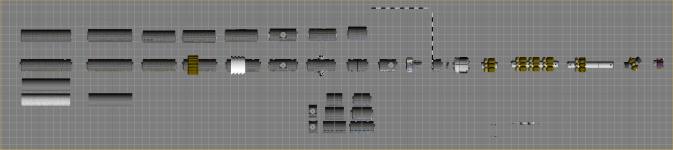
Here is a texture I made for the exterior of the modules, and a screen cap of the types of modules I'm making. You'll have to blow up the texture to see the rivit pattern. I made this in Adobe AI CS4, and exported it to a png, when I'm finished I'll convert them to DDS and use them in the mesh final conversion.

The texture: Each panel is 4'x4' there are 4 panels tall by 4 panels wide in this texture

14.7' diameter Modules from left
Power, 55'
X module 49'
Y module 42'
Fuel Module 42'
Thermal control module 42'
Habitat A module 36'
Habitat B module 36'
Graviton 17'
Node 21'
Airlock(will be modified to simplify the design)18'
Guidance, Navigation, and control Module(GNC) 9'
CBM-LIDS adapter 2'
ATV Propulsion section (Prop Module) 20'

9'diameter
Short Tunnel Module 16'
Long Tunnel Module 49'
Ladder Module 55'
Elbow Module 22'

Prop Module (based on NRS ICM module for ISS)

You will notice the ISS v3.0.7 modules by Thorton and others, I had to use as place holders, don't worry I won't use any of them, I'm building my own modules, I had to tear them apart to find out how they were made, My skills are still infantile, so my modules will be simpler, but still look nice in the end.

PS great work guys!(Thorton and others)
 

Attachments

  • 4x4.png
    4x4.png
    10.1 KB · Views: 50
  • Modules.png
    Modules.png
    86.4 KB · Views: 76
Last edited:
:facepalm:
Thanks for clarifying, both of you.

I'll still be here as a sounding board if you want me.
 
It will have UMMU and UCGO?

Don't know how to make them happen, but yes I want them to have full capability. Are there special considerations for the meshes that I need to incorporate? I know there is code, we can get to that later.

---------- Post added at 11:52 AM ---------- Previous post was at 11:45 AM ----------

To hold enough fuel to get a vessel into orbit. It would be missing the whole point otherwise. :P

Yeah, I want to recycle, or re-purpose a set of tanks for two reasons.

Huge tanks are for getting large payloads into orbit. In this case the tank itself, due to the heavy mods needed to turn it into a workshop.

Second, I want to prevent space junk/while taking advantage of a very large, pre-engineered pressure vessel that can actually be used for some real good.

The 2 storage tanks just make sense, once the tanks are empty from launch, you can fill them with atmosphere gasses needed on orbit. So mount them to the station, make them refillable, and viola, you kill two birds with one stone.

---------- Post added at 12:06 PM ---------- Previous post was at 11:52 AM ----------

A few page turners for some advanced techniques in radiation control...

http://www.radshield.com/
http://science.slashdot.org/story/11/03/21/2059208/NASA-Wants-Revolutionary-Radiation-Shielding-Tech
http://www.networkworld.com/community/blog/nasa-wants-revolutionary-radiation-shielding-
http://news.yahoo.com/s/ac/20110322...shielding_technology_for_future_space_voyages
http://www.advancedshieldingtech.com/wst_page2.html
 
Is there a specific reason you are using rigid hull modules as opposed to TransHabs?
 
Back
Top