


[FONT=VERDANA, ARIAL, HELVETICA, SANS-SERIF]
Rocket: Atlas V
Payload: NROL-38
Date: June 20, 2012 (delayed from the 18th)
Window: [/FONT]from 12:28 to 13:27 UTC / 8:28 to 9:27 a.m. EDT[FONT=VERDANA, ARIAL, HELVETICA, SANS-SERIF]
Site: SLC-41, Cape Canaveral, Florida[/FONT]
From Spaceflight Now :
MONDAY, JUNE 11, 2012
The final days of preparations are underway at Cape Canaveral for next Monday morning's Atlas 5 rocket flight on a milestone-setting mission for America's Evolved Expendable Launch Vehicle fleet.
Now topped with its secret satellite cargo for the U.S. National Reconnaissance Office, the United Launch Alliance-built rocket is targeting liftoff some time between 8 and 10 a.m. EDT (1200-1400 GMT) from the Cape's Complex 41 pad.
The exact time has not yet been revealed, given the hush-hush nature of the mission.
The Launch Readiness Review is planned for Friday, which gives approval to transport the the 19-story rocket aboard its mobile platform from the vehicle assembly building to the pad. Rollout is slated for Saturday 10 a.m. EDT (1400 GMT).
Sunday is set aside as a crew rest day before the launch team assembles to start the 7-hour countdown sequence early Monday.
Known only as NROL-38, the payload belongs to the secretive government agency that designs and operates the country's fleet of orbiting spy satellites.
More often than not, the purpose of any NRO launch is the rejuvenation of the existing constellation by replacing an aging orbiting asset with a new satellite or bringing the next generation on line.
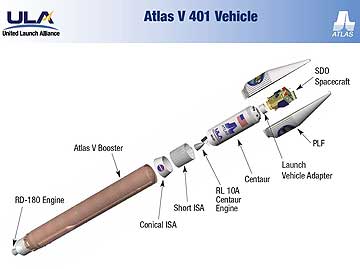
The rocket flying this satellite to orbit is the 401-version of the Atlas 5 family, distinguished by the bronze-color first stage, stretching 107 feet long and 12.5 feet in diameter, and equipped with a dual-nozzle RD-180 main engine that will burn kerosene fuel and supercold liquid oxygen during the initial four minutes of flight.
The stage was erected onto the mobile launch platform at the Vertical Integration Facility on Friday, May 18, kicking off what was quick pre-flight processing flow and the first Atlas 5 campaign to delete the countdown dress rehearsal and fueling exercise.
The following week at the VIF, technicians hoisted the barrel-like interstage adapter into place and then attached the workhorse Centaur upper stage that will deliver the satellite into its intended orbit.
The stage, 41.5 feet long and 10 feet wide, will use a single Pratt & Whitney-built RL10A-4-2 liquid oxygen/liquid hydrogen engine that develops a thrust of about 22,300 pounds and features the capability for in-space restarting to shape the orbit and altitude as desired. The exact number of burns on this launch and the targeted orbit are secrets.
Encapsulating the payload is the rocket's four-meter-diameter nose cone.
Marking a milestone for the EELV program, this will be the 50th launch in the decade of flight for Atlas 5 and Delta 4 rockets.
Born as rivals in the 1990s, the two modular systems were conceived to carry all of the military's satellite fleets -- from the smallest weather satellites to the biggest craft produced by the NRO.
The Air Force sought, developed, funded and now enjoys the fruits of the EELV program, phasing out its use of the medium-class Delta 2, the intermediate Atlas 2 and heavy-lift Titan 4 rockets.
The maiden missions for both EELV rockets occurred in 2002 under the direction of their original parent companies -- Lockheed Martin for Atlas and Boeing for Delta.
But in subsequent years, the Air Force pushed for the creation of United Launch Alliance to operate both rocket lines, ensuring they remained viable and alive, while reducing overhead costs and erasing duplication in efforts between the two aerospace giants.
To date, the combined record for both EELV systems includes 19 launches dedicated to the Defense Department, 13 commercial flights, 11 missions with spy satellites for the National Reconnaissance Office and six for NASA.
The 51st EELV launch will follow fast with a Delta 4-Heavy on another NRO deployment mission scheduled from Cape Canaveral on June 28 during a period between 5:30 and 10:30 a.m. EDT (0930-1430 GMT).
THURSDAY, JUNE 14, 2012
Weather forecasters are predicting good conditions to launch the Atlas 5 rocket on its classified satellite-deployment mission for the National Reconnaissance Office on Monday morning.
Liftoff will be possible during a window of 8:26 to 9:25 a.m. EDT (1226-1325 GMT), the Air Force announced today.
"A front will move through Central Florida today causing afternoon showers and thunderstorms. Friday, the front continues to push south as a high pressure area builds in from the north. The Space Coast will remain cloudy with a brisk northeast wind. Isolated showers remain possible with a reduced chance of thunderstorms," the forecast team reports.
"For the weekend and into early next week, the high remains to the north and easterly flow will continue over the Space Coast. With this weather regime, morning coastal showers may occur, but afternoon thunderstorms remain inland and along the west coast of the Florida peninsula. Saturday, coastal showers are likely in the morning decreasing by the afternoon. There is slight chance of a morning thunderstorm, but weather is generally favorable for the mobile launch platform roll.
"This weather pattern continues through Monday, with morning coastal showers and winds from the east-northeast. Our primary concern for launch is a cumulus cloud rule violation."
The outlook for the hour-long launch window calls for scattered low- and high-level clouds, isolated showers in the vicinity, good visibility, easterly winds of 10 to 15 knots and a temperature around 78 degrees F.
The odds of acceptable weather for launch are 80 percent on Monday and the backup opportunity Tuesday, with cumulus clouds the only worry. For Wednesday, clouds and also a slight concern for winds drop the odds to 70 percent.
Last edited:


