
TransX Change LEO inc. with a Moon slingshot

wingnut

Donator
Donator
Joined
May 10, 2013
Messages
129
Reaction score
0
Points
16
I'm trying to change my Low Earth Orbit's inclination with a Moon slingshot in TransX.

Is this possible to setup with TransX completely before leaving LEO?

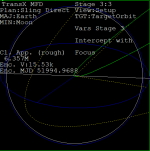
What I've tried so far is to setup the Moon slingshot and in stage 3 set a dummy ship as target which is exactly in the orbit I want to transfer to in the first place.
I set the "Intercept with" and "Graph projection" variable of stage 3 in the attached screenshot to "Focus".

I just cannot get to grips with how I have to align the orbits in this view and why the Closest Approach value in this view is not updated after I amend the maneuver in stage 1 as in the Encounter view for example?
Do I have to align the white intersect line with the two yellow dashed lines as in the maneuver plan?
 

Attachments

  • transx.png
    transx.png
    12.1 KB · Views: 28
It seems the solution to ur problem is very much similar to the manoeuvre i did in flytanthem's challenge in which u are supposed to get into an equatorial orbit from a polar orbit.


Ur diagram is more or less confusing me,someone more experienced than me in transX will have to analyse that.


But I would like to post a simpler solution if u prefer.

Starting from a LEO,
Set up a plan in transX to intercept moon in stage 1.(get closest approach to around a few million meters)
Click FWD.
Stage 2-->Select escape and then click FWD.
U can now see the sling direct view in stage 3.
There u can see the your inclination(inc) with respect to the ecliptic and distance from the center(PeR) when u arrive back at earth.
Open transX in another MFD,in stage 1,play with the variables and watch the Inc and PeR values in stage 3.Adjust the variables so that u get ur desired Inc and PeR values.
Make sure Pe/Pl ratio in stage 3 is greater than 1,else u will be hitting the moon.
Thats it,execute ur burn in stage 1.

Additional info:As of my experience,transX seems to get more inaccurate then any other manoeuvre in this manoeuvre,so just plan an interception to the moon and execute it and while ur half way to moon,correct the inc and PeR values in a mid course correction.

I have gravity gradient torque and non spherical gravity sources on,so transX MAY be more accurate for u.
 
Last edited:
That's how I tried it at first too downloaderfan. However the inclination and Focus PeD values are not updated in stage 3's Sling Direct view when I alter the Outward angle and Inc. angle values.
That's why I put a dummy ship into my target orbit with the Scenario Editor so that I can target with my TransX plan.
 
That's how I tried it at first too downloaderfan. However the inclination and Focus PeD values are not updated in stage 3's Sling Direct view when I alter the Outward angle and Inc. angle values.
That's why I put a dummy ship into my target orbit with the Scenario Editor so that I can target with my TransX plan.


U are not supposed to play with outward angle and inc angle in stage 3,instead open transX stage 3 on one MFD,stage 1 on another MFD and play with the variables in STAGE 1 and watch the updated values of inc and Focus PeD in STAGE 3.
 
Last edited:
Ah, now I got it.

I thought I have to adjust the solid green orbit instead of the dashed yellow one which would only be needed if there was an additional stage.

The predicted values jump significantly when crossing spheres of influence and finally all the stages will be deleted automatically by TransX so it is impossible to do a final mid course correction because the inclination and PeA values are not displayed anymore.

Is it possible to prevent TransX from deleting stages?
 
The predicted values jump significantly when crossing spheres of influence and finally all the stages will be deleted automatically by TransX so it is impossible to do a final mid course correction because the inclination and PeA values are not displayed anymore.

Is it possible to prevent TransX from deleting stages?

TransX doesn't delete all the stages,instead it deletes only ur stage 1.Ur stage 2 then becomes stage 1 and ur stage 3 becomes ur stage 2,u can still see the inc and Focus PeD values in stage 2 once u enter the sphere of influence of the moon.
 
I don't have much to add to downloaderfan's advice.

One thing to remember is this: "You change planes at a node". Simple, but sometimes overlooked.

If you want to go from Orbit A to Orbit B, through a plane change maneuver, you need to perform said maneuver at one of the points where the planes of Orbit A and Orbit B intersect (aka a "node").

In the case where you perform the maneuver using the Moon's gravity instead of a burn, you need to make sure that when you arrive at the Moon, the Moon is at an intersection node with Orbit B.

In flytandem's 2006 Polar to GEO challenge:

Notice the orbit of the Deltaglider has it's node very close to the node of the moon, meaning both the moon and the ship cross the equator at the same points. This was provided intentionally to allow the best chance of returning to Earth as close as possible to equatorial alignment.

The starting orbit in that challenge has been carefully selected. Other orbits will require slightly different solutions.

If we want to sling around the moon and return in plane with the Earth's equator we should sling the moon when the moon is passing though it's node, ie; the moon is above the Earth's equator.

It is not enough to simply sling the Moon and get back to LEO. Timing is very important here. You need to be at the Moon when it is at a node with your target orbit.
 
Other orbits will require slightly different solutions.

Overlooked indeed :facepalm:,what would be the solution in that case?
I'm guessing plane change while ur far away from earth to make the nodes of moon and equator intersect.

:feedback:
 
Overlooked indeed :facepalm:,what would be the solution in that case?
I'm guessing plane change while ur far away from earth to make the nodes of moon and equator intersect.

:feedback:

Your guess is correct. Keep in mind that you don't want the energy of the burn to raise the apoapsis to go to waste, so it would be best to select a point in the orbit that could serve as a Moon transfer later.
 
It was just a guess based on very very basic orbiter stuff,but i have no idea what inc and LAN am i targeting to get the nodes of equator and moon intersect.

After playing with inc and LAN with the scenario editor,i found that the nodes intersect when the ship and the moon have the same equatorial inclination,but different LAN.Also some other situations which i could not interpret.

Can u please throw some more light on it?
 
I am not sure I understand your question.

The orbits of the Moon and Equator already intersect. It can't be any other way.
What you want is that the orbit of the ship (the starting orbit) has its intersection points close to the nodes of the Moon and Equator planes.

Flytandem's scenario starts you already in such an orbit.
 
I am not sure I understand your question.

The orbits of the Moon and Equator already intersect. It can't be any other way.
What you want is that the orbit of the ship (the starting orbit) has its intersection points close to the nodes of the Moon and Equator planes.

Flytandem's scenario starts you already in such an orbit.


What i meant was,lets say i start out in a random orbit,now i want to adjust planes so that the nodes of my orbit with the moon and the equator become the same points.I noticed this is how flytanthem's scenario starts after ur previous comment,but what if i just started out in a random orbit?To what should i change the inc and LAN values so that the nodes of my orbit with the moon and the equator become the same points?
 
With respect to what? The ecliptic plane? The equatorial plane?
How can I give a specific answer for Inc and LAN, in a "random" example without a reference plane and a specific starting orbit?
Do you mean what values you need to look at?

Post a specific scenario if you can and I'll have a look at it.

EDIT: The reason I am asking this, is because each orbit is different. Sometimes it is NOT better to use the Moon for a plane change.
 
Last edited:
[/QUOTE]
With respect to what? The ecliptic plane? The equatorial plane?
How can I give a specific answer for Inc and LAN, in a "random" example without a reference plane and a specific starting orbit?
Do you mean what values you need to look at?

Post a specific scenario if you can and I'll have a look at it.

EDIT: The reason I am asking this, is because each orbit is different. Sometimes it is NOT better to use the Moon for a plane change.

It seems the answer to my question is more complex than i thought,probably i don't understand much about it.

Here is a scenario:

Code:
BEGIN_DESC

END_DESC

BEGIN_ENVIRONMENT
  System Sol
  Date MJD 51982.5311990061
END_ENVIRONMENT

BEGIN_FOCUS
  Ship GL-01
END_FOCUS

BEGIN_CAMERA
  TARGET GL-01
  MODE Cockpit
  FOV 50.00
END_CAMERA

BEGIN_HUD
  TYPE Surface
END_HUD

BEGIN_MFD Left
  TYPE User
  MODE Interplanetary
  Scenario Old2
  MapMFD V5
  Reference Auto
  Target moon
  Center Earth
  Data 0 1 1.782308992693406e-005 0 0 0 0 1 1 0 0 0
  MassLimit 1e+020
  CMode 0
  Config 1 1 1 1 0 0
  ExtMode 0
  Periapis Earth
  END 
  CorMFD V4
  Reference Auto
  Target none
  Source none
  ActiveProg 0 1
  DataA 0 3 0 0 0 0
  DataB 1 1 0 0 0 0 0 0 0
  DVProg 0 0 0 1
  AdvConf 0 0 0 0 0
  Guidance 0
  END 
  EjectMFD V5
  Reference Auto
  Data 0 1 3 0 1 51982.52952236134 10
  Guidance 0
  END 
  BaseAprMFD V2
  Reference Auto
  Target none
  Source none
  DataA 0 0 120000 0.10821 0.366519 1 1 51982.52952236134 51982.52952236134 0
  DataB 0 3 0 1 0 1
  END 
  SlingMFD V4
  Reference Auto
  Source none
  Data 0 1 1 3 0 1 51982.52952236134 0
  END 
  LaunchMFD V4
  Target None
  Data 0 1 1 3 0 1 0
  END 
  CF1_DataA 0 0
  CF1_DataB 0 10 120000 2 20 150000
  CF1_SecTgt 
  mfdShare -1
  mfdProgram 4
END_MFD

BEGIN_MFD Right
  TYPE User
  MODE Interplanetary
  Scenario Old2
  MapMFD V5
  Reference Auto
  Target l
  Center Earth
  Data 0 1 1.885912705423903e-005 1 0 0 0 1 1 0 0 0
  MassLimit 1e+020
  CMode 0
  Config 1 1 1 1 0 0
  ExtMode 0
  Periapis Earth
  END 
  CorMFD V4
  Reference Auto
  Target none
  Source none
  ActiveProg 0 1
  DataA 0 3 0 0 0 0
  DataB 1 1 0 0 0 0 0 0 0
  DVProg 0 0 0 1
  AdvConf 0 0 0 0 0
  Guidance 0
  END 
  EjectMFD V5
  Reference Auto
  Data 0 1 3 0 1 51982.52941470488 10
  Guidance 0
  END 
  BaseAprMFD V2
  Reference Auto
  Target none
  Source none
  DataA 0 0 120000 0.10821 0.366519 1 1 51982.52941470488 51982.52941470488 0
  DataB 0 3 0 1 0 1
  END 
  SlingMFD V4
  Reference Auto
  Source none
  Data 0 1 1 3 0 1 51982.52941470488 0
  END 
  LaunchMFD V4
  Target None
  Data 0 1 1 3 0 1 0
  END 
  CF1_DataA 0 0
  CF1_DataB 0 10 120000 2 20 150000
  CF1_SecTgt 
  mfdShare -1
  mfdProgram 4
END_MFD

BEGIN_PANEL
END_PANEL

BEGIN_SHIPS
ISS:ProjectAlpha_ISS
  STATUS Orbiting Earth
  RPOS -2344599.41 6179991.28 -1290081.18
  RVEL 7073.991 2257.937 -2010.011
  AROT 29.95 -0.16 50.34
  AFCMODE 7
  IDS 0:588 10 1:586 10 2:584 10 3:582 10 4:580 10
  NAVFREQ 0 0
  XPDR 466
END
Mir:Mir
  STATUS Orbiting Earth
  RPOS -5284020.20 248800.76 4069601.93
  RVEL -4721.128 -374.606 -6105.092
  AROT 0.00 -45.00 90.02
  AFCMODE 7
  IDS 0:540 10 1:542 10 2:544 10
  XPDR 482
END
Luna-OB1:Wheel
  STATUS Orbiting Moon
  RPOS 849474.09 2070410.56 242.92
  RVEL -1369.179 561.724 0.289
  AROT -0.00 0.00 -152.60
  AFCMODE 7
  IDS 0:560 10 1:564 10
  XPDR 494
END
GL-01:DeltaGlider
  STATUS Orbiting Earth
  RPOS 3094648.84 -3175613.76 -4824681.47
  RVEL 3218.409 -4993.675 5211.607
  AROT -52.67 -56.82 90.24
  AFCMODE 7
  PRPLEVEL 0:0.553000 1:0.900000
  NAVFREQ 0 0 0 0
  XPDR 0
  AAP 0:0 0:0 0:0
END
SH-03:ShuttleA
  STATUS Landed Earth
  BASE Habana:4
  POS -82.3982414 23.0005396
  HEADING 70.00
  AFCMODE 7
  PRPLEVEL 0:1.000000 1:1.000000
  NAVFREQ 0 0
  XPDR 0
  PODANGLE 0.0000 0.0000
  DOCKSTATE 0 0.0000
  AIRLOCK 0 0.0000
  GEAR 0 0.0000
  PAYLOAD MASS 0.0 0
END
PB-01:ShuttlePB
  STATUS Landed Earth
  BASE Habana:1
  POS -82.4000000 22.9994604
  HEADING 22.00
  AFCMODE 7
  PRPLEVEL 0:1.000000
  NAVFREQ 0 0
END
GL-02:DeltaGlider
  STATUS Landed Mars
  BASE Olympus:3
  POS -135.4300000 12.7366196
  HEADING 0.00
  AFCMODE 7
  PRPLEVEL 0:1.000000 1:1.000000
  NAVFREQ 0 0 0 0
  XPDR 0
  GEAR 1 1.0000
  AAP 0:0 0:0 0:0
END
SH-01:ShuttleA
  STATUS Landed Moon
  BASE Brighton Beach:1
  POS -33.4375000 41.1184067
  HEADING 0.00
  AFCMODE 7
  PRPLEVEL 0:1.000000 1:1.000000
  NAVFREQ 0 0
  XPDR 0
  PODANGLE 0.0000 0.0000
  DOCKSTATE 0 0.0000
  AIRLOCK 0 0.0000
  GEAR 0 0.0000
  PAYLOAD MASS 0.0 0
END
END_SHIPS

BEGIN_ExtMFD
END

In that scenario,i have two IMFDs open,one targeting the equator and other targeting the moon,now to set things up as in flytanthem's scenario,i believe i have adjust INC and LAN so the node lines in both the MFDs are in the same position.My question is how to do that?
 
Last edited:
A lot of ships in that scenario. What is your goal? To get the GL-01 in a geostationary orbit?
 
This is the solution that I would choose, if I wanted to use the Moon for the plane change.
The advantage is that the Moon also changes the periapsis altitude, eliminating the need for a burn to raise the periapsis to GEO altitude. The disadvantage is that from this starting orbit, I could not find a way to get the equatorial Inc to 0° in a single burn.
IMO this is because the Moon, the equator and the ship, have different points of intersection.


Ok, so at the start of the scenario, the Moon was too close to the node (less than 40°) and the ship was at ~53° equitorial inclination.

Untitled-1_zpsf664d160.jpg


For this type of maneuver a Hohmann type transfer to the Moon is prefered (at least by me), so I time warped until the Moon was about 65° away fro the next node. This would allow for a Moon transfer with minimum dV

Untitled-2_zps1c397502.jpg


I used IMFD's Delta Velocity and Map programs to get a transfer to the Moon and then I switched target to GEO (Target "g") and played around with the variables (mainly TEj and dVf) to get a return to GEO altitude with minimum R.Inc.

Untitled-3_zps71bb35a0.jpg


I could not get the Rinc less than ~12°. That by itself wouldn't be a problem, but the node of the resulting orbit with the geostationary one was not near the periapsis, meaning that it would not be possible to take advantage of the high apoapsis of the resulting orbit after the sling, to make a cheap plane change and take care of those remaining 12°.

So I switched tactics and tried for a sling that would get me back to periapsis at GEO altitude, without caring about how much R.Inc would be left. All I wanted was to get the node of the resulting orbit and GEO as close to periapsis as possible. I was able to do that with a R.Inc 28.3°.

Untitled-4_zpsfcd45792.jpg


Now the plan is:
1.Make the burn and sling the Moon.
2.Sling back around Earth at GEO altitude and go back up at apoapsis. (Do nothing).
3.At apoapis take care of the 28.3° R.Inc. (It should cost around 150 m/s) Also take care of periapsis altitude adjustment if needed.
4.Get back at periapsis and circularize the orbit.

Here is the scenario ~2 minutes before the burn for the Moon sling.
Code:
BEGIN_DESC
Contains the latest simulation state.
END_DESC

BEGIN_ENVIRONMENT
  System Sol
  Date MJD 51991.5574593787
END_ENVIRONMENT

BEGIN_FOCUS
  Ship GL-01
END_FOCUS

BEGIN_CAMERA
  TARGET GL-01
  MODE Cockpit
  FOV 50.00
END_CAMERA

BEGIN_HUD
  TYPE Surface
END_HUD

BEGIN_MFD Left
  TYPE User
  MODE Interplanetary
  Scenario Old2
  MapMFD V5
  Reference Auto
  Target g
  Center Earth
  Data 0 1 3.380735037738572e-007 0 0 0 0 2 1 0 0 0
  MassLimit 1e+020
  CMode 0
  Config 0 1 1 0 0 0
  ExtMode 2
  Periapis Earth
  END 
  CorMFD V4
  Reference Earth
  Target Ecliptic
  Source GL-01
  ActiveProg 5 5
  DataA 0 3 0 0 0 0
  DataB 1 1 51991.55881892712 0 0 0 0 0 0
  DVProg 3058.100000000003 0 0 1
  AdvConf 0 0 0 0 0
  Guidance 0
  END 
  EjectMFD V5
  Reference Auto
  Data 0 1 3 0 1 51982.52941470488 10
  Guidance 0
  END 
  BaseAprMFD V2
  Reference Auto
  Target none
  Source none
  DataA 0 0 120000 0.10821 0.366519 1 1 51982.52941470488 51982.52941470488 0
  DataB 0 3 0 1 0 1
  END 
  SlingMFD V4
  Reference Auto
  Source none
  Data 0 1 1 3 0 1 51982.52941470488 0
  END 
  LaunchMFD V4
  Target None
  Data 0 1 1 3 0 1 0
  END 
  CF1_DataA 0 0
  CF1_DataB 0 10 120000 2 20 150000
  CF1_SecTgt 
  mfdShare 1
  mfdProgram 4
END_MFD

BEGIN_MFD Right
  TYPE User
  MODE Interplanetary
  Scenario Old2
  MapMFD V5
  Reference Auto
  Target g
  Center Earth
  Data 0 1 3.380735037738572e-007 0 0 0 0 2 1 0 0 0
  MassLimit 1e+020
  CMode 0
  Config 0 1 1 0 0 0
  ExtMode 2
  Periapis Earth
  END 
  CorMFD V4
  Reference Earth
  Target Ecliptic
  Source GL-01
  ActiveProg 5 5
  DataA 0 3 0 0 0 0
  DataB 1 1 51991.55881892712 0 0 0 0 0 0
  DVProg 3058.100000000003 0 0 1
  AdvConf 0 0 0 0 0
  Guidance 0
  END 
  EjectMFD V5
  Reference Auto
  Data 0 1 3 0 1 51982.52941470488 10
  Guidance 0
  END 
  BaseAprMFD V2
  Reference Auto
  Target none
  Source none
  DataA 0 0 120000 0.10821 0.366519 1 1 51982.52941470488 51982.52941470488 0
  DataB 0 3 0 1 0 1
  END 
  SlingMFD V4
  Reference Auto
  Source none
  Data 0 1 1 3 0 1 51982.52941470488 0
  END 
  LaunchMFD V4
  Target None
  Data 0 1 1 3 0 1 0
  END 
  CF1_DataA 0 0
  CF1_DataB 0 10 120000 2 20 150000
  CF1_SecTgt 
  mfdShare -1
  mfdProgram 2
END_MFD

BEGIN_SHIPS
ISS:ProjectAlpha_ISS
  STATUS Orbiting Earth
  RPOS -1432954.23 -4717911.90 4600134.32
  RVEL -5486.746 4528.780 2928.282
  AROT 56.73 24.35 101.41
  VROT 0.04 0.06 0.06
  AFCMODE 7
  IDS 0:588 100 1:586 100 2:584 100 3:582 100 4:580 100
  NAVFREQ 0 0
  XPDR 466
END
Mir:Mir
  STATUS Orbiting Earth
  RPOS -5910156.12 -2975319.33 929907.44
  RVEL -1603.846 875.880 -7496.651
  AROT -148.22 46.93 -46.49
  VROT -0.10 0.02 -0.12
  AFCMODE 7
  IDS 0:540 100 1:542 100 2:544 100
  XPDR 482
END
GL-01:DeltaGlider
  STATUS Orbiting Earth
  RPOS -5370520.50 1481998.41 -3644701.68
  RVEL 3004.414 -4278.103 -5770.370
  AROT 27.96 -1.46 -157.13
  VROT -0.02 -0.05 0.02
  AFCMODE 7
  PRPLEVEL 0:0.553000 1:0.900000
  NAVFREQ 0 0 0 0
  XPDR 0
  AAP 0:0 0:0 0:0
END
END_SHIPS

BEGIN_ExtMFD
END

I haven't looked into other solutions yet, but DV-wise, it seems ok. It can be used as a comparison benchmark for other solutions.
It seems to me that the equatorial inclination of the starting orbit is low enough for a more traditional method (Hohmann transfer to GEO - plane change&circularization combined) to give similar, if not better results.
 
Sweet,with your expert advice,it seems everything about this topic is pretty clear now.
IMFD's preferred over transX in this case cuz the inaccuracy of transX was so great,that when i actually inputted the values from transX into the delta velocity program,i literally thought that IMFD map wasn't working properly in this case. :P

As always,thanks a lot dgat :thumbup:
 
[...]
One thing to remember is this: "You change planes at a node". Simple, but sometimes overlooked.

If you want to go from Orbit A to Orbit B, through a plane change maneuver, you need to perform said maneuver at one of the points where the planes of Orbit A and Orbit B intersect (aka a "node").

In the case where you perform the maneuver using the Moon's gravity instead of a burn, you need to make sure that when you arrive at the Moon, the Moon is at an intersection node with Orbit B.
[...]
It is not enough to simply sling the Moon and get back to LEO. Timing is very important here. You need to be at the Moon when it is at a node with your target orbit.

Thanks for pointing this out dgatsoulis, I did not consider the nodes indeed.

After thinking about this a bit now and trying some things in TransX and it seems that using the Moon to change my LEO inclination is not significantly cheaper than doing it close to Earth in the first place. Quite the contrary...

So I will just move into an elliptic orbit, do the plane change and circularize again. I guess this will be the cheapest way to get from Inc./LAN 74/169 to 25.17/211.8
 
Here is a little bit of theory, to help make desicions about which method to follow.

Direct plane change:
The calculation for a plane change delta-v of a circular orbit is:
dV = 2*Vorb*sin(θ/2), where Vorb is the orbital velocity and θ is the inclination change.
You can see that as soon as θ=60° , the dV to make the plane change is equal to the orbital velocity.
This method requires 1 burn.

High apoapsis plane change:
Any plane change, costs about 0.8 times the orbital velocity of the initial orbit (assuming initial and final orbits are circular and at the same altitude).
Here is why:
The escape velocity of a circular orbit is the orbital velocity times the square root of 2.
Vesc = Vorb*sqrt(2). So the delta-v to reach Vesc is Vorb*0.4142135...
Rounding to 0.4 means that you will have an orbit slightly less than an escape trajectory. At the apoapsis you can perform the plane change with negligable dV and then at periapsis you need another 0.4*Vorb_initial to recircularize the orbit.
If you can find a clever way to reduce the dV of the last part (aerobrake perhaps?) you can have significant savings, compared to the direct method.
This method requires 3 burns.
1.High apoapsis→2.Plane Change at apoapsis→3.Circularize at periapsis
or
1a.High apoapsis→2.Plane Change&lower periapsis at apoapsis (single burn combined)→3.Aerobrake→Exit the atmosphere and circularize at (new) apoapsis.

Using the Moon:
The Moon is great for plane changes because you can change your inclination AND your periapsis altitude with a single burn. If we compare to the previous method (1a), you can see that there is no need for step No2.
The downside is that when you arrive at the Moon, you need the Moon to be close to a node with the final orbit.

Aero-plane change (aka Aero-surfing):
It takes a bit of practice, but for LEO, this method has the potential of the most dV savings compared to the other methods. You need to make a burn to lower your periapsis inside the atmosphere and arrive at a node. There you bank the spacecraft to lower the R.Inc, exit the atmosphere and burn to go to apoapsis above it. Repeat if necessary.
Goes without saying that this works only for winged spacecrafts.

Each case is a different one that requires investigation, before deciding which method is best. In some cases it takes a combination of the methods above to get the best results.

Hope this helps
:cheers:
 
Back
Top