
You are using an out of date browser. It may not display this or other websites correctly.
You should upgrade or use an alternative browser.
You should upgrade or use an alternative browser.
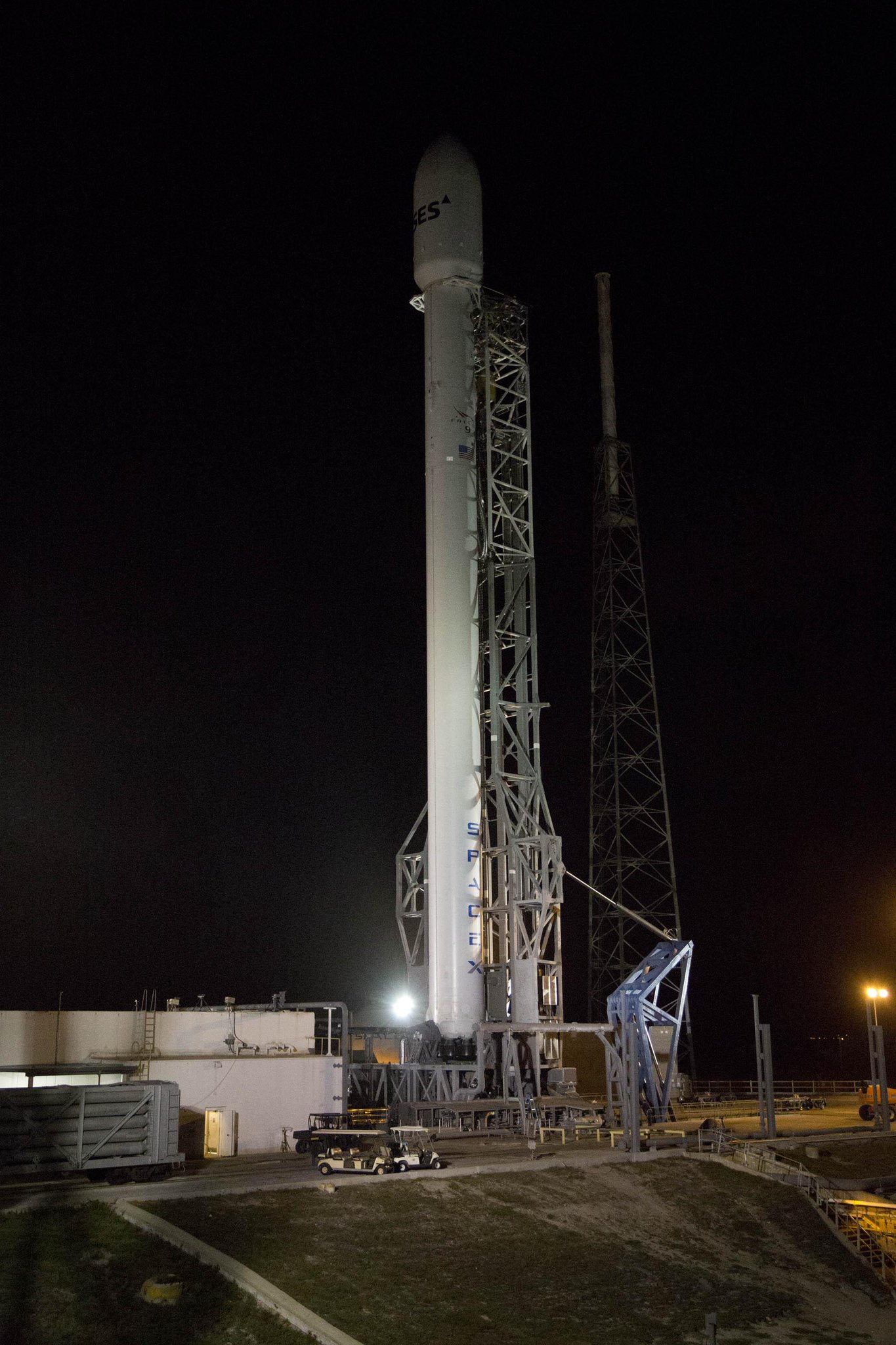
Launch News SpaceX Falcon 9 v1.1 with SES-8, December 3, 2013
- Thread starter Kyle
- Start date

Some tweets indicating that they recycled and got the hot fire off a few minutes ago (?).
http://inagist.com/all/403639720938196992/
http://inagist.com/all/403639720938196992/

Hotfire confirmed! Great news.
Hotfire confirmed! Great news.
Where? That must have been some recycle.
Where? That must have been some recycle.
Chris B - NSF @NASASpaceflight 1h
Good News! SpaceX Falcon 9 v1.1 conducts its Hot Fire for the first time in Florida after an e-vent-ful WDR (pun intended). Article later.
Weather is 80% go for a Monday attempt.

A photo of the Falcon 9 being worked at SLC-40 by a crane:

Found at the Facebook page of the mobile crane company, of all places in the world. :hmm:
Found at the Facebook page of the mobile crane company, of all places in the world. :hmm:
Livestream announced, which confirms the launch date is set for November 25th.
http://new.livestream.com/spacex/events/2565780
http://new.livestream.com/spacex/events/2565780
Press kit out!
http://forum.nasaspaceflight.com/index.php?action=dlattach;topic=32783.0;attach=558496
---------- Post added 11-24-13 at 08:45 PM ---------- Previous post was 11-23-13 at 11:59 PM ----------
Weather remains 80% go for launch tomorrow, with a 30% go for launch on Tuesday. The first "real" front this fall is coming into Florida as temperatures will be dropping to the upper-30s and low-40s across the state.
http://www.patrick.af.mil/shared/media/document/AFD-070716-028.pdf
My guess is, if they can't go on Monday for whatever reason, they'll try again Tuesday then again on Friday.
Stephen Clark
@StephenClark1
#SES8 was mated to Falcon 9 yesterday. Rollout to the pad this evening. Launch from Cape Canaveral at 537 pm EST tomorrow.
http://forum.nasaspaceflight.com/index.php?action=dlattach;topic=32783.0;attach=558496
---------- Post added 11-24-13 at 08:45 PM ---------- Previous post was 11-23-13 at 11:59 PM ----------
Weather remains 80% go for launch tomorrow, with a 30% go for launch on Tuesday. The first "real" front this fall is coming into Florida as temperatures will be dropping to the upper-30s and low-40s across the state.
http://www.patrick.af.mil/shared/media/document/AFD-070716-028.pdf
My guess is, if they can't go on Monday for whatever reason, they'll try again Tuesday then again on Friday.
Stephen Clark
@StephenClark1
#SES8 was mated to Falcon 9 yesterday. Rollout to the pad this evening. Launch from Cape Canaveral at 537 pm EST tomorrow.
Last edited:
The rocket is already at the pad 8 hours ago:


- Joined
- Sep 12, 2010
- Messages
- 3,133
- Reaction score
- 415
- Points
- 123
- Location
- Rome
- Website
- www.tuttovola.org
Elon Musk tweeted:
...Isn't a GEO/GTO around 40.000 km?
[ame="http://en.wikipedia.org/wiki/Geostationary_orbit"]Geostationary orbit - Wikipedia, the free encyclopedia[/ame]
[ame="http://en.wikipedia.org/wiki/Geostationary_transfer_orbit"]Geostationary transfer orbit - Wikipedia, the free encyclopedia[/ame]
Will be toughest mission to date. Requires coast + upper stage restart + going to 80,000 km altitude (~1/4 way to moon).
...Isn't a GEO/GTO around 40.000 km?
[ame="http://en.wikipedia.org/wiki/Geostationary_orbit"]Geostationary orbit - Wikipedia, the free encyclopedia[/ame]
[ame="http://en.wikipedia.org/wiki/Geostationary_transfer_orbit"]Geostationary transfer orbit - Wikipedia, the free encyclopedia[/ame]
Last edited:
GEO's altitude is 35786 km. This launch is going to a so called "super-synchronous transfer orbit", in which the apogee is above the GEO altitude. Remember that the higher you go, the less delta-v you need for making plane changes, such that in some cases the delta-v saved for lowering the inclination to 0 is higher than the delta-v needed to lower the apogee to GEO altitude. It make sense if either the launcher cannot go to a lower inclination orbit or that it allows faster drifting to the planned GEO slot. :tiphat:

- Joined
- Oct 11, 2009
- Messages
- 3,488
- Reaction score
- 407
- Points
- 123
- Location
- Utrecht
- Website
- www.spaceflightnewsapi.net
Remember that the higher you go, the less delta-v you need for making plane changes, such that in some cases the delta-v saved for lowering the inclination to 0 is higher than the delta-v needed to lower the apogee to GEO altitude. It make sense if either the launcher cannot go to a lower inclination orbit or that it allows faster drifting to the planned GEO slot. :tiphat:
Why's that? I know this and I often use this in Orbiter but why is it cheaper then doing a plane change burn in a lower orbit?
:tiphat:

- Joined
- Feb 6, 2008
- Messages
- 38,965
- Reaction score
- 3,937
- Points
- 203
- Location
- Wolfsburg
- Preferred Pronouns
- Sire
Why's that? I know this and I often use this in Orbiter but why is it cheaper then doing a plane change burn in a lower orbit?
Because you are slower. The formula for the DV for a change in inclination is
DV = 2 * Velocity * sin(RInc/2)
Mathematically, this is simply: "how much do I need to add to a vector to rotate it by a set angle?"
The slower you are, the less DV you need.
A bielliptic transfer (=two transfer ellipses), like SpaceX is about to do, is also more effective than a simple Hohmann transfer for GTO missions (even without the plane change), because it makes more use of the Oberth effect. But it requires a few engine restarts, that is why Ariane does not do it usually.
But it requires a few engine restarts, that is why Ariane does not do it usually.
Yeah, Ariane missions usually don't have such a problem with the inclination. Due to some mysterious reason.:lol:
But the Proton which of course has trouble getting down from 51.6° does this regularly, IIRC.

- Joined
- Apr 14, 2012
- Messages
- 2,585
- Reaction score
- 0
- Points
- 36
But the Proton which of course has trouble getting down from 51.6° does this regularly, IIRC.
And we wonder why the Russians have such a powerful launcher fleet. :lol:

- Joined
- Feb 6, 2008
- Messages
- 38,965
- Reaction score
- 3,937
- Points
- 203
- Location
- Wolfsburg
- Preferred Pronouns
- Sire
Yes, and instead of engine restarts, the Ariane does a long burn with the cryogen upper stage simply placing the payload into a GTO that brings it more or less fast to its target slot in the Clarke Belt.
Some weeks of drifting into position are common for geostationary satellites anyway.
Some weeks of drifting into position are common for geostationary satellites anyway.
GEO's altitude is 35786 km. This launch is going to a so called "super-synchronous transfer orbit", in which the apogee is above the GEO altitude. Remember that the higher you go, the less delta-v you need for making plane changes, such that in some cases the delta-v saved for lowering the inclination to 0 is higher than the delta-v needed to lower the apogee to GEO altitude. It make sense if either the launcher cannot go to a lower inclination orbit or that it allows faster drifting to the planned GEO slot. :tiphat:
And just to double-check, I tried it on Orbiter and it worked. :thumbup:
Similar threads

- Replies
- 13
- Views
- 6K

- Replies
- 20
- Views
- 8K

- Replies
- 60
- Views
- 25K


- Replies
- 1
- Views
- 1K
