Launch News SpaceX Falcon 9 v1.2 with SES-9 March 4 2016

the helium is it. Something made it possible to create helium bubbles between tank and engine. Possibly a leak.
Pressure valve going blinky ?
Question: I take it that this is not a recycled stage ? ( I haven't followed this stuff to closely )
 
Last edited:
Pressure valve going blinky ?
Question: I take it that this is not a recycled stage ? ( I haven't followed this stuff to closely )

It's not. They've only fully recovered one stage so far, and they've been keeping that for study/historic purposes. This is a fresh launch vehicle. If it is returned (big if; the demanding launch will make it likely they just crash it into the drone ship), this will probably be the first reused booster stage.
 
I don't think they're ready to start reusing just yet. Probably are going to want a few to look at first.
 
I don't think they're ready to start reusing just yet. Probably are going to want a few to look at first.

That's what I would have expected, but Musk did say that there's a good chance they'll attempt reuse of the second booster they recover.
 
If the short hold due to a range violation had no impact on the launch abort then it really would not present a serious problem. You just hold for the short time, then launch after the short hold.

I get the impression that even short holds present a problem for the superchilled LOX.

Bob Clark

The hold was approximately 35 minutes. In the context of trying to load the LOX just a couple of minutes before liftoff, this was quite a long hold. Why this led to a helium bubble is something for them to take back to the labs, but the fact that they are scheduling for tomorrow suggests that it's not a big concern for them.

4th time lucky, I hope. I want to see how high an orbit that F9 can muster for this satellite.
 
4th time lucky, I hope. I want to see how high an orbit that F9 can muster for this satellite.

What altitude did they say they were aiming for? I heard it on the stream but forgot. From what I gathered, the satellite will need to give itself the final push to GTO altitude with a chemical engine after deployment, then has a xenon ion engine for circularisation, right?
 
What altitude did they say they were aiming for? I heard it on the stream but forgot. From what I gathered, the satellite will need to give itself the final push to GTO altitude with a chemical engine after deployment, then has a xenon ion engine for circularisation, right?

The initial contract was for a "sub-synchronous" orbit of 26000km x 290 km, and then SES-9 would use it's own rocket to kick to a rough orbit, and then the ion engine for fine-tuning. This was to take 90 days. SpaceX announced last week that they would run the Merlin engine to nearly dry, to give it as much dV as possible (rather than programming a specific target orbit for the SECO). They are aiming for a slightly super-synchronous orbit of 39,300 km x 290 km, which will shorten the commissioning time by 45 days. So yeah - interested to see what the little Merlin can do for SES.
 
The Tuesday launch is in fact NOT confirmed, my local paper shows why it is going out of business yet again!
 
Well, another one:

Elon Musk on Twitter said:
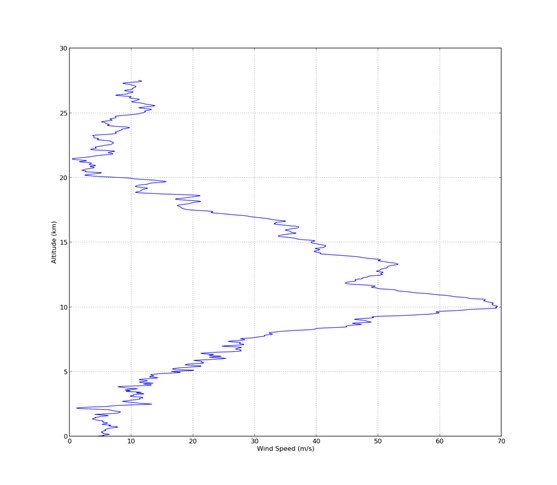
Pushing launch to Friday due to extreme high altitude wind shear. Hits like a sledgehammer when going up supersonic

CcfYzdsUkAE3cFf.jpg
 
250 km/h? :shrug:
 
Yep, it happens from time to time. Keep in mind that there are no obstacles up there for the wind to run into.

I know. Its a bit windy. Might even be stormy. :shrug:
 
Meh.
It's the return from Year in Space tonight anyway. :cheers:
 
Finally! I´ll be able to watch it.

Very bad launch time in workdays for Europe spectators.
 
250 km/h? :shrug:

Yes ... but at 10km altitude, and 250mb. So effectively more like 60km/h at ground speed.

I made the mistake of watching just the horizontal shear (pretty small), and not the vertical shear. Did not think that a rapidly growing tailwind would be a problem, but apparently yes.
 
Yes ... but at 10km altitude, and 250mb. So effectively more like 60km/h at ground speed.

I made the mistake of watching just the horizontal shear (pretty small), and not the vertical shear. Did not think that a rapidly growing tailwind would be a problem, but apparently yes.

It's not the absolute speed of the air, but the rate of change of the speed. A significant shear can put large bending moments on the rocket.
 
Last edited:
It's not the absolute speed of the air, but the rate of change of the speed. A significant shear can put large bending moments on the rocket.

I'd love to find a better source for the launch criteria for upper level winds and windshear. This is as good as I can find: https://www.nasa.gov/pdf/649911main_051612_falcon9_weather_criteria.pdf ... and it just says not to launch through upper level conditions containing wind shear... without any quantification. Frustrating really.
 
Back
Top