Question What is an electrical bus exactly?

jedidia

shoemaker without legs
Addon Developer
Joined
Mar 19, 2008
Messages
11,319
Reaction score
2,789
Points
203
Location
between the planets
Continuing work on IMS2, I once again find my lack of knowledge one of the biggest hinderances. And once again I think an engineering subforum along with math&physics and astronomy might be a good thing.

I want to put a bit more realism into power distribution than in the original, and have tried learning about a concept that I always knew existed, but never really knew what it is: The electircal bus (not that kind!)

When digging around for buses in a spaceflight context, I have mostly come over buses in computational and communication functions. I know a bit about those, so I'm pretty sure that's not what I'm looking for. The thing I have found (though not in a spaceflight specific context) that seems to fit the bill most closely is the busbar... Which more or less turns out to be a "solid cable". Is this really the usual means how power is distributed through a spacecraft? If yes, what exactly are the advantages over using cables?
 
Well, you have to remember that you also need a "ground" relative to the bus cable. But yes. Essentially, it is one big metal bar and all consumers are switched parallel on it.

The advantage is that you have a huge cross section and a relatively high surface area with a very simple component, which makes it a good way to carry a lot of amperes. But you can only use it for short distances. Inside a single module for example. For longer distances, you again need different ways to transport the voltage.
 
So, like, all systems inside a module are connected to a bus (or several), and between modules you'd use a cable?

I'm looking for material on the electrical distribution on the ISS, but articles about it are either extremely superficial or mostly focused on the solar arrays. About the only thing I can tell for sure is that the ISS has a "Main bus" of 160 volts. So, do they actually have a 160 volt busbar running through the thing, or do they just call it a bus for the hell of it?
 
It is a easy way to tap into the power rail just as on a mother board you can tap into the address / memory lines. Same concept, just fatter wire!!
 
Bus only means two conductors of any suitable type with all consumers between them in parallel. Yes, also two cables can form a bus. but a bus bar only makes sense inside a module, otherwise you would need to install a bus bar between modules....
 
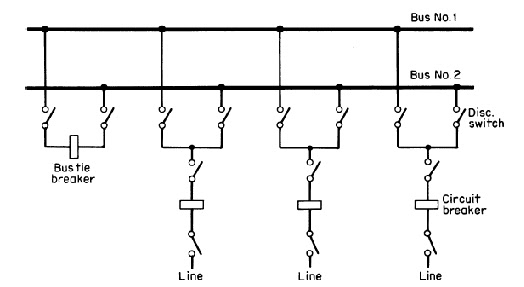
Imagine something like this:
double+bus+single+breaker.bmp
 
Right... so a bus turns out to be more or less what I expected. So the "Main bus" would likely be a power line thatt more or less runs the length of a larger spacecraft at relatively high voltage, and then there would be per-module buses switched into it (presumably via transformers) that carry the power to the actual equipment.

Let me try a hamfisted definition here to see if I got this right: "An electrical bus is a power circuit for the purpose of power distribution at a certain voltage, no matter what the bus is physically made of". How close am I?
 
A bus is just a 'point' on the electrical diagram that can be isolated.

The physical object can be anything from this:
Buss-bar.jpg


To this:
MNS_Unit_Substation_Transformer_Busbar_Connections-2.jpg
 
A bus is just a 'point' on the electrical diagram that can be isolated.

The buses are the points? Oh dear, quite a misconception there, then. So... what do you call the lines? :blink:

EDIT: Wait, no, that makes no sense. I'm clearly taking you too literally. In the diagram you posted above, there are two thick lines, and they are labeled "Bus no 1" and "Bus no 2". Clearly your meaning was not to say that a bus was a point on that diagram.
 
Last edited:
The buses are the points? Oh dear, quite a misconception there, then. So... what do you call the lines? :blink:

EDIT: Wait, no, that makes no sense. I'm clearly taking you too literally. In the diagram you posted above, there are two thick lines, and they are labeled "Bus no 1" and "Bus no 2". Clearly your meaning was not to say that a bus was a point on that diagram.

A diagram shows electrical connection, not physical form (although they can be similar in shape). The lines on the diagram are used to provide a clear picture at a glance. The actual bus could be an isolated bolt with a stack of terminal connectors. (not recommended!!!)
 
So basically the local distributor. Power comes in from somewhere and goes out "the other end" (as much as there is an other end in electric circuits...) to stuff hooked up to it in the vicinity. got it.

In other words, buses are good at getting hooked up to by things. Let's assume I'm hooking up one VASIMR engine to a generator putting out a few Megawatts. Would I still call that Hook-up point a bus, or would I just call it "that really thick cable" or similar?

EDIT:
You can interpret a bus as a junction there, a node in the graph.

Ah... Ahhh, that actually hepls a lot!
 
Last edited:
In other words, buses are good at getting hooked up to by things. Let's assume I'm hooking up one VASIMR engine to a generator putting out a few Megawatts. Would I still call that Hook-up point a bus, or would I just call it "that really thick cable" or similar?

Weeeeeelll ... it would likely be called Bus, even if it would just have a single subsystem getting powered by it.
 
Just Like on an add on card for a PC, there is a voltage provided on a given pin / connector. What you use it for ... not my problem mate.
In a 30kW transmitter I worked on the power bus was two bare copper bars with 1/4inch bolts, on a PC its a fatter then average track.... still a power bus.

Rather than each unit having its own separate wire back to the PSU, install a common power distribution that any thing that needs it, can use it, give it a fancy name and charge twice as much !!!

Think of how each of the power outlets in your house gets its juice, its not one separate wire to the fuse box for each one???? Call it big wire; 1 Pound, call it ring mains; £5. Call it a power distribution bus; 20 quid !!!
 
514862ElectricalA320.jpg


Here's an example from an aviation context. This shows various power buses in an Airbus A320 (allegedly)! You can see the four sources of generated power: one from each main engine (Gen1, Gen2), plus the onboard APU, and the external power feed. This is feeding two primary Alternating Current buses (AC Bus 1 and AC Bus 2), with respective feeds via rectifiers into the DC Bus 1 and 2. Essential A/C power equipment is on the AC Essential Bus, with primary feed from AC 1, and a tie to swap to AC 2. Batteries are there for the essential DC equipment.

Basically - this is a panel board with ties and breakers to route power around the plane.

For way more info, go here: http://www.smartcockpit.com/aircraft-ressources/A319-320-321-Electrical.html
 
Last edited:
In computing or electronics, a bus is just a "source" common to many things.

It might be providing a specific voltage or a specific signal. It might be a physical conductor or just an imaginary construct in a computer program.

A common power source is convenient but you do have implications such as the possibility that one device connected to the bus might alter the bus voltage/signal if there is not protection built into every connection (be careful what you connect to an Arduino; many of the pins connect to the bus that powers the board :) )
 
An electrical bus is a power circuit for the purpose of power distribution at a certain voltage, no matter what the bus is physically made of

Sounds actually good to me.

Let's list a few characteristics:

* is has one or more power sources (batteries, generators,...) and one or more power sinks (otherwise known as equipment you want to run)

* it can be of different type - there's AC and DC buses aboard the Space Shuttle, and equipment needs to be of compatible type

* it has 'large' conductivity, which in practice means that you can talk of a 'bus voltage' and don't need to specify where on the bus the voltage was measured, all equipment on the bus gets the same voltage

* as a result, if some equipment shorts out, the bus won't protect the rest of the equipment on the bus, the voltage will floor for everything - which is why there's circuit breakers for the specific pieces of equipment

* you can 'tie' two (or more) compatible buses such that the voltage equalizes and hence the sum of all input power feeds the sum of equipment hanging on two buses - you can however not tie a 117 V AC bus with a 28 V DC bus

So for each piece of equipment, you might want to know which bus it's connected to, because if the bus goes without power, all equipment on that bus will go.
 
Copper that big, looks scary when it's that exposed. I mean I guess it could be carrying like a million amps at one volt...but I doubt it.

Actually it can, but only for a very short time. Circuit breakers have to be quick to protect the system. BTW a million amps is a million amps no matter what the voltage.
Fun fact: One of the reason for the bulky copper bars is to withstand the magnetic forces during a short circuit.
 
Actually it can, but only for a very short time. Circuit breakers have to be quick to protect the system. BTW a million amps is a million amps no matter what the voltage.
Fun fact: One of the reason for the bulky copper bars is to withstand the magnetic forces during a short circuit.

Well, now that is a fun fact. Wouldn't want to be nearby with metal piercings at the wrong moment! Is there (I assume there is) a way to compute the potential magnetic force of such an event based on the anticipated peak flow (which of course would be much higher than normal)?
 
Back
Top