Bayesian evidence for the prevalence of waterworlds

Urwumpe

Not funny anymore
Addon Developer
Donator
Joined
Feb 6, 2008
Messages
38,965
Reaction score
3,937
Points
203
Location
Wolfsburg
Preferred Pronouns
Sire
https://academic.oup.com/mnras/article/468/3/2803/3059153/Bayesian-evidence-for-the-prevalence-of

Abstract:

Should we expect most habitable planets to share the Earth's marbled appearance? For a planetary surface to boast extensive areas of both land and water, a delicate balance must be struck between the volume of water it retains and the capacity of its perturbations. These two quantities may show substantial variability across the full spectrum of water-bearing worlds. This would suggest that, barring strong feedback effects, most surfaces are heavily dominated by either water or land. Why is the Earth so finely poised? To address this question, we construct a simple model for the selection bias that would arise within an ensemble of surface conditions. Based on the Earth's ocean coverage of 71 per cent, we find substantial evidence (Bayes factor K ≃ 6) supporting the hypothesis that anthropic selection effects are at work. Furthermore, due to the Earth's proximity to the waterworld limit, this model predicts that most habitable planets are dominated by oceans spanning over 90 per cent of their surface area (95 per cent credible interval). This scenario, in which the Earth has a much greater land area than most habitable planets, is consistent with results from numerical simulations and could help explain the apparently low-mass transition in the mass–radius relation.

Its interesting, maybe we should not try to focus on landing on solid ground too much, because a splash down might be necessary more than once.

And does that mean that Orbiter needs a better ocean model? :lol:
 
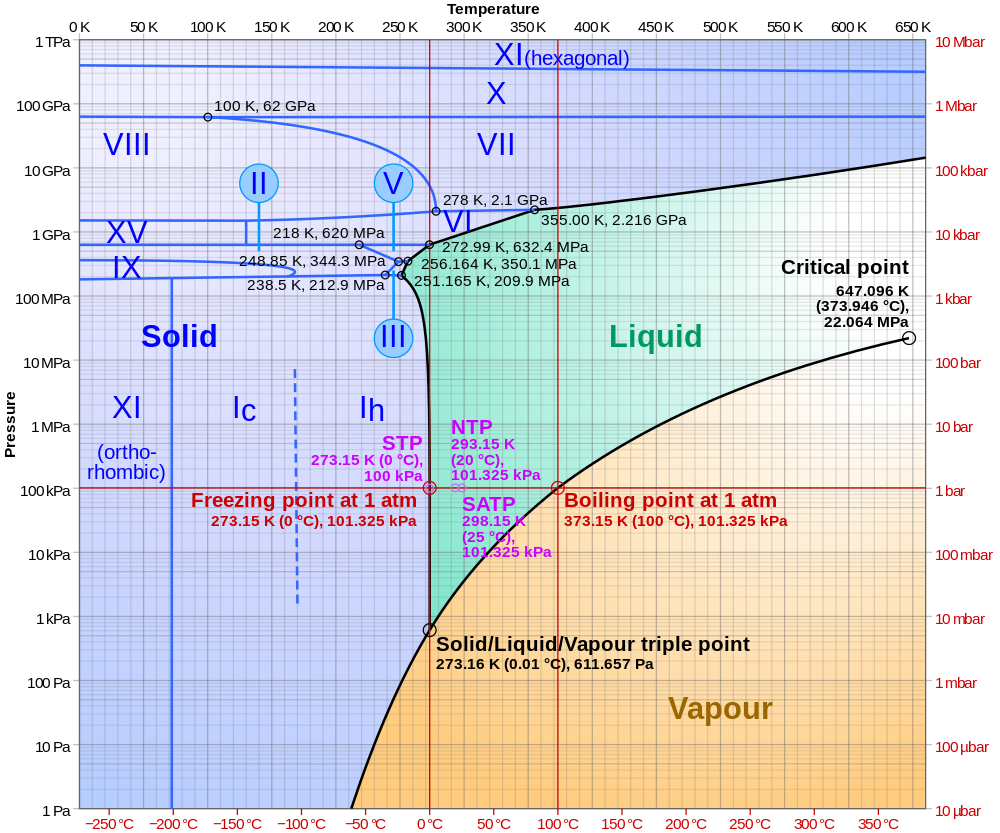
Imagine a world with oceans 1000km deep. That'd be impressive.
 
Imagine a world with oceans 1000km deep. That'd be impressive.

Yeah - it would turn to a special kind of ice at that kind of pressure.

1000px-Phase_diagram_of_water.svg.png
 
Well, statistical analysis based on a sample size of one are always good for surprises. Don't get me wrong, I do know the concept of the Self-Sampling-Assumption, the thing is just that you can only tell with what probability you are kind of right, and with what probability you can be completely wrong.

Still, I'll make sure to pack a Post-Apocalyptic Trimaran when I go on interstellar exploration trips... :lol:
 
at that kind of pressure.
Makes me wonder what sort of pressure would that be.
A rule of thumb gives about 100Mbar, but that assumes constant density, which we no longer have after first 10Km or so. Even if density is accounted for, the gravity would start changing given the depth involved...
Hm.
 
Makes me wonder what sort of pressure would that be.
A rule of thumb gives about 100Mbar, but that assumes constant density, which we no longer have after first 10Km or so. Even if density is accounted for, the gravity would start changing given the depth involved...
Hm.

Well, I got 20 GBar there, assuming standard gravity on the surface of the ocean. Since you can assume water to have a nearly constant density, using the average of the gravity between surface and bottom would be correct.
 
Don't get me wrong, I do know the concept of the Self-Sampling-Assumption, the thing is just that you can only tell with what probability you are kind of right, and with what probability you can be completely wrong.

"It's almost miraculous!", said the puddle. "That shape in the ground I'm inhabiting fits my own size and shape so perfectly!" :lol:


Edit: After reading the paper - the obvious catch here is how to model the assumed statistical surface relief distribution - because if you feed your model with large surface reliefs, it'll pop out significantly less water worlds.

Now the actual amount of information on that is... slim:

Among the Solar system's terrestrial planets, there is no clear trend to suggest how the amplitude of elevation profiles change with respect to the planet's radius.

Moreover, it's not uncorrelated - part of what may keep water liquid (internal heat) is also what drives geology. Moreover, the existence of high plateaus can be expected to generally lower liquid waters by ice formation (Antarctica) and corresponding albedo changes.

So, as frequent with Bayesian, in the absence of any solid data, the answer you get back is what you put in as your default model.
 
Last edited:
Back
Top