
You are using an out of date browser. It may not display this or other websites correctly.
You should upgrade or use an alternative browser.
You should upgrade or use an alternative browser.
Project Mir station complex / UR-500 family
- Thread starter MaxBuzz
- Start date
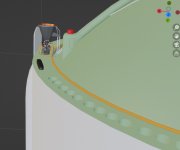

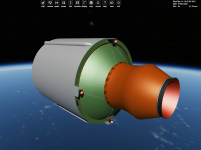
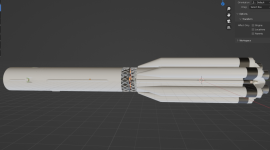
So here's the Stage 3 fore mostly done, from the only pic I have :
That's the end of the "root architecture" of the Proton-K. I think I'll go for the "Mir" adapters / PLFs first (that word means "Peace" in russian).
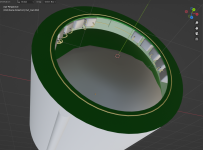
That's the end of the "root architecture" of the Proton-K. I think I'll go for the "Mir" adapters / PLFs first (that word means "Peace" in russian).
Last edited:

MaxBuzz
Well-known member
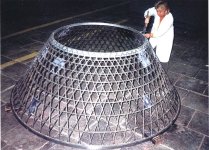
3rd Stage when building a Priroda module (head fairings i can make myself)Do you know about the kind of adapters (for Stage 3)

Proton rocket adapter
Last edited:
Cleaning up the Stage 3 mesh, in order to make it export properly in Orbiter, with meshgroupes indexed in a somewhat logical fashion... Lot of "behind the scene" work.
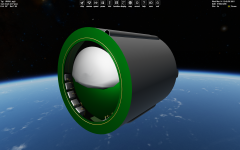
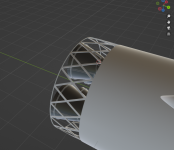
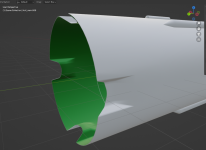
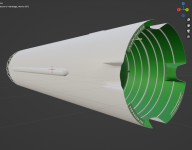
Stage 2 is elongated from the "K" version expanding the propellant capacity and adding a long interstage that houses the Stage 3 main nozzle. Note the exhaust vents for the verniers hotfire separation (I'm quite happy of those, the schematics helped me a lot).



- Joined
- Feb 6, 2008
- Messages
- 38,965
- Reaction score
- 3,937
- Points
- 203
- Location
- Wolfsburg
- Preferred Pronouns
- Sire
@Urwumpe : what do you think all that mess is ? I mean those white boxes with all those plugs ? Some kind of those Soviet non-miniaturized electronics ? Not that I really need to know but I'm curious... ?
I can only guess and that with a huge amount of incompetence*: Boxes with good old relays, since most of them accept a number of cables from one side and pass out a similar number from the other side. That is not even a bad choice, those relays are also still used in the west to isolate that stage from the other stages before staging. Some could also contain filters or signal amplifiers for steering the second stage, but most look like they are storing relays there. Also possible would be PICs, which send power spikes to ignite pyrotechnics. Theoretically, there could also be boxes with navigation sensors like gyroscopes.
* I really only know some coarse, sketchy information about soviet era electronics and packaging, and their shortcomings in spaceflight compared to western technology. I can only talk half-competent about western, especially European standards. I believe, @Artlav might know more there, what to expect and what to look for.
- Joined
- Feb 6, 2008
- Messages
- 38,965
- Reaction score
- 3,937
- Points
- 203
- Location
- Wolfsburg
- Preferred Pronouns
- Sire
Thanks, that's something already, my technical knowledge about electrics is close from zero. Replacing a light socket is the most complex thing I can do ?
I am officially a software guy and should NEVER EVER touch any hardware. ? But explaining why I can easily fix most cables and sockets in my house despite that specialization would go too far into the off-topic and is really boring (My father taught me).
I see, well I remember my father tried to replace a 220V AC plug when I was like 15... A "old" house (1950s...) we had in town (Nantes). Well, let's say my sister had to use an extension cord for her room the few years we spent there. To his credit France 1950's seems to have been quite an anarchy period from an electrical perspective (post-war rebuilding era, people were not picky)... They used anything they had to wire the houses, regardless the colors, even some cloth-insulated wires... We were lucky the house didn't burn. Well some estate agent offered my parents a nice check for the land to build appartements and that house of electrical horror is no more ?
So OK those are big, space-grade switches.
So OK those are big, space-grade switches.
Last edited:
- Joined
- Feb 6, 2008
- Messages
- 38,965
- Reaction score
- 3,937
- Points
- 203
- Location
- Wolfsburg
- Preferred Pronouns
- Sire
I see, well I remember my father tried to replace a 220V AC plug when I was like 15... A "old" house (1950s...) we had in town (Nantes). Well, let's say my sister had to use an extension cord for her room the few years we spent there. To his credit France 1950's seems to have been quite an anarchy period from an electrical perspective (post-war rebuilding era, people were not picky)... They used anything they had to wire the houses, regardless the colors, even some cloth-insulated wires... We were lucky the house didn't burn. Well some estate agent offered my parents a nice check for the land to build appartements and that house of electrical horror is no more ?
I had once seen such a house. Former GDR, somewhere far away from civilization at all eras, fairly old structure, about 1920s I estimated.... Without my metal detector and multimeter, some people would have been dead. Power lines went diagonal across the wall, sometimes crossed each other, removing the all fuses did not remove power from all lines there. Light switches and fuse box had been made in the GDR around 1950-1960. Had only some small tools with me, can't remember what I wanted to do there... I believe it was just about a new light in a bathroom. Recommended to call a professional. One really old cable was terribly corroded and caused many ghostly phenomena in the house.
So OK those are big, space-grade switches.
Must not be that big, but especially in the electrical power system, there can be of some huge remote switches, that can even take a few seconds of operation to open or close.
Recommended to call a professional.
That's where complete demolition is in most cases a bargain ?
- Joined
- Feb 6, 2008
- Messages
- 38,965
- Reaction score
- 3,937
- Points
- 203
- Location
- Wolfsburg
- Preferred Pronouns
- Sire
That's where complete demolition is in most cases a bargain ?
Yeah, but in that case, even my heart would have been bleeding. Was a really nice, not too small house with a beautiful garden, with some small work, it could look like a small palace. But some eldritch cultist did the electrical system there and I didn't even ask about the heating system.
Similar threads


- Replies
- 12
- Views
- 16K


