
You are using an out of date browser. It may not display this or other websites correctly.
You should upgrade or use an alternative browser.
You should upgrade or use an alternative browser.
Updates Rosetta Mission News
- Thread starter Notebook
- Start date

Unstung
Active member
Does anybody know why Rosetta will approach the comet in an unusual way?
It seems like getting closer and preforming one longer burn would be more efficient than a looping pattern. I think Rosetta may do this for safety, to avoid entering any potential coma or tail.

- Joined
- Feb 6, 2008
- Messages
- 38,965
- Reaction score
- 3,937
- Points
- 203
- Location
- Wolfsburg
- Preferred Pronouns
- Sire
Does anybody know why Rosetta will approach the comet in an unusual way?
Rosetta's orbit around the comet
It seems like getting closer and preforming one longer burn would be more efficient than a looping pattern. I think Rosetta may do this for safety, to avoid entering any potential coma or tail.
That, but also remember that the gravity of the comet has almost no effect on Rosetta. The perturbations of the planets will constantly distort the very weak gravity field and require constant corrections to prevent drifting away or crashing into the comet.

Does anybody know why Rosetta will approach the comet in an unusual way?
It seems like getting closer and preforming one longer burn would be more efficient than a looping pattern. I think Rosetta may do this for safety, to avoid entering any potential coma or tail.
It needs to first map the details of the comet and hazard zones. The imagery of the comet right now is rather coarse.
Also, keep in mind that the animation is much faster than the actual motion. The energy to make these trajectory changes is miniscule as it really is not "fighting" the comet's gravity in any meaningful way. Even when it finally settles into "orbit" the period will be very long and perturbations from other cosmic bodies will necessitate frequent small corrections to stay in orbit.

- Joined
- Feb 11, 2008
- Messages
- 2,604
- Reaction score
- 31
- Points
- 63
Does anybody know why Rosetta will approach the comet in an unusual way?
That approach makes perfect sense. The initial part is not an orbit at all. The craft is so far away that it can fly a triangle path using 3 small burns. This is a good way to get imagery of possible hazards and measuring the gravitational forces.
Notice the position of the comets tail. The craft is kept as far away from it as possible.
This animation is not to scale; Rosetta's solar arrays span 32 m, and the comet is approximately 4 km wide.
The initial distance is 100 km, and the close 'periapsis' is 2.5 km. The displayed maneuvers stretch from August to November.
Last edited:

- Joined
- Jan 7, 2008
- Messages
- 5,814
- Reaction score
- 869
- Points
- 203
- Location
- Earth
- Website
- orbides.org
- Preferred Pronouns
- she/her
What sort of propulsion Rosetta have?
Ion engine?
Surprisingly, neither wiki, nor ESA site seem to say.
Ion engine?
Surprisingly, neither wiki, nor ESA site seem to say.

What sort of propulsion Rosetta have?
Ion engine?
Surprisingly, neither wiki, nor ESA site seem to say.
"Bipropellant"
http://www.esa.int/Our_Activities/Space_Science/Rosetta/The_Rosetta_orbiter
---------- Post added at 12:37 AM ---------- Previous post was at 12:35 AM ----------
"The Rosetta thruster are bipropellants units which use monomethylhydrazine fuel and mixed oxides of nitrogen as oxidizer."
http://space.unibe.ch/fileadmin/images/rosina/thrusterfiring_AIAA_rev.pdf

- Joined
- Feb 13, 2008
- Messages
- 5,398
- Reaction score
- 8
- Points
- 0
- Location
- Khimki
- Website
- tigerofsiberia.livejournal.com
I can't wait until the data start to come! It is not the wheezing by as all the previous missions!
- Joined
- Jan 7, 2008
- Messages
- 5,814
- Reaction score
- 869
- Points
- 203
- Location
- Earth
- Website
- orbides.org
- Preferred Pronouns
- she/her
It's been a decade, can as well wait another 6 months.I can't wait until the data start to come!

- Joined
- Feb 6, 2008
- Messages
- 38,965
- Reaction score
- 3,937
- Points
- 203
- Location
- Wolfsburg
- Preferred Pronouns
- Sire
It's been a decade, can as well wait another 6 months.
When it was designed, I was still apprentice at the German aerospace agency, and had the team designing the lander structure in my institute.

- Joined
- Oct 11, 2009
- Messages
- 3,488
- Reaction score
- 407
- Points
- 123
- Location
- Utrecht
- Website
- www.spaceflightnewsapi.net
Unstung
Active member
Rosetta recently captured the first two photos of its target, 5 million km away, since hibernation using the wide-angle (top image) and narrow-angle (bottom) cameras:
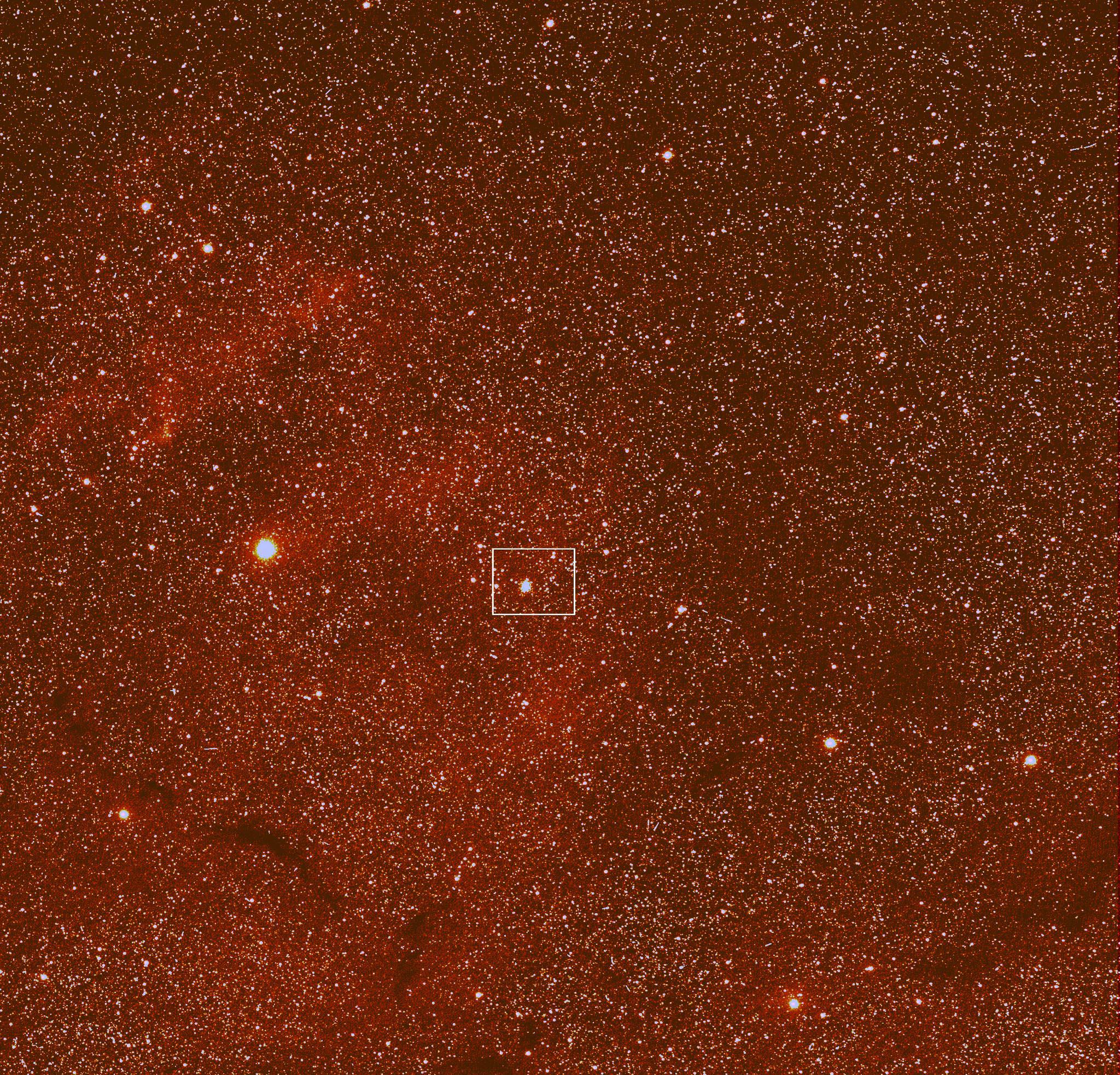
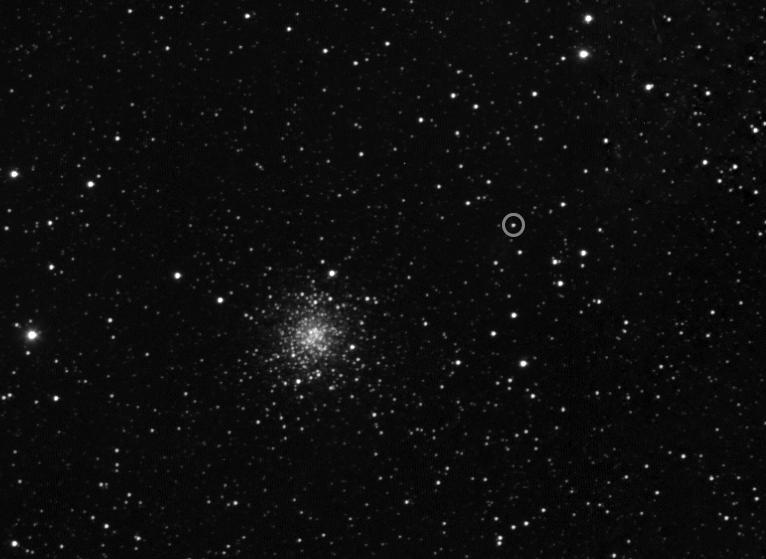
The globular cluster M107 is in the above image.
JPL: "Rosetta Sets Sights on Destination Comet"
The Planetary Society: "Comet spotted! Rosetta's first sight of Churymov-Gerasimenko since wakeup"
This is what 67P/Churyumov-Gerasimenko will look like in the coming months from the spacecraft's perspective:
Philae has also been successfully reactivated.
Universe Today: "ESA Awakens Rosetta’s Comet Lander"
The globular cluster M107 is in the above image.
JPL: "Rosetta Sets Sights on Destination Comet"
The Planetary Society: "Comet spotted! Rosetta's first sight of Churymov-Gerasimenko since wakeup"
This is what 67P/Churyumov-Gerasimenko will look like in the coming months from the spacecraft's perspective:
Philae has also been successfully reactivated.
Universe Today: "ESA Awakens Rosetta’s Comet Lander"
- Joined
- Feb 6, 2008
- Messages
- 38,965
- Reaction score
- 3,937
- Points
- 203
- Location
- Wolfsburg
- Preferred Pronouns
- Sire
Rosetta performed the first small deceleration manoeuvre to test the thruster system. Over the next weeks, a number of burns will be performed to slow the spacecraft to less than 8 m/s relative to the comet. Rosetta is now 2 million kilometres away from the target and approaching it with 775 m/s relative velocity.
Here is the table of the burns from the blog article:
Date|Delta-v|Midpoint of burn (UTC)|ROS/67P dist|ROS/67P rel-v
Wed 07/05/14|20 m/s|16:45|1,918,449|775.1
Wed 21/05/14|290.89 m/s|19:08|1,005,056|754.1
Wed 04/06/14|270.98 m/s|17:48|425,250|463.0
Wed 18/06/14|90.76 m/s|14:31|194,846|192.1
Wed 02/07/14|58.80 m/s|12:57|51,707|101.3
Wed 09/07/14|24.91 m/s|11:57|22,314|43.0
Wed 16/07/14|10.65 m/s|11:12|9,590|18.4
Wed 23/07/14|4.62 m/s|10:30|4,126|7.9
http://blogs.esa.int/rosetta/2014/05/07/thruster-burn-kicks-off-crucial-series-of-manoeuvres/
Also, what might be interesting for the German forum members: The magazine c't has a longer article about Rosetta in its current issue.
http://www.heise.de/ct/inhalt/2014/11/82/
Here is the table of the burns from the blog article:
Wed 07/05/14|20 m/s|16:45|1,918,449|775.1
Wed 21/05/14|290.89 m/s|19:08|1,005,056|754.1
Wed 04/06/14|270.98 m/s|17:48|425,250|463.0
Wed 18/06/14|90.76 m/s|14:31|194,846|192.1
Wed 02/07/14|58.80 m/s|12:57|51,707|101.3
Wed 09/07/14|24.91 m/s|11:57|22,314|43.0
Wed 16/07/14|10.65 m/s|11:12|9,590|18.4
Wed 23/07/14|4.62 m/s|10:30|4,126|7.9
http://blogs.esa.int/rosetta/2014/05/07/thruster-burn-kicks-off-crucial-series-of-manoeuvres/
Also, what might be interesting for the German forum members: The magazine c't has a longer article about Rosetta in its current issue.
http://www.heise.de/ct/inhalt/2014/11/82/
Unstung
Active member
Rosetta captured a special sequence of images of the comet over 42 days (or 41, depending on how "between March 24 and May 4" is interpreted, but 42 is obviously the right answer). The comet is 600 million kilometers from the sun and must have crossed the frost line for its surface to start sublimating. M107 is visible in this sequence like in the image two posts before, with an exposure time of 720 seconds per frame.
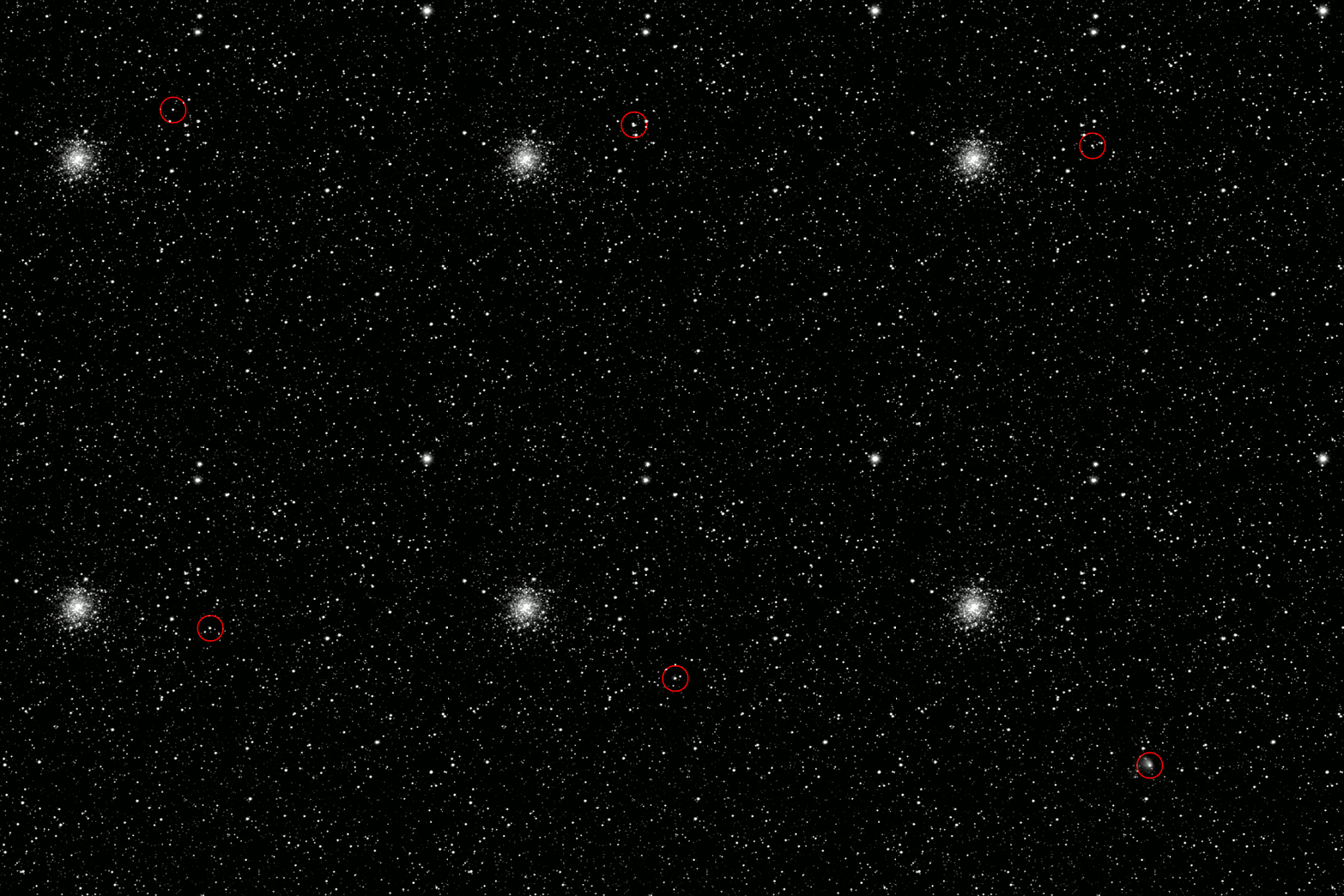
Description:
JPL: "Rosetta's Target Comet is Becoming Active"
The Planetary Society: "Pretty pictures: Rosetta's comet is now acting like one!"
Universe Today: "It’s Alive! Rosetta’s Comet Flares As It Approaches The Sun"
Description:
This sequence of images shows comet 67P/Churyumov-Gerasimenko moving against the background star field. Images were taken by the Optical, Spectroscopic, and Infrared Remote Imaging System (OSIRIS) camera aboard the European Space Agency's Rosetta spacecraft, between March 24 and May 4, 2014, as the spacecraft closed the distance between itself and the comet from around 3.1 million miles (5 million kilometers) to 1.2 million miles (2 million kilometers). The comet is seen to develop a dust coma as the sequence progresses, with the evolving coma reaching approximately 800 miles (1,300 kilometers) into space.
JPL: "Rosetta's Target Comet is Becoming Active"
The Planetary Society: "Pretty pictures: Rosetta's comet is now acting like one!"
Universe Today: "It’s Alive! Rosetta’s Comet Flares As It Approaches The Sun"
Last edited:

- Joined
- Sep 12, 2010
- Messages
- 3,133
- Reaction score
- 415
- Points
- 123
- Location
- Rome
- Website
- www.tuttovola.org
A user on FOI asks at which distance from Earth will the landing occurr?
Anyone knows?
Anyone knows?

A user on FOI asks at which distance from Earth will the landing occurr?
Anyone knows?
sci.esa.int/rosetta/ said:Rosetta will arrive at comet 67P/Churyumov-Gerasimenko in August 2014, and deploy the Philae lander in November 2014.
Stellarium says 3.42AU in mid November. Right now its at 3.08AU, (PeA 2.69AU, end of July).
Unstung
Active member
In the table posted by Urwumpe, the two longest burns to slow Rosetta relative to the comet were already supposed to occur. Both of these burns have been successful and the spacecraft is on track. Currently, Rosetta is about 500,000 kilometers (according to the JPL article) from 67P and approaching 17,000 kilometers closer every day until the burn on 18 June (which is on my birthday and the fifth anniversary of the LRO's launch).
The Planetary Society: "Rosetta update: Both "big burns" completed successfully"
JPL: "NASA Instruments on Rosetta Start Comet Science"
Date|Delta-v|Midpoint of burn (UTC)|ROS/67P dist|ROS/67P rel-v
Wed 07/05/14|20 m/s|16:45|1,918,449|775.1
Wed 21/05/14|290.89 m/s|19:08|1,005,056|754.1
Wed 04/06/14|270.98 m/s|17:48|425,250|463.0
Wed 18/06/14|90.76 m/s|14:31|194,846|192.1
Wed 02/07/14|58.80 m/s|12:57|51,707|101.3
Wed 09/07/14|24.91 m/s|11:57|22,314|43.0
Wed 16/07/14|10.65 m/s|11:12|9,590|18.4
Wed 23/07/14|4.62 m/s|10:30|4,126|7.9
The Planetary Society: "Rosetta update: Both "big burns" completed successfully"
JPL: "NASA Instruments on Rosetta Start Comet Science"
Three NASA science instruments aboard the European Space Agency's (ESA) Rosetta spacecraft, which is set to become the first to orbit a comet and land a probe on its nucleus, are beginning observations and sending science data back to Earth.
Launched in March 2004, Rosetta was reactivated in January 2014 after a record 957 days in hibernation. Composed of an orbiter and lander, Rosetta's objective is to arrive at comet 67P/Churyumov-Gerasimenko in August to study the celestial object up close in unprecedented detail and prepare for landing a probe on the comet's nucleus in November.
Rosetta's lander will obtain the first images taken from a comet's surface and will provide the first analysis of a comet's composition by drilling into the surface. Rosetta also will be the first spacecraft to witness at close proximity how a comet changes as it is subjected to the increasing intensity of the sun's radiation. Observations will help scientists learn more about the origin and evolution of our solar system and the role comets may have played in seeding Earth with water, and perhaps even life.
"We are happy to be seeing some real zeroes and ones coming down from our instruments, and cannot wait to figure out what they are telling us," said Claudia Alexander, Rosetta's U.S. project scientist at NASA's Jet Propulsion Laboratory in Pasadena, California. "Never before has a spacecraft pulled up and parked next to a comet. That is what Rosetta will do, and we are delighted to play a part in such a historic mission of exploration."
Rosetta currently is approaching the main asteroid belt located between Jupiter and Mars. The spacecraft is still about 300,000 miles (500,000 kilometers) from the comet, but in August the instruments will begin to map its surface.
The three U.S. instruments aboard the spacecraft are the Microwave Instrument for Rosetta Orbiter (MIRO), an ultraviolet spectrometer called Alice, and the Ion and Electron Sensor (IES). They are part of a suite of 11 science instruments aboard the Rosetta orbiter.
MIRO is designed to provide data on how gas and dust leave the surface of the nucleus to form the coma and tail that gives comets their intrinsic beauty. Studying the surface temperature and evolution of the coma and tail provides information on how the comet evolves as it approaches and leaves the vicinity of the sun.
Alice will analyze gases in the comet's coma, which is the bright envelope of gas around the nucleus of the comet developed as a comet approaches the sun. Alice also will measure the rate at which the comet produces water, carbon monoxide and carbon dioxide. These measurements will provide valuable information about the surface composition of the nucleus.
The instrument also will measure the amount of argon present, an important clue about the temperature of the solar system at the time the comet's nucleus originally formed more than 4.6 billion years ago.
IES is part of a suite of five instruments to analyze the plasma environment of the comet, particularly the coma. The instrument will measure the charged particles in the sun's outer atmosphere, or solar wind, as they interact with the gas flowing out from the comet while Rosetta is drawing nearer to the comet's nucleus.
NASA also provided part of the electronics package for the Double Focusing Mass Spectrometer, which is part of the Swiss-built Rosetta Orbiter Spectrometer for Ion and Neutral Analysis (ROSINA) instrument. ROSINA will be the first instrument in space with sufficient resolution to be able to distinguish between molecular nitrogen and carbon monoxide, two molecules with approximately the same mass. Clear identification of nitrogen will help scientists understand conditions at the time the solar system was formed.
U.S. scientists are partnering on several non-U.S. instruments and are involved in seven of the mission's 21 instrument collaborations. NASA's Deep Space Network is supporting ESA's Ground Station Network for spacecraft tracking and navigation.

Knock knock... Things just got interesting...
http://www.bbc.com/news/science-environment-27110882

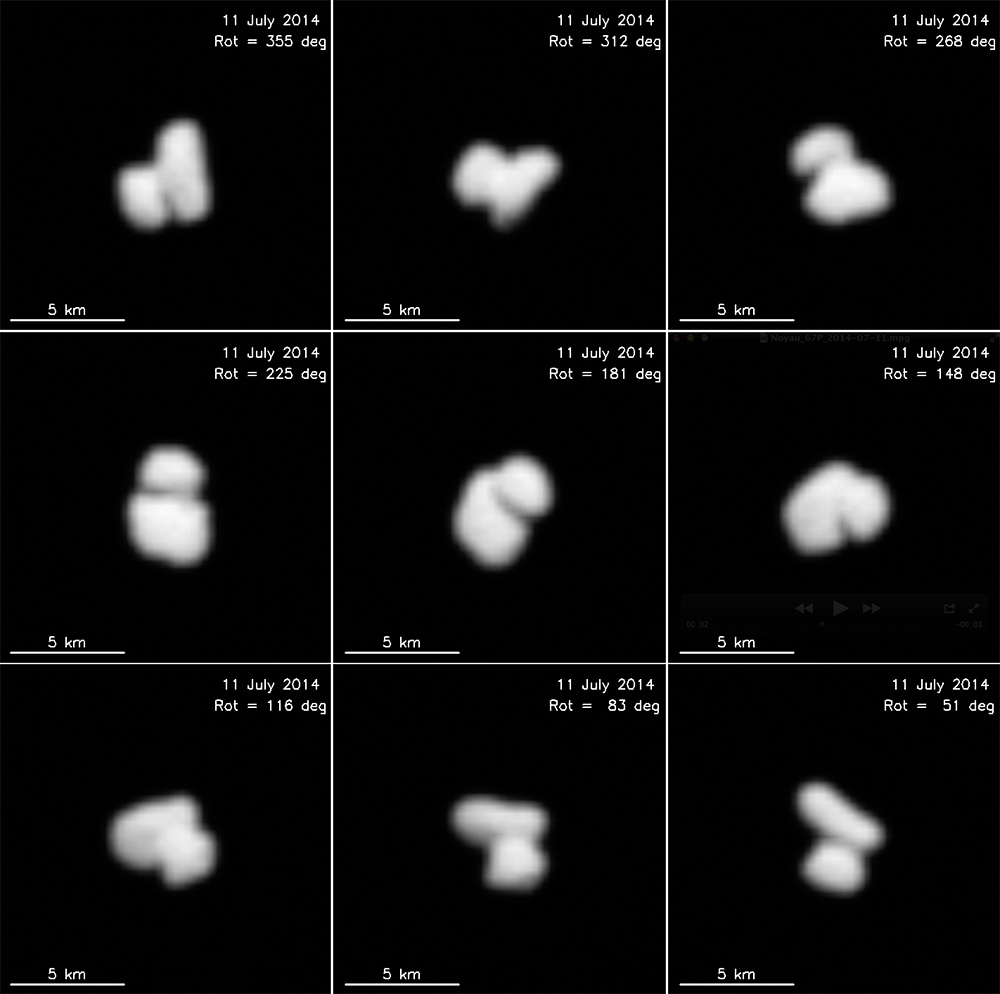
http://www.bbc.com/news/science-environment-27110882
The pictures show that 67P/Churyumov-Gerasimenko appears to be not one but two objects joined together. It is what scientists call a "contact binary".
How the comet came to take this form is unknown.
It is possible that 67P suffered a major fracture at some point in its past; it is also possible the two parts have totally different origins.
What is clear is that the European Space Agency (Esa) mission team now has additional and unexpected considerations as it plans how to land on the comet later this year - not least, which part of the comet should be chosen for contact?
The images in the sequence of nine were acquired last Friday.
They are an interpolation. That is, the "real" pictures are much more pixelated because of the thousands of km that still separate the probe and the comet. The outlines that you see have therefore been "smoothed" to make the scene easy to understand.
Last edited:
Similar threads

- Replies
- 3
- Views
- 925


- Replies
- 0
- Views
- 1K