A proposal to reduce the delta-V to orbit.

RGClark

Mathematician
Joined
Jan 27, 2010
Messages
1,635
Reaction score
1
Points
36
Location
Philadelphia
Website
exoscientist.blogspot.com
To reach orbit you have to have your vehicle have a horizontal, i.e., tangential, orbital velocity, of about 7,800 m/s and have sufficient altitude, say at least 100 km, the altitude considered to be "space". To get to this altitude you have to have a separate velocity in the vertical direction. The usual way to estimate this vertical velocity is by using the relation between kinetic energy and potential energy. It gives the speed of v = sqrt(2gh) to reach an altitude of h meters. At 100,000 m, v is 1,400 m/s. So then it is common to estimate the required delta-V to orbit to be 1400 + 7800 = 9,200 m/s.
However, it seems to me you can reduce this by traveling in a straight-line path. If you travel at an angle to the horizontal so that your vertical velocity component is 1,400 m/s and your horizontal component is 7,800 m/s then you only actually need sqrt(7800^2 + 1400^2) = 7,925 m/s delta-V. Actually if you add on the ca. 460 m/s velocity you get for free from the Earth's rotation you might be able to reduce this to sqrt(7400^2 + 1400^2) = 7,531 m/s. So what I'm trying to investigate is if it is possible for a rocket, without using wings or lifting surfaces, to travel at such a straight-line trajectory at an angle from lift-off so that the achieved velocity will be in this range.
The question is: if you angle the rocket from the start with the thrust vector along the center line with the trajectory angle such that the vertical component of the thrust equals the rocket weight could you have the rocket travel at a straight-line all the way to orbit? I'm inclined to say no because the gravity is operating at the center of gravity of the rocket not at the tail where the thrust is operating. This would certainly work if you had a point particle, but I'm not sure if it would work when your body has some linear extent.
This method for traveling at a straight-line at an angle for some or all of the trip would make my calculations easier. However, I'll show in a following post there is another way to do it even if this first method doesn't work. The second method though would require some modification to the usual design of rockets and is more computationally complicated.

The question I'm asking can be boiled down to this: imagine you have a long cylindrical object, could be a pencil, could be broom stick. You can give it an initial thrust at the bottom and push it away at an angle. It will then follow a curved trajectory with its center of mass following a parabolic arc, disregarding air drag.
Then what I'm asking is will it work to supply a continual push at the bottom with the force maintained at the bottom at a fixed angle to the horizontal so that the vertical component of this force is the cylindrical body's weight? Will the body maintain a continual straight-line trajectory at this set fixed angle?

This is really actually a question in continuum mechanics, sometimes called solid mechanics. In physics we often idealize a body subject to forces as a point particle. Idealized this way, the thrust force applied to the rocket would add as a vector to the force of gravity so it would cancel gravity no matter what the angle of the trajectory.
But in continuum mechanics you have to consider the physical extent of the body and where on the body the forces are applied. I imagine this is a common type of problem addressed in mechanical engineering and civil engineering.
A force applied at one position on the body won't have the same effect as when it is applied to another point for instance in regards to the torque produced. Torque is measuring the turning "force" on the body. But it's defined as the cross product of the force vector times the radial vector to the center of rotation.
Intuitively, what we have to worry about is rotation of the rocket with the thrust applied only at the tail. But if the rocket were to rotate it would be about the center of gravity. However, if we make it so the thrust is always along the center line, the radial vector to
the cg and the force vector are parallel, resulting in a 0 torque vector. That would mean there would be no rotation around the center of gravity so we should be able to maintain our straight-line trajectory.
This would be valid if the center of gravity were fixed. But the cg is accelerating as the thrust is applied. So I'm not sure if this argument applies in that case.


Bob Clark
 
The straight line approach wouldn't really work here on Earth, because the atmospheric drag losses would be major. It's cheaper to waste a little bit of delta-v on the radial segment of the flight to clear the lower atmosphere, then run a pitch program and start working on the tangential. This is just like your broomstick example (I believe) - we give it a little initial push, then start pitching and thanks to the inertia of the cg the thrust vector goes always through the cg, without generating torque.

On an airless body however, that's a different story. I'm routinely taking off in this way, actually - liftoff into a hover just a couple dozen meters AGL, and then blast mains and let the curvature of the Moon take care of the altitude. During this I'm progressively throttling the hover engines down, so that the prograde vector points above the horizon and never below it. This is analogous to having a single engine and vectoring it (along with the vehicle itself to maintain cg in line with the thrust).
 
You mean a "gravity-turn"? That is a standard maneuver during launch vehicle ascent, especially during the early boost phase, when closed-loop guidance is not practical.

[ame="http://en.wikipedia.org/wiki/Gravity_turn"]Gravity turn - Wikipedia, the free encyclopedia[/ame]

Please note that in terms of impulse, a gravity turn is a minimum energy maneuver - anything that is NO gravity turn, either curving faster or slower, produces control losses in the launch equation.
 
in the DG to Moon tutorial, Martin did fly the DG in a similar path... he flew 30 degrees at first, to clear the thick of the atmosphere, then pitched down to reach orbital velocity at about 60km...

then he let the glider coast it's way to outside the atmosphere on its own inertia, gliding "upwards", if you will... then finished it off with a circularization burn...

the DG had more than half of it's magically powerful fuel left when it reached stable orbit...


i do understand, however... the DG is a physicist's craft, not quite an engineering-realistic vessel...

but assuming you could build a vessel somewhat similar, capable of hypersonic flight, then with the wings countering the effect of gravity, you could -theoretically- reduce the dV required for orbital insertion this way :hmm:
 
The straight line approach wouldn't really work here on Earth, because the atmospheric drag losses would be major. It's cheaper to waste a little bit of delta-v on the radial segment of the flight to clear the lower atmosphere, then run a pitch program and start working on the tangential. This is just like your broomstick example (I believe) - we give it a little initial push, then start pitching and thanks to the inertia of the cg the thrust vector goes always through the cg, without generating torque.
On an airless body however, that's a different story. I'm routinely taking off in this way, actually - liftoff into a hover just a couple dozen meters AGL, and then blast mains and let the curvature of the Moon take care of the altitude. During this I'm progressively throttling the hover engines down, so that the prograde vector points above the horizon and never below it. This is analogous to having a single engine and vectoring it (along with the vehicle itself to maintain cg in line with the thrust).

Thanks for the response. Your description of your lunar launch method is that "second method" I mentioned in my post. It's pretty clear this method would work when you have a second engine or multiple engines for balance around the cg to cancel gravity.
However, it is not quite the same as the method I'm asking about because it would not have a second engine located at the cg or multiple engines whose combined effect operates at the cg.
If the single engine approach would work then this would clearly be an easier way of accomplishing this.

Note though the saving in the delta-V in traveling straight-line is not just "a little bit":
Delta-v budget.

Launch/landing.

"The delta-v requirements for sub-orbital spaceflight can be surprisingly low. For the Ansari X Prize altitude of 100 km, Space Ship One required a delta-v of roughly 1.4 km/s. To reach low earth orbit of the space station of 300 km, the delta-v is over six times higher about 9.4 km/s. Because of the exponential nature of the rocket equation the orbital rocket needs to be considerably bigger.

  • Launch to LEO — this not only requires an increase of velocity from 0 to 7.8 km/s, but also typically 1.5–2 km/s for atmospheric drag and gravity drag"
http://en.wikipedia.org/wiki/Delta-v_budget#Launch.2Flanding

So by traveling straight-line you might be knock off close to 2,000 m/s from the delta-V to orbit, once you include the Earth's rotational boost.
The air drag would be increased but I don't think it would be as high 2,000 m/s.


Bob Clark
 
Last edited:
So by traveling straight-line you might be knock off close to 2,000 m/s from the delta-V to orbit, once you include the Earth's rotational boost.

Wrong - you ADD 2,000 m/s. You are countering the ballistic arc. Not using the way of the lowest resistance.

The air drag would be increased but I don't think it would be as high 2,000 m/s.

Air resistance is usually 150 m/s, but that assumes leaving the atmosphere as soon as possible. If you fly straight and have high acceleration, it CAN exceed 2,000 m/s.
 
in the DG to Moon tutorial, Martin did fly the DG in a similar path... he flew 30 degrees at first, to clear the thick of the atmosphere, then pitched down to reach orbital velocity at about 60km...
then he let the glider coast it's way to outside the atmosphere on its own inertia, gliding "upwards", if you will... then finished it off with a circularization burn...
the DG had more than half of it's magically powerful fuel left when it reached stable orbit...
i do understand, however... the DG is a physicist's craft, not quite an engineering-realistic vessel...
but assuming you could build a vessel somewhat similar, capable of hypersonic flight, then with the wings countering the effect of gravity, you could -theoretically- reduce the dV required for orbital insertion this way :hmm:

Actually, this is more than just a physicists craft. It is known that by using aerodynamic lift you can reduce the fuel requirements to orbit.
For instance it was explored for use on a reusable orbitalcraft in the 80's:

Fire in the sky: the Air Launched Sortie Vehicle of the early 1980s (part 1)
by Dwayne Day
Monday, February 22, 2010
http://www.thespacereview.com/article/1569/1


Also the X-33/VentureStar was intended to use a lifting trajectory to orbit:

A Multidisciplinary Performance Analysis of a Lifting-Body Single-Stage-to-Orbit Vehicle(2000).
"Abstract
".
..Significant improvements in ascent performance were achieved when the vehicle flew a lifting trajectory and varied the engine mixture ratio during flight."
http://citeseerx.ist.psu.edu/viewdoc/summary?doi=10.1.1.32.1381

However, I'm trying to see if this could work if you didn't use wings, just angled the thrust from the start, making sure this was at the same angle as the centerline of the vehicle and the velocity vector.

Bob Clark


---------- Post added at 01:50 PM ---------- Previous post was at 01:32 PM ----------

Wrong - you ADD 2,000 m/s. You are countering the ballistic arc. Not using the way of the lowest resistance.
Air resistance is usually 150 m/s, but that assumes leaving the atmosphere as soon as possible. If you fly straight and have high acceleration, it CAN exceed 2,000 m/s.


Obviously, you don't stay in the lower atmosphere during the entire trip, since you wouldn't get to 100 km and above altitude that way. For usual rockets the pitch over might be at say 50 to 60 km altitude, then thereafter you are applying mostly horizontal thrust to achieve the required tangential orbital velocity.
For traveling at an angle, how much further are you traveling along that straight-line while below say 50 km? Perhaps 4 times, 5 times longer distance, say 200 to 250 km? I don't think the air drag would increase by close to 2,000 m/s over that distance.


Bob Clark
 
Last edited:

I don't think the air drag would increase by close to 2,000 m/s over that distance.

Don't think - measure.

You can actually easily use Orbiter for testing your hypothesis. Just make a MFD to integrate acceleration by thrust and acceleration by drag.
 
Wrong - you ADD 2,000 m/s. You are countering the ballistic arc. Not using the way of the lowest resistance.

Not necessarily - the lowest energy ascent is essentially a hohmann from a point on the ground to a point in the orbit, so the lowest energy launch starts with horizontal thrust. All launches are a derivation of this, where the horizontal component is "postponed" a bit, due to obvious issues with our atmosphere. We really can't fly a rocket through it, so we need to clear it asap.

The only case when you do want to stay in the atmosphere is when you have a bunch of lifting surfaces to exploit it. Otherwise gtfo straight up.

So I'm guessing that if you begin with a "straight line" launch and add tweaks and corrections to avoid unnecessary amounts of lower atmosphere you end up with exactly the launch profiles that contemporary lift vehicles use.
 
Not necessarily - the lowest energy ascent is essentially a hohmann from a point on the ground to a point in the orbit, so the lowest energy launch starts with horizontal thrust. All launches are a derivation of this, where the horizontal component is "postponed" a bit, due to obvious issues with our atmosphere. We really can't fly a rocket through it, so we need to clear it asap.

No, the lowest energy ascent wouldn't exactly be a Hohmann, since you don't do point burns, but a spiral (Think of it as the sum of many smaller hohmann burns). At one point you would always end with a small positive flightpath angle. The steepness of this spiral depends on your burn time and acceleration.

You can fly a much more shallow trajectory, the drag is less a problem than Max-Q, but you would never be able to fly for minimum energy in a straight line (in horizon coordinates, a constant FPA trajectory would be a spiral in global coordinates again, in global coordinates, a straight line would be with increasing FPA).
 
You're right. Point burns. Those get me all the time. :embarrassed:
 
You're right. Point burns. Those get me all the time. :embarrassed:

Yeah, it gets really complicated if you find out that gravity losses also happen during orbital burns. :lol:
 
I haven't used Orbiter yet. What's a good source to use as a tutorial?

Bob Clark
Here you'll find lots of tutorials. The go play in space is excellent for beginners and explains everything in terms comprehensible even by someone with no experience whatsoever in flight sims or physics without appearing boring if you already have some background knowledge. It is a bit dated but everything in it also applies to orbiter 2010.

A word of caution: Orbiter isn't only accurate from a physical point of view, but also tremendously fun and addictive.
 
The reason they travel vertically first has nothing to do with whether or not it is the 'most direct path to orbit' it is because the spacecraft has a greater overall efficiency outside of the incredibly draggy atmosphere. If you use some of the automatic rocketry add-ons you will see that their circularizing algorithms may be similar to what you describe, except they only start the process once they have cleared 100km or so. especially the soyuz family i noticed they do alot of vector management to keep forward and tangential velocity increasing at balanced rates, and then cutting when it is circular. Going at an angle through the atmosphere would ONLY be helpful with some kind of lift surfaces
 
Not necessarily - the lowest energy ascent is essentially a hohmann from a point on the ground to a point in the orbit, so the lowest energy launch starts with horizontal thrust. All launches are a derivation of this, where the horizontal component is "postponed" a bit, due to obvious issues with our atmosphere. We really can't fly a rocket through it, so we need to clear it asap.
The only case when you do want to stay in the atmosphere is when you have a bunch of lifting surfaces to exploit it. Otherwise gtfo straight up.
So I'm guessing that if you begin with a "straight line" launch and add tweaks and corrections to avoid unnecessary amounts of lower atmosphere you end up with exactly the launch profiles that contemporary lift vehicles use.

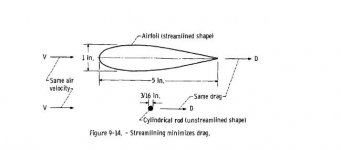
Can we do better than the usual cylindrical rocket with a conical nose cone to reduce drag? Take a look at the attached image of drag of an airfoil compared to a cylindrical rod(represented in cross-section by a disk) taken from p. 18 of this report:

EXPLORING IN AEROSPACE ROCKETRY
9. ROCKET TRAJECTORIES, DRAG, AND STABILITY.
by Roger W. Luidens
Lewis Research Center, Cleveland, Ohio
http://ntrs.nasa.gov/archive/nasa/casi.ntrs.nasa.gov/19680008648_1968008648.pdf

Now this is for the cylinder's axial direction being crosswise to the airflow. You see a remarkably larger cross-section for the airfoil would have the same drag as for the cylinder. Or said another way a much larger volume contained in the airfoil shape would have the same drag of a much smaller cylindrical shape.
Now instead of the airfoil being the cross-section of a horizontal wing, suppose we rotated the airfoil around its central axis to get a 3-dim'l streamlined shape, that is, a teardrop shape. And we also did the same for the disk cross-section of the cylinder to get a sphere. Would the much larger volume teardrop shape again have the same drag of the much smaller sphere?
If so, then we would expect a long cylindrical rocket of the same diameter as the sphere to have more drag than the sphere so would have more drag than the teardrop shape, while containing less volume.
No doubt Orbiter has the capability to calculate these effects? How do you set it up?


Bob Clark
 

Attachments

  • streamlining and drag.JPG
    streamlining and drag.JPG
    16.2 KB · Views: 32
it's my understanding that a shape like an teardrop is mainly only effective when it is complete. altering the tear drop shape creates just as much drag as other shapes, of course, not all shapes.

Not taking into account that rockets are supersonic vehicles, and fluid dynamics change, so the drag is different than at lower air velocity.

Not taking into account what will happen when the rocket is staging? Then it will be drastically changing it's shape periodically. that bulbous shape will look like a hemisphere if you keep chopping it in half! lol
 
Also, for rockets, you need to take the exhaust in account for the aerodynamics: A few tons ejected every second are significant.
 
Rocket engines are more efficient in near vacuum/vacuum so it is desirable to clear the densest part of atmosphere as fast as possible even if it adds some extra gravity drag. Also going hypersonic while still in the dense part of atmosphere would add thermal loads which would need to be dealt with by adding extra insulation which means more mass.
 
Back
Top