

- Joined
- Oct 30, 2009
- Messages
- 14,019
- Reaction score
- 4
- Points
- 0
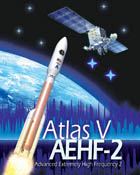
The United Launch Alliance Atlas 5 rocket (AV-031) will launch the second Advanced Extremely High Frequency (AEHF) satellite. Built by Lockheed Martin, this U.S. military spacecraft will provide highly-secure communications. The rocket will fly in the 531 vehicle configuration with a five-meter fairing, three solid rocket boosters and a single-engine Centaur upper stage.
 |
|
{colsp=2}
|

Scrubbed on May 3 due to purge problem for the Centaur interstage adapter.
There is calendar event created for this launch, for which you can request a reminder.
Viewing the Launch Live:
Payload:
Launch Vehicle:
 |
|
Launch Preparations:
Countdown Timeline:
Launch Timeline & Ground Track:
Links:
|
Launch date:
|
May 4, 2012
Window open:
|
18:42 UTC / 2:42 p.m. EDT
Window close:
|
20:42 UTC / 4:42 p.m. EDT
Launch site:
|
SLC-41, CCAFS, Florida
{colsp=2}
[highlight]L[eventtimer]2012-5-4 18:42;%c%%ddd%/%hh%:%mm%:%ss%[/eventtimer][/highlight]
Scrubbed on May 3 due to purge problem for the Centaur interstage adapter.
There is calendar event created for this launch, for which you can request a reminder.
[table="head"]{colsp=2}
 |
| [/table]
Mission Insignia (clickable)
 |
| [/table]
Viewing the Launch Live:
A live simulcast of the launch broadcast will begin 20 minutes before opening of the launch window, at 18:22 UTC / 2:22 p.m. EDT:
Alternate video streams:
- Flash Player - Standard quality
- Flash Enabled Mobile Devices - Low quality
- SES 2, C-band, Transponder 21, 87° West
The live coverage [eventtimer]2012-5-4 18:22?will begin in|has begun;%c% %h% hours, %m%[/eventtimer]minutes[eventtimer]2012-5-4 18:22?.| ago.;%c%[/eventtimer]
Alternate video streams:
Payload:
The AEHF (Advanced Extreme High Frequency Satellite), a.k.a. AWS (Advanced Wideband Satellite), program is the next generation of highly secure, high capacity, survivable communications to the U.S. warfighters during all levels of conflict, and will become the protected backbone of the Department of Defense's military satellite communications architecture. The AEHF system will be integrated into the legacy Milstar (Military Strategic & Tactical Relay) constellation, and will be backward compatible with Milstar's low data rate (LDR) and medium data rate (MDR) capabilities, while providing extreme data rates (XDR) and larger capacity at substantially less cost than the Milstar system. Each satellite will be launched on an Evolved Expendable Launch Vehicle (EELV), with the first launch planned for April 2008. They cost approximately $580 million per satellite
On-board signal processing will provide protection and ensure optimum resource utilization and system flexibility among the Armed Forces and other users who operate terminals on land, sea and air. The AEHF system will be integrated into the legacy Milstar constellation, and will be backward compatible with Milstar's low data rate (LDR) and medium data rate (MDR) capabilities, while providing extreme data rates (XDR) and larger capacity at substantially less cost than the Milstar system.
AEHF satellites feature following antennas:
Up to six satellites were planned, but in late 2004 it was decided, to end the AEHF program after the third satellite in favour of introducing the next generation T-Sat earlier. Problems with the T-Sat program might lead to procurement of two more AEHFs instead.

On-board signal processing will provide protection and ensure optimum resource utilization and system flexibility among the Armed Forces and other users who operate terminals on land, sea and air. The AEHF system will be integrated into the legacy Milstar constellation, and will be backward compatible with Milstar's low data rate (LDR) and medium data rate (MDR) capabilities, while providing extreme data rates (XDR) and larger capacity at substantially less cost than the Milstar system.
AEHF satellites feature following antennas:
- 2 SHF Downlink Phased Arrays,
- 2 Crosslinks,
- 2 Uplink/Downlink Nulling Antennas,
- 1 Uplink EHF Phased Array,
- 6 Uplink/Downlink gimbaled Dish Antenna,
- 1 Each Uplink/downlink earth coverage horns
Up to six satellites were planned, but in late 2004 it was decided, to end the AEHF program after the third satellite in favour of introducing the next generation T-Sat earlier. Problems with the T-Sat program might lead to procurement of two more AEHFs instead.
Type / Application:
|
- Comsat
Operator:
|
- USAF
Contractors:
|
- Lockheed Martin (Bus),
- Northrop Grumman (ex TRW) (Payload)
Configuration:
|
- A2100M
Propulsion:
|
- IHI BT-4,
- HCT
Power:
|
- 2 deployable 5 segment solar arrays,
- batteries
Lifetime:
|
- 14 years
Mass:
|
- 6168 kg
Orbit:
|
- GEO
Launch Vehicle:
The Atlas 5 was developed by Lockheed Martin Commercial Launch Services as part of the US Air Force Evolved Expendable Launch Vehicle (EELV) program. Each Atlas 5 rocket uses a Russian-built RD-180 engine burning kerosene and liquid oxygen to power its first stage and an American-built RL10 engine burning liquid hydrogen and liquid oxygen to power its Centaur upper stage.
The rocket will fly in the 531 vehicle configuration with a five-meter fairing, three solid rocket boosters and a single-engine Centaur upper stage.
Rocket stages / engines:[table="head;width=500"]Strap-On|Stage 1|Stage 2
3 × SRB|CCB / RD-180|Centaur-5-SEC / RL-10A4-2
3 × SRB|CCB / RD-180|Centaur-5-SEC / RL-10A4-2
Performance:[table="head;width=500"]LEO|LPEO|SSO|GTO|GEO|MolO|IP
15300 kg|12185 kg|11160 kg|7425 kg|3250 kg||[/table]
[/table]15300 kg|12185 kg|11160 kg|7425 kg|3250 kg||[/table]
Launch Preparations:
Encapsulation:
Mating:
Rollout:
On the pad:
[table="head"]{colsp=4}
 |
| |
| |
| [/table]
Click on images to enlarge
 |
| |
| |
| [/table]
Mating:
[table="head"]{colsp=3}
 |
| |
| [/table]
Click on images to enlarge
 |
| |
| [/table]
Rollout:
[table="head"]{colsp=4}
 |
| |
| |
|
 |
| |
| |
| [/table]
Click on images to enlarge
 |
| |
| |
|
 |
| |
| |
| [/table]
On the pad:
[table="head"]{colsp=3}
 |
| |
| [/table]
Click on images to enlarge
 |
| |
| [/table]
Countdown Timeline:
[table="head;width=500"]
T [HH:MM]
|UTC
|EDT
|Event-6:20
|11:42
|7:42 a.m.
|Countdown begins with rocket power up-5:30
|12:32
|8:32 a.m.
|Weather briefing-4:55
|13:07
|9:07 a.m.
|Start clearing assembly building area-4:20
|13:42
|9:42 a.m.
|C-band tracking beacon testing-3:40
|14:22
|10:22 a.m.
|S-band telemetry link checks-2:55
|15:07
|11:07 a.m.
|Establish blast danger area roadblocks-2:20
|15:42
|11:42 a.m.
|Weather briefing-2:15
|15:47
|11:47 a.m.
|Clear the pad-2:00
|16:02
|12:02 p.m.
|T-120 minutes and holding (for 30min)-2:00
|16:27
|12:27 p.m.
|Launch conductor briefing to team-2:00
|16:29
|12:29 p.m.
|Readiness poll for fueling-2:00
|16:32
|12:32 p.m.
|Resume countdown-1:50
|16:42
|12:42 p.m.
|Centaur LOX transfer line chilldown-1:43
|16:49
|12:49 p.m.
|Begin Centaur liquid oxygen loading-1:30
|17:02
|1:02 p.m.
|Begin Atlas first stage LOX loading-1:25
|17:07
|1:07 p.m.
|Centaur LH2 transfer line chilldown-1:10
|17:22
|1:22 p.m.
|Centaur RL10 engine chilldown-1:02
|17:30
|1:30 p.m.
|Begin Centaur liquid hydrogen loading-0:40
|17:52
|1:52 p.m.
|FLight termination system final test-0:16
|18:16
|2:16 p.m.
|RD-180 engine fuel fill sequence-0:10
|18:22
|2:22 p.m.
|Weather briefing-0:04
|18:28
|2:28 p.m.
|T-4 minutes and holding (for 10min)-0:04
|18:35
|2:35 p.m.
|Readiness poll for launch-0:04
|18:38
|2:38 p.m.
|Resume countdown-0:00
|18:46
|2:42 p.m.
|LAUNCH[/table]Launch Timeline & Ground Track:
[table="head;width=500"]
{colsp=2}
{colsp=2}
{colsp=2}
{colsp=2}
{colsp=2}
{colsp=2}
{colsp=2}
{colsp=2}
{colsp=2}
{colsp=2}
{colsp=2}
{colsp=2}
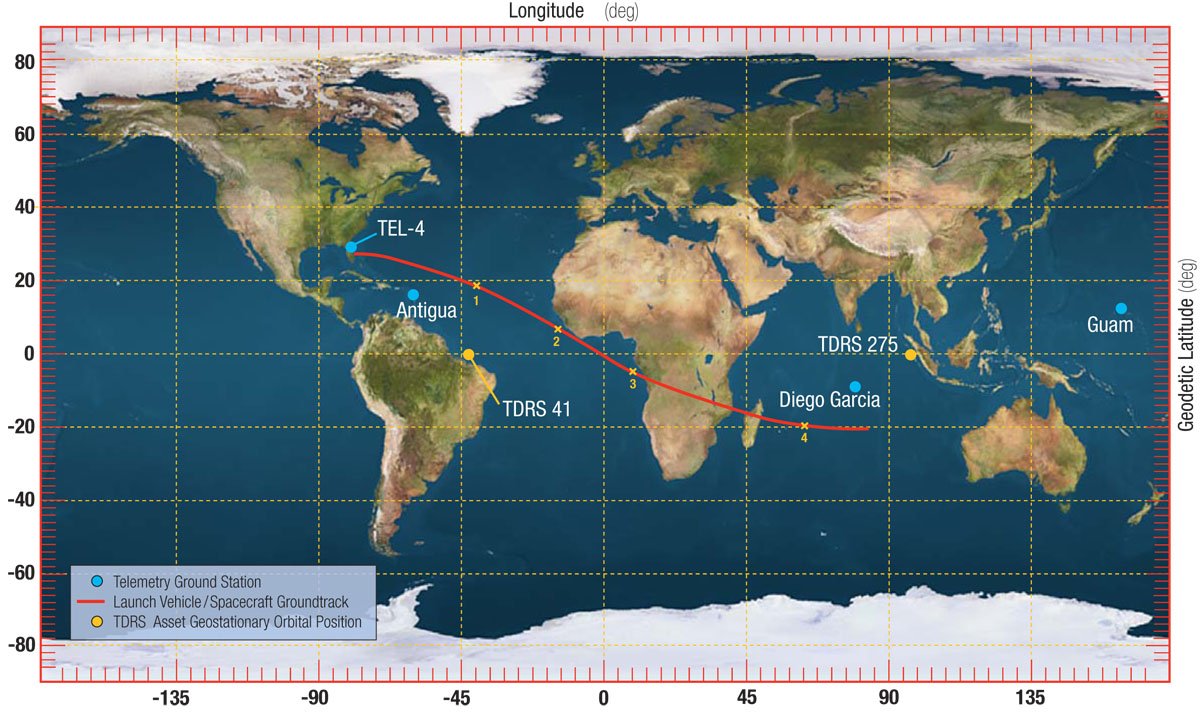
T [MM:SS]
| Event
-00:02.7
| Engine Start{colsp=2}
The Russian-designed RD-180 main engine is ignited and undergoes checkout prior to launch.
+00:01.1
| Liftoff{colsp=2}
The three strap-on solid rocket boosters are lit as the Atlas 5 vehicle, designated AV-031, lifts off and begins a vertical rise away from Complex 41 at Cape Canaveral Air Force Station, Florida.
+01:56.0
| Jettison SRBs{colsp=2}
Having burned out of propellant approximately 25 seconds earlier, the spent solid rocket boosters are jettisoned to fall into the Atlantic Ocean.
+03:34.0
| Nose Cone Jettison{colsp=2}
The payload fairing that protected the AEHF 2 spacecraft during launch is separated once heating levels drop to predetermined limits.
+03:39.0
| Forward Load Reactor Jettison{colsp=2}
The Forward Load Reactor deck that supported the payload fairing's structure to Centaur upper stage is released seconds after the shroud's jettison.
+04:18.0
| Main Engine Cutoff{colsp=2}
The RD-180 main engine completes its firing after consuming its kerosene and liquid oxygen fuel supply in the Atlas first stage.
+04:24.0
| Stage Separation{colsp=2}
The Common Core Booster first stage of the Atlas 5 rocket separates from the Centaur upper stage. Over the next few seconds, the Centaur engine liquid hydrogen and liquid oxygen systems are readied for ignition.
+04:34.0
| Centaur Ignition 1{colsp=2}
The Centaur RL10 engine ignites for the longer of the two upper stage firings. This burn will inject the Centaur stage and AEHF 2 spacecraft into a parking orbit.
+13:57.0
| Centaur Cutoff 1{colsp=2}
The Centaur engine shuts down after arriving in a planned parking orbit. The vehicle enters a brief coast period lasting nearly 8 minutes before arriving at the required location in space for the second burn.
+22:06.0
| Centaur Ignition 2{colsp=2}
The Centaur re-ignites over the equatorial Atlantic to accelerate the payload into geosynchronous transfer orbit from the parking achieved earlier in the launch sequence.
+27:48.0
| Centaur Cutoff 2{colsp=2}
At the conclusion of its second firing, the Centaur will have delivered the AEHF 2 spacecraft into the targeted orbit with an apogee of 31,070 statute miles, perigee of 140 statute miles and inclination of 21 degrees.
+51:11.0
| Spacecraft Separation{colsp=2}
The U.S. military's second Advanced Extremely High Frequency communications satellite is released into orbit from the Centaur upper stage to complete the AV-031 launch.
[/table]
Links:
- Spaceflight Now:
- Mission Status Center
- Atlas/AEHF launch timeline
- Atlas launch ground track
- Advanced Extremely High Frequency (AEHF) System
- [highlight]▤[/highlight] Lockheed brochure (PDF)
- News releases:
- Photo galleries:
- AEHF 2 encapsulated for launch (PHOTO GALLERY
- AEHF 2 hoisted atop its Atlas launcher (PHOTO GALLERY
- Atlas 5 rocket rolled out to launch pad (PHOTO GALLERY #1
- Atlas 5 rocket rolled out to launch pad (PHOTO GALLERY #2
- Atlas 5 rocket poised for military satellite launch (PHOTO GALLERY
- Atlas 5 rocket on the launch pad (PHOTO GALLERY
- Atlas 5 rocket at night (PHOTO GALLERY
- United Launch Alliance:
- AEHF-2 Atlas V 531 mission page
- Multimedia Webcast page
- [highlight]▤[/highlight] Atlas V AEHF-2 Mission Booklet (PDF)
- Patrick Air Force Base:
- [highlight]▤[/highlight] Launch Hazard Area (PDF)
- [highlight]▤[/highlight] Restricted Airspace Map (PDF)
- Los Angeles Air Force Base:
- Lockheed Martin:
- Advanced Extremely High Frequency (AEHF)
- 2012-02-27: Lockheed Martin Delivers Second AEHF Satellite To U.S. Air Force For Upcoming Launch
- Florida Today (you may need to disable scripts on these pages to view contents):
- 2012-04-24: Military satellite launch planned from Cape on May 3
- 2012-04-25: Back-to-back launches set for early May
- 2012-04-30: United Launch Alliance gearing up for Atlas launch Thursday
- 2012-05-02: Atlas rolls out to pad for Thursday launch
- 2012-05-03: Rocket routine never gets old for this 2nd-generation space worker
- 2012-05-03: Countdown to Atlas V launch from Cape Canaveral under way
- 2012-05-03: LIVE COVERAGE: Atlas V rocket launch
- Airforce Technology:
- 2012-02-29: US Air Force receives second AEHF-2 satellite
- SPACE.com:
- Gunter's Space Page:
- Wikipedia:
- [ame="http://en.wikipedia.org/wiki/Atlas_V"]Atlas V - Wikipedia, the free encyclopedia[/ame]
- [ame="http://en.wikipedia.org/wiki/Advanced_Extremely_High_Frequency"]Advanced Extremely High Frequency - Wikipedia, the free encyclopedia[/ame]


