Science Amphibicopter Concept (Warning: A.I. Spoilers)

How do those tiny little ducts manage to syphon enough air to produce meaningful thrust?
 
The thing is, in movies, you can get the effects to do stuff that isn't possible in reality. This can be a very good thing in a film, obviously (when you're purposefully trying to create something fantastical), and a bad thing in reality (because, well, following the design of the Millenium Falcon is about as likely to get you into space as a Falcon 9 pointed 180 degrees from the sky). It can also be a very bad thing in films- when you're trying to create something believable, but it just doesn't 'look' right and ruins the suspension of disbelief of the audience.

Since the amphibicopter is created via special effects, it's hardly a guide for engineering something in real life (though kudos to those who base their effects on real-life engineering).

Steering away from movie concepts for a bit though; what if a 'rotorcraft', instead of a true rotor(s) driven mechanically by engine(s), had a surface (like a set of slats or louvers) covered in a multitude of small electrically driven fans? Not on the nano or even microscale; they could be quite big. You could avoid safety problems with those large spinning rotors and you'd have plenty of redundancy, with the trade-off of having to produce and maintain all those individual propulsive elements...
 
Thats' the thing: Stanley Kubrick was all about realism and not rediculous sci-fi. A.I. attempted to portray realistic and reasonable concepts. I wouldn't have a difficult time believing an AI could fit into a small cube (as in the opening scene) after a hundred or more years of technological developments. It's a movie that tries to be realistic- Speilburg certainly accomplished this as Kubrick would have wanted.

The amphibicopter is no millennium falcon, and I really think that after some modifications to the design, a VTOL like this would be possible. Like I said, a more balanced body would certainly help. These effects are based on real life engineering. The design isn't perfect, but it's on the right track.

Except it is.

Those modifications would have to include the massive whirling blades that you are so opposed to. The closest you're going to get is something akin to the Moller Skycar, but you still need to pump enough air through those ducts to over come the mass of your vehicle.

ETA: The smaller the duct, the higher velocity and pressure required to achieve the same amount of thrust. Supersonic bursts of high pressure air are just as much (if not more) of a safety hazzard than the afore-mentioned whirling blades.

T.Neo's slat Idea is real a possibility but the mass/complexity issues for something big enough to be manned are a little beyond the ability of current tech. Maybe in 20 years...
 
Last edited:
I think if you're wanting believable vehicles with whirling blades, check out the helicopters from The 6th Day.
 
I really like the thopters from Avatar
 
I really like the thopters from Avatar

This?
http://www.aliexpress.com/product-fm/383445025-Avatar-Scorpion-fighter-attack-aircraft-alloy-model-aircraft-sound-and-light-aircraft-Avatar-Back-wholesalers.html
 
Also, T.Neo, I'm exactly sure what your proposing. Could you be a little more specific about the engines?

Essentially, small, individually powered electric fans placed in large arrays replace the large rotor(s) of a conventional rotorcraft. The fans would derive their power from some sort of battery- obviously you would need a battery with quite a high energy density for this to be practical.

Here is a very simplistic and very poorly done rendition of what I would imagine such a vehicle could look like;
attachment.php
 
Last edited:
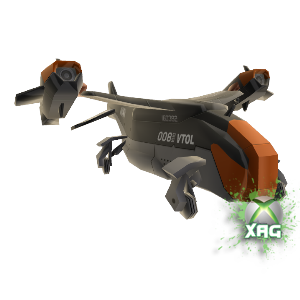
What about something like the VTOL in Deus Ex: Human Revolution (Which they called a helicopter to my great nerdrage.) No blades, just fiery geysers of thrust.

wwwxboxavatargearcom-dxhr-vtol-avatar-prop.png
 
Interesting, but the other challenge is the engines that power those fans- I'm not you could produce enough lift.

Each fan is its own engine, with with power supplied electrically, rather than mechanically, from a power source(s) in the fuseladge (I assumed some sort of 'sufficiently advanced' fuel cell or battery with the necessary energy density for practical operations).

The ability to make miniature fans and a power system that have the necessary efficiency and power-to-weight ratio would be a preassumption for such a machine's existence...
 
considering several police departments in the US are considering UAVs for urban survellience, things might be getting more Orwellian than you thought..
 
Back
Top