An SSTO as "God and Robert Heinlein intended".

Urwumpe's expression of the ascent equation in post 111 lacks a term. In addition to the gravity loss term, drag loss term, and steering loss term, there should be a fourth term for back pressure losses.

Most trajectory codes, and in particular the industry-standard POST and OTIS codes, add this fourth term because it accounts for the difference between vacuum thrust and thrust at any given altitude as a delta-V loss rather than a specific impulse loss. When calculations are performed in this fashion, "Trajectory averaged Isp" isn't a helpful number. The difference between thrust at a given altitude and vacuum thrust is accounted for on the delta-V part of the budget rather than the Isp. It's a bookkeeping expedient - keeping all the deviations from ideal on one side of the equation.

RGClark's understanding of Mitchell Burnside Clapp's argument in post 136 is incomplete. Using the vacuum Isp is industry practice, as explained above, but all that the linked post really claims is that a variety of stages have in excess of 30,000 ft/s of delta-V, that 30,000 ft/s is "SSTO-class" delta-V, and that many of them use dense propellants. Indeed, the ones using dense propellants are generally smaller than the ones using hydrogen, and while the mass ratios of such stages need to be higher for lower Isp propellants, the increase in propellant density that typically accompanies lower Isp makes that easier to achieve.

Burnside Clapp does NOT argue that one should "Just use 30,000 ft/s." That's the whole point of argument linked in post 106 of this thread. Lower Isp propellants need somewhat less delta-V to orbit because of the reduction in gravity losses. It's about a 1000 ft/sec advantage. It's nothing to do with density (except for perhaps a modest benefit in reduced drag losses), but just a "accelerates faster earlier in the trajectory" effect, which causes the reduction in gravity loss. But lower Isp fuels are generally also denser ones, so you can see how the two concepts get linked together.

The conclusion of this line of reasoning is that while a hydrogen-based SSTO might be possible, a clear understanding of the engineering challenges of working with hydrogen and developing a vehicle that uses it might lead a designer to conclude that a dense-propellant, lower-Isp-based SSTO might be an easier engineering challenge, and have other operational advantages.

Whether an SSTO is itself a good idea is an entirely separate matter. TSTO's have advantages in gross weight and payload fraction, but the upper stage has to support stage 1 burnout g fully loaded, and the lower stage has to support all that weight at burnout g as well. These conditions impose non-trivial structural penalties. A dispositive answer is design, market, and technology dependent, and while not yet definitive, the evidence at the moment seems to favor a TSTO approach.
 
Urwumpe's expression of the ascent equation in post 111 lacks a term. In addition to the gravity loss term, drag loss term, and steering loss term, there should be a fourth term for back pressure losses.

Not needed if you have the total impulse already including the back pressure losses, but you are right on the back pressure losses being easier to handle if they are included as extra term and thus explicitly trajectory dependent (not just bookkeeping). But then, this ascent equation wasn't meant to include all extra terms and options, but is rather the text book version for simplicity.

You would also have boat tail effects in all rockets, that are usually part of the aerodynamics, but can also be described as separate term to account for the engine thrust dependency.


RGClark's understanding of Mitchell Burnside Clapp's argument in post 136 is incomplete. Using the vacuum Isp is industry practice, as explained above, but all that the linked post really claims is that a variety of stages have in excess of 30,000 ft/s of delta-V, that 30,000 ft/s is "SSTO-class" delta-V, and that many of them use dense propellants. Indeed, the ones using dense propellants are generally smaller than the ones using hydrogen, and while the mass ratios of such stages need to be higher for lower Isp propellants, the increase in propellant density that typically accompanies lower Isp makes that easier to achieve.

Burnside Clapp does NOT argue that one should "Just use 30,000 ft/s." That's the whole point of argument linked in post 106 of this thread. Lower Isp propellants need somewhat less delta-V to orbit because of the reduction in gravity losses. It's about a 1000 ft/sec advantage. It's nothing to do with density (except for perhaps a modest benefit in reduced drag losses), but just a "accelerates faster earlier in the trajectory" effect, which causes the reduction in gravity loss. But lower Isp fuels are generally also denser ones, so you can see how the two concepts get linked together.

Or in more focused axioms: It is a matter of acceleration and the trajectory that you can thus follow. ;)

The conclusion of this line of reasoning is that while a hydrogen-based SSTO might be possible, a clear understanding of the engineering challenges of working with hydrogen and developing a vehicle that uses it might lead a designer to conclude that a dense-propellant, lower-Isp-based SSTO might be an easier engineering challenge, and have other operational advantages.

Whether an SSTO is itself a good idea is an entirely separate matter. TSTO's have advantages in gross weight and payload fraction, but the upper stage has to support stage 1 burnout g fully loaded, and the lower stage has to support all that weight at burnout g as well. These conditions impose non-trivial structural penalties. A dispositive answer is design, market, and technology dependent, and while not yet definitive, the evidence at the moment seems to favor a TSTO approach.

Also, a current TSTO bias in technology doesn't mean SSTOs are for all eternity bad. But today, and in the years we can foresee to come, a SSTO will be a pretty risky technology, even if it is already slightly possible as Skylon demonstrates (with hydrogen and not with dense fuels then ;) )

If you would have optimized ships by their fuel consumptions, we would be using sails still... now sails silently return to ships with pretty good results, being already in their prototype stage able to make profits. Maybe we will one day have SSTOs and TSTOs at the same time, with SSTOs being better suited for some requirements, while TSTOs are better suited for the other roles.
 
Urwumpe's expression of the ascent equation in post 111 lacks a term. In addition to the gravity loss term, drag loss term, and steering loss term, there should be a fourth term for back pressure losses.
Most trajectory codes, and in particular the industry-standard POST and OTIS codes, add this fourth term because it accounts for the difference between vacuum thrust and thrust at any given altitude as a delta-V loss rather than a specific impulse loss. When calculations are performed in this fashion, "Trajectory averaged Isp" isn't a helpful number. The difference between thrust at a given altitude and vacuum thrust is accounted for on the delta-V part of the budget rather than the Isp. It's a bookkeeping expedient - keeping all the deviations from ideal on one side of the equation.
RGClark's understanding of Mitchell Burnside Clapp's argument in post 136 is incomplete. Using the vacuum Isp is industry practice, as explained above, but all that the linked post really claims is that a variety of stages have in excess of 30,000 ft/s of delta-V, that 30,000 ft/s is "SSTO-class" delta-V, and that many of them use dense propellants. Indeed, the ones using dense propellants are generally smaller than the ones using hydrogen, and while the mass ratios of such stages need to be higher for lower Isp propellants, the increase in propellant density that typically accompanies lower Isp makes that easier to achieve.
Burnside Clapp does NOT argue that one should "Just use 30,000 ft/s." That's the whole point of argument linked in post 106 of this thread. Lower Isp propellants need somewhat less delta-V to orbit because of the reduction in gravity losses. It's about a 1000 ft/sec advantage. It's nothing to do with density (except for perhaps a modest benefit in reduced drag losses), but just a "accelerates faster earlier in the trajectory" effect, which causes the reduction in gravity loss. But lower Isp fuels are generally also denser ones, so you can see how the two concepts get linked together.
The conclusion of this line of reasoning is that while a hydrogen-based SSTO might be possible, a clear understanding of the engineering challenges of working with hydrogen and developing a vehicle that uses it might lead a designer to conclude that a dense-propellant, lower-Isp-based SSTO might be an easier engineering challenge, and have other operational advantages.
Whether an SSTO is itself a good idea is an entirely separate matter. TSTO's have advantages in gross weight and payload fraction, but the upper stage has to support stage 1 burnout g fully loaded, and the lower stage has to support all that weight at burnout g as well. These conditions impose non-trivial structural penalties. A dispositive answer is design, market, and technology dependent, and while not yet definitive, the evidence at the moment seems to favor a TSTO approach.

You are correct that the origin of the reduction in gravity loss for "dense" propellants is due, counterintuitively, to their lower Isp and that the delta-V to orbit for all dense propellants is not 30,000 fps for all of them. The difference though between the Isp's of the hydrocarbon fuels being considered is relatively small compared to the large difference between hydrogen and kerosene, so 30,000 fps is being taken as a catch all delta-V for all the hydrocarbon fuels. For hydrogen though, the delta-V to orbit being in the range of 31,000 fps is significantly larger and this should be taken into account.
BTW, if you want to see a mathematical argument for this reduction in gravity drag due to lower Isp see:

A Flexible Reusable Space Transportation System.
Steven S. Pietrobon, Member, BIS
Journal of the British Interplanetary Society, vol. 53, pp. 276-288, May/June 2000.
http://www.sworld.com.au/steven/pub/nsto.pdf

Also, readers of this forum might enjoying trying out this program that allows you to calculate rocket engine performance parameters for various propellant combinations:

RPA – Tool for Rocket Propulsion Analysis.
http://www.propulsion-analysis.com/examples.htm


Bob Clark
 
BTW, if you want to see a mathematical argument for this reduction in gravity drag due to lower Isp see:

How did my old professor teach me, there is no better way to deceive somebody than by mathematics... lets see...

page 2, equation 1, already rocket equation done wrong. Ka-pow.

[math]w \cdot \ln{\frac{m_0}{m_1}} < w \cdot \ln{\left ( 1 + \frac{m_0}{m_1} \right )}[/math]

Interestingly, this error doesn't really matter, because they investigate on the following pages something else than what you claim.

Let me quote, because you obviously didn't even bother reading and understanding it.

This implies that for a fixed propellant volume, not as much propellant can be carried as for a higher density propellant.

Fixed propellant volume. of course this will automatically favor something with a higher energy density, as long as the gains in density exceed the loss of performance.

But practically, propellant volume is rarely fixed during early design. Not even for those rockets that start with it as design constraint.
 
Last edited:
How did my old professor teach me, there is no better way to deceive somebody than by mathematics... lets see...
page 2, equation 1, already rocket equation done wrong. Ka-pow.
[math]w \cdot \ln{\frac{m_0}{m_1}} < w \cdot \ln{\left ( 1 + \frac{m_0}{m_1} \right )}[/math]
Interestingly, this error doesn't really matter, because they investigate on the following pages something else than what you claim.
Let me quote, because you obviously didn't even bother reading and understanding it.

This implies that for a fixed propellant volume, not as much propellant can be carried as for a higher density propellant.
Fixed propellant volume. of course this will automatically favor something with a higher energy density, as long as the gains in density exceed the loss of performance.
But practically, propellant volume is rarely fixed during early design. Not even for those rockets that start with it as design constraint.

That eq. 1 is on page 3 in this version of the paper downloadable from the authors site. It actually says this:

[math]\Delta{v} = v_e \cdot \ln{\left ( 1 + \frac{m_p}{m_f} \right )}[/math]

Here, the m_p represents the propellant mass and m_f is the final mass, i.e., vehicle dry mass + payload. This is a common way of writing the rocket equation for doing calculations because you can plug in different values for the payload in only one position to see how high you can make it and still reach the delta-v for orbit.
The author reaches the conclusion that LH2/LOX is the worst propellant combination because of its low density despite its high Isp, and gives some examples that would work better:

A Flexible Reusable Space Transportation System.
Steven S. Pietrobon, Member, BIS.
Some comment needs to be made as to why O2/H2 has been traditionally chosen for SSTO vehicles, whereas we have come to the opposite conclusion, that O2/H2 is the worst combination (at
least for VTHL). We believe this is due to historical reasons where it was initially recognised that
the high exhaust speed of O2/H2 gave significant payload increases when used in the second stage.
It could have easily been thought that this advantage could flow into the first stage as has been demonstrated by the many single and two stage vehicles designed using O2/H2.
As we have shown, this is not true. For the first stage of a multistage vehicle, the propellant impulse density is the most important factor. O2/H2 has a poor impulse density and thus makes a poor18
first stage propellant. For NSTO or SSTO, high impulse density propellants are still desirable, although the highest impulse density propellants may not give the best performance.
p. 17

The equation that shows the acceleration is increased with smaller Isp, and so smaller time required for the period where gravity drag is operating, is equation 4 on page 14.


Bob Clark
 
Let's do a little comparison, shall we;

1. Hydrolox, ISP 453 seconds, dV to orbit of 9500 m/s. Mass ratio of 8.5.

2. Kerolox, ISP 340 seconds, dV to orbit of 7500 m/s (impossible efficiency I know, but just for the sake of having the smallest number possible). Mass ratio 9.5

Hydrolox beats kerolox, even if your dV to orbit magically goes down dramatically.

Don't get me wrong. I don't like hydrolox. But my reason for disliking it is due to the fact that it makes for big, ugly propellant tanks. :lol:

And even hydrolox is better than having an NTR with LH2 fuel. With hydrolox, roughly 80% of the propellant mass is in the form of liquid oxygen, which is quite dense (slightly denser than water, in fact- and denser than kerosene).

That said, there are various other advantages and disadvantages to various different propellants and propellant combinations. Kerolox for example is denser and has less strenuous thermal requirements. But it also has a lower exhaust velocity. There is always a tradeoff involved.

I wouldn't say that one propellant mixture is better than the other. Both have their advantages and disadvantages.

For an SSTO though, hydrolox is generally better because it has higher performance. You can fit more kerolox than hydrolox into a propellant tank of the same volume (and thus similar mass), but you also need more propellant for a set dV.

And having a bigger propellant tank might not be that bad at all... by having a larger surface area, you could reduce the maximum temperature of your vehicle caused by atmospheric heating on reentry, and thus have a less intensive TPS.
 
RGClark: Wasn't denoted as such in the paper, but at least makes more sense. Still it doesn't matter because the paper investigated something completely different as you claim.

Don't get me wrong. I don't like hydrolox. But my reason for disliking it is due to the fact that it makes for big, ugly propellant tanks. :lol:

That is why most people dislike it. ;) Also cryogenic hydrogen is as nasty as cryogenic oxygen.

But the propellant tank volume is easier handled as the mass limitations of kerolox. especially if you already want a high surface area and low dry mass for reentry.
 
It would be a truly watershed moment just creating a SSTO even if it doesn't carry much payload. It wouldn't have to be anything extensive like perhaps what Boeing is planning with their X-37B derived SSTO.
A small one could be demonstrated by amateur science or technical organizations, for instance by the British Interplanetary Society, or the Planetary Society.
The Planetary Society is spending about $5.8 million total on their two attempts at solar sail demonstators:

Cosmos 1.
Cosmos 1 - Wikipedia, the free encyclopedia

LightSail-1.
http://en.wikipedia.org/wiki/LightSail-1#Creation

A small SSTO demonstrator that could carry a few hundred pound payload could be developed for less than this amount and would be far more important for it would show that low cost SSTO's are possible.
In fact the organization developing it could even make money on it because they could use it to launch small scientific payloads.


For the purpose of just making the demonstration it might work to make the vehicle half the size of the one I described here:

http://www.orbiter-forum.com/showthread.php?p=292116&postcount=136

So it would use one RD-0242 engine, have a propellant load about 10,000 kg, and, perhaps, have a dry weight of 475 kg. However, vehicle dry weights don't scale linearly. Scaling a vehicle up actually improves your mass ratio. So by making the vehicle half-scale we probably would not get as good a mass ratio, i.e., the dry mass would likely be more than just half that of the full sized vehicle.
In addition to the amateur science organization funded test SSTO's, it might be funded as an X-prize competition. This might have the same effect as the Ansari X-Prize had in spurring commercial suborbital ventures. It would spur manned commercial orbital ventures.
However, these would need high performance turbopump fed engines. This is an entire level of difficulty above that of the suborbital rockets which just use pressure-fed engines. In fact the complexity of turbopump fed engines have led rocket engineers to opine "orbital launchers are turbopump developments with rockets attached".
I recommend teams attempting the venture engage in partnerships with Aerojet or Pratt & Whitney who have experience with high chamber pressure, turbopump-fed engines, especially of the Russian type. They both also have experience in converting an engine from one fuel to another, Aerojet with the conversion of the Titan II engines from kerosene to hypergolics, and Pratt & Whitney more recently with the conversion of the Apollo lunar lander engines from hypergolics to methane.
Their costs would be partially defrayed by the amount of the X-prize. This prize amount should at least be that of the $30 million total prize money offered for the Google Lunar X-Prize competition, since its importance greatly exceeds it. Note too for such prize competitions the amount spent by the teams often exceeds that offered by the prize. They could also be offered a portion of the profits that would come from development of the vehicles as small payload orbital launchers.
For this prototype test vehicle you probably would not need to use the SpaceX weight optimized Falcon 1 first stage since you just want to get positive payload to orbit. Interestingly I found that Armadillo Aerospace has successfully used common bulkhead design which saves significantly on tank weight for their suborbital test rockets. They would be a good choice for a low cost stage.
However, Armadillo has not been successful in their last two suborbital test flights, apparently due to failures in guidance and control. Though Armadillo apparently has solved this for hovering vehicles, it is a significantly more difficult problem for a vehicle traveling at high speed. I recommend a partnership with the MIT Draper labs. They did the G & C for the Apollo missions. More recently they are engaged in partnerships to win the Google Lunar X-Prize.


Bob Clark

---------- Post added at 07:02 PM ---------- Previous post was at 01:40 AM ----------

A common estimate is that orbital flight is an order of magnitude more difficult than suborbital flight, as measured for example by the energy requirements. On that basis a prize for a commercial manned flight to orbit might be 10 times that of the suborbital X-Prize, so to $100 million. This is actually probably doable considering that the required engines and stages already exist to do it as an SSTO.
Another source for funding might be Bigelow Aerospace. Bigelow had offered a prize in 2004 of $50 million for a commercial reusable manned launcher to orbit. The prize though expired in January 2010 with no takers:

America's Space Prize.
http://en.wikipedia.org/wiki/America's_Space_Prize

However, the original Orteig Prize for a non-stop cross Atlantic flight also expired with no takers. It was the second offer of the prize for an additional 5 year period which was won by Lindbergh.
Then Bigelow could offer the manned space flight prize for an additional 5 year period. But the original conditions for the prize were probably too ambitious. Bigelow appeared to want manned transport craft to his Bigelow space hotels to be fully developed from the winner of the prize in his requiring a 5 man vehicle. However, following the example of the suborbital X-Prize, just accomplishing a small 1 man test flight would be sufficient to serve as an impetus for commercial ventures to invest in developing such launchers aside from the prize.
Then I suggest Bigelow lower the requirement to only needing a single crew member. This would allow multiple test flights before a manned flight is attempted.


Bob Clark
 
Who is going to pay $100 million?

Especially when development would easily be in the multiple hundreds of millions at least, SpaceX has spent something like $500-600 developing Falcon 9.

And the engines would also be pretty pricey... the only extant (or semi-extant) reusable engine I can think of is the SSME, and I've read a lower bound price of $50 million, with some prices even higher than that! Circa $90 million.

And of course refurbishment also has nonzero cost. And actual vehicle cost would be pretty high- a lot of things have to be built into an RLV, that aren't in an ELV, because the ELV only has to be operated a single time.
 
Also, what T.Neo did not mention yet: Ground infrastructure is also part of your vehicle costs. Even for aircraft, though the costs there are more indirectly hidden already because of the huge infrastructure available for aircraft. For spacecraft, such kind of infrastructure still has to be build up.
 
European Manned SSTO's.

Under this thread I mentioned the Ariane 5 core stage and the Hermes spaceplane could be used to produce a European manned SSTO:

WSJ: Europe Ends Independent Pursuit of Manned Space Travel.
http://www.orbiter-forum.com/showthread.php?p=295365&postcount=21

Below is the calculation for the Hermes. This page gives the specifications for the Hermes as of 1985 using lightweight composites:

Hermes.
http://translate.googleusercontent....ossiers/espace_europeen/hermes/1985_part2.htm

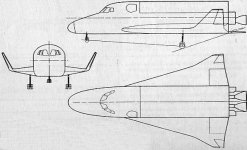
Note that the fuselage for aircraft is mostly just empty space. The plan will be to fill the cylindrical portion of the fuselage with propellant tanks, use a smaller crew cabin, and use the high efficiency NK-33 engine with altitude compensation to produce a VTHL SSTO.
The Hermes page gives it a length of 17.9 m and a wingspan of 10.2 m. I'll use the first image attached below taken from the Hermes page to estimate how much volume to fill with propellant. Printing it out on standard 11" x 8.5" paper in landscape orientation, I measured in the printed image the length of the fuselage from the tip of the nose cone to the end of the fuselage, without the engine nozzles, as 14.3 cm, and the wingspan as 8.2 cm.
Often when the length of a rocket is given it includes also the length of the nozzles. However, to match the proportion of the listed length to the wingspan it must mean just the fuselage proper without the engine nozzles in this case.
The width of the fuselage measured on the printed image was 2.8 cm. From the proportion of the printed image length to the listed vehicle length, this corresponds to a fuselage width of 3.5 m. Note that the payload bay is given a diameter of 3 m. However, the payload bay is frequently supported within the fuselage by support structures, which would account for this difference. However, for a rocket the propellant tank skin itself makes up the outer wall of the rocket. So I'll take the propellant tank diameter as 3.5 m.
For the length of the propellant tank I'll measure this from the front of the windows to the end of the fuselage. On the printed image it was 11.4 cm. This corresponds to a length on the vehicle of 14.3 m. Then this is a volume of 138 m^3. From this we'll subtract off 10 m^3 for the crew cabin, giving a propellant volume of 128 m^3.
The density of kerolox is about 1,030 kg/m^3. Then we have a propellant mass of 132,000 kg.
The mass of the Hermes with a 4,500 kg payload is given as 16,750 kg, for a dry mass of 12,250 kg. However, to this we have to add the mass of engines and the propellant tanks. We'll use a NK-33 engine at a mass of 1,220 kg. For the propellant tank mass, for kerolox for metal tanks the tank weight is about 1/100th that of the propellant mass. However, with composites this can be taken as one-half that so to 660 kg. Then the dry mass is 14,130 kg.
However, the Hermes was also given an on board orbital maneuvering propellant mass of 2,000 kg. We'll just use it for getting to orbit so remove this mass, bringing the dry mass to 12,130 kg. Now use a high energy density hydrocarbon fuel other than kerosene such as methylacetylene. Bruce Dunn in his report Alternate Propellants for SSTO Launchers gives methylacetylene an ideal vacuum Isp of 391.1 s. High performance engines can get an Isp upwards of 97% of the ideal Isp. So I'll give the engine an Isp of 384 s. With subcooling, Dunn gives the density of methylacetylene/lox as about the same as kerolox.
Then the delta-V we can achieve will be 384*9.8ln(1+132,000/12,130) = 9,310 m/s, sufficient for orbit.
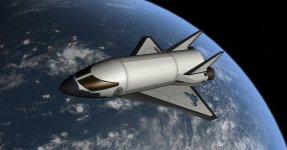
You can get better payload if some portion of the front fuselage ahead of the crew cabin can also be filled with propellant. The amount of this volume is easier to calculate with an ogive shape for this front portion such as with the version of a spaceplane by Loru in the second image below. I'll calculate that in a following post.


Bob Clark
 

Attachments

  • 1985%20nov.jpg
    1985%20nov.jpg
    48 KB · Views: 12
  • vertigo11.jpg
    vertigo11.jpg
    114.2 KB · Views: 15
Last edited:
With all that numbers you've got lift-off thrust to weight ratio at 10,44 in terms of acceleration in m/s2. (units I use to check the thing is able to lift itself)

that will barelly lift from a pad.

Most of gravity losses occurs close to Earth at vertical and close to vertical parts of ascent.

With those numbers I've ended up with folowing numbers:

rg1.jpg


I encourage you to put your values into sc3 vessel and try to reach orbit.
 
Last edited:
With all that numbers you've got lift-off thrust to weight ratio at 10,44 in terms of acceleration in m/s2. (units I use to check the thing is able to lift itself)
that will barelly lift from a pad.
Most of gravity losses occurs close to Earth at vertical and close to vertical parts of ascent.
With those numbers I've ended up with folowing numbers:
<image>
I encourage you to put your values into sc3 vessel and try to reach orbit.

A fair point. Actually there are two factors that will increase the thrust. One is the fact this is using the higher energy fuel which raises the Isp; the other is we are using altitude compensation which improves the Isp throughout the flight.
I'm estimating the vacuum Isp with the methylacetylene fuel as 384 s compared to the 360 s vacuum Isp with kerosene, both under the assumption the high performance engine is given altitude compensation. This corresponds to an increase by a factor of 1.07 so the T/W measured in common units of Newtons or pounds will be increased to about 1.11. And then the improvement of the sea level thrust from altitude compensation will increase this further.
However, probably a single NK-33 would not be the best choice. This is because for a manned vehicle you want engine-out capability. Take a look at this list of kerolox engines:

LOX/Kerosene.
http://www.friends-partners.org/mwade/props/loxosene.htm

We want an engine of about 1/3rd the thrust of the NK-33. The RD-0234-HC looks to be a good choice. It is of high chamber pressure suggesting it can get comparably high Isp values as the NK-33 with altitude compensation. It also has a good T/W ratio. We'll use four of them. This will allow a 1 engine out to still leave the launch pad.
The four engines will increase the dry mass by 340 kg over that using the single NK-33, but we'll still have sufficient delta-V for orbit:

384*9.8ln(1+132,000/12,470) = 9,220 m/s.


Bob Clark
 
Last edited:
Actually there are two factors that will increase the thrust. One is the fact this is using the higher energy fuel which raises the Isp; the other is we are using altitude compensation which improves the Isp throughout the flight.

No - to increase the thrust you need stronger engine not higher ISP.


We want an engine of about 1/3rd the thrust of the NK-33. The RD-0234-HC looks to be a good choice. It is of high chamber pressure suggesting it can get comparably high Isp values as the NK-33 with altitude compensation. It also has a good T/W ratio. We'll use four of them. This will allow a 1 engine out to still leave the launch pad.
The four engines will increase the dry mass by 340 kg over that using the single NK-33, but we'll still have sufficienct delta-V for orbit:

384*9.8ln(1+132,000/12,470) = 9,220 m/s.


Bob Clark

Results:
rg2.jpg


0.4 G at lift off seems reasonable but you have around 16G at burnout or if you reduce thrust to 50% (also seems reasonable in engine capability) you still have 8G

Enjoy the ride...
 
You can always cut off engines. :shifty:

They will be dead weight, but at least they won't cause your crew huge discomfort or lead to a requirement for a very heavy structure...
 
The point of the matter is that if you use highly weight optimized structures and high efficiency engines at the same time then what you wind up with will be a SSTO capable stage. The Ariane 5 core stage is another weight optimized structure using common bulkhead design for its propellant tanks. The Ariane 5 core stage will also become SSTO if using high efficiency SSME's instead of the Vulcain engines.
The specifications of the Ariane 5 are given here:

Ariane 5 Data Sheet.
http://www.spacelaunchreport.com/ariane5.html

The Ariane 5 generic "G" version could be lofted by a single SSME. It's gross mass is listed as 170 mT, and the propellant mass as 158 mT, for a dry mass of 12 mT. The Vulcain engine is listed on this page as weighing 1,700 kg:

Vulcain - Specifications.
http://www.spaceandtech.com/spacedata/engines/vulcain_specs.shtml

Switching to a heavier SSME engine would add 1.4 mT to the vehicle dry mass, so to 13.4 mT for the dry mass. Using a 425s average Isp again for the SSME, this would allow a 6,000 kg payload:

425*9.8ln(1 + 158/(13.4+6)) = 9,218 m/s.

We wish to use this for a man-rated vehicle though. The Ariane 5 was originally intended to be man-rated using the Hermes spaceplane to carry crew. However, it's not certain the degree this was followed-through when the Hermes was canceled.
As with the Ares I upper stage, there are means to increase the payload capacity. Subcooled densification allows 10% greater propellant to be carried, so then 10% greater mass can be lofted to orbit. This brings the total lofted weight from 19.4 mT to 21.3 mT. This extra weight can go to extra payload, so from 6 mT to about 8 mT in payload.
The Ariane 5 uses an aluminum alloy, but not the aluminum-lithium alloy being used now for the lightest weight designs. Switching to aluminum-lithium allows approx. 10% weight saving over the previous aluminum alloy. The structural mass sans the SSME engine is 10.3 mT, so about 1 mT would be saved that could go to extra payload.
I also mentioned before the new research that suggests 10% to 20% can be saved in structural mass because of overly conservative design now used. This would be another 1 mT that could be saved off the dry weight. These weight savings could go to extra payload, bringing the payload capacity to 10 mT.
ESA appears to be amenable to adapting the Ariane 5 core stage for other uses, considering its agreement with ATK to use it for an upper stage. So NASA or a private company should be able to make an agreement with the ESA to use it for this purpose, based on getting sufficient financing. In this regard, to get a prototype done at low cost I suggest using the RD-0120 russian analogue of the SSME's. These are in mothballs and probably can be obtained at greatly reduced price. As a point of comparison the NK-33 was mothballed by the russians and Aerojet was able to buy 36 of them for only $1.1 million each(!) Aerojets version of the NK-33 is now on track to be used by Orbital Sciences on their Taurus II launcher.
Then the Ariane 5 core version of this SSTO has the advantage over the Ares I upper stage and S-IVB versions in being already built and in current use. It also has now the capability when powered by an SSME or RD-0120 to launch a SpaceX Dragon sized spacecraft to orbit without having to use special fuel densifying or lightweighting methods.
NASA has said they want to support commercial space. Support for this launcher would allow for a small, relatively low cost launcher that would permit independent private companies to launch their own manned, or cargo flights to space.

Here's how you can get an all European manned SSTO using the Ariane 5 core stage and Vulcain engines this time. Note that this is one that can be produced from currently existing components, aside from the capsule, so at least an unmanned prototype vehicle can be manufactured and tested in the short term and at lowered development cost.
We'll use three Vulcain 2's instead of the 1 normally used with the Ariane 5 core stage. There are varying specifications given on the Vulcain 2 depending on the source. I'll use the Astronautix site:

Vulcain 2.
http://www.astronautix.com/engines/vulcain2.htm

From the sea level thrust given there, using three Vulcain 2's will give us one engine out capability. The weight is given as 1,800 kg. So adding on two will take the dry mass from 12 mT to 15.6 mT.
To calculate the delta-V achieved I'll use the idea again to just use the vacuum Isp, but adding the loss due to back pressure onto the delta-V required for orbit, as I explained in post #136. However, here for hydrogen fuel which has higher gravity loss, I'll use a higher required delta-V of 9,400 m/s when you add on the back pressure loss. With the vacuum Isp given for the Vulcain 2 of 434 s, we get an payload of 3.8 mT:

434*9.8ln(1+158/(15.6+3.8)) = 9,412 m/s.

Note this is just using the standard nozzle Isp for the Vulcain, no altitude compensation. So this could be tested, like, tomorrow.
However, for a SSTO you definitely want to use altitude compensation. Using those engine performance programs such as ProPEP we can calculate that using long nozzles, you can get a vacuum Isp of 470 s for this engine. This means if you use altitude compensation you can get a comparable Isp. This allows us to get payload of 8 mT:

470*9.8ln(1+158/(15.6+8) = 9,400 m/s.

This will allow us to add a Dragon-sized capsule and also the reentry and landing systems to make it reusable.


Bob Clark
 
If I am not completely wrong, the sea level thrust of the Vulcain II can be well described as "Not existing" (Just 318 s according to Astronautix, that means only 989 kN thrust left). The boosters do the work, the Vulcain II is just ignited on the ground for health checking.

Also, you are completely wrong about your ProPEP "estimate" (lets call it wild-guestimate) for the Vulcain II vacuum thrust with longer nozzles: It is still a gas generator/open cycle engine.

You can't get the same specific impulse from it as if you would use a closed cycle high pressure engine with the same propellant combination. The maximum chamber pressure is limited to 130 bar (theoretical limit by using hydrogen/oxygen) and the specific impulse is reduced a lot by the turbine exhaust.

The Vulcain II is actually already at the maximum possible for a gas generator cycle engine. You would need a closed cycle there for further improvements in effectivity, effectively a new engine.

The RS-68 has even less chamber pressure as gas generator cycle engine.

Also, you can't gain much more vacuum performance by making the nozzle even longer - the Vulcain II has already a very long nozzle.
 
This will allow us to add a Dragon-sized capsule and also the reentry and landing systems to make it reusable.

To make the Dragon reusable, or make the whole vehicle reusable?

I have a feeling that to make the whole vehicle reusable, you would need a good deal more mass.

Also, did you include the extra piping and support structure for those two extra Vulcains? You can't just slap extra engines onto a rocket.

Does anyone have any data on how much the piping and support structure of a launch vehicle weigh? I haven't been able to find this data so far.
 
If I am not completely wrong, the sea level thrust of the Vulcain II can be well described as "Not existing" (Just 318 s according to Astronautix, that means only 989 kN thrust left). The boosters do the work, the Vulcain II is just ignited on the ground for health checking.
Also, you are completely wrong about your ProPEP "estimate" (lets call it wild-guestimate) for the Vulcain II vacuum thrust with longer nozzles: It is still a gas generator/open cycle engine.
You can't get the same specific impulse from it as if you would use a closed cycle high pressure engine with the same propellant combination. The maximum chamber pressure is limited to 130 bar (theoretical limit by using hydrogen/oxygen) and the specific impulse is reduced a lot by the turbine exhaust.
The Vulcain II is actually already at the maximum possible for a gas generator cycle engine. You would need a closed cycle there for further improvements in effectivity, effectively a new engine.
The RS-68 has even less chamber pressure as gas generator cycle engine.
Also, you can't gain much more vacuum performance by making the nozzle even longer - the Vulcain II has already a very long nozzle.

The most important single parameter for maximizing performance at vacuum conditions is the length of the nozzle, more so than the chamber pressure. See for example the specifications for the various incarnations of the RL-10 engine:

RL-10 - Specifications.
http://www.spaceandtech.com/spacedata/engines/rl10_specs.shtml

For example the RL10-B2 has a nozzle area ratio of 285 to 1, resulting in a 464 s vacuum Isp, even though the chamber pressure is only 640 psi, about 43 bar. So you can get an even higher Isp with the higher chamber pressure Vulcain if it was given a similar high nozzle area ratio.
Note though the RL10-B2 with that long nozzle results in a mass nearly twice that of the other RL10 versions. Getting lightweight engines at such high Isp's is a key factor in regards to my SSTO proposals. It is essential that methods be found of altitude compensation that can give comparable results of the very long nozzles without adding too much to the engine weight. In a follow up post I'll discuss some possibilities for such lightweight altitude compensation.
There are several incarnations of the ProPEP program available on the net. Since they all are based on the same program they all give the same results, with some variations in how the results are displayed.
However, the original ProPEP was a MS-DOS program; it may not run on the modern Windows computers. You can download it and some other more modern GUI-based versions here:

Software, Simulations, etc.
http://www.spl.ch/software/index.html

There is also this version whose demo version is free:

RPA – Tool for Rocket Propulsion Analysis.
http://www.propulsion-analysis.com/examples.htm


Bob Clark
 
Nozzle length is completely secondary. What counts is expansion ratio.

A low chamber pressure nozzle with the same expansion ratio is at the same thrust much larger than a high chamber pressure nozzle. And the high pressure engine is also much smaller and much lighter, despite the higher pressure and the higher expansion ratio. But it also requires much more sophisticated cooling for the nozzle, which is why many engines for upper stages are less than optimal in chamber pressure and expansion ratio for the sake of saving mass and use radiative cooled nozzles.
 
Back
Top