
Flight Question Approaching Runway after Re-Entry

Yep. That ineffectiveness is caused by air building up at the leading edges of the wings, jamming the control surfaces. Using a delta wing shape helps, but not at our speeds.

---------- Post added at 03:11 PM ---------- Previous post was at 03:06 PM ----------

Is there an mfd that helps with following a heading alignment circle that works for ships other than the sts fleet?
 

Is there an mfd that helps with following a heading alignment circle that works for ships other than the sts fleet?

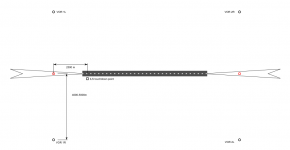
No, but if you have a VOR beacon at the center of such a heading alignment cone, you can use the HSI MFD for intercepting it. I did such editing on Johnson atoll, for making it easier to land a dyna-soar there. placed one VOR at each side of the runway, about 4000 m away from it.
 
So I want to place a VOR beacon about 4k down range of the runway in each direction? Alright thanks, I'll need to look up exactly how to do it, but it should suit Wideawake perfectly, with its very long cargo-ship runway it should have them anyway.
 
So I want to place a VOR beacon about 4k down range of the runway in each direction? Alright thanks, I'll need to look up exactly how to do it, but it should suit Wideawake perfectly, with its very long cargo-ship runway it should have them anyway.

Well, for the XR-5 you should have the VORs a bit further spaced. I can make you a quick drawing on how to place the VORs effectively.
 

Is there an mfd that helps with following a heading alignment circle that works for ships other than the sts fleet?


Again, this is why I would like a GPS MFD so that the necessary lat/lon's can be plugged in for this sort of thing.
 
Here is a quick drawing with the distances I used for the Dynasoar base modification. Not to scale.
 

Attachments

  • VORPlacement.png
    VORPlacement.png
    17.7 KB · Views: 31
Well, the key for most winged vehicles is to cross over your runway at a sufficient height and airspeed to allow you time to circle around onto final approach. In another thread I wrote that for the X-20 Dynasoar 20km alt. and mach 1 was good. But I'm not familiar with your Vanguard, so I can't say for sure. It may be the case that it has a wide turn radius and a lousy glide ratio which makes it difficult for anything but a straight-in approach.


I actually recently had my first successful reentry and landing with the XR5, and this is exactly the approach I took to KSC. I crossed over RWY33 at the midpoint heading East at about 18-20km alt, I believe, then set airspeed hold to between 130 and 150 m/s and began a steady descending right turn. Since it was a night landing, I used the HSI to line up with RWY33 for a visual approach, waited till I was about 200m off the ground, deployed the landing gear, flared, and brought her down gently, engaged wheel brakes and, just in case, thrust reversers (retros) until I knew I had plenty of runway, wheels stop and welcome home.

For me personally, nailing the timing of the deorbit burn & getting close enough to the base to land either unpowered or with engines still remains the bigger challenge when compared to actually setting the craft down on the runway. Like someone already said, the best way is to practice, practice, practice, (until you find the method that is best for you from a realism & skill standpoint).
 
Interesting. I'll try the DGIV.

What I mean by re-entry angle is relevant to the decent slope. If the decent slope is -10 degrees, and your re-entry angle is +30 degrees, your pitch angle relative to the ground is +20 degrees. Well, in my case, my decent slope was about -3 degrees and my re-entry angle was about +5 degrees. That means my pitch angle was about +2 degrees. I also had the stick pulled back as far as it would go. But a re-entry angle of just 1 degree is not a good angle. Heat would quickly reach the fuselage and tear the space craft apart. And there comes a point where you're going so fast that control surface movements have no effect on the flight path. It's called mack-tuck. And at that speed, the only usefull item is the thrusters.

Urwumpe already pointed out that "mack-tuck" is not what you were thinking of, but you were trying to give it the name of "mach tuck":
http://en.wikipedia.org/wiki/Mach_tuck
 
Just because I don't use the "official" terms of flight, doesn't mean I don't know them. I was trying to explain things in a simple way.

No, you don't. You don't make it simpler, you make it even more confusing, especially since you don't use meaningful translations, but instead just arbitrary names.

Please stop making yourself smarter than you are, when caught making errors. This is not the UN kindergarten, here people will know if you are talking about things you have not understood properly yourself. Such behavior insults both you and us.
 
Just because I don't use the "official" terms of flight, doesn't mean I don't know them. I was trying to explain things in a simple way.
You were not using a simple way of explaining things. You were using incorrect and misleading terms for concepts that have technical terms already. You can't go and make up your own definitions for technical terms.
 
Just because I don't use the "official" terms of flight, doesn't mean I don't know them. I was trying to explain things in a simple way.
Once again, stop digging.
 
Chill guys, no need to fall out over a definition.
On topic, I find it works quite well to come in about 35k out and just eyeball it, and i'm sure ur's VOR technique will work even better. Biggest problem really is the XR 5 really does turn like a pig!
 
I use both the Re-entry MFD and the GPC MFD at the same time with winged vehicles.

When I get close to the landing site I set the left MFD to GPC OPS4, and leave the Re-entry program on the right MFD. That way I can manage my energy and get set up for my HAC turn.

At the same time I have a third MFD opened up to the HSI to help on final approach, and usually a 4th MFD opened up to SurfaceMFD or SpaceShipOneMFD.

I also have HUD Data MFD turned on so that I can see my longitudinal acceleration, altitude, mach #, vertical velocity, and vertical acceleration without taking my eyes off the runway.

Of course, I get a kick out of all this tech stuff, and after flying enough re-entries and landings you get a feel for what setup works best for you.
 
I usually use only orbit MFD, map MFD surface MFD, Orbit and surface HUD to manage deorbit burn, reentry and landing because I like to fly with as little aids as possible.

This is how I reenter and land empty XR5 from 650 km equatorial orbit where I`m building a station

1. when ~10 000 km from base orient retrograde and do a deorbit burn till my impact point on a map MFD hit`s my base.

2. orient prograde and when crossing 150 - 180 km altitude close all doors.

3. when crossing 100 km alt engage attitude hold autopilot and set pitch to 15 deg for maximum lift to kill excess VS. At that point I`m 1000 - 1200 km from my base and my VS is ~-640 m/s.

4. hitting atmosphere and when my VS reduces to -200 - -250 m/s pith up to 45 deg and as my HS drops reduce pitch to maintain -100 - -150 m/s VS.

5. continue reentry and watch my distance from base, deceleration, hull temp, VS, HS and adjust pitch as needed. If I feel I`m going to be short of my base I come out of reentry and glide, if I feel I`m going to overshoot I increase pitch to 60 - 70 deg for maximum braking and/or bank to do S turns. My target is to have ~1 km/s speed and 20 - 30 km altitude when 100 km from base.

6. when my speed drops to 1 km/s and distance to 100 km I come out of reentry, turn towards the base and glide to the runway for landing.

It took me about 4 - 5 tries to get everything right and land deadstick.
 
Back
Top