
Updates Ares Updates and Discussion

The huge vibrations I see are created by hobby-experts in blogs and forums, who are going to become minimized and lost in the deepness of the internet the day Ares lifts of manned ;)

Yeah, if you just stick your fingers into your ears and say "nananananah" physics will obey you.

Please: Read the NASA documents about the Shuttle launch environment (which contains the official vibration levels) and shut up until you have done so. You only insult yourself and us with your trolling.


-----Post Added-----


But I don't understand why strap-on boosters weren't considered, instead of an extra segment. The 4-segment SRB doesn't have 4+G axial oscilations, does it?

Would have to read about it again, but I think they are not much lower. The beam between both SRBs in the shuttle is pretty massive and has the task to dampen the worst oscillations out of it.

The main problem for the five segment should be the different resonance frequency as the standing wave is one segment longer now.

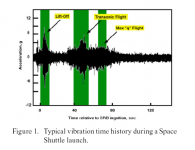
EDIT: Found the plot in an interesting paper about spacecraft vibrations, if you assume the SRB vibrations to be "only" proportional to the vacuum thrust of the SRB, the peak contributions of the SRBs measured by sensors in the mid deck would be already at an amplitude of 1.5G right after lift-off.

http://www.scielo.cl/pdf/ingeniare/v14n3/art09.pdf

It also contains a nice drawing of the noise sources during the shuttle lift-off
 

Attachments

  • ShuttleVibrations.png
    ShuttleVibrations.png
    68.1 KB · Views: 21
Do you really think that reading a few NASA documents such as about the Shuttle launch environment makes you an expert and enables you to conclude that Ares won't work successfully?

This does not impress me. Especially in case people are not involved in the Ares development at all. Against this backdrop you can read and conclude almost everything, but it does not matter.
 
Do you really think that reading a few NASA documents such as about the Shuttle launch environment makes you an expert and enables you to conclude that Ares won't work successfully?

No - but it makes me a better expert than you are and that is enough for today. :P

Also: If the vibrations will just disappear and will be no problem: Why does the Ares-I project group put more shock dampers into a single rocket than on a M1 tank? Sure they expect the same as most people here in this forum: The vibrations will stay and will become bad.

Their solution for the vibration problem is not looking for a more controllable propulsion system, they try to fight the vibrations by adding more damper mass and more structure, so they can stick to their solid rocket motor. Which I (and others) consider a dead-end idea. NASA spends time and money for fixing problems, which they wouldn't have without the SRM.

This does not impress me.

I know. Your are often enough arguing by ignorance that I should not expect you to not ignore this.
 
What's always gotten to me about Ares is we have proven rocket systems like the Delta IV, my personal favorite, and the Atlas V that can launch an Orion-class capsule into LEO. Why build this new troubled tihng. The only real reason I've heard from griffin is that "we have explored alternatives and determined that these rockets don't suit the mission of Orion" or some such bureaucratic BS. I've never seen any concrete evidence to support that these vehicles couldn't be used for a manned mission. In fact, Boeing specifically even said that the Dealta IV could be man-rated, but griffin rejected it. Just remember that a single-SRB burning under the back-sides of a half-dozen astronauts was HIS idea BEFORE he was administrator.
 
The Orion capsule is now already almost too heavy to be launched by a Ares-I.
 
Yes, they keep stripping it down, and watering down its capabilities along the way.
Skip re-entry: gone
Land recovery: gone
Reusability: in doubt

All those things that were promised at the program's outset are dwindling away to make the space vehicle fit the launch vehicle.

Bass ackwards. Decide on what space vehicle you want, than design a good launch vehicle to do the job. Something with..ahem...low vibrations, and give it growth potential in case you want a bigger capsule someday.

But, hey, since I'm not a NASA engineer, I guess I know nothing. Maybe it will all magically work right because Griffin wills it to be so. More likely, it will all work right because enough money gets thrown at it. Even bowling balls can fly when your propellant is cash.
 
I agree with Andy44.

I hate seeing this Ares program being used to justify the money spent on STS. It doesn't need justifying!
 
Well,

Bigelow may get one of those EELVs manrated for himself. Of course, he is looking forward to using the Falcon and Dragon but may stil luse one of the other LVs. That would stick it up Griffin's ....
 
Why build this new troubled tihng.

Because new untroubled things do not exist.

"I hope no one was so ill-informed as to believe that we would be able to develop a system to replace the shuttle without facing any challenges in doing so. NASA has an excellent track record of resolving technical challenges. We’re confident we’ll solve this one as well."
Michael Griffin

PS:

"Will metall withstand stand this kind of vibration? Have the engineers realized how this thing shakes? Because it shakes and vibrates so much more than I ever imagined."
Alan Bean (Apollo 12)

"I was wondering: why did we do all the launch simulation?" If I'd had to reach a switch with all of that vibrations going on, I wouldn't have quite been sure where I was putting my hand"
Harrison Schmitt (Apollo 17)

I don't think that either the STS is, nor the Ares will be anything close to what Apollo astronauts experienced during first stage of a SaturnV launch, which produced 7.5 million pounds of rocket thrust.
 
I don't think that either the STS is, nor the Ares will be anything close to what Apollo astronauts experienced during first stage of a SaturnV launch, which produced 7.5 million pounds of rocket thrust.

See my attachment - STS reaches +/- 6G oscillations during the launch vibrations.

On Apollo:

http://history.nasa.gov/SP-4205/ch10-6.html

The Saturn V could even have had less vibrations than a Shuttle - most of the Shuttle vibrations are aerodynamic, caused by the parallel configuration.

http://ntrs.nasa.gov/archive/nasa/casi.ntrs.nasa.gov/20080018689_2008018688.pdf
 
Apollo 12 was nearly a failed mission, and that not because of the lightning strike, but because of the fact that oscillations of a single rocket engine of the second stage already reached 7 cm magnitude when the problematic engine was shut-off early.

Just nitpicking here, but I think you're mixing up Apollo 12 and 13: http://klabs.org/history/history_docs/jsc_t/apollo_12_saturn_v.pdf

Pogo suppression was added to later flights, but the first had to go without even though the problem was known after the first Saturn V test flight.

And it is not different now.

Pogo and thrust oscillation (aka resonant burn) is something different. You can mitigate pogo by "de-tuning" the oscillating devices (pumps, pipes), but thrust oscillation is something every solid motor experiences, it's not avoidable (yet, save special "inhibitors" inside the motor).

As you already pointed out, the Shuttle mitigates thrust oscillation of the SRBs by directing the vibrations into the external tank, using the propellant as a kind of big damper. Ares/Orion can't do that as the upper stage and Orion are stitting upon the solid motor directy and the "stick" needs to be stiff enough during the flight. So you need to add dampers of some kind and always will have some "weight penalty" because of that compared to a liquid engine.

Cheers
Tschachim
 
Pogo and thrust oscillation (aka resonant burn) is something different. You can mitigate pogo by "de-tuning" the oscillating devices (pumps, pipes), but thrust oscillation is something every solid motor experiences, it's not avoidable (yet, save special "inhibitors" inside the motor).

I do wonder whether the MLV Saturn 1B would have run into the same oscillation problems if it had been built, given it was a very similar design (SRB(s) for first stage, SIVB on top). I don't know whether any of the studies looked into that.
 
Pogo and thrust oscillation (aka resonant burn) is something different. You can mitigate pogo by "de-tuning" the oscillating devices (pumps, pipes), but thrust oscillation is something every solid motor experiences, it's not avoidable (yet, save special "inhibitors" inside the motor).

They are physically different, but have similar effects on the payload (humans).

I think it is possible to reduce the resonant burn effects dramatically - but for that, you would need to research it better. I am not aware of any study of the phenomena on large rocket motors.

Also, there was never an attempt to research it before Ares. The MSFC had designed solid rocket first stages already for the Saturn IB, but resonant burn was never mentioned at that time. Maybe they did not think about it, maybe there was never communication between the projects which use solid rocket motors and those who designed with them.

As you already pointed out, the Shuttle mitigates thrust oscillation of the SRBs by directing the vibrations into the external tank, using the propellant as a kind of big damper. Ares/Orion can't do that as the upper stage and Orion are stitting upon the solid motor directy and the "stick" needs to be stiff enough during the flight. So you need to add dampers of some kind and always will have some "weight penalty" because of that compared to a liquid engine.

Yes - but also work. The SRB solution was chosen to avoid work and the early design phases already show that this promise is not true, compared to the already standardized process of designing bipropellant rockets.
 
Anyway, a ride with a Saturn V certainly is not comparable with a plush Space Shuttle ride, especially staging (S-IC). But next year we'll get exact data of what a Shuttle crew feels, as well as data about the SRB's and its attachment points.

Like Apollo, I also like the entire concept and designs of Constellation. Engineers will solve that short 5 seconds of TO at about 115 seconds into the flight of Ares I, which potentially just makes it difficult for the crew to read displays ("We found that the crew health issue is easy to mitigate", Garry Lyles, associate director for technical management). It's certainly not an insuperable challenge, and by far not a collapse of the entire project, like some people love to suggest.

PS: "There is nothing on our list that is a showstopper. Everything is within what you typically associate with a launch vehicle development program."
Steve Cook (Ares Project Manager)


-----Post Added-----


The latest news regarding TO's during Ares I's first stage might be interesting for sceptics:

http://www.nasaspaceflight.com/2008...n-meetings-encouraging-allowance-for-changes/
 
Last edited:
The latest news regarding TO's during Ares I's first stage might be interesting for sceptics:

[URL="http://www.nasaspaceflight.com/2008/...e-for-changes/"]http://www.nasaspaceflight.com/2008/...e-for-changes/[/URL]

Interesting, and a little encouraging. But they said they must add 2 tons of gear for damping at the interstage, which is another 2 tons of upper stage and payload that will be lost. I also noticed how they put off the change request for shock absorbers on the seats in order to squeak through the PDR, which Lockheed is justifiably not happy about, since that will be another change to the baseline Orion.

Best of luck to 'em, though. We shall see.
 
Two tons of extra weight is not just a little indeed. But it's a compromise (which you have to make one way or another if your intention is to use a single SRB as a first stage) and a possible solution of too high TO's, which potentially can happen for only about 5 seconds shortly before staging.

All that criticism obviously is much bigger than the actual challenge. And I have no doubt those guys will do the job. Just let's wait for Ares I-X...
 
Just let's wait for Ares I-X...

As DaveS has said before, Ares 1-X is just a 250 million fireworks show, It will not really prove anything and nothing will be lost if it blows up (Except 250 million)
 
As DaveS has said before, Ares 1-X is just a 250 million fireworks show, It will not really prove anything and nothing will be lost if it blows up (Except 250 million)

The intention of Ares I-X is to assure that the launch vehicle performs as expected, including it's aerodynamics and to look for potential TO's. To say that it is just a fireworks show is not really smart I think (and who is DaveS? if you know what I mean). It shows that you both just tend to bash the program.
 
The intention of Ares I-X is to assure that the launch vehicle performs as expected, including it's aerodynamics and to look for potential TO's. To say that it is just a fireworks show is not really smart I think (and who is DaveS? if you know what I mean). It shows that you both just tend to bash the program.

Ares I-X is going to have a 4-segment SRB and a dummy upper stage, so the difference to the "final" Ares-I is huge. I guess they can get some aerodynamic data, but the performance is going to be different to the 5-segment model.
 
Back
Top