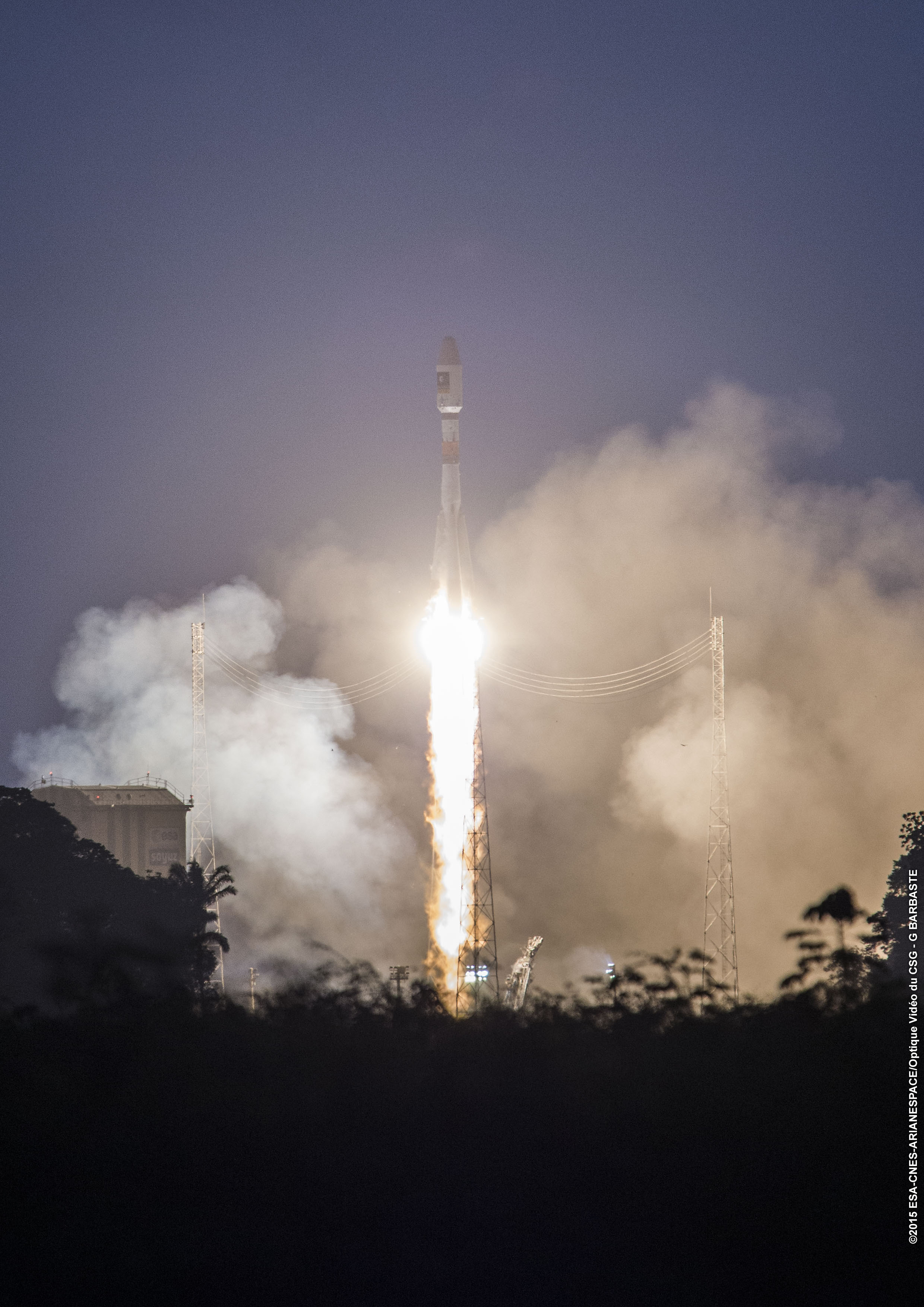
Europe's own satellite navigation system really needs more luck than it has today.
The deployment has been years behind schedule. The European nations are not funding enough amounts for long periods. And of the 6 satellites now in orbit, some of the first 4 have irregular power problems and the latest 2 ended up in wrong orbits thanks to Russian wiring problems on the Fregat :facepalm: - after some work ESA finally put them into better orbits that allows for them to become operational.
Today, though, might be the point that the Galileo GNSS strikes back. After discussion whether or not to ditch the Soyuz rocket from their launch deployments, this was eventually turned down. So today the 3rd and 4th Full Operational Capability (FOC) satellites of Galileo is waiting for launch down in French Guiana, just 2 hours after the one year expedition to the ISS flies on the same rocket. Good luck to them two!


Launch location:
Kourou ELS 5°18'18"N 52°50'02"W

Launch dates and times:
[table="head"]{colsp=7}Launch times (updated)
Time Zone|Australia - Sydney/AEDT|Moscow / MSK/ UTC+3|CEST/ UTC+1|Universal / UTC|French Guiana|Washington / EDT
Launch time:|08:46:18|00:46:18|22:46:18|21:46:18|18:46:18|17:46:18
on:|Mar. 28, 2015|Mar. 28, 2015|Mar. 27, 2015|Mar. 27, 2015|Mar. 27, 2015|Mar. 27, 2015
{colsp=7}
Live Coverage


PAYLOADS 1/2
Galileo FOC-3/4 navigation satellites
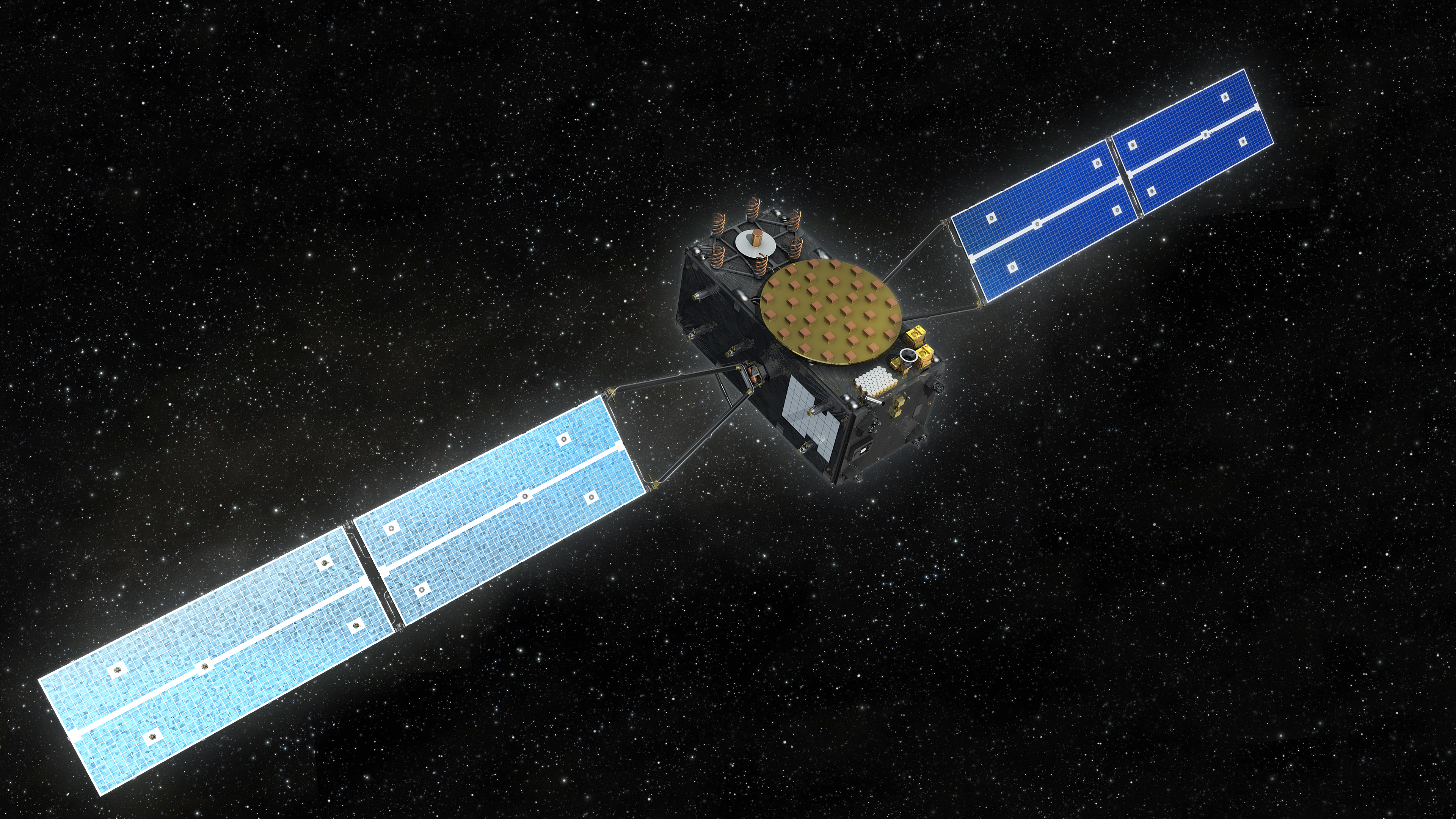
The Galileo satellite navigation system will consist of a total of 30 spacecraft in three planes in medium Earth orbit, which will each be occupied by nine satellites, and with three spares satellites distributed on the three orbital planes. At an altitude of 23,616 kilometers and an inclination of 56 degrees, the system will provide accurate positioning data to users as far north as 75 degrees longitude.
Although similar in design to the American GPS system and the Russian GLONASS navigation network, Galileo-FOC will be under the control of strictly civilian organizations. Galileo is the first joint program to be shared between the European Space Agency and the European Union.
In January 2010 the consortium consisting of OHB-System GmbH and SSTL was selected to built the first 14 Galileo-FOC (Galileo-Full Operational Capability) satellites of the system. OHB-System will act as prime contractor, build the busses while SSTL will provide the payloads. In January 2012, eight more satellites were ordered.

[table="head"]Characteristics|Values
Orbit| Medium-Earth orbit, altitude 23522 km, inclination 55.040°
Weight at launch|730 kg
Size (with solar wings stowed)|2.5 x 1.2 x 1.1 m
Span (with solar wings deployed)|14.74 m
Available power|1420 watts
Design life|more than 12 years
Prime contractor|OHB-System (platform) / SSTL (assembly and testing)
Navigation payload|

Launch Vehicle:
[table="head"]{colsp=2}Characteristics
 |[table="head"]{colsp=2}

[/table]
[/table]


The launch vehicle's reliability standings
According to http://www.spacelaunchreport.com/log2015.html#rate:
Ascent profile


Weather Forecast for Kourou, French Guiana on March 27, 2015 (7 p.m.)
Cloudy with periods of rain. High 27C. Winds NE at 10 to 15 km/h. Chance of rain 90%. Rainfall around 6mm.
Time|Temps|Dew Point|Relative Humidity|Precip|Snow|Cloud cover|Pressure|Wind|Weather
7 PM|26°C|22°C|81%|45%|0%|78%|1013 hPa|13 km/h NE|
 Chance of Rain
References
http://www.esa.int/Our_Activities/Navigation/The_future_-_Galileo/Launching_Galileo
http://download.esa.int/docs/Galileo_IOV_Launch/FOC_factsheet_20111003.pdf
http://www.arianespace.com
http://forum.nasaspaceflight.com
http://www.novosti-kosmonavtiki.ru
http://www.forum-conquete-spatiale.fr
http://www.spacelaunchreport.com
http://www.samspace.ru
http://www.laspace.ru
http://english.wunderground.com/weather-forecast/zmw:00000.1.81403?
The deployment has been years behind schedule. The European nations are not funding enough amounts for long periods. And of the 6 satellites now in orbit, some of the first 4 have irregular power problems and the latest 2 ended up in wrong orbits thanks to Russian wiring problems on the Fregat :facepalm: - after some work ESA finally put them into better orbits that allows for them to become operational.
Today, though, might be the point that the Galileo GNSS strikes back. After discussion whether or not to ditch the Soyuz rocket from their launch deployments, this was eventually turned down. So today the 3rd and 4th Full Operational Capability (FOC) satellites of Galileo is waiting for launch down in French Guiana, just 2 hours after the one year expedition to the ISS flies on the same rocket. Good luck to them two!
Launch location:
Kourou ELS 5°18'18"N 52°50'02"W
Launch dates and times:
[table="head"]{colsp=7}Launch times (updated)
Time Zone|Australia - Sydney/AEDT|Moscow / MSK/ UTC+3|CEST/ UTC+1|Universal / UTC|French Guiana|Washington / EDT
Launch time:|08:46:18|00:46:18|22:46:18|21:46:18|18:46:18|17:46:18
on:|Mar. 28, 2015|Mar. 28, 2015|Mar. 27, 2015|Mar. 27, 2015|Mar. 27, 2015|Mar. 27, 2015
{colsp=7}
[highlight][eventTimer]2015-03-27 21:46:18?before|after;%dd% Days %hh% Hours %mm% Minutes %ss% Seconds %c%[/eventTimer] Galileo FOC-3/4 Launch[/highlight]
[/table]Live Coverage
- http://www.arianespace.tv/ - begins 20 minutes before the launch
PAYLOADS 1/2
Galileo FOC-3/4 navigation satellites
The Galileo satellite navigation system will consist of a total of 30 spacecraft in three planes in medium Earth orbit, which will each be occupied by nine satellites, and with three spares satellites distributed on the three orbital planes. At an altitude of 23,616 kilometers and an inclination of 56 degrees, the system will provide accurate positioning data to users as far north as 75 degrees longitude.
Although similar in design to the American GPS system and the Russian GLONASS navigation network, Galileo-FOC will be under the control of strictly civilian organizations. Galileo is the first joint program to be shared between the European Space Agency and the European Union.
In January 2010 the consortium consisting of OHB-System GmbH and SSTL was selected to built the first 14 Galileo-FOC (Galileo-Full Operational Capability) satellites of the system. OHB-System will act as prime contractor, build the busses while SSTL will provide the payloads. In January 2012, eight more satellites were ordered.
[table="head"]Characteristics|Values
Orbit| Medium-Earth orbit, altitude 23522 km, inclination 55.040°
Weight at launch|730 kg
Size (with solar wings stowed)|2.5 x 1.2 x 1.1 m
Span (with solar wings deployed)|14.74 m
Available power|1420 watts
Design life|more than 12 years
Prime contractor|OHB-System (platform) / SSTL (assembly and testing)
Navigation payload|
- Two Passive Hydrogen Maser atomic clocks
- Two Rubidium atomic clocks
- Clock monitoring and control unit
- Navigation signal generator unit (E5, E6, E1 signals)
- L-band antenna for navigation signal transmission
- C-band antenna for up-link signal detection
- Two S-band antennas for telemetry and tele-commands
- Search and rescue antenna
Launch Vehicle:
[table="head"]{colsp=2}Characteristics
Soyuz-2.1b
Prime contractor:
|- Samara Space Sentre (Energia Holding enterprise)

GRAU Index:
|- 14A14
Height:
| 51.1 mDiameter:
| max 10.3 mLiftoff mass:
| 313 metric tonnesPayload mass:
| up to 7835 kg (a launch to LEO from Plesetsk)1st stage (boosters B, V, G, D):
|- 4 X RD-107 engines
- Propellants (T-1 Kerosene and LOX)
- Thrust/ISP in vacuum - / 320.2 s
- Thrust/ISP at sea level 85.6 tonnes / 263.3 s
2nd stage (core A):
|- 1 X RD-108 engine
- Propellants (T-1 Kerosene and LOX)
- Thrust/ISP in vacuum 94 tonnes / 320.6 s
- Thrust/ISP at sea level 80.8 tonnes / 257.7 s
3rd stage (block I):
|- 1 X RD-0124 engine
- Propellants (T-1 Kerosene and LOX)
- Thrust/ISP in vacuum 30.00 tonnes / 359 s
Upper Stage:
|
- GRAU Index: -
- Common Name: Fregat (meaning Frigate)
- Designer & Manufacturer: Lavochkin Association (NPO)
- Dimensions: Length 2.4 m, Diameter (max) 3.350 m
- Empty Mass 930 kg
- Propellants 5250 kg max
- Main Engine: 1 X S5.92
- Thrust in vacuum 2.0 tonnes of force (full power)
- Thrust in vacuum 1.4 tonnes of force (small power)
- ISP 333.2 s
Payload Fairing:
|- Diameter 3.7 m
- Length 7.7 m
[/table]
[/table]
The launch vehicle's reliability standings
According to http://www.spacelaunchreport.com/log2015.html#rate:
Code:
================================================================
Vehicle     Successes/Tries Realzd Pred  Consc. Last     Dates
                             Rate  Rate* Succes Fail
================================================================
Soyuz 2-1b/Fregat 16    18    .89  .85      2    08/22/14 2006-
Ascent profile
Weather Forecast for Kourou, French Guiana on March 27, 2015 (7 p.m.)
Cloudy with periods of rain. High 27C. Winds NE at 10 to 15 km/h. Chance of rain 90%. Rainfall around 6mm.
7 PM|26°C|22°C|81%|45%|0%|78%|1013 hPa|13 km/h NE|
References
http://www.esa.int/Our_Activities/Navigation/The_future_-_Galileo/Launching_Galileo
http://download.esa.int/docs/Galileo_IOV_Launch/FOC_factsheet_20111003.pdf
http://www.arianespace.com
http://forum.nasaspaceflight.com
http://www.novosti-kosmonavtiki.ru
http://www.forum-conquete-spatiale.fr
http://www.spacelaunchreport.com
http://www.samspace.ru
http://www.laspace.ru
http://english.wunderground.com/weather-forecast/zmw:00000.1.81403?