News Asiana 777-200 Crash on landing at SFO

It's still possible to fly a VNAV coupled with the FMC flying the approach plate STAR. Of course, SFO controllers will probably have requested a change to the published approach which caused a high workload on the flight deck.


GPS-NPA is not allowed for SFO anyway, not enough lateral accuracy. Without the localizer beam, there would have been even extreme restrictions regarding the aircraft spacing for the two parallel runways.

Also it is possible that radar altitude is not included in VNAV on a 777, so there is just Baro-VNAV possible (GPS-VNAV is still not allowed, since WAAS does not always guarantee the needed accuracy.
 
Parallel topic.
If it's determined to be a pilot error, what are the consequences for the pilot?
Would he get jail term for mass negligent manslaughter, or are there some exemptions for jobs like that?
 
Parallel topic.
If it's determined to be a pilot error, what are the consequences for the pilot?
Would he get jail term for mass negligent manslaughter, or are there some exemptions for jobs like that?

Only if there is enough evidence that he acted criminal. It does not look like that now.

As the situation looks to me now (I can be wrong): He was a bloody beginner on the aircraft and should have let somebody more experienced with the aircraft handle the difficult landing. He was NOT the captain of this flight and not the most senior pilot in the flight deck during landing. The second pilot had twice the total flight-hours and over 3400 hours experience with the 777.

The only really poor decision I can see is the late call for go-around, after at least 5 seconds of warning signs. That is bad, but not criminal. Remember that he needed a moment to read through the instruments to make sense of the situation, maybe he just thought twice as long as he should have done.

That would mean most likely just, that he and the more senior pilot are both responsible for the crash and might still maximal face disciplinary punishments, like reduced salary, if at all.

So far, it sounds like an accident to me, even if a human is ultimatively responsible for not aborting when it was really about time for it. The crew will have to handle their own errors there and learn from them. Nobody of them deserves even to be fired, but they deserve badly to get their own errors analysed, so they never repeat them again.

More important would be fixing all the correctable problems, that led to the crash. Letting an practically unexperienced pilot handle a difficult landing is bad, but not a big issue (remember the touch-and-go of a German plane during storm strength side winds? this difficult and luckily non-fatal accident was flown by a rookie pilot as well. No fines or punishments for the crew, since she did the best she can). The actions of SFO are more critical there. Why has the ILS been inoperative? Had the final approach been directed wrong?

 
...
As the situation looks to me now (I can be wrong): He was a bloody beginner on the aircraft and should have let somebody more experienced with the aircraft handle the difficult landing. He was NOT the captain of this flight and not the most senior pilot in the flight deck during landing. The second pilot had twice the total flight-hours and over 3400 hours experience with the 777.

What I don't get is why the more experienced pilot waited so long to tell the pilot at the controls that they were so far below required landing speed. That's what made me wonder if the pilot at controls was more senior though not as experienced at this type of craft.

Bob Clark

---------- Post added at 10:25 AM ---------- Previous post was at 10:19 AM ----------

Parallel topic.
If it's determined to be a pilot error, what are the consequences for the pilot?
Would he get jail term for mass negligent manslaughter, or are there some exemptions for jobs like that?

With so few hours at this aircraft it's possible this pilot never had to do a fully manual landing on it without the glideslope enabled.
In that case this is another reason why the more experienced pilot should have been at the controls.
This reminds me of the Air France crash where the more experienced pilot should have been at the controls during an unusual scenario requiring a more skilled pilot.

Bob Clark
 
What I don't get is why the more experienced pilot waited so long to tell the pilot at the controls that they were so far below required landing speed. That's what made me wonder if the pilot at controls was more senior though not as experienced at this type of craft.

Bob Clark

Well, the responsibility is at the flying pilot. Even if he is not experienced, once he has taken over control, he has the last word and should be respected. There is nothing more dangerous to a plane, as if flying and assisting pilot are disagreeing on the next action and steer in different directions.

The usual procedure would be the flying pilot declare a go around, and on the next attempt, the roles are switched. You don't switch roles during final approach.

The question before landing was maybe something like "We are doing a standard visual approach, do you think you can do that already?" but I doubt that there was even a question. It is usual to let the least experienced pilot do the first landing, unless the situation is really non-standard or the other pilot feels incapable of doing this. Usually, you can expect somebody with 10000 hours experience to handle a visual approach, even if he does not yet know the aircraft well beyond the simulator.

Rookie in that context should also be used as "Rookie on the 777". 43 hours of flight experience means just 4 flights.
 
The actions of SFO are more critical there. Why has the ILS been inoperative? Had the final approach been directed wrong?

If I'm not mistaken, there was construction going on at the airport.

Also, a NOTAM had been available that the ILS would be inoperative from June 1 through August 22.

NOTAM 06/009: San Francisco International Airport (KSFO)
!SFO 06/009 SFO NAV ILS RWY 28R CAT 2/3 NA WEF 1306011400-1308222359
CREATED: 01 Jun 2013 13:42:00
SOURCE: KOAKYFYX

This leads me to conclude that visual and localizer-only approaches have been happening on that runway (when it was the active) for over 30 days without incident.
 
With so few hours at this aircraft it's possible this pilot never had to do a fully manual landing on it without the glideslope enabled.

Scarily that may be right. Hopefully the flight crew at least did touch n goes in a real 777 and not just a simulator.
 
Too much pressure to get the plane on the ground the first time. Airlines are averse to go-arounds because of fuel cost.
 
Last edited:
Well, the responsibility is at the flying pilot. Even if he is not experienced, once he has taken over control, he has the last word and should be respected. There is nothing more dangerous to a plane, as if flying and assisting pilot are disagreeing on the next action and steer in different directions.

The usual procedure would be the flying pilot declare a go around, and on the next attempt, the roles are switched. You don't switch roles during final approach.

I am little surprised by this. Shouldn't the senior pilot make sure that the pilot under training is doing his job properly, if not, then take the control of the plane ?

Every pilot has his first time on every plane and airport he lands. Never heard of a pilot who would have started his career from a middle 20000h in a record. Also, we can't ground the rookies otherwise we run out of pilots in a long run.

I am not a pilot (beyond x-plane) but unless I am mistaking the plane crashed because of a lack of air-speed/engine power. Shouldn't the air-speed be well visible despite of a lack of ILS or other visual guidance helpers. I fail to understand way a sufficient engine power was missing. If that was the case. EDIT: Or was there a problem with the engines not powering up after a power reduction earlier ?
 
Last edited:
Parallel topic.
If it's determined to be a pilot error, what are the consequences for the pilot?
Would he get jail term for mass negligent manslaughter, or are there some exemptions for jobs like that?

Unlikely in the US, but from what I've heard about criminal charges surrounding other accidents, it would be a possibility if this had happened in certain other countries (such as France).

I have no idea how South Korea would treat it legally, or how heavyhanded Asiana Airlines management will be with the guy (though it certainly won't look good on his resume).
 
I am not a pilot (beyond x-plane) but unless I am mistaking the plane crashed because of a lack of air-speed/engine power. Shouldn't the air-speed be well visible despite of a lack of ILS or other visual guidance helpers. I fail to understand way a sufficient engine power was missing. If that was the case. EDIT: Or was there a problem with the engines not powering up after a power reduction earlier ?

Reports so far suggested that the plane was too high on early finals, and the PF tried to correct by having the engines back at idle (probably air brakes too). Somewhere on mid/late finals, the plane went through the desired glideslope plane and ended up low & slow. The responsibility was on both PF and PNF to evaluate whether the plane was on a stabilized approach at least by 500ft and if not, call it off. One element of a stabilized approach is engines NOT at idle.

Have a read of this (Airbus I know, but I presume very similar for the 777):

http://www.google.com/url?sa=t&rct=j&q=&esrc=s&frm=1&source=web&cd=15&cad=rja&ved=0CEkQFjAEOAo&url=http%3A%2F%2Fwww.airbus.com%2Ffileadmin%2Fmedia_gallery%2Ffiles%2Fsafety_library_items%2FAirbusSafetyLib_-FLT_OPS-APPR-SEQ01.pdf&ei=g1XbUfOWFZHe4AOmtYAg&usg=AFQjCNERifaAl_IRL2gNnbZ1iE5324d0HQ&sig2=G7PxrR6kbrfE5q_500i8nQ
 
It reminds me some episode of Air Crash Investigation. The pilot was also training on a new plane and he confused approach speed numbers with another plane, or forgot something like fuel, passengers and luggage load, something like that. Which led him to believe that he still had "margin" before stalling, which wasn't the case. And a plane that loses lift is not better than a standard brick.
 
I am little surprised by this. Shouldn't the senior pilot make sure that the pilot under training is doing his job properly, if not, then take the control of the plane ?

Yes but we don't know who the pilot flying was. It may well be the senior pilot and asian countries have had crashes in the past due to the first officer not speaking up or taking control. The flash airlines crash is a good example of this.

Every pilot has his first time on every plane and airport he lands. Never heard of a pilot who would have started his career from a middle 20000h in a record. Also, we can't ground the rookies otherwise we run out of pilots in a long run.

Asianna stated that the pilots had 10,000hours. Even so, if they were new to type they may have had less than 100 hours on the 777. In a stressful situation after a long flight they may well have simply forgot something like the engines being at idle and not coupled to the autothrottle.
 
Asianna stated that the pilots had 10,000hours. Even so, if they were new to type they may have had less than 100 hours on the 777. In a stressful situation after a long flight they may well have simply forgot something like the engines being at idle and not coupled to the autothrottle.

One had 9,793 total hours with 43 in the 777, the other had 12,387 with 3,220 in the 777.
 
One had 9,793 total hours with 43 in the 777, the other had 12,387 with 3,220 in the 777.

Interesting things are now coming to light.

It seems that the Co-Pilot was flying and had just 43 hours in the 777 whereas the Captain had 3,220 but even so, 12,387 hours is low for a captain in such a big aircraft.

This was their first flight into SFO so did they check the landing aids before hand? Did they look at the approach? years ago it was a requirement to watch a video of the approach so that the crew would have some familiarity with the approach before flying it.

One of the pilots allegedly said this:

"Right before touchdown, I felt like the plane was trying to take off. I was thinking, 'What's happening?' and then I felt a bang," Lee said. "That bang felt harder than a normal landing. It was a very big shock. Afterward, there was another shock and the plane swayed to the right and to the left."

Emphasis mine and if true a clear indication that he let the plane get ahead of him and no one was monitoring the instruments. Pilot error.
 
Something distract the pilots.
All pilots is trained to always watch their PFD at all times.
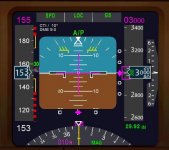
Here is what a typical PFD looked like in landing mode and flaps fully extended:
It's a PFD from FSX, but the real one should look the same.
http://www.orbiter-forum.com/attachment.php?attachmentid=11906&stc=1&d=1373399602

Clearly there is red bar at the top and the bottom which indicated the airspeed limits.
How could they missed that?
 

Attachments

  • PFD Landing mode.jpg
    PFD Landing mode.jpg
    27.1 KB · Views: 31
It's ironic that a lot of people don't trust machines to fly planes / drive vehicles and prefer the human factor. Especially when most tasks in an airplane are already somewhat automated and could be automated fully with some more R&D and work.

It's likely that if the ILS was working, this wouldn't have happened...
 
Back
Top