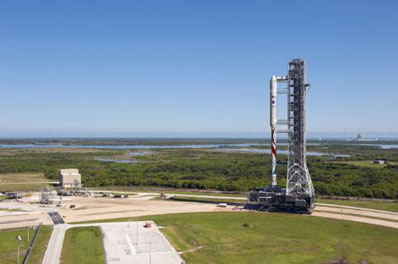
News ATK & Astrium Liberty™ Launch Vehicle

Why not use Ariane 5 that is already in operation? Performance is quite similar to Liberty then why spend money to develop yet another rocket that will do the same thing. Using Ariane 5 would also increase the flight rate which would help to keep costs down.
 
I agree. But ATK doesn't get any moolah from anyone with ArianeV, whereas the Liberty keeps their market open for the 5 segment "booster".
 
And "Liberty" sure sounds American ;)
 
Why not use Ariane 5 that is already in operation?
Ariane 5 = Launch from ELA-3, Kourou, French Guiana
Liberty = Launch from LC-39B, Merritt Island, Florida, USA
 
I'm not sure which way to lean on the Liberty rocket. In a way it looks cool, but then again it looks like a huge lawn dart.

I'm not so sure that Liberty will receive a whole lot of congressional support simply because of the Astrium EADS = not built here mentality. They might get some money, but I think I'd be dreaming if they were fully funded. Looking at the specs, it's throw weight really isn't all that impressive when you look at the cost.

But that's just my $0.02

All that being said I do have a simple mesh/texture/config via multistage of it...
Other projects are in front of it though.
 
All that being said I do have a simple mesh/texture/config via multistage of it...

If you have a nice second stage of it, I could integrate it into the Ares I-X Ultra add-on, I already designed it back then for launching more than ballast and instrumentation.
 
Ariane 5 = Launch from ELA-3, Kourou, French Guiana
Liberty = Launch from LC-39B, Merritt Island, Florida, USA

Upgrading the lauchpad to accept existing rocket should be cheaper than developing new rocket (that also need different launchpad). Or alternatively what is the problem of lauching from Kuorou? I guess too much not made in US problem.
 
Or alternatively what is the problem of lauching from Kuorou?
The whole reason the Liberty rocket is being developed is to launch it from KSC, not Kourou. Or alternatively, NASA should consider closing KSC until SLS is ready (or not), and all others should launch existing rockets from Kourou. It's much better place to launch rockets, after all, and 3 types of those existing rockets can be utilized, no development required.

Upgrading the lauchpad to accept existing rocket should be cheaper than developing new rocket (that also need different launchpad).
But the launchpad is being upgraded to accept various rockets. It has been made a clean pad for that reason, and not because SLS or Constellation required a clean pad.
 
To ATK, Ariane is useless since it doesn't contain any hardware made by them; the fact that it launches from Korou is irrelevant. They're in the business of making SRMs, and Liberty is simply another way for them to sell their product.

From the NASA point of view, both the fact that Liberty launches from US soil and uses US-built components are a plus (and obviously why it would be a choice over Ariane), but doesn't make its use essential- there are suggestions to use LC-39 (along with special launch platforms) as a launch site for other vehicles, such as Atlas (which, unlike Liberty, has been selected by multiple CCDev competitors).

Diversity can be a good thing, but in recent years while there have been many people developing launch vehicles, there have been comparatively fewer efforts at developing payloads to launch on them. If the number of vehicles rises but the launch demand remains constant, the number of flights over which the cost of each vehicle will be amortised over will be reduced- and flight costs will rise.
 
Last edited:
Also, all other US companies already have their own products for the US market, and won't have any motivation to cooperate with ATK. Ariane is the best second choice in this context and for EADS, this is another chance to get on the American aerospace market, which failed pretty often lately. US senators would rather buy Chinese, than European it seems.
 
To ATK, Ariane is useless since it doesn't contain any hardware made by them; the fact that it launches from Korou is irrelevant. They're in the business of making SRMs, and Liberty is simply another way for them to sell their product.

From the NASA point of view, both the fact that Liberty launches from US soil and uses US-built components are a plus (and obviously why it would be a choice over Ariane), but doesn't make its use essential- there are suggestions to use LC-39 (along with special launch platforms) as a launch site for other vehicles, such as Atlas (which, unlike Liberty, has been selected by multiple CCDev competitors).

Diversity can be a good thing, but in recent years while there have been many people developing launch vehicles, there have been comparatively fewer efforts at developing payloads to launch on them. If the number of vehicles rises but the launch demand remains constant, the number of flights over which the cost of each vehicle will be amortised over will be reduced- and flight costs will rise.

Well they now have an anchor payload for it: ATK now has its own commercial crew spacecraft (something a la an Orion derivative) to launch on Liberty!

NASASpaceflight.com: ATK announce Liberty KSC test flights, reveal crew spacecraft with MLAS
 
Liberty second stage

If you have a nice second stage of it, I could integrate it into the Ares I-X Ultra add-on, I already designed it back then for launching more than ballast and instrumentation.

I'll see if I can clean it up and get something to you soon after I'm back from vacation.
 
Spaceflight Now - 09/05/2012

[FONT=VERDANA, ARIAL, HELVETICA, SANS-SERIF][SIZE=+2]ATK adds crew capsule to Liberty rocket proposal[/SIZE][/FONT]

[FONT=VERDANA, ARIAL, HELVETICA, SANS-SERIF][SIZE=-2]BY STEPHEN CLARK
SPACEFLIGHT NOW

Posted: May 9, 2012[/SIZE][/FONT]
spacer.gif


Joining a growing list of aerospace companies competing to build a commercial crew taxi for NASA, rocket contractor ATK announced Wednesday it could launch astronauts into orbit by 2015 aboard the firm's Liberty rocket and a composite module derived from existing programs.

liberty1.jpg

[FONT=Verdana, Arial, Helvetica, sans-serif][SIZE=-2]Artist's concept of the Liberty rocket rolling to the launch pad at the Kennedy Space Center. Credit: ATK[/SIZE][/FONT]

But the Liberty bid faces stiff competition from other companies hoping to snare a slice of NASA funding. And Congress is likely to appropriate less funding than NASA requested for the commercial crew program, potentially leading to delays for any company which wins an award.

NASA is counting on commercial providers to build a crewed rocket and spacecraft to end U.S. reliance on Russia's Soyuz capsules for astronaut trips to the International Space Station.

A proposal for the Liberty rocket and spacecraft was submitted to NASA in March. The space agency expects to announce in August awards of between $300 million and $500 million to at least two companies over a 21-month period.

ATK is vying for NASA awards with SpaceX, Boeing Co., Sierra Nevada Corp., and other companies working on commercial crew transportation vehicles. Unlike other companies, ATK's Liberty program is currently operating entirely on private funding.

But much of Liberty's design, including the rocket's propulsion systems and the composite spacecraft, would recycle previous work on government-funded programs in the United States and Europe.

ATK's late 2015 target date for the system's first crewed flight is earlier than its competitors say they will be ready for a similar mission.

Kent Rominger, ATK's vice president and program manager for Liberty, said the program can meet the ambitious schedule thanks to its incorporation of proven designs used by the space shuttle, Europe's successful Ariane 5 rocket, and work already underway on NASA's Orion multipurpose crew vehicle.

"Our major components are either flying, at the [critical design review] level, or very close," Rominger said in an interview before Wednesday's announcement.

But without a monetary investment from NASA, ATK says it could not meet a 2015 goal for a manned flight. If ATK does not receive NASA funding, Rominger said Liberty's development would continue, but at a slower pace.

ATK, the builder of the space shuttle's strap-on boosters, said it would combine an extended version of the shuttle solid rocket motor with an upper stage based on the cryogenic core of Europe's Ariane 5 rocket. A seven-person capsule built by ATK and Lockheed Martin Corp. would fly into orbit on top of the two-stage Liberty launcher.

ccm.jpg

[FONT=Verdana, Arial, Helvetica, sans-serif][SIZE=-2]File photo of ATK's composite crew module. Credit: ATK[/SIZE][/FONT]

The spacecraft would be made of a lightweight composite shell developed by ATK in partnership with NASA's Langley Research Center beginning in 2007. ATK and Langley built a composite pressure vessel as an alternative to the Orion spacecraft's aluminum-lithium structure.

Lockheed Martin, Orion's prime contractor, picked a traditional metallic shell for the craft, which the space agency is developing to fly astronauts to destinations beyond low Earth orbit. But the composite structure picked by ATK for its commercial crew proposal has approximately the same shape as the Orion spacecraft.

"Each subsystem we're tailoring because Liberty has a simpler mission than the deep space missions that Orion will do," said Scott Norris, the lead Liberty manager from Lockheed Martin, one of the program's main subcontractors.

ATK hopes to use the structural design and tooling developed for the composite crew module for the Liberty spacecraft, which would carry astronauts to the International Space Station and back to Earth. The Liberty capsule would stay docked to the complex for more than six months.

Norris told Spaceflight Now on Wednesday that Lockheed Martin would oversee final assembly of the spacecraft at the Kennedy Space Center. Lockheed Martin would also build the Liberty spacecraft's service module and manage integration of the capsule's avionics provided by other subcontractors.

According to Rominger, an award in the expected range of $300 million to $500 million would allow ATK to reach an overall system critical design review in 2014.

Before then, ATK and Lockheed Martin plan to advance testing of Liberty's avionics through 2013, assuming Liberty wins an award from NASA.

Ground test firings of an air-start version of the Ariane 5's Vulcain 2 main engine are also scheduled to begin in mid-2013. Rominger said the Vulcain tests would likely occur at NASA's Stennis Space Center in Mississippi.
ATK would begin placing personnel at the Kennedy Space Center in late 2012. According to Rominger, Liberty processing and launch operations would eventually bring up to 150 jobs to the Florida spaceport.

ariane5_epc.jpg

[FONT=Verdana, Arial, Helvetica, sans-serif][SIZE=-2]File photo of the cryogenic core stage of an Ariane 5 rocket, which will be modified to become the upper stage of the Liberty launch vehicle. Credit: EADS Astrium[/SIZE][/FONT]

Other milestones planned through 2014 include testing of Liberty's pyrotechnic stage separation system. The rocket's launch abort computer, designed to detect impending failures before they become catastrophic, will also be developed beginning after an August award.

Rominger said ATK does not plan further test firings of Liberty's first stage motor after three successful ground ignitions conducted under the auspices of the canceled Ares rocket program and for the Space Launch System, NASA's heavy-lift booster for deep space exploration.

The Liberty critical design review would lead to a pad abort test using the rocket's Max Launch Abort System in August 2014, Rominger said. The Max Launch Abort System, or MLAS, is a rocket system designed to propel a crew capsule away from a failed launch vehicle.

The MLAS differs from traditional launch abort systems in that it would push a spacecraft away from a rocket. Previous launch escape motors, including the system on Russia's Soyuz rocket, use towers on top of the launcher, adding height and weight to the vehicle.

The MLAS does not require such a tower.

"The abort off the pad is one of the most challenging flight scenarios," Rominger said. "You want that system to get you a mile away from the pad. If the pad turns into a big fireball, you don't want the crew coming down anywhere near it. Our system has that kind of capability."

"Later [in 2014], we will do another ascent abort test that simulates the second stage not igniting," Rominger said.

The ascent abort in late 2014 would launch from the Kennedy Space Center with a five-segment first stage motor.

An unmanned orbital flight test would follow in early 2015, then ATK would mount a crewed mission by late 2015, according to Rominger.

 
WHY does space.com always call CCDev vehicles "Space Taxis"? It makes them sound so unimportant. :facts:

A taxi is only unimportant, until you need one. and the USA badly needs one, that is not driven by Ivan. :lol:
 
Parabolic Arc: Liberty Second Stage a Step Closer to Production:
ARLINGTON, Va., June 28, 2012 (Astrium PR) – Astrium, the number one company in Europe for space technologies and systems, has successfully completed a set of tests on tank structures proving that key design and manufacturing processes used for Ariane launchers are ready for production of the Liberty commercial launch vehicle second stage with ATK.

The tests covering load-carrying cryogenic tanks demonstrate that existing Astrium processes can be leveraged to confirm the overall Liberty schedule and enable a speedy entry into service – and into orbit. Astrium is also working on leaner production processes for the second stage to bring best value to the Liberty launch vehicle.

{...}

Aviation Week: Astrium Says Tests Prove Viability Of Liberty Production

 
Parabolic Arc: ATK Completes Software TIM for Liberty:
ARLINGTON, Va., June 28, 2012 (ATK PR) – ATK completed its Liberty software technical interface meeting (TIM), which was held to support further development of the Liberty space transportation system under the company’s Space Act Agreement (SAA) with NASA for the Commercial Crew Development Program.

The software TIM was conducted to evaluate Liberty’s software development plan with the NASA Liberty team. The plan governs the software process used by Liberty and its subcontractors throughout development, integration, test and flight.

{...}
 
Back
Top