Launch News Atlas V to Launch WorldView-4

Nicholas Kang

Tutorial Publisher
Tutorial Publisher
News Reporter
Joined
Apr 3, 2016
Messages
522
Reaction score
11
Points
18
Location
-
MissionArt_WorldView_4_2_sm.jpg


av_wv4_r5916201663807PM63.jpg


av_wv4_r11916201670657PM63.jpg


av_wv4_e29132016120413AM63.JPG


av_wv4_e39132016120502AM63.JPG


Official ULA Launch Info Page:

http://www.ulalaunch.com/atlas-v-to-launch-worldview4.aspx?title=Atlas+V+to+Launch+WorldView-4&Category=2


Rocket/Payload: A United Launch Alliance Atlas V 401 configuration rocket will launch the WorldView-4 mission for DigitalGlobe. The Atlas V is provided by Lockheed Martin Commercial Launch Services.

Date/Site/Launch Time: Late October/early November, from Space Launch Complex (SLC)-3 at Vandenberg Air Force Base, California.

Mission Description: WorldView-4, a multispectral, high-resolution commercial imaging satellite owned and operated by DigitalGlobe, will help customers around the world see more of our changing planet. The satellite was built by Lockheed Martin Space Systems Company and will provide 31-centimeter panchromatic resolution and 1.24-meter multispectral resolution—the same resolution offered by the WorldView-3 satellite. This industry-leading resolution provides the sharpest view of vital details on the ground, to give customers confidence when making critical decisions.

Launch Notes: WorldView-4 marks ULA’s 9th launch of 2016 and 112th since the company was founded in 2006. ULA also launched WorldView-3 on Atlas V in 2014.

Launch Update:

Update: Oct. 10, 2016, 4:30 p.m. PDT: Launch of the Atlas V carrying the WorldView-4 spacecraft for DigitalGlobe launch is targeted for late October/early Nov. pending final evaluation of infrastructure following the recent wildfires on Vandenberg Air Force Base. ULA will continue to work with DigitalGlobe and the 30th Space Wing to establish a new launch date.

Mission Profile:


Atlas V WorldView-4 Mission Overview:

http://www.ulalaunch.com/uploads/docs/Mission_Booklets/AV/av_wv4_mob.pdf

Go Atlas! Go Centaur! Go WorldView-4!
 
Last edited:
New launch date confirmed!

Date/Site/Launch Time: Sunday, Nov. 6 2016, from Space Launch Complex (SLC)-3 at Vandenberg Air Force Base, California. The launch window is 10:30-10:46 a.m. PST.

Live Broadcast: ULA’s live launch broadcast will begin at 10:05 a.m. PST.

Unfortunately, I won't be able to broadcast the launch live here as it is 1a.m. midnight here when WorldView4 is launched.

So, I will leave the job of broadcasting the launch to other members here. Good luck, WorldView4 and Godspeed Atlas!
 
Another delay.

Update: Nov. 2, 2016, 11:25 a.m. PDT - The launch of a United Launch Alliance Atlas V carrying the WorldView-4 satellite for DigitalGlobe is now scheduled for Nov. 11. The team is actively working to resolve minor Atlas V booster issues discovered during final preparations for launch. The Atlas V will launch from Space Launch Complex-3 at Vandenberg Air Force Base. The launch window is 10:30-10:46 a.m. PST.
 
WorldView 4 to Launch Today!

05-683x1024.jpg


Spaceflightnow.com: https://spaceflightnow.com/2016/11/10/atlas-5-rocket-and-worldview-4-satellite-ready-to-fly-after-wildfire-delay/

The live coverage will begin at 10:05 a.m. local / 1:05 p.m. EST / 1805 GMT here:


Here is the launch profile from spaceflightnow.com:https://spaceflightnow.com/2016/11/10/timeline-atlas-5worldview-4-ascent-profile/

T+0:00:01.1: Liftoff

01-3.jpg


The United Launch Alliance Atlas 5 vehicle, designated AV-062, will lift off and begin a vertical rise away from Space Launch Complex 3-East at Vandenberg.

T+0:01:19.1: Mach 1 and Max Q

02-3.jpg


The Atlas rocket achieves Mach 1 some 79 seconds into the flight, then passes through the region of maximum dynamic pressure at 94 seconds.

T+0:04:03.1: Main Engine Cutoff

03-3.jpg


The RD-180 main engine completes its firing after consuming the load of RP-1 kerosene fuel and liquid oxygen supply in the Atlas first stage.

T+0:04:09.1: Stage Separation

04-3.jpg


The Common Core Booster first stage of the Atlas 5 rocket separates from the Centaur upper stage. Over the next few seconds, the Centaur engine liquid hydrogen and liquid oxygen systems are readied for ignition.

T+0:04:19.0: Centaur Ignition No. 1

05-3.jpg


The Centaur RL10C-1 engine ignites for the longer of the two upper stage firings. This burn will inject the Centaur stage and WorldView 4 spacecraft into polar orbit.

T+0:04:27.1: Nose Cone Jettison

06-3.jpg


The two-piece, 14-foot-diameter payload fairing that protected the WorldView 4 spacecraft during the atmospheric ascent is separated to reveal the satellite to space.

T+0:15:36.9: Centaur Engine Cutoff No. 1

07-3.jpg


The Centaur engine shuts down after arriving in the planned sun-synchronous orbit of 379 by 390 miles tilted 97.96 degrees to the equator.

T+0:19:15.9: Spacecraft Separation

08-3.jpg


The high-resolution WorldView 4 imaging satellite is released into orbit from the Centaur upper stage to complete the primary objectives of the AV-062 launch.

T+2:11:45.9: Cubesat Separation

09-3.jpg


Seven tiny Cubesats being launched through a National Reconnaissance Office-sponsored rideshare, called the ENTERPRISE mission, are ejected from carriers mounted near the RL10 engine over a period of 14 minutes. The Centaur then executes another burn to escape Earth and enter solar orbit.

Also, there is a 360 VR Satellite Launch 3D video by DigitalGlobe here:


or you may choose the 2D one:


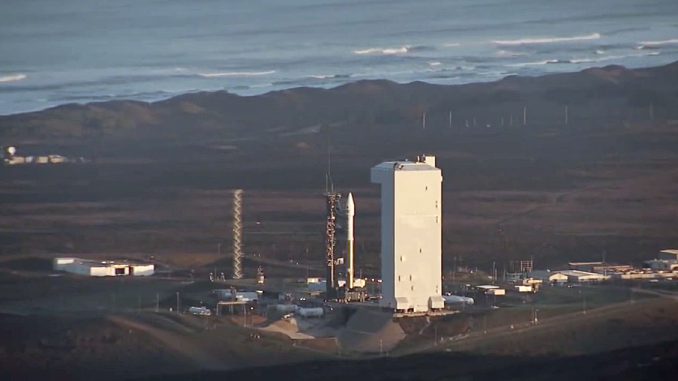
Rocket and launch pad position:

hill_front-678x381.jpg
 
Centaur upper stage venting its excess fuel caught on camera

Last night in Sweden, aurora tour guide Oliver Wright led a group of 8 under the starry skies of Abisko National Park hoping for a glimpse of the aurora borealis. "Suddenly," says Wright, "one of the guests shouted what's that? "I grabbed my binoculars and saw this amazing crescent-shaped thing moving slowly across the sky." It was not the aurora borealis:

7yrYbW.jpg

http://ipic.su/7yrYbW.jpg

Taken by Chad Blakley on November 11, 2016 @ Abisko National Park, Sweden
http://spaceweathergallery.com/indiv_upload.php?upload_id=130644


"I had never seen anything like it," says Wright, "so I called Chad Blakley of Lights over Lapland, and he confirmed that his live webcam saw it too." A four-frame animation shows it moving slowly across the sky for more than 20 minutes.

What was it? Mystery solved: Earlier in the day, an Atlas V rocket blasted off from Vandenberg Air Force Base in California carrying the Worldview 4 satellite to orbit. Later, the rocket's Centaur upper stage vented its excess fuel, creating the ghostly cloud over Sweden.

For Wright and his guests, the show was far from over. "A huge aurora started to develop around the Moon and became a magnificent corona above our heads," he says. This is a 1/2 second exposure:

7yrYc0.jpg

http://ipic.su/7yrYc0.jpg

Taken by Chad Blakley on November 11, 2016 @ Abisko National Park, Sweden
http://spaceweathergallery.com/full...2769.jpg&PHPSESSID=5drc2th50h7vibptep61105ob1


"It was moving super fast--the fastest corona I've seen in 3 years of guiding," says Wright. "In the end we had some super happy guests and a super happy guide!"

Details:
Another great night in Abisko! Massive auroras and an unidentified object are dancing in the sky above Abisko National Park right now! Our group of eight lucky aurora watchers were out in the National Park enjoying a fantastic aurora display this evening when something very odd appeared in the sky. At around 10:40 PM local time I received a text message from Lights Over Lapland guide Oliver Wright informing me that he had just seen and photographed something spectacular, that he could not easily recognise. I immediately checked our webcam and I was blown away by what I saw – a crescent shaped beam of light, with what appears to be some sort of a flowing, cloud like tail. At first I thought the object was lens flare produced by the bright Moon, but the object has moved from one area of the sky to another in four sequential photographs captured over a 20 minute timeframe. Seeing this incredible phenomenon share the sky with a powerful corona must have truly been a once in a lifetime event for our guests. You can see all of the frames from the sequence on our live webcam here: http://lightsoverlapland.com/webcams/ Can anyone help us understand exactly what we saw in the sky tonight?

A four-frame animation:
http://gifmaker.cc/PlayFrameAnimation.php?folder=20161111112AQX0Bxv76PGdc8vW3ijQl
 
WorldView 4 high-resolution satellite now open for business in space
C3w0K8AWIAQsgKJ.jpg-large.jpeg

Less than three months after rocketing into space, the commercial WorldView 4 Earth-imagery satellite has finished in-orbit testing and calibration to begin operations for DigitalGlobe.
To commemorate the milestone, the company has released a stunning image taken from space of the United Launch Alliance Atlas 5 blasting off with WorldView 4 on Nov. 11 from Vandenberg Air Force Base, California.
The picture was snapped by WorldView 2, which launched from the same base atop a Delta 2 booster in 2009. The image was captured as WorldView 2 was 396 miles (637 km) northeast of Vandenberg and 38 degrees off-nadir, according to DigitalGlobe.
http://spaceflightnow.com/2017/02/03/worldview-4-high-resolution-satellite-now-open-for-business-in-space/
 
Well that is a bummer. No RCS for even a shorted time? A little concerning that a single gyro failure is enough to kill the mission.
 
I think it's one of the fine-pointing gyros used for high-resolution imaging... without it, they can't get their advertised resolution. So yeah, mission kill, even though it's not a LOV.
 
Back
Top