Updates Cassini Mission News and Updates

...And there's more today from Cassini than I thought - below.
________________________________________

NASA / NASA JPL:
Cassini Sends Back Postcards of Saturn Moons

February 01, 2011

On Jan. 31, 2011, NASA's Cassini spacecraft passed by several of Saturn's intriguing moons, snapping images along the way. Cassini passed within about 60,000 kilometers (37,282 miles) of Enceladus and 28,000 kilometers (17,398 miles) of Helene. It also caught a glimpse of Mimas in front of Saturn's rings. In one of the images, Cassini is looking at the famous jets erupting from the south polar terrain of Enceladus.

[table="head;width=625"]{colsp=3}
Click on images for details​

||

This image of Saturn's moon Helene was obtained by NASA's Cassini spacecraft on Jan. 31, 2011. Image credit: NASA/JPL/SSI
|
This image of Saturn's moon Enceladus was obtained by NASA's Cassini spacecraft on Jan. 31, 2011. It shows the famous jets erupting from the south polar terrain of Enceladus. Image credit: NASA/JPL/SSI
|
This image of Saturn's moon Mimas was obtained by NASA's Cassini spacecraft on Jan. 31, 2011. It shows the bright, icy moon in front of Saturn's delicate rings. Image credit: NASA/JPL/SSI
[/table]​


To see more raw images, go to http://saturn.jpl.nasa.gov/photos/raw/ and click on "Search Images."

{...}
 
Cassini Finds Enceladus is a Powerhouse

NASA / NASA JPL:
Cassini Finds Enceladus is a Powerhouse

March 07, 2011

PASADENA, Calif. – Heat output from the south polar region of Saturn's moon Enceladus is much greater than was previously thought possible, according to a new analysis of data collected by NASA's Cassini spacecraft. The study was published in the Journal of Geophysical Research on March 4.

Data from Cassini's composite infrared spectrometer of Enceladus' south polar terrain, which is marked by linear fissures, indicate that the internal heat-generated power is about 15.8 gigawatts, approximately 2.6 times the power output of all the hot springs in the Yellowstone region, or comparable to 20 coal-fueled power stations. This is more than an order of magnitude higher than scientists had predicted, according to Carly Howett, the lead author of study, who is a postdoctoral researcher at Southwest Research Institute in Boulder, Colo., and a composite infrared spectrometer science team member.

"The mechanism capable of producing the much higher observed internal power remains a mystery and challenges the currently proposed models of long-term heat production," said Howett.

[table="head;width=225"]
Click on image for details​


This graphic, using data from NASA's Cassini spacecraft, shows how the south polar terrain of Saturn's moon Enceladus emits much more power than scientists had originally predicted. Image credit: NASA/JPL/SWRI/SSI
[/table]​


It has been known since 2005 that Enceladus' south polar terrain is geologically active and the activity is centered on four roughly parallel linear trenches, 130 kilometers (80 miles) long and about 2 kilometers (1 mile) wide, informally known as the "tiger stripes." Cassini also found that these fissures eject great plumes of ice particles and water vapor continually into space. These trenches have elevated temperatures due to heat leaking out of Enceladus' interior.

A 2007 study predicted the internal heat of Enceladus, if principally generated by tidal forces arising from the orbital resonance between Enceladus and another moon, Dione, could be no greater than 1.1 gigawatts averaged over the long term. Heating from natural radioactivity inside Enceladus would add another 0.3 gigawatts.

The latest analysis, which also involved the composite infrared spectrometer team members John Spencer at Southwest Research Institute, and John Pearl and Marcia Segura at NASA's Goddard Space Flight Center in Greenbelt, Md., uses observations taken in 2008, which cover the entire south polar terrain. They constrained Enceladus' surface temperatures to determine the region's surprisingly high output.

A possible explanation of the high heat flow observed is that Enceladus' orbital relationship to Saturn and Dione changes with time, allowing periods of more intensive tidal heating, separated by more quiescent periods. This means Cassini might be lucky enough to be seeing Enceladus when it's unusually active.

The new, higher heat flow determination makes it even more likely that liquid water exists below Enceladus' surface, Howett noted.

Recently, scientists studying ice particles ejected from the plumes discovered that some of the particles are salt-rich, and are probably frozen droplets from a saltwater ocean in contact with Enceladus' mineral-rich rocky core. The presence of a subsurface ocean, or perhaps a south polar sea between the moon's outer ice shell and its rocky interior would increase the efficiency of the tidal heating by allowing greater tidal distortions of the ice shell.

"The possibility of liquid water, a tidal energy source and the observation of organic (carbon-rich) chemicals in the plume of Enceladus make the satellite a site of strong astrobiological interest," Howett said.

{...}
 
NASA / NASA JPL:
Cassini Sees Seasonal Rains Transform Titan's Surface

March 17, 2011

PASADENA, Calif. -- As spring continues to unfold at Saturn, April showers on the planet's largest moon, Titan, have brought methane rain to its equatorial deserts, as revealed in images captured by NASA's Cassini spacecraft. This is the first time scientists have obtained current evidence of rain soaking Titan's surface at low latitudes.

Extensive rain from large cloud systems, spotted by Cassini's cameras in late 2010, has apparently darkened the surface of the moon. The best explanation is these areas remained wet after methane rainstorms. The observations released today in the journal Science, combined with earlier results in Geophysical Research Letters last month, show the weather systems of Titan's thick atmosphere and the changes wrought on its surface are affected by the changing seasons.

[table="head;width=675"]{colsp=3}
Click on images for details and larger versions​

||

NASA's Cassini spacecraft chronicles the change of seasons as it captures clouds concentrated near the equator of Saturn's largest moon, Titan. Image credit: NASA/JPL/SSI
|
A huge arrow-shaped storm blows across the equatorial region of Titan in this image from NASA's Cassini spacecraft, chronicling the seasonal weather changes on Saturn's largest moon. Image credit: NASA/JPL/SSI
|
This series of images from NASA's Cassini spacecraft shows changes on the surface of Saturn's moon Titan, as the transition to northern spring brings methane rains to the moon's equatorial latitudes. Image credit: NASA/JPL/SSI
[/table]​


"It's amazing to be watching such familiar activity as rainstorms and seasonal changes in weather patterns on a distant, icy satellite," said Elizabeth Turtle, a Cassini imaging team associate at the Johns Hopkins University Applied Physics Lab in Laurel, Md., and lead author of today's publication. "These observations are helping us to understand how Titan works as a system, as well as similar processes on our own planet."

The Saturn system experienced equinox, when the sun lies directly over a planet's equator and seasons change, in August 2009. (A full Saturn "year" is almost 30 Earth years.) Years of Cassini observations suggest Titan's global atmospheric circulation pattern responds to the changes in solar illumination, influenced by the atmosphere and the surface, as detailed in the Geophysical Research Letters paper. Cassini found the surface temperature responds more rapidly to sunlight changes than does the thick atmosphere. The changing circulation pattern produced clouds in Titan's equatorial region.

Clouds on Titan are formed of methane as part of an Earth-like cycle that uses methane instead of water. On Titan, methane fills lakes on the surface, saturates clouds in the atmosphere, and falls as rain. Though there is evidence that liquids have flowed on the surface at Titan's equator in the past, liquid hydrocarbons, such as methane and ethane, had only been observed on the surface in lakes at polar latitudes. The vast expanses of dunes that dominate Titan's equatorial regions require a predominantly arid climate. Scientists suspected that clouds might appear at Titan's equatorial latitudes as spring in the northern hemisphere progressed. But they were not sure if dry channels previously observed were cut by seasonal rains or remained from an earlier, wetter climate.

An arrow-shaped storm appeared in the equatorial regions on Sept. 27, 2010 -- the equivalent of early April in Titan's "year" -- and a broad band of clouds appeared the next month. As described in the Science paper, over the next few months, Cassini's imaging science subsystem captured short-lived surface changes visible in images of Titan's surface. A 193,000-square-mile (500,000-square-kilometer) region along the southern boundary of Titan's Belet dune field, as well as smaller areas nearby, had become darker. Scientists compared the imaging data to data obtained by other instruments and ruled out other possible causes for surface changes. They concluded this change in brightness is most likely the result of surface wetting by methane rain.

These observations suggest that recent weather on Titan is similar to that over Earth's tropics. In tropical regions, Earth receives its most direct sunlight, creating a band of rising motion and rain clouds that encircle the planet.

"These outbreaks may be the Titan equivalent of what creates Earth's tropical rainforest climates, even though the delayed reaction to the change of seasons and the apparently sudden shift is more reminiscent of Earth's behavior over the tropical oceans than over tropical land areas," said Tony Del Genio of NASA's Goddard Institute for Space Studies, New York, a co-author and a member of the Cassini imaging team.

On Earth, the tropical bands of rain clouds shift slightly with the seasons but are present within the tropics year-round. On Titan, such extensive bands of clouds may only be prevalent in the tropics near the equinoxes and move to much higher latitudes as the planet approaches the solstices. The imaging team intends to watch whether Titan evolves in this fashion as the seasons progress from spring toward northern summer.

"It is patently clear that there is so much more to learn from Cassini about seasonal forcing of a complex surface-atmosphere system like Titan's and, in turn, how it is similar to, or differs from, the Earth's," said Carolyn Porco, Cassini imaging team lead at the Space Science Institute, Boulder, Colo. "We are eager to see what the rest of Cassini's Solstice Mission will bring."

{...}
 
NASA / NASA JPL:
Cassini Finds Saturn Sends Mixed Signals

March 22, 2011

Like a petulant adolescent, Saturn is sending out mixed signals.

Recent data from NASA's Cassini spacecraft show that the variation in radio waves controlled by the planet's rotation is different in the northern and southern hemispheres. Moreover, the northern and southern rotational variations also appear to change with the Saturnian seasons, and the hemispheres have actually swapped rates. These two radio waves, converted to the human audio range, can be heard in a new video available online at: http://www.nasa.gov/multimedia/videogallery/index.html?media_id=74390781

[table="head;width=450"]{colsp=2}
Click on images for details​

|

This unique image from NASA/ESA's Hubble Space Telescope from early 2009 features Saturn with the rings edge-on and both poles in view, offering a stunning double view of its fluttering auroras. Image credit: NASA/ESA/STScI/University of Leicester
|
Mixed Signals from Saturn​
(VIDEO)​
[/table]​


"These data just go to show how weird Saturn is," said Don Gurnett, Cassini's radio and plasma wave science instrument team lead and professor of physics at the University of Iowa, Iowa City. "We thought we understood these radio wave patterns at gas giants, since Jupiter was so straightforward. Without Cassini's long stay, scientists wouldn't have understood that the radio emissions from Saturn are so different."

Saturn emits radio waves known as Saturn Kilometric Radiation, or SKR for short. To Cassini, they sound a bit like bursts of a spinning air raid siren, since the radio waves vary with each rotation of the planet. This kind of radio wave pattern had been previously used at Jupiter to measure the planet's rotation rate, but at Saturn, as is the case with teenagers, the situation turned out to be much more complicated.

When NASA's Voyager spacecraft visited Saturn in the early 1980s, the radiation emissions indicated the length of Saturn's day was about 10.66 hours. But as its clocking continued by a flyby of the joint ESA-NASA Ulysses spacecraft and Cassini, the radio burst varied by seconds to minutes. A paper in Geophysical Research Letters in 2009 analyzing Cassini data showed that the Saturn Kilometric Radiation was not even a solo, but a duet, with two singers out of sync. Radio waves emanating from near the north pole had a period of around 10.6 hours; radio waves near the south pole had a period of around 10.8 hours.

A new paper led by Gurnett that was published in Geophysical Research Letters in December 2010 shows that, in recent Cassini data, the southern and northern SKR periods crossed over around March 2010, about seven months after equinox, when the sun shines directly over a planet's equator. The southern SKR period decreased from about 10.8 hours on Jan. 1, 2008 and crossed with the northern SKR period around March 1, 2010, at around 10.67 hours. The northern period increased from about 10.58 hours to that convergence point.

Seeing this kind of crossover led the Cassini scientists to go back into data from previous Saturnian visits. With a new eye, they saw that NASA's Voyager data taken in 1980, about a year after Saturn's 1979 equinox, showed different warbles from Saturn's northern and southern poles. They also saw a similar kind of effect in the Ulysses radio data between 1993 and 2000. The northern and southern periods detected by Ulysses converged and crossed over around August 1996, about nine months after the previous Saturnian equinox.

Cassini scientists don't think the differences in the radio wave periods had to do with hemispheres actually rotating at different rates, but more likely came from variations in high-altitude winds in the northern and southern hemispheres. Two other papers involving Cassini investigators were published in December, with results complementary to the radio and plasma wave science instrument -- one by Jon Nichols, University of Leicester, U.K., in the same issue of Geophysical Research Letters, and the other led by David Andrews, also of University of Leicester, in the Journal of Geophysical Research.

In the Nichols paper, data from the NASA/ESA Hubble Space Telescope showed the northern and southern auroras on Saturn wobbled back and forth in latitude in a pattern matching the radio wave variations, from January to March 2009, just before equinox. The radio signal and aurora data are complementary because they are both related to the behavior of the magnetic bubble around Saturn, known as the magnetosphere. The paper by Andrews, a Cassini magnetometer team associate, showed that from mid-2004 to mid-2009, Saturn's magnetic field over the two poles wobbled at the same separate periods as the radio waves and the aurora.

"The rain of electrons into the atmosphere that produces the auroras also produces the radio emissions and affects the magnetic field, so scientists think that all these variations we see are related to the sun's changing influence on the planet," said Stanley Cowley, a co-author on both papers, co-investigator on Cassini's magnetometer instrument, and professor at the University of Leicester.

As the sun continues to climb towards the north pole of Saturn, Gurnett's group has continued to see the crossover trend in radio signals through Jan. 1, 2011. The period of the southern radio signals continued to decrease to about 10.54 hours, while the period of the northern radio signals increased to 10.71 hours.

"These papers are important in helping to explain the complicated dance between the sun and Saturn's magnetic bubble, something normally invisible to the human eye and imperceptible to the human ear," said Marcia Burton, a Cassini fields and particles scientist at NASA's Jet Propulsion Laboratory, Pasadena, Calif., who was not involved in the work. "Cassini will continue to keep an eye on these changes."

{...}
 
NASA / NASA JPL:
New Theory: Titan Shaped By Weather, Not Ice Volcanoes

April 07, 2011

Have the surface and belly of Saturn's smog-shrouded moon, Titan, recently simmered like a chilly, bubbling cauldron with ice volcanoes, or has this distant moon gone cold? In a newly published analysis, a pair of NASA scientists analyzing data collected by the Cassini spacecraft suggest Titan may be much less geologically active than some scientists have thought.

In the paper, published in the April 2011 edition of the journal Icarus, scientists conclude Titan's interior may be cool and dormant and incapable of causing active ice volcanoes.

"It would be fantastic to find strong evidence that clearly shows Titan has an internal heat source that causes ice volcanoes and lava flows to form," said Jeff Moore, lead author of the paper and a planetary scientist at NASA's Ames Research Center, Moffett Field, Calif. "But we find that the evidence presented to date is unconvincing, and recent studies of Titan's interior conducted by geophysicists and gravity experts also weaken the possibility of volcanoes there."

[table="head;width=450"]{colsp=2}
Click on images for details​

|

Four moons huddle near Saturn's multi-hued disk. Image credit: NASA/JPL-Caltech/Space Science Institute
|
These side-by-side images obtained by NASA's Cassini spacecraft show the feature named Tortola Facula on Saturn's moon Titan. Image credit: NASA/JPL-Caltech/University of Arizona

|

These images compare surface features observed by NASA's Cassini spacecraft at the Xanadu region on Saturn's moon Titan (left), and features observed by NASA's Galileo spacecraft on Jupiter's cratered moon Callisto (right). Image credit: NASA/JPL-Caltech
|
These two images demonstrate how, over time, rain can carve landscapes into formations that look like aspects of volcanoes. The images are computer simulation models of landform evolution by Alan Howard at the University of Virginia. Image credit: copyright A. Howard
[/table]​


Scientists agree that Titan shows evidence of having lakes of liquid methane and ethane, and valleys carved by these exotic liquids, as well as impact craters. However, a debate continues to brew about how to interpret the Cassini data on Titan. Some scientists theorize ice volcanoes exist and suggest energy from an internal heat source may have caused ice to rise and release methane vapors as it reached Titan's surface.

But in the new paper, the authors conclude that the only features on Titan's surface that have been unambiguously identified were created by external forces -- such as objects hitting the surface and creating craters; wind and rain pummeling its surface; and the formation of rivers and lakes.

"Titan is a fascinating world," said Robert Pappalardo, a research scientist at NASA's Jet Propulsion Laboratory, Pasadena, Calif., and former project scientist for NASA's Cassini mission. "Its uniqueness comes from its atmosphere and organic lakes, but in this study, we find no strong evidence for icy volcanism on Titan."

In December 2010, a group of Cassini scientists presented new topographic data on an area of Titan called Sotra Facula, which they think makes the best case yet for a possible volcanic mountain that once erupted ice on Titan. Although Moore and Pappalardo do not explicitly consider this recent topographic analysis in their paper, they do not find the recent analysis of Sotra Facula to be convincing so far. It remains to be seen whether ongoing analyses of Sotra Facula can change minds.

Titan, Saturn's largest moon, is the only known moon to have a dense atmosphere, composed primarily of nitrogen, with two to three percent methane. One goal of the Cassini mission is to find an explanation for what, if anything, might be maintaining this atmosphere.

Titan's dense atmosphere makes its surface very difficult to study with visible-light cameras, but infrared instruments and radar signals can peer through the haze and provide information about both the composition and shape of the surface.

"Titan is most akin to Jupiter's moon Callisto, if Callisto had weather," Moore added. "Every feature we have seen on Titan can be explained by wind, rain and meteorite impacts, rather than from internal heating."

Callisto is almost the exact same size as Titan. It has a cratered appearance, and because of its cool interior, its surface features are not affected by internal forces. Moore and Pappalardo conclude that Titan also might have a cool interior, with only external processes like wind, rain and impacts shaping its surface.

The Cassini spacecraft, currently orbiting Saturn, continues to make fly-bys of Titan. Scientists will continue to explore Titan's mysteries, including investigations of the changes in the landscapes.

{...}
 
NASA / NASA JPL:
Cassini Sees Saturn Electric Link With Enceladus

April 20, 2011

PASADENA, Calif. -- NASA is releasing the first images and sounds of an electrical connection between Saturn and one of its moons, Enceladus. The data collected by the agency's Cassini spacecraft enable scientists to improve their understanding of the complex web of interaction between the planet and its numerous moons. The results of the data analysis are published in the journals Nature

Scientists previously theorized an electrical circuit should exist at Saturn. After analyzing data that Cassini collected in 2008, scientists saw a glowing patch of ultraviolet light emissions near Saturn's north pole that marked the presence of a circuit, even though the moon is 240,000 kilometers (150,000 miles) away from the planet.

[table="head;width=450"]{colsp=2}
Click on images for details​

|

Electrical Circuit Between Saturn and EnceladusNASA's Cassini spacecraft has spotted a glowing patch of ultraviolet light near Saturn's north pole that marks the presence of an electrical circuit that connects Saturn with its moon Enceladus.
-​
Image credit: NASA/JPL/University of Colorado/Central Arizona College​
|Enceladus 'Footprint' on SaturnThis artist's concept shows a glowing patch of ultraviolet light near Saturn's north pole that occurs at the "footprint" of the magnetic connection between Saturn and its moon Enceladus.
-​
Credit: NASA/JPL/JHUAPL/University of Colorado/Central Arizona College/SSI​
[/table]​


The patch occurs at the end of a magnetic field line connecting Saturn and its moon Enceladus. The area, known as an auroral footprint, is the spot where energetic electrons dive into the planet's atmosphere, following magnetic field lines that arc between the planet's north and south polar regions.

"The footprint discovery at Saturn is one of the most important fields and particle revelations from Cassini and ultimately may help us understand Saturn's strange magnetic field," said Marcia Burton, a Cassini fields and particles scientist at NASA's Jet Propulsion Laboratory in Pasadena, Calif. "It gives us the first visual connection between Saturn and one of its moons."

[table="head;width=450"]{colsp=2}
Click on images to view videos​

|

Hiss from Aurora Caused by EnceladusThis video demonstrates the hiss-like radio noise generated by electrons moving along magnetic field lines from the Saturnian moon Enceladus to a glowing patch of ultraviolet light on Saturn.
-​
Image credit: NASA/JPL/University of Iowa​
|Saturn and Enceladus Electrical LinkThis animated graphic shows how Saturn and its moon Enceladus are electrically linked. Magnetic field lines, invisible to the human eye but detectable by the fields and particles instruments on NASA’s Cassini spacecraft, arc from Saturn’s north polar region to south polar region.
-​
Image credit: NASA/JPL/University of Iowa​
[/table]​


The auroral footprint measures approximately 1,200 kilometers (750 miles) by less than 400 kilometers (250 miles), covering an area comparable to California or Sweden. At its brightest, the footprint shone with an ultraviolet light intensity far less than Saturn's polar auroral rings, but comparable to the faintest aurora visible at Earth without a telescope in the visible light spectrum. Scientists have not found a matching footprint at the southern end of the magnetic field line.
Jupiter's active moon Io creates glowing footprints near Jupiter's north and south poles, so scientists suspected there was an analogous electrical connection between Saturn and Enceladus. It is the only known active moon in the Saturn system with jets spraying water vapor and organic particles into space. For years, scientists used space telescopes to search Saturn's poles for footprints, but they found none.

"Cassini fields and particles instruments found particle beams aligned with Saturn's magnetic field near Enceladus, and scientists started asking if we could see an expected ultraviolet spot at the end of the magnetic field line on Saturn," said Wayne Pryor, a lead author of the Nature study released today, and Cassini co-investigator at Central Arizona College in Coolidge, Ariz. "We were delighted to find the glow close to the 'bulls-eye' at the center of our target."

[table="head;width=225"]
Click on image for video​


Movie of Enceladus 'Footprint' on SaturnNASA's Cassini spacecraft has spotted a glowing patch of ultraviolet light near Saturn's north pole that marks the presence of an electrical circuit that connects Saturn with its moon Enceladus.
-​
Image Credit: NASA/JPL/University of Colorado/Central Arizona College​
[/table]​


In 2008, Cassini detected a beam of energetic protons near Enceladus aligned with the magnetic field and field-aligned electron beams. A team of scientists analyzed the data and concluded the electron beams had sufficient energy flux to generate a detectable level of auroral emission at Saturn. A few weeks later, Cassini captured images of an auroral footprint in Saturn's northern hemisphere. In 2009, a group of Cassini scientists led by Donald Gurnett at the University of Iowa in Iowa City, detected more complementary signals near Enceladus consistent with currents that travel from the moon to the top of Saturn's atmosphere, including a hiss-like sound from the magnetic connection. That paper was published in March in Geophysical Research Letters.

The water cloud above the Enceladus jets produces a massive, ionized "plasma" cloud through its interactions with the magnetic bubble around Saturn. This cloud disturbs the magnetic field lines. The footprint appears to flicker in these new data, so the rate at which Enceladus is spewing particles may vary.

"The new data are adding fuel to the fire of some long-standing debates about this active little moon," said Abigail Rymer, the other lead author of the Nature study and a Cassini team scientist based at the Johns Hopkins University Applied Physics Laboratory in Laurel, Md. "Scientists have been wondering whether the venting rate is variable, and these new data suggest that it is."

{...}


NASA JPL - Cassini Solstice:NASA: Cassini Probe Sees Electric Link With Saturn And One Of Its Moons

SPACE.com: Icy Moon Creates Extra Northern Lights on Saturn
 
NASA / NASA JPL:
Cassini and Telescope See Violent Saturn Storm

May 19, 2011

PASADENA, Calif. -- NASA's Cassini spacecraft and a European Southern Observatory ground-based telescope tracked the growth of a giant early-spring storm in Saturn's northern hemisphere that is so powerful it stretches around the entire planet. The rare storm has been wreaking havoc for months and shooting plumes of gas high into the planet's atmosphere.

Cassini's radio and plasma wave science instrument first detected the large disturbance, and amateur astronomers tracked its emergence in December 2010. As it rapidly expanded, its core developed into a giant, powerful thunderstorm. The storm produced a 3,000-mile-wide (5,000-kilometer-wide) dark vortex, possibly similar to Jupiter's Great Red Spot, within the turbulent atmosphere.

[table="head;width=625"]{colsp=3}
Click on images for details​

||

Thermal infrared images of Saturn from the Very Large Telescope Imager and Spectrometer for the mid-Infrared (VISIR) instrument on the European Southern Observatory's Very Large Telescope, on Cerro Paranal, Chile, appear at center and on the right. Image credit: ESO/Univ. of Oxford/T. Barry
|
This false-color infrared image, obtained by NASA's Cassini spacecraft, shows clouds of large ammonia ice particles dredged up by a powerful storm in Saturn's northern hemisphere. Image credit: NASA/JPL/Univ. of Arizona
|
Measurements by NASA's Cassini spacecraft reveal temperatures in a high layer of Saturn's atmosphere known as the stratosphere and show the dramatic effects of the massive storm deep below. Image credit: NASA/JPL/GSFC/Univ. Oxford
[/table]​


The dramatic effects of the deep plumes disturbed areas high up in Saturn's usually stable stratosphere, generating regions of warm air that shone like bright "beacons" in the infrared. Details are published in this week's edition of Science Magazine.

"Nothing on Earth comes close to this powerful storm," says Leigh Fletcher, the study's lead author and a Cassini team scientist at the University of Oxford in the United Kingdom. "A storm like this is rare. This is only the sixth one to be recorded since 1876, and the last was way back in 1990."

This is the first major storm on Saturn observed by an orbiting spacecraft and studied at thermal infrared wavelengths, where Saturn's heat energy reveals atmospheric temperatures, winds and composition within the disturbance.

Temperature data were provided by the Very Large Telescope (VLT) on Cerro Paranal in Chile and Cassini's composite infrared spectrometer (CIRS), operated by NASA's Goddard Space Flight Center in Greenbelt, Md.

"Our new observations show that the storm had a major effect on the atmosphere, transporting energy and material over great distances, modifying the atmospheric winds -- creating meandering jet streams and forming giant vortices -- and disrupting Saturn's slow seasonal evolution," said Glenn Orton, a paper co-author, based at NASA's Jet Propulsion Laboratory in Pasadena, Calif.

The violence of the storm -- the strongest disturbances ever detected in Saturn's stratosphere -- took researchers by surprise. What started as an ordinary disturbance deep in Saturn's atmosphere punched through the planet's serene cloud cover to roil the high layer known as the stratosphere.

"On Earth, the lower stratosphere is where commercial airplanes generally fly to avoid storms which can cause turbulence," says Brigette Hesman, a scientist at the University of Maryland in College Park who works on the CIRS team at Goddard and is the second author on the paper. "If you were flying in an airplane on Saturn, this storm would reach so high up, it would probably be impossible to avoid it."

Other indications of the storm's strength are the changes in the composition of the atmosphere brought on by the mixing of air from different layers. CIRS found evidence of such changes by looking at the amounts of acetylene and phosphine, both considered to be tracers of atmospheric motion. A separate analysis using Cassini's visual and infrared mapping spectrometer, led by Kevin Baines of JPL, confirmed the storm is very violent, dredging up larger atmospheric particles and churning up ammonia from deep in the atmosphere in volumes several times larger than previous storms. Other Cassini scientists are studying the evolving storm, and a more extensive picture will emerge soon.

{...}
 
NASA / NASA JPL:
Plasma Spectrometer Operations on Hold

June 15, 2011

PASADENA, Calif. – Mission managers for NASA's Cassini spacecraft suspended operation of the Cassini plasma spectrometer instrument on Tuesday, June 14, 2011, after a series of voltage shifts on the spacecraft. They will determine when the instrument can resume collecting data.

The Cassini spacecraft is designed to operate with a "balanced" voltage source to create a tolerance to short circuits. On May 1, a voltage shift occurred, most likely explained by a short circuit happening somewhere in the system. On June 11, a voltage shift in the opposite direction occurred, indicating an additional short circuit. In both cases, all instruments and engineering subsystems continued to operate properly.

Analysis of telemetry data from the spacecraft by the engineering team pointed to the Cassini plasma spectrometer instrument as the cause of the voltage shifts. The instrument has additional capacitors in the power lines for noise reduction. The concern was that one or more of these capacitors may have short-circuited, which would cause the voltage to shift and explain the observed changes. Although the instrument was operating properly, engineers decided to turn it off as a precaution until the events could be better understood.

The suspension of the plasma spectrometer operations is not expected to affect other science data gathering or navigation. The plan is to resume normal plasma spectrometer operations after further analysis is completed to understand the cause of the issue better.

{...}
 
NASA / NASA JPL:
Cassini Captures Ice Queen Helene

June 20, 2011

NASA's Cassini spacecraft has successfully completed its second-closest encounter with Saturn's icy moon Helene, beaming down raw images of the small moon. At closest approach, on June 18, Cassini flew within 4,330 miles (6,968 kilometers) of Helene's surface. It was the second closest approach to Helene of the entire mission.

[table="head;width=675"]{colsp=3}
Click on images for details​

||

NASA's Cassini spacecraft obtained this unprocessed image of Saturn's moon Helene on June 18, 2011.​
Image credit: NASA/JPL-Caltech/Space Science Institute​
|
NASA's Cassini spacecraft obtained this unprocessed image of Saturn's moon Helene on June 18, 2011.​
Image credit: NASA/JPL-Caltech/Space Science Institute​
|
NASA's Cassini spacecraft obtained this unprocessed image of Saturn's moon Helene on June 18, 2011.​
Image credit: NASA/JPL-Caltech/Space Science Institute​
[/table]​


Cassini passed from Helene's night side to the moon's sunlit side. It also captured images of the Saturn-facing side of the moon in sunlight, a region that was only illuminated by sunlight reflected off Saturn the last time Cassini was close, in March 2010. This flyby will enable scientists to finish creating a global map of Helene, so they can better understand the history of impacts to the moon and gully-like features seen on previous flybys.

The closest Helene encounter of the mission took place on March 10, 2010, when Cassini flew within 1,131 miles (1,820 kilometers) of the moon.

The latest raw images are online at: http://saturn.jpl.nasa.gov/photos/raw/.

{...}
 
NASA / NASA JPL:
Cassini Captures Ocean-Like Spray at Saturn Moon

June 22, 2011

PASADENA, Calif. -- NASA's Cassini spacecraft has discovered the best evidence yet for a large-scale saltwater reservoir beneath the icy crust of Saturn's moon Enceladus. The data came from the spacecraft's direct analysis of salt-rich ice grains close to the jets ejected from the moon.

[table="head;width=225"]
Click on image for details​


Dramatic plumes, both large and small, spray water ice out from many locations along the famed "tiger stripes" near the south pole of Saturn's moon Enceladus. The tiger stripes are fissures that spray icy particles, water vapor and organic compounds.
Image credit: NASA/JPL/Space Science Institute​
[/table]​


Data from Cassini's cosmic dust analyzer show the grains expelled from fissures, known as tiger stripes, are relatively small and predominantly low in salt far away from the moon. But closer to the moon's surface, Cassini found that relatively large grains rich with sodium and potassium dominate the plumes. The salt-rich particles have an "ocean-like" composition and indicate that most, if not all, of the expelled ice and water vapor comes from the evaporation of liquid salt water. The findings appear in this week's issue of the journal Nature.

"There currently is no plausible way to produce a steady outflow of salt-rich grains from solid ice across all the tiger stripes other than salt water under Enceladus's icy surface," said Frank Postberg, a Cassini team scientist at the University of Heidelberg, Germany, and the lead author on the paper. When water freezes, the salt is squeezed out, leaving pure water ice behind. If the plumes emanated from ice, they should have very little salt in them.

The Cassini mission discovered Enceladus' water-vapor and ice jets in 2005. In 2009, scientists working with the cosmic dust analyzer examined some sodium salts found in ice grains of Saturn's E ring, the outermost ring that gets its material primarily from Enceladean jets. But the link to subsurface salt water was not definitive.

The new paper analyzes three Enceladus flybys in 2008 and 2009 with the same instrument, focusing on the composition of freshly ejected plume grains. The icy particles hit the detector target at speeds between 15,000 and 39,000 mph (23,000 and 63,000 kilometers per hour), vaporizing instantly. Electrical fields inside the cosmic dust analyzer separated the various constituents of the impact cloud.

The data suggest a layer of water between the moon's rocky core and its icy mantle, possibly as deep as about 50 miles (80 kilometers) beneath the surface. As this water washes against the rocks, it dissolves salt compounds and rises through fractures in the overlying ice to form reserves nearer the surface. If the outermost layer cracks open, the decrease in pressure from these reserves to space causes a plume to shoot out. Roughly 400 pounds (200 kilograms) of water vapor is lost every second in the plumes, with smaller amounts being lost as ice grains. The team calculates the water reserves must have large evaporating surfaces, or they would freeze easily and stop the plumes.

"This finding is a crucial new piece of evidence showing that environmental conditions favorable to the emergence of life can be sustained on icy bodies orbiting gas giant planets," said Nicolas Altobelli, the European Space Agency's project scientist for Cassini.

Cassini's ultraviolet imaging spectrograph also recently obtained complementary results that support the presence of a subsurface ocean. A team of Cassini researchers led by Candice Hansen of the Planetary Science Institute in Tucson, Ariz., measured gas shooting out of distinct jets originating in the moon's south polar region at five to eight times the speed of sound, several times faster than previously measured. These observations of distinct jets, from a 2010 flyby, are consistent with results showing a difference in composition of ice grains close to the moon's surface and those that made it out to the E ring. That paper was published in the June 9 issue of Geophysical Research Letters.

"Without an orbiter like Cassini to fly close to Saturn and its moons -- to taste salt and feel the bombardment of ice grains -- scientists would never have known how interesting these outer solar system worlds are," said Linda Spilker, NASA's Cassini project scientist at the Jet Propulsion Laboratory in Pasadena, Calif.

{...}


ESA:
Cassini samples the icy spray of Enceladus' water plumes

[table="head;width=400"]
Click on images for larger versions​


Recent Cassini images of Saturn's moon Enceladus backlit by the Sun show the fountain-like sources of the fine spray of material that towers over the south polar region. The image was taken looking more or less broadside at the 'tiger stripe' fractures observed in earlier Enceladus images. It shows discrete plumes of a variety of apparent sizes above the limb of the moon. This enhanced and false-coloured image shows the enormous extent of the fainter, larger-scale component of the plume.​
Credits: NASA/JPL/Space Science Institute​


Jets of icy particles bursting from Saturn's moon Enceladus are shown in this NASA/ESA/ASI Cassini image taken on 27 November 2005. This and other recent images of Enceladus backlit by the Sun show the fountain-like sprays of the fine material that tower over the south polar region.​
This image was taken looking more or less broadside at the 'tiger stripe' fractures observed in earlier Enceladus images. It shows discrete plumes of a variety of apparent sizes above the limb of the moon.​
Credits: NASA/JPL/Space Science Institute​
[/table]​
 
NASA / NASA JPL:
Cassini Captures Images and Sounds of Saturn Storm

July 06, 2011

PASADENA, Calif. -- Scientists analyzing data from NASA's Cassini spacecraft now have the first-ever, up-close details of a Saturn storm that is eight times the surface area of Earth.

On Dec. 5, 2010, Cassini first detected the storm that has been raging ever since. It appears approximately 35 degrees north latitude of Saturn. Pictures from Cassini's imaging cameras show the storm wrapping around the entire planet covering approximately 2 billion square miles (4 billion square kilometers).

The storm is about 500 times larger than the biggest storm previously seen by Cassini during several months from 2009 to 2010. Scientists studied the sounds of the new storm's lightning strikes and analyzed images taken between December 2010 and February 2011. Data from Cassini's radio and plasma wave science instrument showed the lightning flash rate as much as 10 times more frequent than during other storms monitored since Cassini's arrival to Saturn in 2004. The data appear in a paper published this week in the journal Nature.

"Cassini shows us that Saturn is bipolar," said Andrew Ingersoll, an author of the study and a Cassini imaging team member at the California Institute of Technology in Pasadena, Calif. "Saturn is not like Earth and Jupiter, where storms are fairly frequent. Weather on Saturn appears to hum along placidly for years and then erupt violently. I'm excited we saw weather so spectacular on our watch."

At its most intense, the storm generated more than 10 lightning flashes per second. Even with millisecond resolution, the spacecraft's radio and plasma wave instrument had difficulty separating individual signals during the most intense period. Scientists created a sound file from data obtained on March 15 at a slightly lower intensity period.

[table="head;width=675"]{colsp=3}
Click on images for details​

||

The huge storm churning through the atmosphere in Saturn's northern hemisphere overtakes itself as it encircles the planet in this true-color view from NASA's Cassini spacecraft.
Image credit: NASA/JPL-Caltech/SSI​
|
These false-color images from NASA's Cassini spacecraft chronicle a day in the life of a huge storm that developed from a small spot that appeared 12 weeks earlier in Saturn's northern mid-latitudes.
Image credit: NASA/JPL-Caltech/SSI​
|
NASA's Cassini spacecraft captures a composite near-true-color view of the huge storm churning through the atmosphere in Saturn's northern hemisphere.
Image credit: NASA/JPL-Caltech/SSI​
[/table]​

Cassini has detected 10 lightning storms on Saturn since the spacecraft entered the planet's orbit and its southern hemisphere was experiencing summer, with full solar illumination not shadowed by the rings. Those storms rolled through an area in the southern hemisphere dubbed "Storm Alley." But the sun's illumination on the hemispheres flipped around August 2009, when the northern hemisphere began experiencing spring.

"This storm is thrilling because it shows how shifting seasons and solar illumination can dramatically stir up the weather on Saturn," said Georg Fischer, the paper's lead author and a radio and plasma wave science team member at the Austrian Academy of Sciences in Graz. "We have been observing storms on Saturn for almost seven years, so tracking a storm so different from the others has put us at the edge of our seats."

The storm's results are the first activities of a new "Saturn Storm Watch" campaign. During this effort, Cassini looks at likely storm locations on Saturn in between its scheduled observations. On the same day that the radio and plasma wave instrument detected the first lightning, Cassini's cameras happened to be pointed at the right location as part of the campaign and captured an image of a small, bright cloud. Because analysis on that image was not completed immediately, Fischer sent out a notice to the worldwide amateur astronomy community to collect more images. A flood of amateur images helped scientists track the storm as it grew rapidly, wrapping around the planet by late January 2011.

The new details about this storm complement atmospheric disturbances described recently by scientists using Cassini's composite infrared spectrometer and the European Southern Observatory's Very Large Telescope. The storm is the biggest observed by spacecraft orbiting or flying by Saturn. NASA's Hubble Space Telescope captured images in 1990 of an equally large storm.

{...}


NASA Press Release: RELEASE : 11-220 - Cassini Spacecraft Captures Images And Sounds Of Big Saturn Storm
 
NASA / NASA JPL:
Putting it all Together on Titan

August 08, 2011

Three of Titan's major surface features -- dunes, craters and the enigmatic Xanadu -- appear in this radar image from NASA's Cassini spacecraft. The hazy, bright area at the left that extends to the lower center of the image marks the northwest edge of Xanadu, a continent-sized feature centered near the moon's equator. At upper right is the crater Ksa, first seen by Cassini in 2006. The dark lines running between these two features are linear dunes, similar to sand dunes on Earth in Egypt and Namibia.

[table="head;width=225"]
Click on image for details​


Three of Titan's major surface features-dunes, craters and the enigmatic Xanadu-appear in this radar image from NASA's Cassini spacecraft.​
Image credit: NASA/JPL-Caltech​
[/table]​


The image was taken by Cassini's Titan Radar Mapper on June 21, 2011.

{...}

For more information, see: http://saturn.jpl.nasa.gov/photos/imagedetails/index.cfm?imageId=4338.


NASA JPL: Catalog page for the "PIA14500: Titan: Putting it all Together" image
 
NASA / NASA JPL:
Cassini Closes in on Saturn's Tumbling Moon Hyperion

August 26, 2011

NASA's Cassini spacecraft captured new views of Saturn's oddly shaped moon Hyperion during its encounter with this cratered body on Thursday, Aug. 25. Raw images were acquired as the spacecraft flew past the moon at a distance of about 15,500 miles (25,000 kilometers), making this the second closest encounter.

[table="head;width=675"]{colsp=3}
Click on images to enlarge​

||

NASA's Cassini spacecraft obtained this unprocessed image of Saturn's moon Hyperion on Aug. 25, 2011.​
Image credit: NASA/JPL-Caltech/Space Science Institute​
|
Side view taken by NASA's Cassini spacecraft of Saturn's moon Hyperion.​
Image credit: NASA/JPL-Caltech/Space Science Institute​
|
Closeup view of Hyperion taken by NASA's Cassini spacecraft.​
Image credit: NASA/JPL-Caltech/Space Science Institute​
[/table]​


Hyperion is a small moon -- just 168 miles (270 kilometers) across. It has an irregular shape and surface appearance, and it rotates chaotically as it tumbles along in orbit. This odd rotation prevented scientists from predicting exactly what terrain the spacecraft's cameras would image during this flyby.

However, this flyby's closeness has likely allowed Cassini's cameras to map new territory. At the very least, it will help scientists improve color measurements of the moon. It will also help them determine how the moon's brightness changes as lighting and viewing conditions change, which can provide insight into the texture of the surface. The color measurements provide additional information about different materials on the moon's deeply pitted surface.

The latest raw images of Hyperion are online at: http://saturn.jpl.nasa.gov/photos/raw/.

Cassini's closest encounter with Hyperion was on September 26, 2005, when the spacecraft flew approximately 310 miles (500 kilometers) above the moon's surface.
Cassini's next flyby of Hyperion will be on Sept. 16, 2011, when it passes the tumbling moon at a distance of about 36,000 miles (58,000 kilometers).

{...}
 
NASA / NASA JPL:
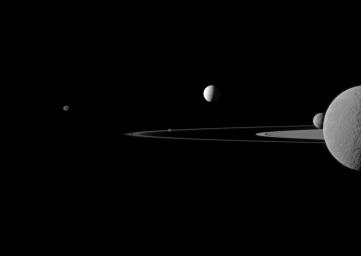
Cassini Presents Saturn Moon Quintet

September 16, 2011

With the artistry of a magazine cover shoot, NASA's Cassini spacecraft captured this portrait of five of Saturn's moons poised along the planet's rings.

[table="head;width=300"]
Click on image for details​


NASA's Cassini spacecraft captures five of Saturn's moons in one image: Janus, Pandora, Enceladus, Mimas and Rhea.
Image credit: NASA/JPL-Caltech/Space Science Institute​
[/table]​


From left to right are Janus, Pandora, Enceladus, Mimas and finally Rhea, bisected by the right side of the frame. The view was acquired at a distance of approximately 684,000 miles (1.1 million kilometers) from Rhea and 1.1 million miles (1.8 million kilometers) from Enceladus.

The image was taken in visible green light with the Cassini spacecraft narrow-angle camera on July 29, 2011. Image scale is about 4 miles (7 kilometers) per pixel on Rhea and 7 miles (11 kilometers) per pixel on Enceladus.

{...}
 
NASA / NASA JPL:
Saturn's Moon Enceladus Spreads Its Influence

September 21, 2011

Chalk up one more feat for Saturn's intriguing moon Enceladus. The small, dynamic moon spews out dramatic plumes of water vapor and ice -- first seen by NASA's Cassini spacecraft in 2005. It possesses simple organic particles and may house liquid water beneath its surface. Its geyser-like jets create a gigantic halo of ice, dust and gas around Enceladus that helps feed Saturn's E ring. Now, thanks again to those icy jets, Enceladus is the only moon in our solar system known to influence substantially the chemical composition of its parent planet.

[table="head;width=225"]
Click on image to enlarge​


Water vapor and ice erupt from Saturn's moon Enceladus, the source of a newly discovered donut-shaped cloud around Saturn.
Image credit: NASA/JPL-Caltech/Space Science Institute​
[/table]​


In June, the European Space Agency announced that its Herschel Space Observatory, which has important NASA contributions, had found a huge donut-shaped cloud, or torus, of water vapor created by Enceladus encircling Saturn. The torus is more than 373,000 miles (600,000 kilometers) across and about 37,000 miles (60,000 kilometers) thick. It appears to be the source of water in Saturn's upper atmosphere.

Though it is enormous, the cloud had not been seen before because water vapor is transparent at most visible wavelengths of light. But Herschel could see the cloud with its infrared detectors. "Herschel is providing dramatic new information about everything from planets in our own solar system to galaxies billions of light-years away," said Paul Goldsmith, the NASA Herschel project scientist at NASA's Jet Propulsion Laboratory, Pasadena, Calif.

The discovery of the torus around Saturn did not come as a complete surprise. NASA's Voyager and Hubble missions had given scientists hints of the existence of water-bearing clouds around Saturn. Then in 1997, the European Space Agency's Infrared Space Observatory confirmed the presence of water in Saturn's upper atmosphere. NASA's Submillimeter Wave Astronomy Satellite also observed water emission from Saturn at far-infrared wavelengths in 1999.

While a small amount of gaseous water is locked in the warm, lower layers of Saturn's atmosphere, it can't rise to the colder, higher levels. To get to the upper atmosphere, water molecules must be entering Saturn's atmosphere from somewhere in space. But from where and how? Those were mysteries until now.

Build the model and the data will come.

The answer came by combining Herschel's observations of the giant cloud of water vapor created by Enceladus' plumes with computer models that researchers had already been developing to describe the behavior of water molecules in clouds around Saturn.

One of these researchers is Tim Cassidy, a recent post-doctoral researcher at JPL who is now at the University of Colorado's Laboratory for Atmospheric and Space Physics, Boulder. "What's amazing is that the model," said Cassidy, "which is one iteration in a long line of cloud models, was built without knowledge of the observation. Those of us in this small modeling community were using data from Cassini, Voyager and the Hubble telescope, along with established physics. We weren't expecting such detailed 'images' of the torus, and the match between model and data was a wonderful surprise."

The results show that, though most of the water in the torus is lost to space, some of the water molecules fall and freeze on Saturn's rings, while a small amount -- about 3 to 5 percent -- gets through the rings to Saturn's atmosphere. This is just enough to account for the water that has been observed there.

Herschel's measurements combined with the cloud models also provided new information about the rate at which water vapor is erupting out of the dark fractures, known as "tiger stripes," on Enceladus' southern polar region. Previous measurements by the Ultraviolet Imaging Spectrograph (UVIS) instrument aboard the Cassini spacecraft showed that every second the moon is ejecting about 440 pounds (200 kilograms) of water vapor.

"With the Herschel measurements of the torus from 2009 and 2010 and our cloud model, we were able to calculate a source rate for water vapor coming from Enceladus," said Cassidy. "It agrees very closely with the UVIS finding, which used a completely different method."

"We can see the water leaving Enceladus and we can detect the end product -- atomic oxygen -- in the Saturn system," said Cassini UVIS science team member Candy Hansen, of the Planetary Science Institute, Tucson, Ariz. "It's very nice with Herschel to track where it goes in the meantime."

While a small fraction of the water molecules inside the torus end up in Saturn's atmosphere, most are broken down into separate atoms of hydrogen and oxygen.
"When water hangs out in the torus, it is subject to the processes that dissociate water molecules," said Hansen, "first to hydrogen and hydroxide, and then the hydroxide dissociates into hydrogen and atomic oxygen." This oxygen is dispersed through the Saturn system. "Cassini discovered atomic oxygen on its approach to Saturn, before it went into orbit insertion. At the time, no one knew where it was coming from. Now we do."

"The profound effect this little moon Enceladus has on Saturn and its environment is astonishing," said Hansen.

{...}

 
NASA / NASA JPL:
Saturn's Geyser Moon Enceladus Shows off for NASA's Cassini

October 03, 2011

PASADENA, Calif. -- NASA's Cassini spacecraft successfully completed its Oct. 1 flyby of Saturn's moon Enceladus and its jets of water vapor and ice. At its closest approach, the spacecraft flew approximately 62 miles (100 kilometers) above the moon's surface. The close approach was designed to give some of Cassini's instruments, including the ion and neutral mass spectrometer, the chance to "taste" the jets themselves.

At a higher vantage point during the encounter, Cassini's high-resolution camera captured pictures of the jets emanating from the moon's south polar region. The latest raw images of Enceladus are online at: http://saturn.jpl.nasa.gov/photos/raw/.

[table="head;width=675"]{colsp=3}
Click on images to enlarge​

||

Cassini sees jets of water vapor and ice from Enceladus.
Image credit: NASA/JPL-Caltech/Space Science Institute​
|
During Cassini's Oct. 1, 2011 flyby, Saturn's moon Enceladus was in full view.
Image credit: NASA/JPL-Caltech/Space Science Institute​
|
NASA's Cassini imaged Enceladus' surface during its Oct. 1, 2011 flyby.
Image credit: NASA/JPL-Caltech/Space Science Institute​
[/table]​


The images of the surface include previously seen leading-hemisphere terrain. However, during this encounter, multi-spectral imaging of these terrains extended farther into the ultraviolet region of the electromagnetic spectrum than had previously been achieved at this resolution. By looking at the surface at ultraviolet wavelengths, scientists can better detect the difference between surface materials and shadows than they can at visible wavelengths, where icy materials are highly reflective and shadows are washed out. With both ultraviolet and visible images of the same terrain available to them, scientists will better understand how the surface coverage of icy particles coming from the vents and plumes changes with terrain type and age.

Cassini's next pass of this fascinating moon will be Oct. 19, when the spacecraft flies by at an altitude of approximately 765 miles (1231 kilometers).

{...}


Discovery News: Cassini Buzzes Cracked and Cratered Enceladus
 
NASA / NASA JPL:
Orion's Belt Lights Up Cassini's View of Enceladus

October 18, 2011

NASA's Cassini mission will take advantage of the position of two of the three stars in Orion's belt when the spacecraft flies by Saturn's moon Enceladus on Wed., Oct. 19. As the hot, bright stars pass behind the moon's icy jets, Cassini's ultraviolet imaging spectrograph will acquire a two-dimensional view of these dramatic plumes of water vapor and icy material erupting from the moon's southern polar region. This flyby is the mission's first-ever opportunity to probe the jets with two stars simultaneously, a dual stellar occultation.

[table="head;width=225"]
Click on image for details​


Dramatic plumes, both large and small, spray water ice out from many locations along the famed "tiger stripes" near the south pole of Saturn's moon Enceladus.
Image credit: NASA/JPL/SSI​
[/table]​


From Cassini's viewpoint, the closest of Orion's stars will appear about 9 miles (15 kilometers) above the moon's limb, or outer edge. The second star will appear higher, about 19 miles (30 kilometers) from the limb. In the foreground will be Enceladus' icy plumes, which extend hundreds of miles into space.

As the spacecraft passes Enceladus, its infrared instruments, cameras and other instruments will also be monitoring activity on the moon. The orbiter will fly within about 765 miles (1,230 kilometers) of Enceladus' surface.

This flyby will provide researchers with new insight into the jets--their content, the speed at which they are travelling and how they vary. It will also provide new information on the famed "tiger stripes" from which the jets erupt. These fissures in Enceladus' surface are the "nozzles" from which the plumes are propelled at supersonic speeds. Knowing more about their structure may help unlock some of the secrets within Enceladus' interior, including the source of the water-rich plumes.

The Cassini mission celebrated the 14th anniversary of the spacecraft's launch last week.
Having completed its four-year prime mission in 2008, the mission is now on its second extension, the Cassini Solstice Mission. One of the mission's goals is to provide further information on previous Cassini discoveries, such as lakes on Titan and plumes on Enceladus, first detected by Cassini in 2005.

{...}

More information on the Enceladus flyby, called "E15," is available at: http://saturn.jpl.nasa.gov/mission/flybys/enceladus20111019/
 
NASA / NASA JPL:
Latest Cassini Images of Enceladus on View

October 20, 2011

Raw, unprocessed images from the successful Oct. 19 flyby of Saturn's moon Enceladus by NASA's Cassini spacecraft provide new views of the moon and the icy jets that burst from its southern polar region.

[table="head;width=225"]
Click on image for details​


Raw, unprocessed image of Saturn's moon Enceladus.
Image credit: NASA/JPL/Space Science Institute​
[/table]​


This flyby gave Cassini its first opportunity to observe Enceladus' plumes with two stars shining behind them, a dual stellar occultation.

To see the raw images, go to http://saturn.jpl.nasa.gov/photos/raw/ and click on "Search Images."

Cassini flew within about 765 miles (1,230 kilometers) of Enceladus' surface at 2:22 a.m. PDT (09:22 UTC) on Oct. 19.

{...}
 
Back
Top