Updates Cassini Mission News and Updates

Universe Today: "A New Look at Saturn’s Northern Hexagon"
8514146553_22bfd4354b_o.jpg


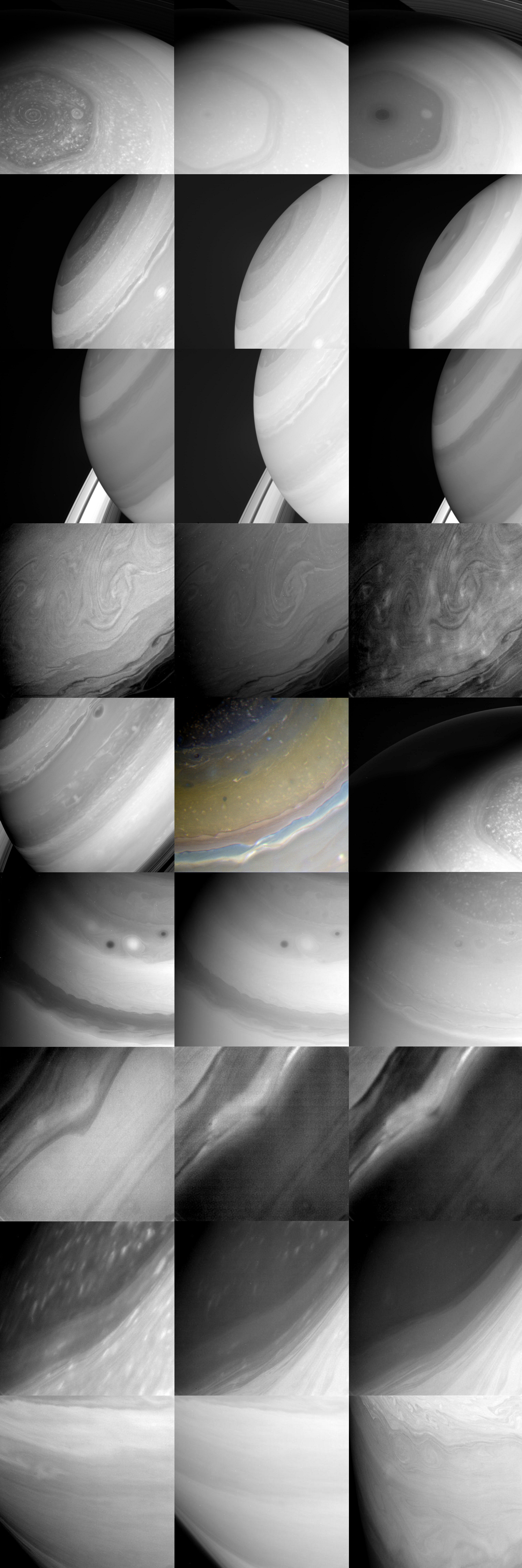
Freshly delivered from Cassini’s wide-angle camera, this raw image gives us another look at Saturn’s north pole and the curious hexagon-shaped jet stream that encircles it, as well as the spiraling vortex of clouds at its center.
[...]
 
CICLOPS: Rev183: Mar 4 - Mar 16 '13:
Cassini continues its exploration of the Saturn system with the 12-day Rev183, which begins on March 4 at its farthest distance from the planet. This is also called the orbit's apoapse. At this point, Cassini is 1.47 million kilometers (0.92 million miles) from Saturn's cloud tops. Rev 183 occurs nearly a year into the first inclined phase of the Cassini Solstice Mission, a phase which lasts until March 2015. The inclined phase will allow for polar views of Saturn and Titan as well as better vistas of Saturn's rings than those Cassini had while in the earlier, equatorial phase of the Solstice Mission. Twenty-nine ISS observations are planned for Rev 183 with the majority focused on Saturn's atmosphere and rings. Cassini will also perform a targeted flyby of Saturn's second largest moon, Rhea.

On March 4, ISS begins its observations for Rev 183 with a pair of quick observations of Saturn using the wide-angle camera (WAC). These observations are part of a series of "Storm Watch" observation sequences designed to take advantage of short, two-minute segments when the spacecraft turns the optical remote sensing (ORS) instruments back to Saturn as a waypoint between other experiments' observations. These sequences include blue, clear, two methane band, and one full-frame, continuum band filter images. Five more are planned between March 5 and 7, while seven more will be acquired between March 10 and 14, after periapse. Between the two "Storm Watch" observations on March 4, ISS will acquire an astrometric observation of Saturn's small, inner moons. Astrometric observations are used to improve our understanding of the orbits of these small satellites, which can be influenced by Saturn's larger icy moons. Additional astrometric observations will be taken on March 6 and 13. After the second "Storm Watch" observation, ISS will acquire a movie of the F ring, observing its various channels and streamers created by the interaction between the ring material and the nearby moon, Prometheus.

On March 6, ISS will acquire a series of images of Saturn rings using the WAC. These images will be tracking spokes -- a ring phenomenon Cassini has monitored throughout the mission -- over the B ring. With Cassini over the unlit side of the rings and with Saturn at a high phase angle, the spokes, if visible, will be brighter than the dark B ring. On March 7, ISS will image the outer A ring, looking at the propellers previously seen in this part of the ring system. Propellers are small voids in Saturn's rings created by the gravitational interaction between large ring particles and the surrounding ring. On March 8 and 9, ISS will acquire a pair of observations of the small, distant, outer moon, Hyrrokkin. These observations will be used to measure the rotation period of the small moon. Given its small size and great distance from Saturn, it likely does not rotate synchronously like Saturn's closer and larger icy moons. Hyrrokkin is eight kilometers (5 miles) across and will be 10 million kilometers (6.22 million miles) away.

On March 10 at 03:40 UTC, Cassini will reach periapse for Rev 183 at an altitude of 424,310 kilometers (263,650 miles) from Saturn. A few hours earlier on March 9 at 18:17 UTC, ISS will perform a targeted encounter with Saturn's second largest moon, Rhea. This is Cassini's fourth targeted encounter with Rhea. The spacecraft will pass within 997 kilometers (620 miles) of the icy moon. Prior to closest approach, ISS will ride along with an observation by the Composite Infrared Spectrometer (CIRS). CIRS will be acquiring a temperature map of Rhea's south polar region, while ISS will acquire a pair of narrow-angle (NAC) and wide-angle (WAC) images that covers a crescent Rhea. As Cassini makes its pass - going from over the moon's south polar region, north over the equator just before closest approach, to over its north polar region - the Radio Sub-System (RSS) will be used to measure Rhea's gravity field. The High-gain antenna will be pointed at Earth during the encounter, and the effect of Rhea's gravity on the spacecraft will be measured by looking at the Doppler Effect on Cassini's signal. This will be used to refine our understanding of Rhea's internal structure. Shortly after closest approach during the RSS observation, Rhea will pass through the NAC field-of-view and the camera system will acquire 10 sets of images, with the first and last including a WAC context frame. These images, with a top resolution of 18 meters (59 feet) per pixel, will cover small portions of Rhea's north polar and sub-Saturn regions. Afterward, ISS will acquire a 12-frame mosaic covering the moon's northern, sub-Saturn hemisphere. Images from this mosaic will have a resolution of between 370 and 520 meters (1,210 and 1,710 feet) per pixel. Finally, ISS will acquire a set of global color images from a distance of 269,000 kilometers (167,000 miles).

As the spacecraft departs from Rhea and nears periapse, ISS will acquire a pair of distant Titan observations on March 13 and 14. These observations will cover the moon's sub-Saturn hemisphere and will be used to monitor cloud activity in the moon's dense atmosphere. These two observations will be taken from a distance of 2.57 and 2.60 million kilometers (1.60 and 1.62 million miles). Also on March 14, ISS will acquire a movie of the Anthe ring arc.

On March 16, Cassini will reach apoapse on this orbit, bringing it to a close and starting Rev184.

{...}
 
NASA / NASA JPL:
Cassini Spies Bright Venus From Saturn Orbit

PASADENA, Calif. - A distant world gleaming in sunlight, Earth's twin planet, Venus, shines like a bright beacon in images taken by NASA's Cassini spacecraft in orbit around Saturn.

One special image of Venus and Saturn was taken last November when Cassini was placed in the shadow of Saturn. This allowed Cassini to look in the direction of the sun and Venus, and take a backlit image of Saturn and its rings in a particular viewing geometry called "high solar phase." This observing position reveals details about the rings and Saturn's atmosphere that cannot be seen in lower solar phase.

One of the Venus and Saturn images being released today is a combination of separate red, green and blue images covering the planet and main rings and processed to produce true color. Last December, a false-color version of the mosaic was released.

[table="head;width=450"]{colsp=2}
Click on images for details​

|

Peering over the shoulder of giant Saturn, through its rings, and across interplanetary space, NASA's Cassini spacecraft spies the bright, cloudy terrestrial planet, Venus. The vast distance from Saturn means that Venus only shows up as a white dot, just above and to the right of the image center.
Image credit: NASA/JPL-Caltech/Space Science Institute​
|Dawn on Saturn is greeted across the vastness of interplanetary space by the morning star, Venus, in this image from NASA's Cassini spacecraft. Venus appears just off the edge of the planet, in the upper part of the image, directly above the white streak of Saturn's G ring. Lower down, Saturn's E ring makes an appearance, looking blue thanks to the scattering properties of the dust that comprises the ring. A bright spot near the E ring is a distant star.
Image credit: NASA/JPL-Caltech/Space Science Institute​
[/table]​


Another image, taken in January, captures Venus just beyond the limb of Saturn and in close proximity to Saturn's G ring, a thin ring just beyond the main Saturnian rings. The diffuse E ring, which is outside the G ring and created by the spray of the moon Enceladus, also is visible.

These images can be found at http://www.jpl.nasa.gov/spaceimages/details.php?id=PIA14935 and http://www.jpl.nasa.gov/spaceimages/details.php?id=PIA14936.

Venus is, along with Mercury, Earth and Mars, one of the rocky "terrestrial" planets in the solar system that orbit relatively close to the sun. Though Venus has an atmosphere of carbon dioxide that reaches nearly 900 degrees Fahrenheit (500 degrees Celsius) and a surface pressure 100 times that of Earth's, it is considered a twin to our planet because of their similar sizes, masses, rocky compositions and close orbits. It is covered in thick sulfuric acid clouds, making it very bright.

{...}


CICLOPS:
NASA JPL - Cassini Solstice Mission:
Slate - Bad Astronomy: Venus… from Saturn

Universe Today: Stunning Views of Venus, All the Way from Saturn

AmericaSpace: Trick Shot: Cassini Spies Venus Through Saturn's Rings

SpaceRef: Venus As Seen From Saturn by Cassini

NBCNEWS.com - Cosmic Log: Venus sparkles in views from Saturn

Phys.org: Cassini spies Earth's twin planet from Saturn orbit

Science Daily: Cassini Spies Bright Venus from Saturn Orbit

The Planetary Society Blog: The Stormscapes of Saturn:

20130303_saturn_storms_feb13.jpg
 
CICLOPS: Rev184: Mar 16 - Mar 28 '13:
Cassini continues its exploration of the Saturn system with the 12-day Rev184, which begins on March 16 at its farthest distance from the planet. This is also called the orbit's apoapse. At this point, Cassini is 1.47 million kilometers (0.92 million miles) from Saturn's cloud tops. Rev 184 occurs nearly a year into the first inclined phase of the Cassini Solstice Mission, a phase which lasts until March 2015. The inclined phase will allow for polar views of Saturn and Titan as well as better vistas of Saturn's rings than those Cassini had while in the earlier, equatorial phase of the Solstice Mission. Eighteen ISS observations are planned for Rev 184 with the majority focused on Saturn's atmosphere and rings.

On March 18, ISS begins its observations for Rev 184 with three quick observations of Saturn using the wide-angle camera (WAC). These observations are part of a series of "Storm Watch" observation sequences designed to take advantage of short, two-minute segments when the spacecraft turns the optical remote sensing (ORS) instruments back to Saturn as a waypoint between other experiments' observations. These sequences include blue, clear, two methane band, and one full-frame, continuum band filter images. Four more Storm Watch observations are planned for March 19, 27, and 28. Between the first two Storm Watch observations on March 18, ISS will acquire an astrometric observation of Saturn's small, inner moons. Astrometric observations are used to improve our understanding of the orbits of these small satellites, which can be influenced by Saturn's larger icy moons. After the second Storm Watch observation, ISS will acquire a series of images of Saturn rings using the WAC. These images will be tracking spokes -- a ring phenomenon Cassini has monitored throughout the mission -- over the B ring. With Cassini over the unlit side of the rings and with Saturn at a high phase angle, the spokes, if visible, will be brighter than the dark B ring. Finally, on March 18, ISS will acquire a movie of the F ring, observing its various channels and streamers created by the interaction between the ring material and the nearby moon, Prometheus.

On March 19, ISS will image the outer A ring, looking at the propellers previously seen in this part of the ring system. Propellers are small voids in Saturn's rings created by the gravitational interaction between large ring particles and the surrounding ring. Later that day, ISS will acquire a distant Titan observation. This observation will be used to look at Titan's upper haze layers as the moon will appear to be thin crescent. These images will be taken from a distance of 1.85 million kilometers (1.15 million miles). On March 19 and 20, ISS will ride along with a pair of Ultraviolet Imaging Spectrometer (UVIS) observations of Saturn's south polar aurora. In addition to making a movie of the planet's aurorae, the images will be used to independently measure the rotation period of Saturn's magnetic field.

On March 22 at 02:46 UTC, Cassini will reach periapse for Rev 184 at an altitude of 424,600 kilometers (263,830 miles) from Saturn. During the periapse period, Cassini will focus on magnetic field observations along with many UVIS observations across the northern auroral oval.

On March 26, ISS will acquire a pair of observations of two small, distant, outer moons, Hyrrokkin and Narvi. These observations will be used to measure the rotation period of these small moons. Given their small size and great distance from Saturn, they don't rotate synchronously like Saturn's closer and larger icy moons. Hyrrokkin is 8 kilometers (5 miles) across and will be 9.76 million kilometers (6.07 million miles) away. Narvi is 7 kilometers (4.3 miles) across and will be 15.5 million kilometers (9.65 million miles) away. On March 27, the camera system will acquire another movie of the F ring. Afterwards, early on March 28, ISS will acquire an observation of Titan from a distance of 2.44 million kilometers (1.51 million miles). The images will be used to look for clouds across the moon's southern Sub-Saturn hemisphere.

On March 28, Cassini will reach apoapse on this orbit, bringing it to a close and starting Rev185. The next orbit includes a close flyby of Titan.

{...}

Some earlier this week bookmarked articles will be in my next post in the thread.
 
CICLOPS: Rev185: Mar 28 - Apr 7 '13:
Cassini continues its exploration of the Saturn system with the 12-day Rev185, which begins on March 28 at its farthest distance from the planet. This is also called the orbit's apoapse. At this point, Cassini is 1.47 million kilometers (0.92 million miles) from Saturn's cloud tops. Rev 185 occurs nearly a year into the first inclined phase of the Cassini Solstice Mission, a phase which lasts until March 2015. The inclined phase will allow for polar views of Saturn and Titan as well as better vistas of Saturn's rings than those Cassini had while in the earlier, equatorial phase of the Solstice Mission. Twenty-six ISS observations are planned for Rev 185 with many observations planned during a targeted flyby of Titan later in the orbit.

On March 28, a few hours after apoapse, ISS will acquire an observation of the small, outer satellite, Hyrrokkin. These images will be used to measure the rotation period of the small moon. Given its small size and great distance from Saturn, it doesn't rotate synchronously like Saturn's closer and larger icy moons. Hyrrokkin is eight kilometers (5 miles) across and will be 9.49 million kilometers (5.90 million miles) away. Later that day, ISS will acquire a distant Titan observation. This observation will be used to look for clouds in Titan's atmosphere. These images will be taken from a distance of 2.23 million kilometers (1.39 million miles). Afterward, ISS will acquire an astrometric observation of Saturn's small, inner moons. Astrometric observations are used to improve our understanding of the orbits of these small satellites, which can be influenced by Saturn's larger icy moons.

On March 30 and 31, ISS will take two quick observations of Saturn using the wide-angle camera (WAC). These observations are part of a series of "Storm Watch" observation sequences designed to take advantage of short, two-minute segments when the spacecraft turns the optical remote sensing (ORS) instruments back to Saturn as a waypoint between other experiments' observations. These sequences include blue, clear, two methane band, and one full-frame, continuum band filter images. On April 1, ISS will ride along with a stellar occultation using the Visual and Infrared Mapping Spectrometer (VIMS) by the ring system of the Mira-like, red giant star R Cassiopeiae. Later that day, it will acquire a 12-hour movie of the gap between the A and F rings, also known as the Roche Division.

On April 3 at 01:46 UTC, Cassini will reach periapse for Rev 185 at an altitude of 423,880 kilometers (263,390 miles) from Saturn. On April 2, ISS will monitor the south polar plume of Enceladus from a distance of 830,000 kilometers (515,000 miles). Next, ISS will image a crescent Mimas at a distance of 590,000 kilometers (366,000 miles). ISS will finish April 2 with three ring observations: first covering the inner D ring (in a region Cassini will fly through numerous times in mid-2017); then a high-resolution, F ring observation; and finally, an observation of the outer A ring, where ISS will be looking at propellers previously imaged by Cassini. Propellers are small voids in Saturn's rings created by the gravitational interaction between large ring particles and the surrounding ring. On April 3 and 4, ISS will acquire a pair of ride along observations of stellar occultations by Saturn's F ring. The first involves the B-type star Delta Centauri while the April 4 observation uses the red giant star, R Hydra.

Two days after periapse, Cassini encounters Titan on April 5 at 21:44 UTC for the 91st time. This is the second Titan flyby planned for 2013, with the next encounter scheduled for May 23. T90 is a low-altitude flyby with a close-approach altitude of 1400 kilometers (870 miles). This flyby will allow for imaging of the southern anti-Saturn hemisphere of Titan outbound from the encounter. Before the encounter, the Composite Infrared Spectrometer (CIRS) will acquire spectral scans and other data of Titan's night side and sunlit crescent. CIRS will scan across Titan in order to map stratospheric temperatures. The instrument will also make scans along the limb of Titan to measure aerosol and chemical abundances at different altitudes above the moon's surface. ISS will ride along to acquire images of Titan's upper haze layers, which are more easily visible at high phase angles.

At closest approach, the VIMS team will be prime. VIMS will acquire image spectral cubes of several surface features as Cassini makes it pass over Titan. It will acquire a noodle image that runs from the small dune fields to the west of the Menrva impact basin, across portions of western Xanadu, across Tui Regio, then south to Hobal Virga. Next, VIMS will acquire several mosaics of the southern anti-Saturn hemisphere as well as the region around the bright area, Adiri. Afterward, CIRS will acquire another pair of compositional and temperature maps. ISS will ride along with VIMS and CIRS to monitor cloud activity on the moon.

On April 7, Cassini will reach apoapse on this orbit, bringing it to a close and starting Rev186. During apoapse, ISS will ride along with CIRS to acquire some parting shots of Titan's trailing hemisphere.

{...}


Earlier news:

NASA JPL:
CICLOPS:
 
CICLOPS: Rev186: Apr 7 - Apr 17 '13:
Cassini continues its exploration of the Saturn system with the 10-day Rev186, which begins on April 7 at its farthest distance from the planet. This is also called the orbit's apoapse. At this point, Cassini is 1.30 million kilometers (0.81 million miles) from Saturn's cloud tops. Rev 186 occurs nearly a year into the first inclined phase of the Cassini Solstice Mission, a phase which lasts until March 2015. The inclined phase will allow for polar views of Saturn and Titan as well as better vistas of Saturn's rings than those Cassini had while in the earlier, equatorial phase of the Solstice Mission. Twenty ISS observations are planned for Rev 186 with most focused on Saturn's atmosphere and rings.

On April 8 and 9, ISS will ride along with a pair of long Titan observations by the Composite Infrared Spectrometer (CIRS). Each observation will allow ISS to track clouds on Titan's southern trailing hemisphere for 15 hours. The April 8 observation will be taken from a distance of 1.05 million kilometers (0.65 million miles), while the observation the next day will be taken from a distance of 1.27 million kilometers (0.79 million miles). On April 10, ISS will acquire a NAC movie of the Encke Gap, which includes the small moon Pan.

On April 12 at 12:35 UTC, Cassini will reach periapse for Rev 186 at an altitude of 316,440 kilometers (196,630 miles) from Saturn. Late on April 11, ISS will acquire an observation of the outer A ring, where it will be looking at propellers previously imaged by Cassini. Propellers are small voids in Saturn's rings created by the gravitational interaction between large ring particles and the surrounding ring. Shortly before periapse on April 12, ISS will monitor the south polar plume of Enceladus from a distance of 450,000 kilometers (280,000 miles). Afterward, ISS will ride along as CIRS observes a stellar occultation by Saturn's rings of the Mira-like red giant star R Doradus. While R Doradus is barely visible to the naked eye at visible wavelengths, at 1.25 microns in the near-infrared, it is the second-brightest star in the night sky (only Betelgeuse in the constellation Orion is brighter). A similar occultation will be observed by the Visual and Infrared Mapping Spectrometer on April 13, this time involving W Hydrae, another Mira-like red giant star. Before the W Hydrae occultation, ISS will acquire an observation of Titan, looking for clouds across the moon's sub-Saturn hemisphere. It will be taken from a distance of 1.79 million kilometers (1.11 million miles). Finally on April 13, ISS will acquire a high-resolution color mosaic of the lit face of Saturn's rings. The mosaic won't cover Saturn's entire ring system, but will be a radial scan from the D ring out to the F ring.

On April 14, ISS will take a quick observation of Saturn using the wide-angle camera (WAC). This observation is part of a series of "Storm Watch" observation sequences designed to take advantage of short, two-minute segments when the spacecraft turns the optical remote sensing (ORS) instruments back to Saturn as a waypoint between other experiments' observations. These sequences include blue, clear, two methane band, and one full-frame, continuum band filter images. Five more storm watch observations are planned for April 15, 16, and 17. Immediately after the Storm Watch observation on April 14, ISS will look for storms on Titan. ISS will observe the moon's sub-Saturn hemisphere from a distance of 2.26 million kilometers (1.40 million miles). It will take two more Titan observations on April 15 and 17. On April 15, ISS will acquire an astrometric observation of Saturn's small, inner moons. Astrometric observations are used to improve our understanding of the orbits of these small satellites, which can be influenced by Saturn's larger icy moons. On April 16, ISS will acquire an observation of the small, outer satellite, Siarnaq. The observation is designed to allow researchers to measure the length of its day. Given its small size and great distance from Saturn, Siarnaq doesn't rotate synchronously like Saturn's closer and larger icy moons. Earlier measurements from 2009 and 2010 yielded inconsistent results, and this observation and other observations this summer will be used to improve our understanding of its rotational state. Siarnaq is 40 kilometers (25 miles) across and will be 10.9 million kilometers (6.76 million miles) away.

On April 17, Cassini will reach apoapse on this orbit, bringing it to a close and starting Rev187.

{...}
 
NASA JPL:
Ice Cloud Heralds Fall at Titan's South Pole

April 11, 2013

An ice cloud taking shape over Titan's south pole is the latest sign that the change of seasons is setting off a cascade of radical changes in the atmosphere of Saturn's largest moon. Made from an unknown ice, this type of cloud has long hung over Titan's north pole, where it is now fading, according to observations made by the composite infrared spectrometer (CIRS) on NASA's Cassini spacecraft.

"We associate this particular kind of ice cloud with winter weather on Titan, and this is the first time we have detected it anywhere but the north pole," said the study's lead author, Donald E. Jennings, a CIRS Co-Investigator at NASA's Goddard Space Flight Center in Greenbelt, Md.

[table="head;width=225"]
Click on image for details​


The recently formed south polar vortex stands out in the color-swaddled atmosphere of Saturn's largest moon, Titan, in this natural color view from NASA's Cassini spacecraft.
Image credit: NASA/JPL-Caltech/Space Science Institute​
[/table]​


The southern ice cloud, which shows up in the far infrared part of the light spectrum, is evidence that an important pattern of global air circulation on Titan has reversed direction. When Cassini first observed the circulation pattern, warm air from the southern hemisphere was rising high in the atmosphere and was transported to the cold north pole. There, the air cooled and sank down to lower layers of the atmosphere and formed ice clouds. A similar pattern, called a Hadley cell, carries warm, moist air from Earth's tropics to the cooler middle latitudes.

Based on modeling, scientists had long predicted a reversal of this circulation once Titan's north pole began to warm and its south pole began to cool. The official transition from winter to spring at Titan's north pole occurred in August 2009. But because each of the moon's seasons lasts about seven-and-a-half Earth years, researchers still did not know exactly when this reversal would happen or how long it would take.

The first signs of the reversal came in data acquired in early 2012, which came shortly after the start of southern fall on Titan, when Cassini images and visual and infrared mapping spectrometer data revealed the presence of a high-altitude "haze hood" and a swirling polar vortex at the south pole. Both features have long been associated with the cold north pole. Later, Cassini scientists reported that infrared observations of Titan's winds and temperatures made by CIRS had provided definitive evidence of air sinking, rather than upwelling, at the south pole. By looking back through the data, the team narrowed down the change in circulation to within six months of the 2009 equinox.

Despite the new activity at the south pole, the southern ice cloud had not appeared yet. CIRS didn't detect it until about July 2012, a few months after the haze and vortex were spotted in the south, according to the study published in Astrophysical Journal Letters in December 2012.

"This lag makes sense because first the new circulation pattern has to bring loads and loads of gases to the south pole. Then, the air has to sink. The ices have to condense. And the pole has to be under enough shadow to protect the vapors that condense to form those ices," said Carrie Anderson, a CIRS team member and Cassini participating scientist at Goddard.

At first blush, the southern ice cloud seems to be building rapidly. The northern ice cloud, on the other hand, was present when Cassini first arrived and has been slowly fading the entire time the spacecraft has been observing it.

So far, the identity of the ice in these clouds has eluded scientists, though they have ruled out simple chemicals, such as methane, ethane and hydrogen cyanide, which are typically associated with Titan. One possibility is that "species X," as some team members call the ice, could be a mixture of organic compounds.

"What's happening at Titan's poles has some analogy to Earth and to our ozone holes," said the CIRS Principal Investigator, Goddard's F. Michael Flasar. "And on Earth, the ices in the high polar clouds aren't just window dressing: They play a role in releasing the chlorine that destroys ozone. How this affects Titan chemistry is still unknown. So it's important to learn as much as we can about this phenomenon, wherever we find it."

{...}


NASA JPL:
Titan's Methane: Going, Going, Soon to Be Gone?

April 15, 2013

By tracking a part of the surface of Saturn's moon Titan over several years, NASA's Cassini mission has found a remarkable longevity to the hydrocarbon lakes on the moon's surface.

A team led by Christophe Sotin of NASA's Jet Propulsion Laboratory in Pasadena, Calif., fed these results into a model that suggests the supply of the hydrocarbon methane at Titan could be coming to an end soon (on geological timescales). The study of the lakes also led scientists to spot a few new ones in images from Cassini's visual and infrared mapping spectrometer data in June 2010.

[table="head;width=225"]
Click on image for details​


These images from NASA's Cassini spacecraft show one of the large seas and a bounty of smaller lakes on Saturn's moon Titan. Scientists saw these small lakes in data obtained by both Cassini's visual and infrared mapping spectrometer (left) and radar instrument (right).
Image credit: NASA/JPL-Caltech/University of Arizona​
[/table]​


Titan is the only other place in the solar system besides Earth that has stable liquid on its surface. Scientists think methane is at the heart of a cycle at Titan that is somewhat similar to the role of water in Earth's hydrological cycle - causing rain, carving channels and evaporating from lakes. However, the fact that the lakes seem remarkably consistent in size and shape over several years of data from Cassini's visual and infrared mapping spectrometer suggests that the lakes evaporate very slowly. Methane tends to evaporate quickly, so scientists think the lakes must be dominated by methane's sister hydrocarbon ethane, which evaporates more slowly.

The lakes are also not getting filled quickly, and scientists haven't seen more than the occasional outburst of hydrocarbon rain at the moon over the mission's eight-plus years in the Saturn system. This indicates that on Titan, the methane that is constantly being lost by breaking down to form ethane and other heavier molecules is not being replaced by fresh methane from the interior. The team suggests that the current load of methane at Titan may have come from some kind of gigantic outburst from the interior eons ago possibly after a huge impact. They think Titan's methane could run out in tens of millions of years.

For more information on this finding and the lakes, visit http://saturn.jpl.nasa.gov/news/cassiniscienceleague/science20130412/.

{...}


NASA JPL - Cassini Solstice Mission:
 
CICLOPS: Rev187: Apr 17 - Apr 26 '13:
Cassini continues its exploration of the Saturn system with the 9.5-day Rev187, which begins on April 17 at its farthest distance from the planet. This is also called the orbit's apoapse. At this point, Cassini is 1.30 million kilometers (0.81 million miles) from Saturn's cloud tops. Rev 187 occurs nearly a year into the first inclined phase of the Cassini Solstice Mission, a phase which lasts until March 2015. The inclined phase will allow for polar views of Saturn and Titan as well as better vistas of Saturn's rings than those Cassini had while in the earlier, equatorial phase of the Solstice Mission. Nineteen ISS observations are planned for Rev 187 with the majority focused on Saturn's atmosphere and rings.

The day after apoapse, ISS will take a pair of quick observations of Saturn using the wide-angle camera (WAC). These observations are part of a series of "Storm Watch" observation sequences designed to take advantage of short, two-minute segments when the spacecraft turns the optical remote sensing (ORS) instruments back to Saturn as a waypoint between other experiments' observations. These sequences include blue, clear, two methane band, and one full-frame, continuum band filter images. Nine more storm watch observations are planned for this orbit. Between the two Storm watch observations on April 18, ISS will acquire an astrometric observation of Saturn's small, inner moons. Astrometric observations are used to improve our understanding of the orbits of these small satellites, which can be influenced by Saturn's larger icy moons. On April 20 and 21, ISS will ride along with a pair of Ultraviolet Imaging Spectrometer (UVIS) observations of Saturn's south polar aurora. In addition to making a movie of the planet's aurorae, the images will be used to independently measure the rotation period of Saturn's magnetic field.

On April 22 at 02:17 UTC, Cassini will reach periapse for Rev 187 at an altitude of 316,700 kilometers (196,790 miles) from Saturn. During the periapse period, except for the Titan observation on the 22nd, ISS will be mostly inactive. On April 21, UVIS will observe a solar occulation by Saturn, which can be used to probe the structure of the planet's upper haze layers. On April 22, UVIS will observe Saturn's northern auroral oval, while the Visual and Infrared Mapping Spectrometer (VIMS) will observe a pair of stellar occultations by Saturn's rings of two red giant stars, R Carinae and Gamma Crucis. Late in the day on April 22, ISS will acquire an observation of Titan, looking for clouds across the moon's northern trailing hemisphere. It will be taken from a distance of 1.20 million kilometers (0.74 million miles).

Late on April 23, ISS will acquire an observation of the outer A ring, where it will be looking at propellers previously imaged by Cassini. Propellers are small voids in Saturn's rings created by the gravitational interaction between large ring particles and the surrounding ring. Afterward, ISS will ride along as UVIS observes a stellar occultation by Saturn's rings of the B-type star, Beta Librae. Afterward, ISS will acquire another astrometric observation of Saturn's small, inner moons. Finally, on April 25, ISS will acquire an observation of the small, outer satellite, Tarvos. The observation is designed to allow researchers to measure the length of its day. Given its small size and great distance from Saturn, Tarvos doesn't rotate synchronously like Saturn's closer and larger icy moons. Tarvos is 15 kilometers (9 miles) across and will be 8.97 million kilometers (5.58 million miles) away.

On April 26, Cassini will reach apoapse on this orbit, bringing it to a close and starting Rev188.

{...}
 
NASA / NASA JPL:
NASA Probe Observes Meteors Colliding with Saturn's Rings

April 25, 2013

PASADENA, Calif. -- NASA's Cassini spacecraft has provided the first direct evidence of small meteoroids breaking into streams of rubble and crashing into Saturn's rings.

These observations make Saturn's rings the only location besides Earth, the moon and Jupiter where scientists and amateur astronomers have been able to observe impacts as they occur. Studying the impact rate of meteoroids from outside the Saturnian system helps scientists understand how different planet systems in our solar system formed.

The solar system is full of small, speeding objects. These objects frequently pummel planetary bodies. The meteoroids at Saturn are estimated to range from about one-half inch to several yards (1 centimeter to several meters) in size. It took scientists years to distinguish tracks left by nine meteoroids in 2005, 2009 and 2012.

Details of the observations appear in a paper in the Thursday, April 25 edition of Science.

[table="head;width=450"]{colsp=2}

|

Five images of Saturn's rings, taken by NASA's Cassini spacecraft between 2009 and 2012, show clouds of material ejected from impacts of small objects into the rings.
Image Credit: NASA/JPL-Caltech/Space Science Institute/Cornell​
|This animation depicts the shearing of an initially circular cloud of debris as a result of the particles in the cloud having differing orbital speeds around Saturn.
Image credit: NASA/Cornell​
[/table]​


Results from Cassini have already shown Saturn's rings act as very effective detectors of many kinds of surrounding phenomena, including the interior structure of the planet and the orbits of its moons. For example, a subtle but extensive corrugation that ripples 12,000 miles (19,000 kilometers) across the innermost rings tells of a very large meteoroid impact in 1983.

"These new results imply the current-day impact rates for small particles at Saturn are about the same as those at Earth -- two very different neighborhoods in our solar system -- and this is exciting to see," said Linda Spilker, Cassini project scientist at NASA's Jet Propulsion Laboratory in Pasadena, Calif. "It took Saturn's rings acting like a giant meteoroid detector -- 100 times the surface area of the Earth -- and Cassini's long-term tour of the Saturn system to address this question."

The Saturnian equinox in summer 2009 was an especially good time to see the debris left by meteoroid impacts. The very shallow sun angle on the rings caused the clouds of debris to look bright against the darkened rings in pictures from Cassini's imaging science subsystem.

"We knew these little impacts were constantly occurring, but we didn't know how big or how frequent they might be, and we didn't necessarily expect them to take the form of spectacular shearing clouds," said Matt Tiscareno, lead author of the paper and a Cassini participating scientist at Cornell University in Ithaca, N.Y. "The sunlight shining edge-on to the rings at the Saturnian equinox acted like an anti-cloaking device, so these usually invisible features became plain to see."

Tiscareno and his colleagues now think meteoroids of this size probably break up on a first encounter with the rings, creating smaller, slower pieces that then enter into orbit around Saturn. The impact into the rings of these secondary meteoroid bits kicks up the clouds. The tiny particles forming these clouds have a range of orbital speeds around Saturn. The clouds they form soon are pulled into diagonal, extended bright streaks.

"Saturn's rings are unusually bright and clean, leading some to suggest that the rings are actually much younger than Saturn," said Jeff Cuzzi, a co-author of the paper and a Cassini interdisciplinary scientist specializing in planetary rings and dust at NASA's Ames Research Center in Moffett Field, Calif. "To assess this dramatic claim, we must know more about the rate at which outside material is bombarding the rings. This latest analysis helps fill in that story with detection of impactors of a size that we weren't previously able to detect directly."

{...}


CICLOPS:
NASA JPL - Cassini Solstice Mission:
SPACE.com: Saturn's Rings Bombarded by Space Rocks

Universe Today: Cassini Watches as Meteors Hit Saturn’s Rings

Slate - Bad Astronomy: Cassini Sees Debris from Meteoroids Colliding with Saturn’s Rings

Phys.org: Cassini observes meteors colliding with Saturn's rings
 
CICLOPS: Rev188: Apr 26 - May 6 '13:
Cassini continues its exploration of the Saturn system with the 9.5-day Rev188, which begins on April 26 at its farthest distance from the planet. This is also called the orbit's apoapse. At this point, Cassini is 1.30 million kilometers (0.81 million miles) from Saturn's cloud tops. Rev 188 occurs a year into the first inclined phase of the Cassini Solstice Mission, a phase which lasts until March 2015. The inclined phase will allow for polar views of Saturn and Titan as well as better vistas of Saturn's rings than those Cassini had while in the earlier, equatorial phase of the Solstice Mission. Sixteen ISS observations are planned for Rev 188 with the majority focused on Saturn's atmosphere.

Two days after apoapse, ISS will acquire an astrometric observation of Saturn's small, inner moons. Astrometric observations are used to improve our understanding of the orbits of these small satellites, which can be influenced by Saturn's larger icy moons. Also on April 28, ISS will acquire a pair of quick observations of Saturn using the wide-angle camera (WAC). These observations are part of a series of "Storm Watch" observation sequences designed to take advantage of short, two-minute segments when the spacecraft turns the optical remote sensing (ORS) instruments back to Saturn as a waypoint between other experiments' observations. These sequences include blue, clear, two methane band, and one full-frame, continuum band filter images. Two more storm watch observations are planned for this orbit. After the first storm watch observation, ISS will ride along with an Ultraviolet Imaging Spectrometer (UVIS) observation of a stellar occultation of the A-type star Vega by Dione. Finally, ISS will image the outer A ring, where it will be looking at propellers previously imaged by Cassini. Propellers are small voids in Saturn's rings created by the gravitational interaction between large ring particles and the surrounding ring. On April 29, ISS will ride along with a UVIS observation of Saturn's south polar aurora. In addition to making a movie of the planet's aurorae, the images will be used to independently measure the rotation period of Saturn's magnetic field.

On May 1 at 15:59 UTC, Cassini will reach periapse for Rev 188 at an altitude of 316,450 kilometers (196,630 miles) from Saturn. During the periapse period, ISS will acquire several observations of Saturn's atmosphere. First, ISS will look for high-altitude haze layers above Saturn's south polar region by acquiring images of Saturn's limb while Cassini is in the planet's shadow. ISS will then ride along with the Composite Infrared Spectrometer (CIRS), taking a 30-minute movie of Saturn's nightside in order to search for lightning in the planet's southern high- to mid-latitudes. Next, ISS will monitor the south polar plume of Enceladus from a distance of 546,000 kilometers (280,000 miles). Late on the 1st, ISS will ride along with the Visual and Infrared Mapping Spectrometer (VIMS) to acquire several mosaics of Saturn's north polar region using the Wide-Angle Camera (WAC). Spring has progressed far enough that the entirety of the hexagonal jet stream that lies near 77 degrees North latitude will be in sunlight. The hexagon would fill the WAC images from this observation, but ISS will be covering it with two-by-two mosaics.

On May 3, ISS will ride along with VIMS again, this time acquiring several two-frame mosaics of Saturn's northern hemisphere. ISS will then track various cloud features as they move across the face of Saturn as the planet rotates. Afterward, ISS will acquire another astrometric observation of Saturn's small, inner moons. On May 5, between a pair of Saturn storm watch observations, ISS will acquire a movie of the G ring arc that is associated with the small moon Aegaeon.

On May 6, Cassini will reach apoapse on this orbit, bringing it to a close and starting Rev189.

{...}
 
NASA / NASA JPL:
NASA Probe Gets Close-Up Views of Large Hurricane on Saturn

April 26, 2013

PASADENA, Calif. - NASA's Cassini spacecraft has provided scientists the first close-up, visible-light views of a behemoth hurricane swirling around Saturn's north pole.

In high-resolution pictures and video, scientists see the hurricane's eye is about 1,250 miles (2,000 kilometers) wide, 20 times larger than the average hurricane eye on Earth. Thin, bright clouds at the outer edge of the hurricane are traveling 330 mph(150 meters per second). The hurricane swirls inside a large, mysterious, six-sided weather pattern known as the hexagon.

"We did a double take when we saw this vortex because it looks so much like a hurricane on Earth," said Andrew Ingersoll, a Cassini imaging team member at the California Institute of Technology in Pasadena. "But there it is at Saturn, on a much larger scale, and it is somehow getting by on the small amounts of water vapor in Saturn's hydrogen atmosphere."


Scientists will be studying the hurricane to gain insight into hurricanes on Earth, which feed off warm ocean water. Although there is no body of water close to these clouds high in Saturn's atmosphere, learning how these Saturnian storms use water vapor could tell scientists more about how terrestrial hurricanes are generated and sustained.

Both a terrestrial hurricane and Saturn's north polar vortex have a central eye with no clouds or very low clouds. Other similar features include high clouds forming an eye wall, other high clouds spiraling around the eye, and a counter-clockwise spin in the northern hemisphere.

A major difference between the hurricanes is that the one on Saturn is much bigger than its counterparts on Earth and spins surprisingly fast. At Saturn, the wind in the eye wall blows more than four times faster than hurricane-force winds on Earth. Unlike terrestrial hurricanes, which tend to move, the Saturnian hurricane is locked onto the planet's north pole. On Earth, hurricanes tend to drift northward because of the forces acting on the fast swirls of wind as the planet rotates. The one on Saturn does not drift and is already as far north as it can be.

"The polar hurricane has nowhere else to go, and that's likely why it's stuck at the pole," said Kunio Sayanagi, a Cassini imaging team associate at Hampton University in Hampton, Va.

[table="head;width=675"]{colsp=3}
Click on images for details​

||

The Rose
The spinning vortex of Saturn's north polar storm resembles a deep red rose of giant proportions surrounded by green foliage in this false-color image from NASA's Cassini spacecraft. Measurements have sized the eye at a staggering 1,250 miles (2,000 kilometers) across with cloud speeds as fast as 330 miles per hour (150 meters per second).
Image Credit: NASA/JPL-Caltech/SSI​
|
Spring at the North Pole
The north pole of Saturn, in the fresh light of spring, is revealed in this color image from NASA's Cassini spacecraft.
Image Credit: NASA/JPL-Caltech/SSI​
|
Enter the Vortex ... in Psychedelic Color
This spectacular, vertigo inducing, false-color image from NASA's Cassini mission highlights the storms at Saturn's north pole.
Image credit: NASA/JPL-Caltech/SSI​
[/table]​


Scientists believe the massive storm has been churning for years. When Cassini arrived in the Saturn system in 2004, Saturn's north pole was dark because the planet was in the middle of its north polar winter. During that time, the Cassini spacecraft's composite infrared spectrometer and visual and infrared mapping spectrometer detected a great vortex, but a visible-light view had to wait for the passing of the equinox in August 2009. Only then did sunlight begin flooding Saturn's northern hemisphere. The view required a change in the angle of Cassini's orbits around Saturn so the spacecraft could see the poles.

"Such a stunning and mesmerizing view of the hurricane-like storm at the north pole is only possible because Cassini is on a sportier course, with orbits tilted to loop the spacecraft above and below Saturn's equatorial plane," said Scott Edgington, Cassini deputy project scientist at NASA's Jet Propulsion Laboratory in Pasadena, Calif. "You cannot see the polar regions very well from an equatorial orbit. Observing the planet from different vantage points reveals more about the cloud layers that cover the entirety of the planet."

Cassini changes its orbital inclination for such an observing campaign only once every few years. Because the spacecraft uses flybys of Saturn's moon Titan to change the angle of its orbit, the inclined trajectories require attentive oversight from navigators. The path requires careful planning years in advance and sticking very precisely to the planned itinerary to ensure enough propellant is available for the spacecraft to reach future planned orbits and encounters.

{...}


CICLOPS:
NASA JPL - Cassini Solstice Mission:
ESA: Cassini eyes Saturn hurricane

Universe Today: Saturn Storm’s ‘Suck Zone’ Shown In Spectacular Cassini Shots

Slate - Bad Astronomy: The Glowering Red Eye of A Saturn Hurricane

NBCNEWS.com - Cosmic Log: Who knew a monstrous Saturnian hurricane could look so lovely?

Discovery News: There's a Mighty Maelstrom at Saturn's North Pole

SPACE.com: Wow! Monster Hurricane on Saturn Spied by NASA Spacecraft

Phys.org: Cassini probe gets close views of large Saturn hurricane (w/ video)

SpaceRef: A Large Hurricane At Saturn's North Pole

AmericaSpace: NASA Probe Gets Clos​e-Up Views of Large ​Hurricane on Saturn​

Saturn Daily: Spacecraft returns dramatic images of massive hurricane on Saturn
 
CICLOPS: Rev189: May 6 - May 16 '13:
Cassini continues its exploration of the Saturn system with the 9.6-day Rev 189, which begins on May 6 at its farthest distance from the planet. This is also called the orbit's apoapse. At this point, Cassini is 1.30 million kilometers (0.81 million miles) from Saturn's cloud tops. Rev 189 occurs a year into the first inclined phase of the Cassini Solstice Mission, a phase which lasts until March 2015. The inclined phase will allow for polar views of Saturn and Titan as well as better vistas of Saturn's rings than those Cassini had while in the earlier, equatorial phase of the Solstice Mission. Twenty-four ISS observations are planned for Rev 189 with the majority focused on Saturn's atmosphere.

A little over an hour after apoapse, ISS will acquire a pair of quick observations of Saturn using the wide-angle camera (WAC). These observations are part of a series of "Storm Watch" observation sequences designed to take advantage of short, two-minute segments when the spacecraft turns the optical remote sensing (ORS) instruments back to Saturn as a waypoint between other experiments' observations. These sequences include blue, clear, two methane band, and one full-frame, continuum band filter images. Thirteen more storm watch observations are planned for this orbit. Immediately afterward, ISS will acquire a movie of the F ring, observing its various channels and streamers created by the interaction between the ring material and the nearby moon, Prometheus. On May 7, in addition to four Saturn storm watch observations, ISS will acquire an astrometric observation of Saturn's small, inner moons. Astrometric observations are used to improve our understanding of the orbits of these small satellites that can be influenced by Saturn's larger icy moons. On May 9, ISS will acquire a 12-hour movie with the narrow-angle camera (NAC) of the unlit side of the outer B ring.

On May 11 at 05:37 UTC, Cassini will reach periapse for Rev 189 at an altitude of 316,230 kilometers (196,500 miles) from Saturn. During the periapse period, Cassini's various optical-remote sensing instruments will focus on Saturn's ring system. First though, late on May 10, the Radio Sub-system (RSS) will acquire a pair of radio occultation observations of Saturn's atmosphere. These are designed to measure the density, pressure, and temperature of Saturn's upper atmosphere along with measuring the vertical profile of the electron density in the ionosphere. Earlier in the day, the Composite Infrared Spectrometer (CIRS) will measure the helium abundance near the RSS ingress occultation point. On May 11, the Visual and Infrared Mapping Spectrometer (VIMS) will map the composition of the lit face of Saturn's rings before ISS searches for propellers in the outer A ring. Propellers are small voids in Saturn's rings created by the gravitational interaction between large ring particles and the surrounding ring. On May 12, ISS will ride-along with VIMS as it observes an occultation by Saturn's rings of the red-giant star W Hydrae.

On May 14, ISS will image several of Saturn's faint rings at low phase and low elevation. ISS will take a look at the E ring and the Anthe and Methone ringlets. Next, ISS will look for clouds across Titan's sub-Saturn hemisphere from a distance of 2.37 million kilometers (1.47 million miles). Afterward, ISS will acquire another astrometric observation of Saturn's small, inner moons. Finally on May 14, ISS will watch as the small moon Pandora appears to pass under Mimas's south pole. On May 15, ISS will again look for clouds across Titan's sub-Saturn hemisphere, this time from a distance of 2.49 million kilometers (1.55 million miles).

On May 16, Cassini will reach apoapse for this orbit, bringing it to a close and starting Rev190. Cassini will encounter Titan during the next orbit on May 23.

{...}
 
CICLOPS: Rev190: May 16 - May 26 '13:
Cassini continues its exploration of the Saturn system with the 9.6-day Rev 190, which begins on May 16 at its farthest distance from the planet. This is also called the orbit's apoapse. At this point, Cassini is 1.30 million kilometers (0.81 million miles) from Saturn's cloud tops. Rev 190 occurs a year into the first inclined phase of the Cassini Solstice Mission, a phase which lasts until March 2015. The inclined phase will allow for polar views of Saturn and Titan as well as better vistas of Saturn's rings than those Cassini had while in the earlier, equatorial phase of the Solstice Mission. Twenty-six ISS observations are planned for Rev 190 many of which take place during a targeted flyby of Titan later in the orbit.

On May 16, a couple of hours after apoapse, ISS will acquire a quick observation of Saturn using the wide-angle camera (WAC). This observation is part of a series of "Storm Watch" observation sequences designed to take advantage of short, two-minute segments when the spacecraft turns the optical remote sensing (ORS) instruments back to Saturn as a waypoint between other experiments' observations. These sequences include blue, clear, two methane band, and one full-frame, continuum band filter images. Two more storm watch observations are planned for May 16, while three more will be taken the following day. Between the first two storm watch observations, ISS will acquire a distant Titan observation of the moon's sub-Saturn hemisphere. This observation will be used to look for clouds in Titan's atmosphere. These images will be taken from a distance of 2.53 million kilometers (1.57 million miles). Next, ISS will acquire a movie observation of the ring arc associated with the small moon Anthe, followed by an astrometric observation of Saturn's small, inner moons. Astrometric observations are used to improve our understanding of the orbits of these small satellites, which can be influenced by Saturn's larger icy moons.

On May 17, ISS will again take a look at Titan's sub-Saturn hemisphere, monitoring clouds that may appear in the region. This observation will be taken from a distance of 2.35 million kilometers (1.46 million miles). Next, ISS will image the outer A ring, where it will be looking at propellers previously imaged by Cassini. Propellers are small voids in Saturn's rings created by the gravitational interaction between large ring particles and the surrounding ring. On May 18, ISS will ride along with an Ultraviolet Imaging Spectrometer (UVIS) observation of Saturn's south polar aurora. In addition to making a movie of the planet's aurorae, the images will be used to independently measure the rotation period of Saturn's magnetic field.

On May 20 at 19:22 UTC, Cassini will reach periapse for Rev 190 at an altitude of 316,000 kilometers (196,350 miles) from Saturn. On May 19, ISS will observe Titan. This observation, taken from a distance of 1.80 million kilometers (1.12 million miles), will be used to look for clouds across the Fensal-Aztlan and Tsegihi regions of Titan. Later in the day, ISS will again ride along with UVIS as it observes Saturn's south polar aurorae. Shortly before periapse on May 20, ISS will ride along with the Composite Infrared Spectrometer (CIRS) as it observes the north polar region of Mimas along with the large crater Herschel, which will appear along with dawn terminator during the observation. On May 21, UVIS will observe an occultation of the B-type star, Theta Carinae, by Saturn's rings. It will also perform slewing observations of Saturn's aurorae.

Three days after periapse, Cassini encounters Titan on May 23 at 17:33 UTC for the 92nd time. This is the third Titan flyby planned for 2013, with the next encounter scheduled for July 10. T91 is a very low-altitude flyby with a close-approach altitude of 970 kilometers (603 miles). This flyby will allow for imaging of the southern anti-Saturn hemisphere of Titan outbound from the encounter. Before the encounter, CIRS will acquire spectral scans and other data of Titan's night side and sunlit crescent. CIRS will scan across Titan in order to map stratospheric temperatures. The instrument will stare along the limb of Titan to measure aerosol and chemical abundances at different latitudes. ISS will ride along with these observations to observe the north polar lakes region. Several sets of wide-angle camera (WAC) and one set of narrow-angle camera (NAC) images will be taken of the region. The NACs will be centered near the north polar "Great Lakes" region, an area containing Bolsena Lacus, Neagh Lacus, and Ladoga Lacus. These three lakes, along with Jingpo Lacus, are the largest bodies of liquid methane/ethane outside of the three seas in Titan's north polar region.

At closest approach, the RADAR team will be prime. The team has planned several observations during this period. First, RADAR will acquire radiometry and scatterometry of the north polar region which can be used to measure the brightness temperature of the surface as well as its roughness. As Cassini approaches Titan, RADAR will acquire high-altitude SAR imaging of the southern and eastern portion of Kraken Mare, Titan's largest methane/ethane sea. During closest approach, RADAR will acquire altimetry over Ligeia Mare. At this altitude and observing mode, sea surface roughness of several millimeters can be measured, giving researchers their most sensitive test for surface waves resulting from winds, drainage from rivers flowing into Ligeia, or tides. Afterwards, RADAR will acquire SAR imaging along a north-south swath running along 250 degrees West Longitude across the northern boundary of Belet, followed by a north-south altimetry swath west of Adiri. The altimetry swath also includes Concordia Regio, an area that experienced localized flooding in late 2010. The altimetry swath can be compared to the pattern of brightening following the storm to see if it matches with the idea that it was due to rain runoff that flowed into local basins and river flood plains. Finally, high-altitude SAR imaging will be acquired of southern Adiri, another area affected by 2010's "Arrow Storm".

After closest approach, ISS will acquire a mosaic that covers Titan's mid-latitudes south of Belet, including areas as far north as Concordia Regio. This observation will be used to improve the ISS surface map of Titan. Two frames will also be used for a final Cassini mission observation of the south polar vortex cloud, first observed in March 2012, before the sun sets on the feature in the south. Assuming that it is illuminated during the observation, this will be ISS' highest resolution imaging of the stratospheric cloud. ISS will also use the observation to track smaller, tropospheric clouds between 50 and 60 degrees South Latitude. Finally, ISS will ride along with CIRS again as the spectrometer performs several scans of Titan's southern hemisphere.

On May 25, ISS will acquire five observations designed to monitor clouds across Titan's southern and trailing hemispheres. The next day, on May 26, Cassini will reach apoapse on this orbit, bringing it to a close and starting Rev191.

{...}

 
NASA / NASA JPL:
'Tis the Season -- for Plasma Changes at Saturn

May 02, 2013

Researchers working with data from NASA's Cassini spacecraft have discovered one way the bubble of charged particles around Saturn -- known as the magnetosphere -- changes with the planet's seasons. The finding provides an important clue for solving a riddle about the planet's naturally occurring radio signal. The results might also help scientists better understand variations in Earth's magnetosphere and Van Allen radiation belts, which affect a variety of activities at Earth, ranging from space flight safety to satellite and cell phone communications.

[table="head;width=225"]
Click on image for details​


This is an artist's concept of the Saturnian plasma sheet based on data from Cassini magnetospheric imaging instrument. It shows Saturn's embedded "ring current," an invisible ring of energetic ions trapped in the planet's magnetic field.
Image credit: NASA/JPL/JHUAPL​
[/table]​


The paper, just published in the Journal of Geophysical Research, is led by Tim Kennelly, an undergraduate physics and astronomy major at the University of Iowa, Iowa City, who is working with Cassini's radio and plasma wave science team.

In data collected by Cassini from July 2004 to December 2011, Kennelly and his colleagues examined "flux tubes," structures composed of hot, electrically charged gas called plasma, which funnel charged particles in towards Saturn. Focusing on the tubes when they initially formed and before they had a chance to dissipate under the influence of the magnetosphere, the scientists found that the occurrence of the tubes correlates with radio wave patterns in the northern and southern hemisphere depending upon the season. This seasonal effect is roughly similar to the way Earth's northern lights appear more frequently in the spring and autumn months.

Radio emissions have been used to measure Jupiter's rotation period reliably, and scientists thought it would also help them determine Saturn's rotation period. To their chagrin, however, the pattern has varied over the visits by different spacecraft and even in radio emissions originating in the northern and southern hemispheres. The new results could help scientists hone in on why these signals vary the way they do.

For more on the finding, go to: http://now.uiowa.edu/2013/03/telling-time-saturn.

{...}


NASA JPL - Cassini Solstice Mission: 'Tis the Season -- for Plasma Changes at Saturn

Phys.org: 'Tis the season—for plasma changes at Saturn
 
Will they post this on google earth and make it zoomable?
 
About that picture of Earth:
20130722_annotated_earth-moon_from_saturn_1920x1080.jpg

The Day the Earth Smiled: Sneak Preview

In this rare image taken on July 19, 2013, the wide-angle camera on NASA's Cassini spacecraft has captured Saturn's rings and our planet Earth and its moon in the same frame. It is only one footprint in a mosaic of 33 footprints covering the entire Saturn ring system (including Saturn itself). At each footprint, images were taken in different spectral filters for a total of 323 images: some were taken for scientific purposes and some to produce a natural color mosaic. This is the only wide-angle footprint that has the Earth-moon system in it.
The photo and article are from the NASA website.
 
Last edited:
NASA / NASA JPL:
NASA's Cassini Spacecraft Finds Ingredient of Household Plastic in Space

September 30, 2013

PASADENA, Calif. - NASA's Cassini spacecraft has detected propylene, a chemical used to make food-storage containers, car bumpers and other consumer products, on Saturn's moon Titan.

This is the first definitive detection of the plastic ingredient on any moon or planet, other than Earth.

A small amount of propylene was identified in Titan's lower atmosphere by Cassini's composite infrared spectrometer (CIRS). This instrument measures the infrared light, or heat radiation, emitted from Saturn and its moons in much the same way our hands feel the warmth of a fire.

Propylene is the first molecule to be discovered on Titan using CIRS. By isolating the same signal at various altitudes within the lower atmosphere, researchers identified the chemical with a high degree of confidence. Details are presented in a paper in the Sept. 30 edition of the Astrophysical Journal Letters.

"This chemical is all around us in everyday life, strung together in long chains to form a plastic called polypropylene," said Conor Nixon, a planetary scientist at NASA's Goddard Space Flight Center in Greenbelt, Md., and lead author of the paper. "That plastic container at the grocery store with the recycling code 5 on the bottom -- that's polypropylene."

CIRS can identify a particular gas glowing in the lower layers of the atmosphere from its unique thermal fingerprint. The challenge is to isolate this one signature from the signals of all other gases around it.

The detection of the chemical fills in a mysterious gap in Titan observations that dates back to NASA's Voyager 1 spacecraft and the first-ever close flyby of this moon in 1980.

Voyager identified many of the gases in Titan's hazy brownish atmosphere as hydrocarbons, the chemicals that primarily make up petroleum and other fossil fuels on Earth.


On Titan, hydrocarbons form after sunlight breaks apart methane, the second-most plentiful gas in that atmosphere. The newly freed fragments can link up to form chains with two, three or more carbons. The family of chemicals with two carbons includes the flammable gas ethane. Propane, a common fuel for portable stoves, belongs to the three-carbon family.

Previously, Voyager found propane, the heaviest member of the three-carbon family, and propyne, one of the lightest members. But the middle chemicals, one of which is propylene, were missing.

As researchers continued to discover more and more chemicals in Titan's atmosphere using ground- and space-based instruments, propylene was one that remained elusive. It was finally found as a result of more detailed analysis of the CIRS data.

"This measurement was very difficult to make because propylene's weak signature is crowded by related chemicals with much stronger signals," said Michael Flasar, Goddard scientist and principal investigator for CIRS. "This success boosts our confidence that we will find still more chemicals long hidden in Titan's atmosphere."

Cassini's mass spectrometer, a device that looks at the composition of Titan's atmosphere, had hinted earlier that propylene might be present in the upper atmosphere. However, a positive identification had not been made.

"I am always excited when scientists discover a molecule that has never been observed before in an atmosphere," said Scott Edgington, Cassini's deputy project scientist at NASA's Jet Propulsion Laboratory in Pasadena, Calif. "This new piece of the puzzle will provide an additional test of how well we understand the chemical zoo that makes up Titan's atmosphere."

{...}


SPACE.cpm: NASA Finds Ingredient for Plastic on Saturn's Moon Titan
 
Back
Top