Unstung
Active member

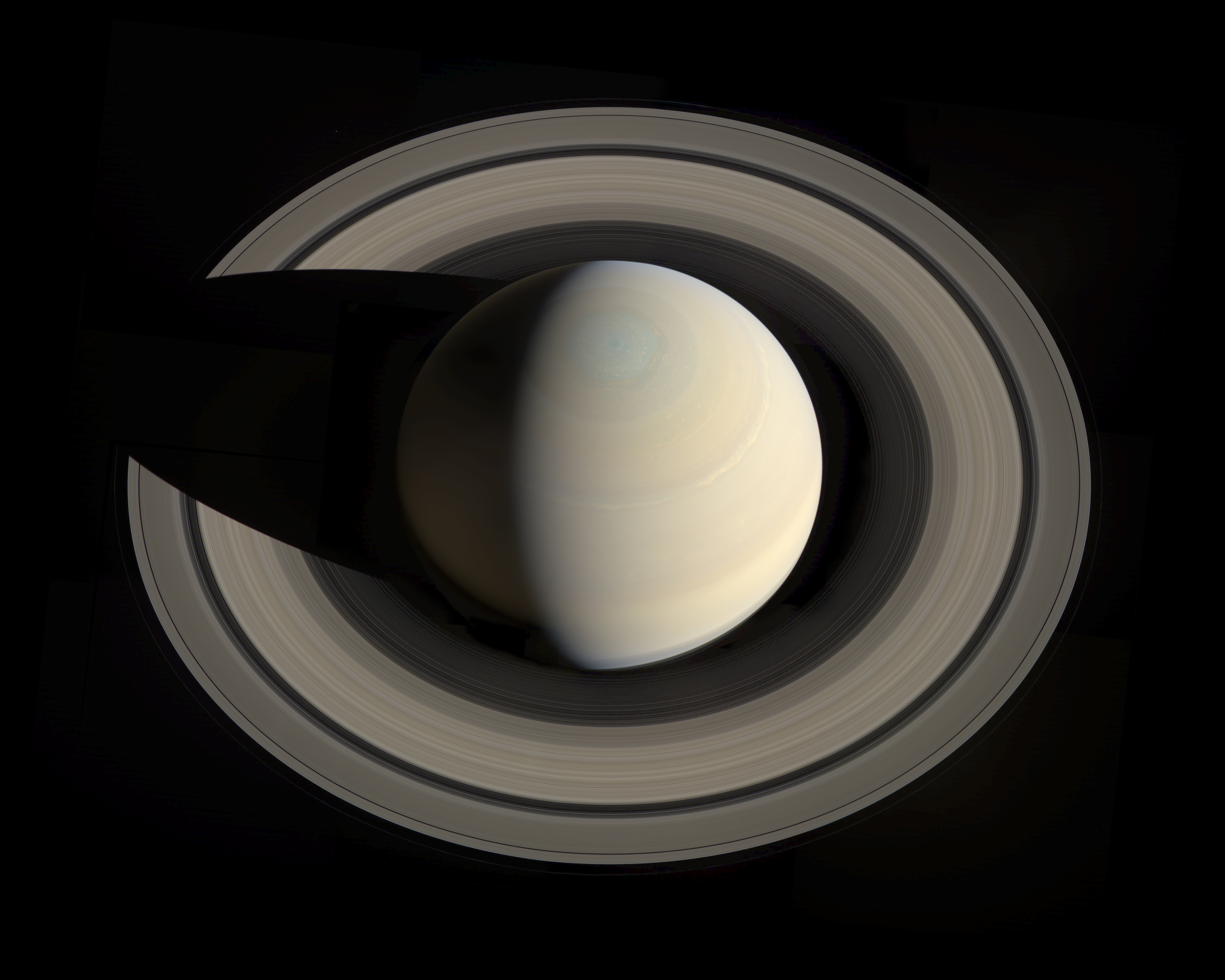
The Planetary Society: "One for the history books: Stunning Saturn mosaic captured last week by Cassini"
(no words)


Cassini continues its exploration of the Saturn system with the 40-day Rev 199, which begins on November 7 at its farthest distance from the planet. This is also called the orbit's apoapse. At this point, Cassini is 3.81 million kilometers (2.37 million miles) from Saturn's cloud tops. Rev 199 occurs during the first inclined phase, which lasts until March 2015, of the Cassini Solstice Mission. The inclined phase will allow for polar views of Saturn and Titan as well as better vistas of Saturn's rings than those Cassini had while in the earlier, equatorial phase of the Solstice Mission. Thirty-seven ISS observations are planned for Rev 199, most observations are focused on Saturn's atmosphere and rings and on Titan during the T96 flyby.
Rev199 starts with Cassini still in solar conjunction, which continues until late on November 8. During this period, communications between Earth and Cassini are limited and few scientific investigations are performed. The first observation for the camera system, ISS, will be acquired on November 9. ISS will observe the small, outer moon Skoll from a distance of 11.5 million kilometers (7.13 million miles) in order to measure its rotational period. While most moons of Saturn have days that match their orbital period, Skoll and other small outer moons typically have days lasting a few hours to one Earth day (compared to orbital periods exceeding one Earth year). Skoll will be too far away to observe any surface features, so its day will be calculated by observing slight variations in its apparent brightness as it rotates. Between November 11 and 18, ISS will take four movies of Saturn's B ring, looking for dust spokes. On November 22 and 23, ISS will acquire a cloud and haze monitoring observation of Titan. Observations like this one are designed to track changes in the distribution of cloud across Titan as well as to monitor changes to its haze layers. The November 22 observation will be taken from a distance of 2.66 million kilometers (1.66 million miles). A similar observation will be taken on November 23 from a distance of 2.30 million kilometers (1.43 million miles). Both observations will cover Titan's north polar region, though the later one will have a better phase angle for observing the surface.
On November 23, ISS will acquire an astrometric observation of Saturn's small, inner moons. Astrometric observations are used to improve our understanding of the orbits of these small satellites, which can be influenced by Saturn's larger icy moons. Two more astrometric observations will be acquired on November 28 and December 3. Immediately afterward, ISS will acquire a quick observation of Saturn using the WAC. This observation is part of a series of "Storm Watch" observation sequences designed to take advantage of short, two-minute segments when the spacecraft turns the optical remote sensing (ORS) instruments back to Saturn as a waypoint between other experiments' observations. These sequences include blue, clear, two methane band, and one full-frame, continuum band filter images. Two more will be taken later on December 6 and 7. Also on November 23, ISS will ride along with the Visual and Infrared Mapping Spectrometer (VIMS) as it observes an occultation of the red giant star L2 Puppis by the ring system.
On November 25, ISS will acquire a movie of the Encke Gap in the outer A ring. This gap contains and is maintained by the small moon, Pan. On November 27, ISS will ride along with VIMS to acquire a mosaic of Saturn's north polar region using the WAC. Spring has progressed far enough that the entirety of the hexagonal jet stream that lies near 77 degrees North latitude will be in sunlight. ISS will be imaging the hexagon with a two-by-two mosaic rather than centering the field-of-view on the north pole. On November 28, ISS will ride-along with VIMS as it maps the clouds across Saturn's northern hemisphere. Later that day, ISS will image the outer A ring, where it will be looking at propellers previously imaged by Cassini. Propellers are small voids in Saturn's rings created by the gravitational interaction between large ring particles and the surrounding ring. A similar observation will be acquired of the A ring's unlit side on December 3.
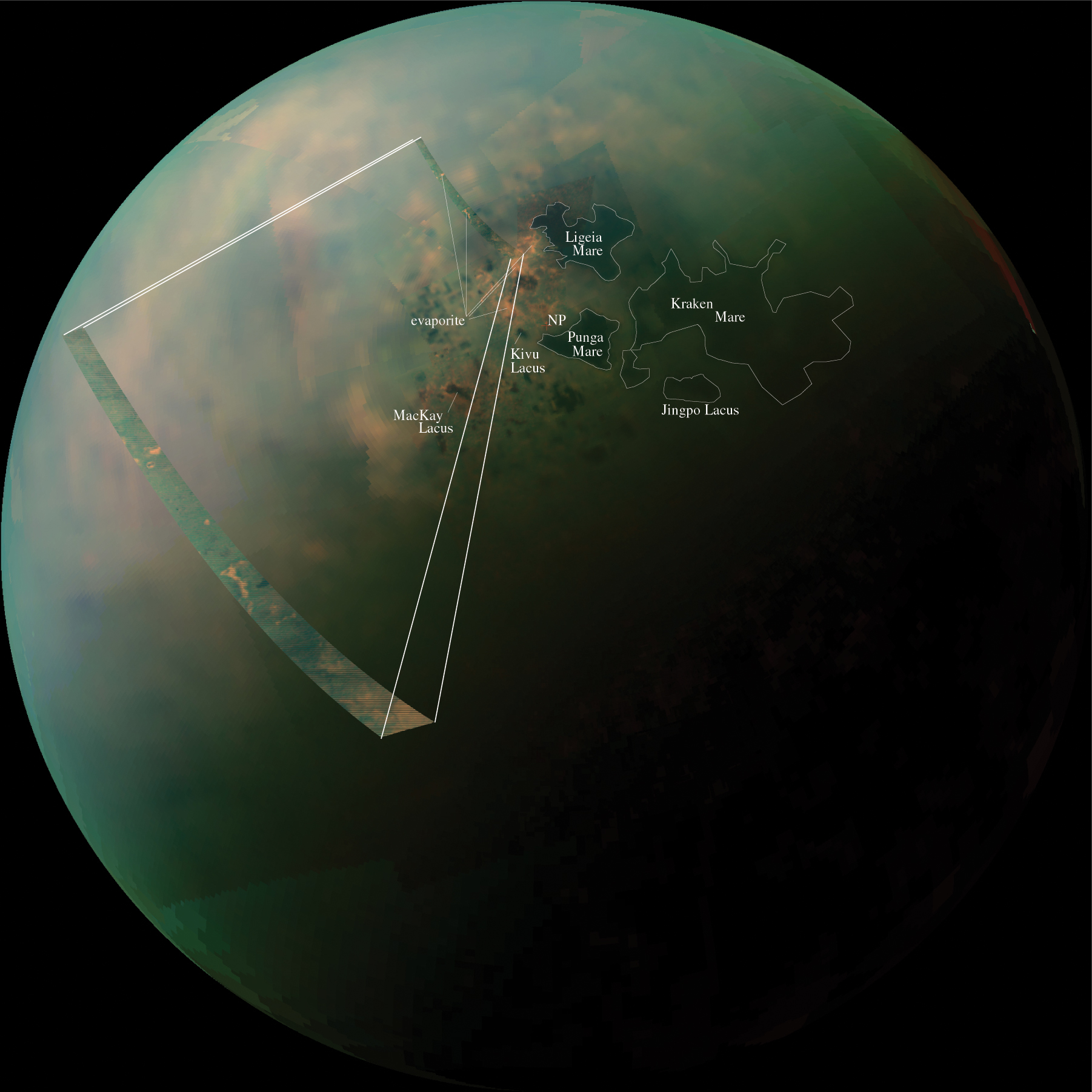
Cassini encounters Titan on December 1 at 00:41 UTC for the 97th time. This is the eighth and final Titan flyby planned for 2013, with the next encounter scheduled for January 1, 2014. T96 has a close-approach altitude of 1,400 kilometers (870 miles). This flyby will allow for imaging of the north polar region inbound to the encounter and the southern anti-Saturn hemisphere of Titan on the outbound leg. Before the encounter on November 29, ISS will acquire three cloud monitoring observations. Early on November 30, ISS will ride-along with the Composite Infrared Spectrometer (CIRS) as it stares at Titan in order to acquire mid-infrared spectral and temperature information about Titan's atmosphere. Afterward, ISS will acquire three mosaics that will cover the northern hemisphere and north polar region of Titan. These mosaics will allow researchers to study the distribution of lakes across the north polar region, compare them to their appearance at other wavelengths, and to search for small clouds that might be in the area. In addition, these observations will help fill in the largest gap in ISS's map of Titan. The final mosaic will contain four frames covering some of the small lakes on the leading hemisphere side of the north pole as well as Mackay Lacus.
During closest approach, VIMS will be the prime instrument with ISS riding along. VIMS will acquire several images of an area of small lakes on the leading hemisphere side of the north pole. VIMS will be mapping the distribution of both filled lakes and empty lakes coated with evaporites. These evaporites appear bright at VIMS' longer wavelengths. VIMS will also acquire a noodle-like image strip covering the border between dark, dune-filled Shangri-La and bright and rough Xanadu near Titan's equator, crossing Tui Regio in southwestern Xanadu. After the closest approach period, CIRS will acquire more data about Titan's upper haze layers - its structure, temperature, and composition - as well as the now-cooling south polar vortex. VIMS will also acquire a global mapping observation of Titan's southern hemisphere in order to search for clouds.
During the playback of T96 data following the encounter, late on December 1 at 22:43 UTC, Cassini will reach periapse for Rev 199 at an altitude of 1.12 million kilometers (0.69 million miles) from Saturn's cloud tops. Cassini will be 420,500 kilometers (261,290 miles) from Titan at the time.
On December 2, ISS will ride along with VIMS to observe cloud systems across the southern hemisphere of Saturn. On December 2 and 3, ISS will ride along with a VIMS observation of an occultation of the star R Lyrae by Saturn's F ring. On December 6, ISS will acquire a movie of the F ring, observing its various channels and streamers created by the interaction between the ring material and the nearby moon, Prometheus. On December 7, a similar ring movie will be taken of the D ring.
On December 17, Cassini will reach apoapse, bringing Rev 199 to a close and starting up the next orbit, Rev 200, which will include another targeted flyby of Titan.
{...}
 |
|
The near-infrared images from Cassini's imaging cameras show a bright unit of terrain in the northern land of lakes that had not previously been visible in the data. The bright area suggests that the surface here is unique from the rest of Titan, which might explain why almost all of the lakes are found in this region. Titan's lakes have very distinctive shapes -- rounded cookie-cutter silhouettes and steep sides -- and a variety of formation mechanisms have been proposed. The explanations range from the collapse of land after a volcanic eruption to karst terrain, where liquids dissolve soluble bedrock. Karst terrains on Earth can create spectacular topography such as the Carlsbad Caverns in New Mexico.
[...]


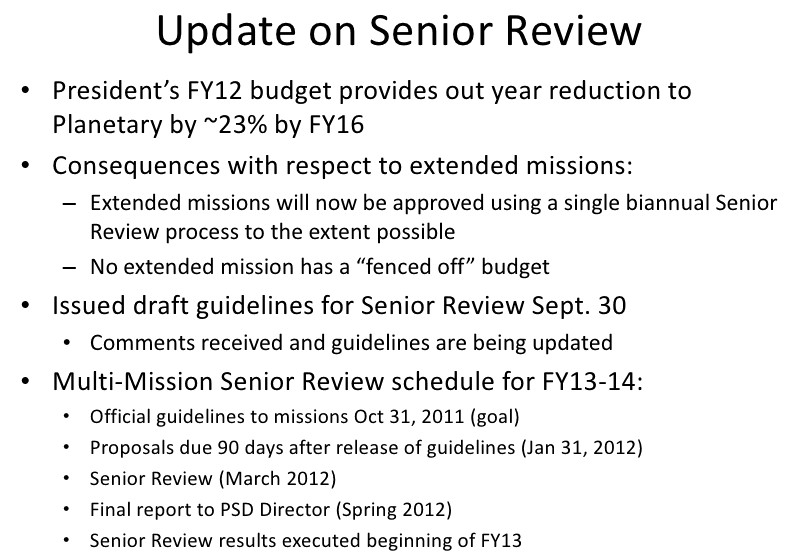
The Planetary Society Blog - Van Kane: Will We Lose Cassini’s “New” Mission at Saturn to Budget Cuts?
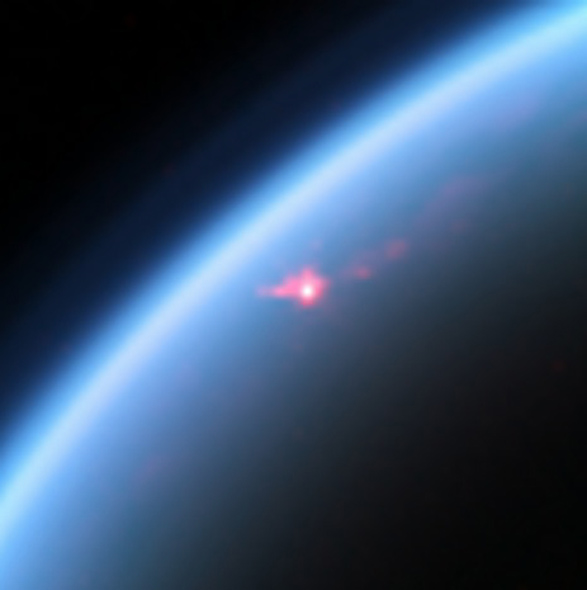
An image of Titan's north pole taken by the Cassini probe during a flyby in July 2012 shows sunlight being reflected from surface liquid in much the same way as a mirror re-directs light. This phenomenon is known as a specular reflection.
Dr Barnes, from the University of Idaho in Moscow, US, used a mathematical model to investigate whether the features in the image were compatible with waves.
"We think we've found the first waves outside the Earth," he told the meeting.
"What we're seeing seems to be consistent with waves at just a few locations in Punga Mare [with a slope] of six degrees."
He said other possibilities, such as a wet mudflat, could not be ruled out.
But assuming these were indeed waves, Dr Barnes calculates that a wind speed of around 0.75 m/s is required to produce ripples with the requisite slope of six degrees.
That points to the waves being just 2cm high. "Don't make your surfing vacation reservations for Titan just yet," Dr Barnes quipped.
However, Titan appears to be on the brink of major seasonal changes, which present important opportunities for scientists to gain a better understanding of this complex and endlessly surprising world.
"The expectation is that any day now, the winds will start getting strong enough as we move into northern summer, and the waves will start picking up," Ralph Lorenz, from the Johns Hopkins Applied Physics Laboratory (JHUAPL) in Maryland, told BBC News.
"You can also get a phenomenon known as wind set-up, where wind over a body of water will cause the liquid to pile up, potentially causing a storm surge."
He added: "A metre of storm surge, a metre of tides, is certainly within the realms of possibility for Titan. Whether we can see that [with Cassini] is another matter."
Dr Lorenz said he was hopeful that sea level rise of a metre in height could cause shorelines to migrate and that this could be picked up from orbit.
[...]


Scientists say they have discovered what could be the birth of a new moon in the rings of Saturn.
Informally named Peggy, the object would become the 63rd moon in Saturn's orbit - if confirmed.
The evidence comes from a black-and-white image of the outermost ring captured by the Cassini spacecraft.
"Witnessing the birth of a tiny moon is an exciting, unexpected event," said Linda Spilker of Nasa's Jet Propulsion Laboratory (JPL).


I am absolutely convinced that the Cassini-Huygens mission is the best and most complete mission which sent the humanity to another planet. The images provided are amazing and a huge, spectacular quality. And the Huygens probe was successful. For me the list of missions humanity should be made well (at least that I know):
1.- Apollo
2.- ISS
3 - Voyager
4.- Cassini
5.- Venera
6.- Hubble Space Telescope
7.- Mars Exploration Rover
As NASA's Cassini spacecraft zooms toward Saturn's smoggy moon Titan for a targeted flyby on June 18, mission scientists are excitedly hoping to repeat a scientific tour de force that will provide valuable new insights into the nature of the moon's surface and atmosphere.
For Cassini's radio science team, the last flyby of Titan, on May 17, was one of the most scientifically valuable encounters of the spacecraft's current extended mission. The focus of that flyby, designated "T-101," was on using radio signals to explore the physical nature of Titan's vast northern seas and probe the high northern regions of its substantial atmosphere.
The Cassini team hopes to replicate the technical success of that flyby during the T-102 encounter, slated for June 18, during which the spacecraft will attempt similar measurements of Titan. During closest approach, the spacecraft will be just 2,274 miles (3,659 kilometers) above the surface of the moon while travelling at 13,000 miles per hour (5.6 kilometers per second).
During the upcoming flyby, if all goes well as before, Cassini's radio science subsystem will bounce signals off the surface of Titan, toward Earth, where they will be received by the ground stations of NASA's Deep Space Network. This sort of observation is known as a bistatic scattering experiment and its results can yield clues to help answer a variety of questions about large areas of Titan's surface: Are they solid, slushy or liquid? Are they reflective? What might they be made of?
[...]
During the Titan 102 flyby, labeled T-102, on June 18, the Radio Science (RSS) instrument carried out a maneuver in which it passed its signal through the atmosphere of Titan and back to the Deep Space Network (DSN) stations on Earth until the signal was fully blocked (occulted) by Titan itself. These observations of Titan’s atmosphere help answer three main science questions.
First, the occultation will help determine seasonal changes in the high latitude atmosphere, specifically the temperature structure and formation and breakup of the winter polar vortex. Second, it will determine tropospheric winds from measurements of tropospheric temperature profiles. And third, it will determine the atmospheric and ionospheric structure at all levels.
This flyby also presents another northern lake-crossing opportunity to bounce signals off the surface of the liquid. Known as a bistatic scattering experiment, the results can be used to reveal details about the nature and composition of the surface and how those characteristics vary from place to place.
The geometry of such opportunities is usually less optimal than that of standalone bistatic opportunities such as those on T-106 and T-124, hence tend to have less chance of surface echo detectability. They have proved useful nonetheless. The T-102 bistatic ground grazes the presently known edge of Ligeia Mare, the second largest body of liquid on the moon. It continues over Kraken Mare, the largest body of liquid. Both inbound and outbound the DSN should be able to capture scattering signals that are partly within an angle range, referred to as Brewster’s angle, that makes the measurements useful.
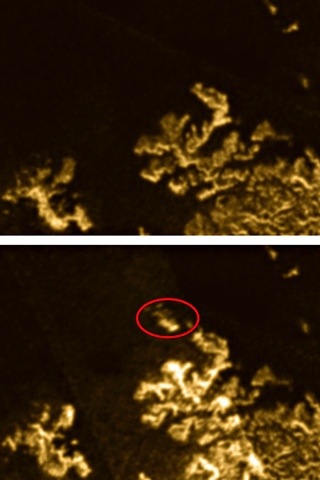
Now you don't see it. Now, you do. And now you don't see it again. Astronomers have discovered a bright, mysterious geologic object – where one never existed – on Cassini mission radar images of Ligeia Mare, the second-largest sea on Saturn's moon Titan. Scientifically speaking, this spot is considered a "transient feature," but the astronomers have playfully dubbed it "Magic Island."
Reporting in the journal Nature Geoscience June 22, the scientists say this may be the first observation of dynamic, geological processes in Titan's northern hemisphere. "This discovery tells us that the liquids in Titan's northern hemisphere are not simply stagnant and unchanging, but rather that changes do occur," said Jason Hofgartner, a Cornell University graduate student in the field of planetary sciences, and the paper's lead author. "We don't know precisely what caused this 'magic island' to appear, but we'd like to study it further."
Titan, the largest of Saturn's 62 known moons, is a world of lakes and seas. The moon – smaller than our own planet – bears close resemblance to watery Earth, with wind and rain driving the creation of strikingly familiar landscapes. Under its thick, hazy nitrogen-methane atmosphere, astronomers have found mountains, dunes and lakes. But in lieu of water, liquid methane and ethane flow through riverlike channels into seas the size of Earth's Great Lakes.
To discover this geologic feature, the astronomers relied on an old technique – flipping. The Cassini spacecraft sent data on July 10, 2013, to the Jet Propulsion Laboratory at the California Institute of Technology for image processing. Within a few days, Hofgartner and his colleagues flipped between older Titan images and the newly processed pictures for any hint of change. This is a long-standing method used to discover asteroids, comets and other worlds. "With flipping, the human eye is pretty good at detecting change," said Hofgartner.
Prior to the July 2013 observation, that region of Ligeia Mare had been completely devoid of features, including waves.
Titan's seasons change on a longer time scale than Earth's. The moon's northern hemisphere is transitioning from spring to summer. The astronomers think the strange feature may result from changing seasons.
In light of the changes, Hofgartner and the other authors speculate on four reasons for this phenomenon:
- Northern hemisphere winds may be kicking up and forming waves on Ligeia Mare. The radar imaging system might see the waves as a kind of "ghost" island.
- Gases may push out from the sea floor of Ligeia Mare, rising to the surface as bubbles.
- Sunken solids formed by a wintry freeze could become buoyant with the onset of warmer temperatures during the late Titan spring.
- Ligeia Mare has suspended solids, which are neither sunken nor floating, but act like silt in a terrestrial delta.
[...]
Scientists are investigating a mystery object that appeared and then vanished again from a giant lake on Titan, the largest moon of Saturn.
They spotted the object in an image taken by Nasa's Cassini probe last year as it swung around the alien moon, more than a billion kilometres from Earth. Pictures of the same spot captured nothing before or some days later.
Little more than a white blob on a grainy image of Titan's northern hemisphere, the sighting could be an iceberg that broke free of the shoreline, an effect of rising bubbles, or waves rolling across the normally placid lake's surface, scientists say.
Astronomers have named the blob the "magic island" until they have a better idea what they are looking at. "We can't be sure what it is yet because we only have the one image, but it's not something you would normally see on Titan," said Jason Hofgartner, a planetary scientist at Cornell University in New York. "It is not something that has been there permanently."
[...]
The US team made their curious discovery while poring over radar images of Ligeia mare, a 150-metre-deep sea that stretches for hundreds of kilometres in Titan's northern hemisphere. Among the snapshots taken in 2007, 2009 and 2013 was one with the strange white feature, about six miles off the mountainous southern shore.
[...]
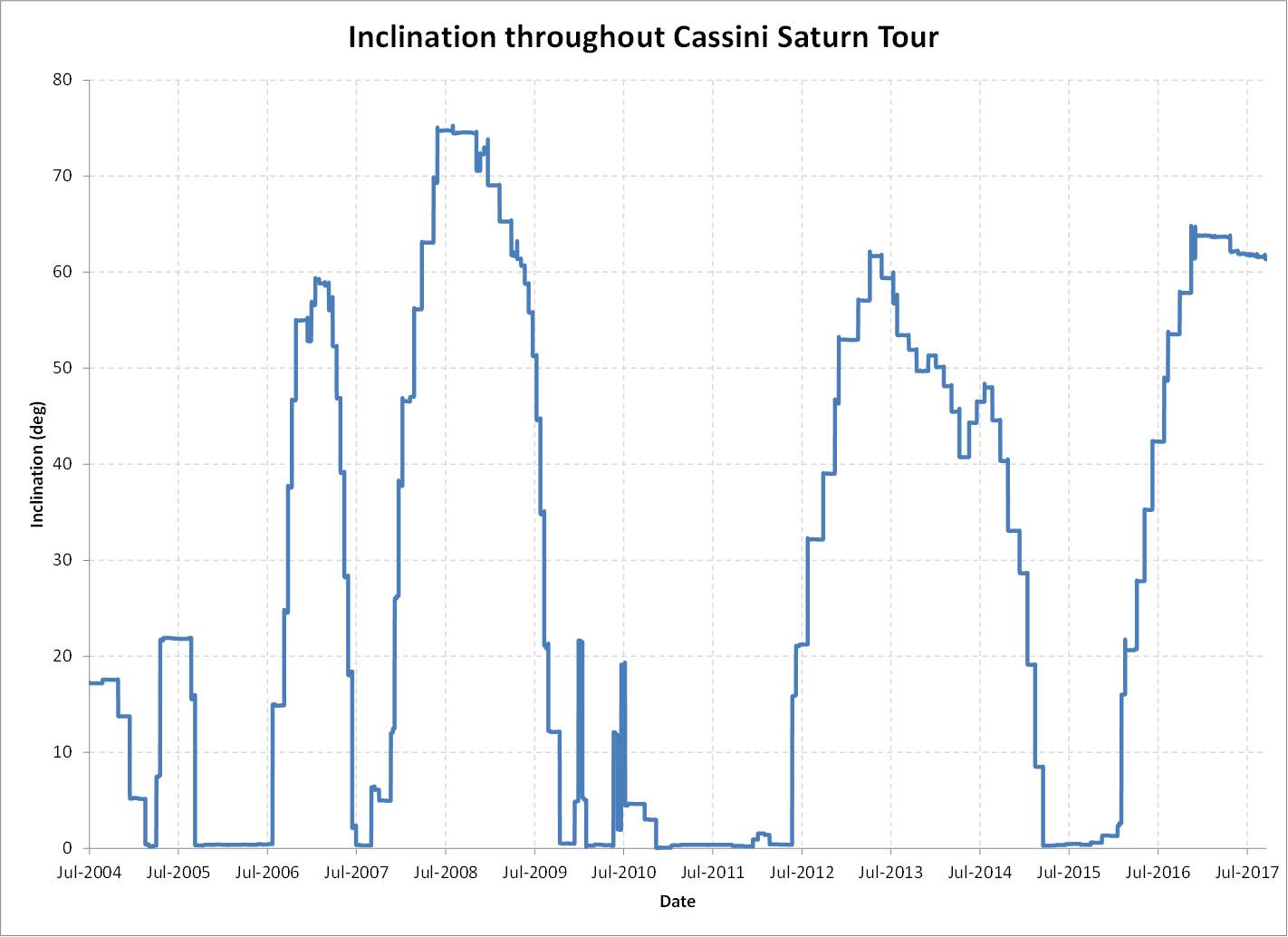
Does Cassini perform any DSM between the flybys? How much fuel she has?

Cassini started with 132 kilograms of hydrazine and has about 68 kilograms remaining. The spacecraft also started with 1,131 kilograms of mono-methyl hydrazine and 1,869 kilograms of nitrogen tetroxide. The spacecraft is now down to 76 kilograms of mono-methyl hydrazine and 126 kilograms nitrogen tetroxide.