
sorindafabico
New member
Thanks! You solved a long lasting question of mine.


It has been a decade since a robotic traveler from Earth first soared over rings of ice and fired its engine to fall forever into the embrace of Saturn. On June 30, the Cassini mission will celebrate 10 years of exploring the planet, its rings and moons.
The Cassini spacecraft, carrying the European Space Agency's Huygens probe, arrived in the Saturn system on June 30, 2004, for a four-year primary mission. Since 2008, NASA has granted the mission three extensions, allowing scientists an unprecedented opportunity to observe seasonal changes as the planet and its retinue completed one-third of their nearly 30-year-long trek around the sun.
"Having a healthy, long-lived spacecraft at Saturn has afforded us a precious opportunity," said Linda Spilker, Cassini project scientist at NASA's Jet Propulsion Laboratory in Pasadena, California. "By having a decade there with Cassini, we have been privileged to witness never-before-seen events that are changing our understanding of how planetary systems form and what conditions might lead to habitats for life."
[...]
A combined NASA and European Space Agency (ESA)-funded study has found firm evidence that nitrogen in the atmosphere of Saturn's moon Titan originated in conditions similar to the cold birthplace of the most ancient comets from the Oort cloud. The finding rules out the possibility that Titan's building blocks formed within the warm disk of material thought to have surrounded the infant planet Saturn during its formation.
The main implication of this new research is that Titan's building blocks formed early in the solar system's history, in the cold disk of gas and dust that formed the sun. This was also the birthplace of many comets, which retain a primitive, or largely unchanged, composition today.
The research, led by Kathleen Mandt of Southwest Research Institute in San Antonio, was published this week in the Astrophysical Journal Letters. Co-authors on the study include colleagues from France's National Center for Scientific Research (CNRS) and Observatoire de Paris.
Nitrogen is the main ingredient in the atmosphere of Earth, as well as on Titan. The planet-sized moon of Saturn is frequently compared to an early version of Earth, locked in a deep freeze.
The paper suggests that information about Titan's original building blocks is still present in the icy moon's atmosphere, allowing researchers to test different ideas about how the moon might have formed. Mandt and colleagues demonstrate that a particular chemical hint as to the origin of Titan's nitrogen should be essentially the same today as when this moon formed, up to 4.6 billion years ago. That hint is the ratio of one isotope, or form, of nitrogen, called nitrogen-14, to another isotope, called nitrogen-15.
The team finds that our solar system is not old enough for this nitrogen isotope ratio to have changed significantly. This is contrary to what scientists commonly have assumed.
"When we looked closely at how this ratio could evolve with time, we found that it was impossible for it to change significantly. Titan's atmosphere contains so much nitrogen that no process can significantly modify this tracer even given more than four billion years of solar system history," Mandt said.
The small amount of change in this isotope ratio over long time periods makes it possible for researchers to compare Titan's original building blocks to other solar system objects in search of connections between them.
As planetary scientists investigate the mystery of how the solar system formed, isotope ratios are one of the most valuable types of clues they are able to collect. In planetary atmospheres and surface materials, the specific amount of one form of an element, like nitrogen, relative to another form of that same element can be a powerful diagnostic tool because it is closely tied to the conditions under which materials form.
[...]
With input from more than 2,000 members of the public, team members on NASA's Cassini mission to Saturn have chosen a name for the final phase of the mission: the Cassini Grand Finale.
Starting in late 2016, the Cassini spacecraft will begin a daring set of orbits that is, in some ways, like a whole new mission. The spacecraft will repeatedly climb high above Saturn's north pole, flying just outside its narrow F ring. Cassini will probe the water-rich plume of the active geysers on the planet's intriguing moon Enceladus, and then will hop the rings and dive between the planet and innermost ring 22 times.
Because the spacecraft will be in close proximity to Saturn, the team had been calling this phase "the proximal orbits," but they felt the public could help decide on a more exciting moniker. In early April, the Cassini mission invited the public to vote on a list of alternative names provided by team members or to suggest ideas of their own.
"We chose a name for this mission phase that would reflect the exciting journey ahead while acknowledging that it's a big finish for what has been a truly great show," said Earl Maize, Cassini project manager at NASA's Jet Propulsion Laboratory in Pasadena, California.
Scientists analyzing data from NASA's Cassini mission have firm evidence the ocean inside Saturn's largest moon, Titan, might be as salty as Earth's Dead Sea.
The new results come from a study of gravity and topography data collected during Cassini's repeated flybys of Titan during the past 10 years. Using the Cassini data, researchers presented a model structure for Titan, resulting in an improved understanding of the structure of the moon's outer ice shell. The findings are published in this week's edition of the journal Icarus.
"Titan continues to prove itself as an endlessly fascinating world, and with our long-lived Cassini spacecraft, we're unlocking new mysteries as fast as we solve old ones," said Linda Spilker, Cassini project scientist at NASA's Jet Propulsion Laboratory in Pasadena, California, who was not involved in the study.
Additional findings support previous indications the moon's icy shell is rigid and in the process of freezing solid. Researchers found that a relatively high density was required for Titan's ocean in order to explain the gravity data. This indicates the ocean is probably an extremely salty brine of water mixed with dissolved salts likely composed of sulfur, sodium and potassium. The density indicated for this brine would give the ocean a salt content roughly equal to the saltiest bodies of water on Earth.
"This is an extremely salty ocean by Earth standards," said the paper's lead author, Giuseppe Mitri of the University of Nantes in France. "Knowing this may change the way we view this ocean as a possible abode for present-day life, but conditions might have been very different there in the past."
Cassini data also indicate the thickness of Titan's ice crust varies slightly from place to place. The researchers said this can best be explained if the moon's outer shell is stiff, as would be the case if the ocean were slowly crystalizing and turning to ice. Otherwise, the moon's shape would tend to even itself out over time, like warm candle wax. This freezing process would have important implications for the habitability of Titan's ocean, as it would limit the ability of materials to exchange between the surface and the ocean.
A further consequence of a rigid ice shell, according to the study, is any outgassing of methane into Titan's atmosphere must happen at scattered "hot spots" -- like the hot spot on Earth that gave rise to the Hawaiian Island chain. Titan's methane does not appear to result from convection or plate tectonics recycling its ice shell.
How methane gets into the moon's atmosphere has long been of great interest to researchers, as molecules of this gas are broken apart by sunlight on short geological timescales. Titan's present atmosphere contains about five percent methane. This means some process, thought to be geological in nature, must be replenishing the gas. The study indicates that whatever process is responsible, the restoration of Titan's methane is localized and intermittent.
"Our work suggests looking for signs of methane outgassing will be difficult with Cassini, and may require a future mission that can find localized methane sources," said Jonathan Lunine, a scientist on the Cassini mission at Cornell University, Ithaca, New York, and one of the paper's co-authors. "As on Mars, this is a challenging task."

Scientists using mission data from NASA’s Cassini spacecraft have identified 101 distinct geysers erupting on Saturn’s icy moon Enceladus. Their analysis suggests it is possible for liquid water to reach from the moon’s underground sea all the way to its surface.
These findings, and clues to what powers the geyser eruptions, are presented in two articles published in the current online edition of the Astronomical Journal.
Over a period of almost seven years, Cassini’s cameras surveyed the south polar terrain of the small moon, a unique geological basin renowned for its four prominent "tiger stripe” fractures and the geysers of tiny icy particles and water vapor first sighted there nearly 10 years ago. The result of the survey is a map of 101 geysers, each erupting from one of the tiger stripe fractures, and the discovery that individual geysers are coincident with small hot spots. These relationships pointed the way to the geysers’ origin.
[...]
The answer to this mystery came from comparison of the survey results with high-resolution data collected in 2010 by Cassini’s heat-sensing instruments. Individual geysers were found to coincide with small-scale hot spots, only a few dozen feet (or tens of meters) across, which were too small to be produced by frictional heating, but the right size to be the result of condensation of vapor on the near-surface walls of the fractures. This immediately implicated the hot spots as the signature of the geysering process.
“Once we had these results in hand we knew right away heat was not causing the geysers, but vice versa,” said Carolyn Porco, leader of the Cassini imaging team from the Space Science Institute in Boulder, Colorado, and lead author of the first paper. “It also told us the geysers are not a near-surface phenomenon, but have much deeper roots.”
Thanks to recent analysis of Cassini gravity data, the researchers concluded the only plausible source of the material forming the geysers is the sea now known to exist beneath the ice shell. They also found that narrow pathways through the ice shell can remain open from the sea all the way to the surface, if filled with liquid water.
[...]

NASA's Cassini spacecraft will execute the largest planned maneuver of the spacecraft's remaining mission on Saturday, Aug. 9. The maneuver will target Cassini toward an Aug. 21 encounter with Saturn's largest moon, Titan.
The main engine firing will last about a minute and will provide a change in velocity of 41 feet per second (12.5 meters per second). This is the largest maneuver by Cassini in five years. No other remaining maneuver comes close, in the amount of propellant it will consume and the amount by which it will change the spacecraft's velocity. By contrast, the smallest maneuvers Cassini routinely executes are about 0.4 inches (10 millimeters) per second.
The large size of the Aug. 9 burn is needed to begin the process of "cranking down" Cassini's orbit, so that the spacecraft circles Saturn nearer to the plane of the rings and moons. Previously, with each Titan flyby, mission controllers adjusted the spacecraft's orbit to be increasingly inclined, carrying Cassini high above Saturn's polar regions. The upcoming maneuver starts reversing that trend, making the orbit increasingly close to the equator.
Although Cassini has occasionally performed similar large propulsive maneuvers during its decade in the Saturn system, Titan itself has proven to be the workhorse for steering Cassini around Saturn. It is not uncommon for the spacecraft to receive a gravitational assist, or boost, from Titan that rivals or exceeds the 96-minute engine burn Cassini performed in 2004 to insert itself into Saturn orbit.
[...]
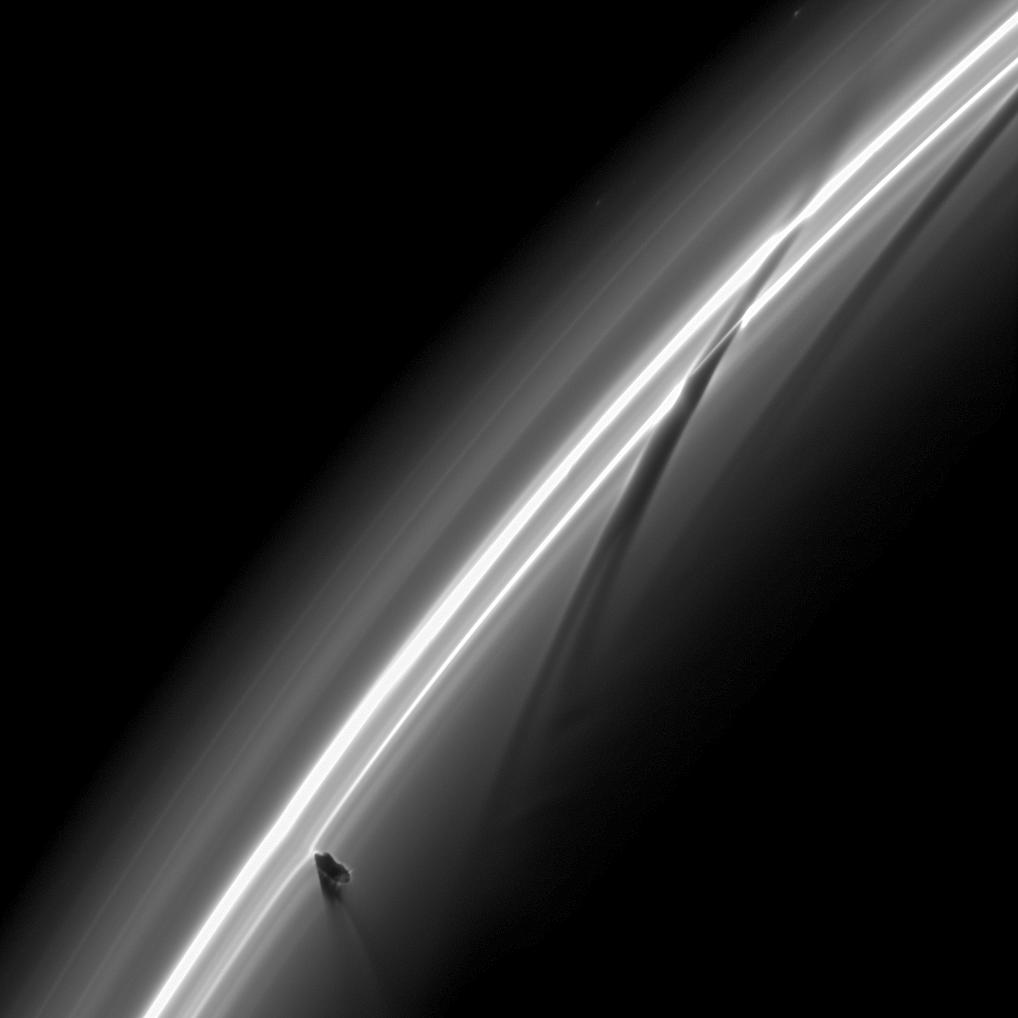
[...] A recent NASA-funded study compared the F ring's appearance in six years of observations by the Cassini mission to its appearance during the Saturn flybys of NASA's Voyager mission, 30 years earlier. The study team found that, while the overall number of clumps in the F ring remained the same, the number of exceptionally bright clumps of material plummeted during that time. While the Voyagers saw two or three bright clumps in any given observation, Cassini spied only two of the features during a six-year period. What physical processes, they wondered, could cause only the brightest of these features to decline sharply?
While a variety of features in Saturn's many rings display marked changes over multiple years, the F ring seems to change on a scale of days, and even hours. Trying to work out what is responsible for the ring's tumultuous behavior is a major goal for ring scientists working on Cassini.
"Saturn's F ring looks fundamentally different from the time of Voyager to the Cassini era," said Robert French of the SETI Institute in Mountain View, California, who led the study along with SETI Principal Investigator Mark Showalter. "It makes for an irresistible mystery for us to investigate."
The researchers hypothesize that the brightest clumps in the F ring are caused by repeated impacts into its core by small moonlets up to about 3 miles (5 kilometers) wide, whose paths around Saturn lie close to the ring and cross into it every orbit. They propose that the diminishing number of bright clumps results from a drop in the number of these little moonlets between the Voyager and Cassini eras.
As for what might have caused the moonlets to become scarce, the team has a suspect: Saturn's moon Prometheus. The F ring encircles the planet at a special location, near a place called the Roche limit -- get any closer to Saturn than this, and tidal forces from the planet's gravity tear apart smaller bodies. "Material at this distance from Saturn can't decide whether it wants to remain as a ring or coalesce to form a moon," French said. Prometheus orbits just inside the F ring, and adds to the pandemonium by stirring up the ring particles, sometimes leading to the creation of moonlets, and sometimes leading to their destruction.
Every 17 years, the orbit of Prometheus aligns with the orbit of the F ring in such a way that its influence is particularly strong. The study team thinks this periodic alignment might spur the creation of many new moonlets. The moonlets would then crash repeatedly through the F ring, like cars in a Hollywood high-speed chase, creating bright clumps as they smash across lanes of ring material. Fewer clumps would be created as time goes by, because the moonlets themselves are eventually destroyed by all the crashes.
As with any good scientific hypothesis, the researchers offer a way to test their ideas. It happens that the Voyager encounters with Saturn occurred a few years after the 1975 alignment between Prometheus and the F ring, and Cassini was present for the 2009 alignment. If the moon's periodic influence is indeed responsible for creating new moonlets, then the researchers expect that Cassini would see the F ring return to a Voyager-like number of bright clumps in the next couple of years.
"Cassini's continued presence at Saturn gives us an interesting opportunity to test this prediction," said Linda Spilker, Cassini project scientist at NASA's Jet Propulsion Laboratory in Pasadena, California, who was not involved in the study. "Whatever the result, we're certain to learn something valuable about how rings, as well as planets and moons, form and evolve."

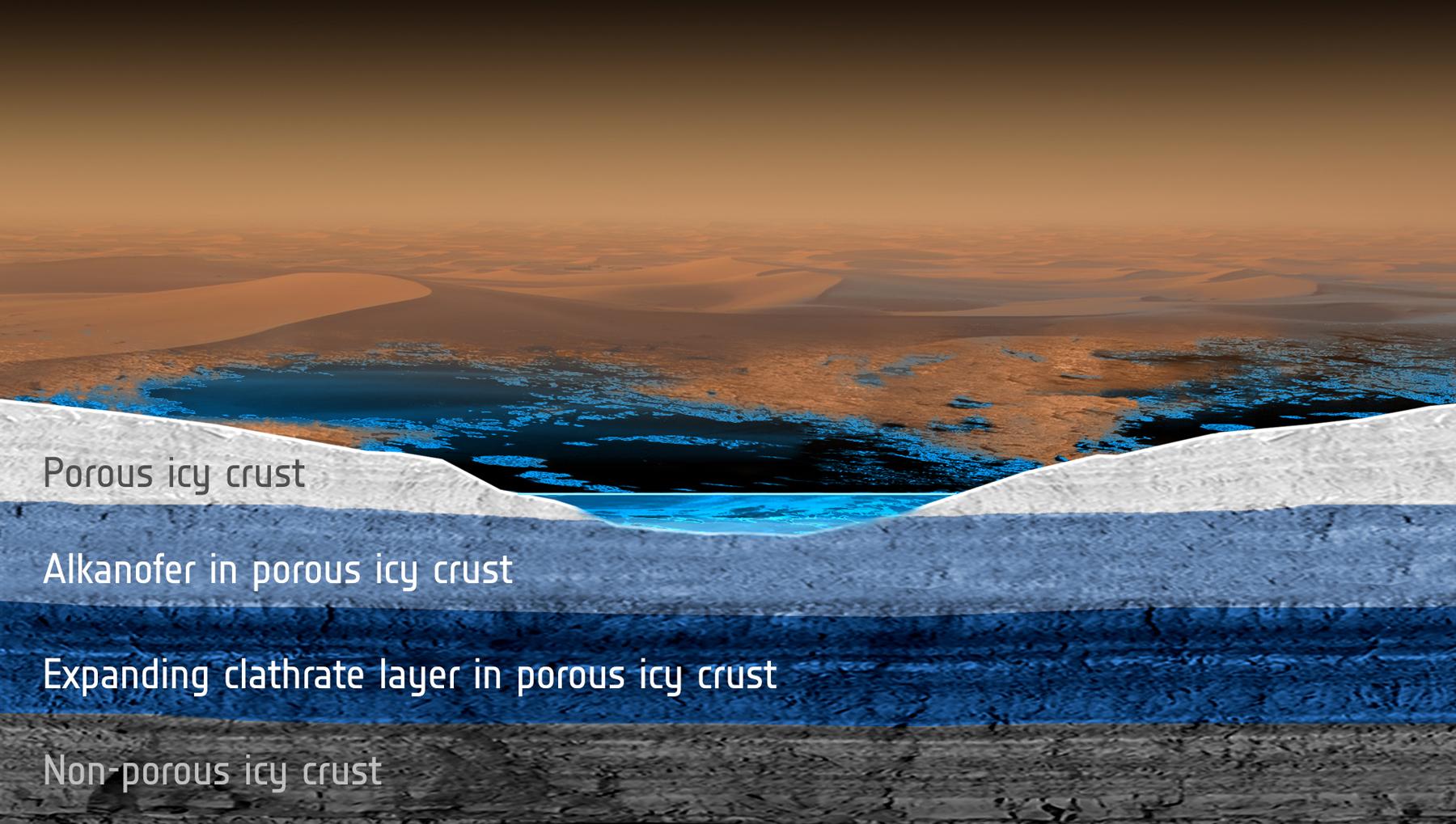
[...] A recent study led by Olivier Mousis, a Cassini research associate at the University of Franche-Comté, France, examined how Titan's methane rainfall would interact with icy materials within underground reservoirs. They found that the formation of materials called clathrates changes the chemical composition of the rainfall runoff that charges these hydrocarbon "aquifers." This process leads to the formation of reservoirs of propane and ethane that may feed into some rivers and lakes.
"We knew that a significant fraction of the lakes on Titan's surface might possibly be connected with hidden bodies of liquid beneath Titan's crust, but we just didn't know how they would interact," said Mousis. "Now, we have a better idea of what these hidden lakes or oceans could be like."
Mousis and colleagues at Cornell University, Ithaca, New York, and NASA's Jet Propulsion Laboratory, Pasadena, California, modeled how a subsurface reservoir of liquid hydrocarbons would diffuse, or spread, through Titan's porous, icy crust. They found that, at the bottom of the original reservoir, which contains methane from rainfall, a second reservoir would slowly form. This secondary reservoir would be composed of clathrates.
Clathrates are compounds in which water forms a crystal structure with small cages that trap other substances like methane and ethane. Clathrates that contain methane are found on Earth in some polar and ocean sediments. On Titan, the surface pressure and temperature should allow clathrates to form when liquid hydrocarbons come into contact with water ice, which is a major component of the moon's crust. These clathrate layers could remain stable as far down as several miles below Titan's surface.
One of the peculiar properties of clathrates is that they trap and split molecules into a mix of liquid and solid phases, in a process called fractionation. Titan's subsurface clathrate reservoirs would interact with and fractionate the liquid methane from the original underground hydrocarbon lake, slowly changing its composition. Eventually the original methane aquifer would be turned into a propane or ethane aquifer.
"Our study shows that the composition of Titan's underground liquid reservoirs can change significantly through their interaction with the icy subsurface, provided the reservoirs are cut off from the atmosphere for some period of time," said Mathieu Choukroun of JPL, one of three co-authors of the study with Mousis.
Importantly, the chemical transformations taking place underground would affect Titan's surface. Lakes and rivers fed by springs from propane or ethane subsurface reservoirs would show the same kind of composition, whereas those fed by rainfall would be different and contain a significant fraction of methane. This means researchers could examine the composition of Titan's surface lakes to learn something about what is happening deep underground, said Mousis.
Almost immediately after NASA's twin Voyager spacecraft made their brief visits to Saturn in the early 1980s, scientists were hungry for more. The Voyagers had offered them only a brief glimpse of a family of new worlds -- Saturn's icy moons -- and the researchers were eager to spend more time among those bodies.
The successor to the Voyagers at Saturn, NASA's Cassini spacecraft, has spent the past 10 years collecting images and other data as it has toured the Ringed Planet and its family of satellites. New color maps, produced from this trove of data, show that Cassini has essentially fulfilled one of its many mission objectives: producing global maps of Saturn's six major icy moons.
These are the large Saturnian moons, excluding haze-covered Titan, known before the start of the Space Age: Mimas, Enceladus, Tethys, Dione, Rhea and Iapetus. Aside from a gap in the north polar region of Enceladus (to be filled in next year), and some areas of Iapetus, this objective is now more or less complete.
Swipe between the Voyager and Cassini maps below to see how 10 years have changed our view of Saturn's moons.


NASA's Cassini spacecraft has provided scientists the first clear evidence that Saturn's moon Enceladus exhibits signs of present-day hydrothermal activity which may resemble that seen in the deep oceans on Earth. The implications of such activity on a world other than our planet open up unprecedented scientific possibilities.
"These findings add to the possibility that Enceladus, which contains a subsurface ocean and displays remarkable geologic activity, could contain environments suitable for living organisms," said John Grunsfeld, astronaut and associate administrator of NASA's Science Mission Directorate in Washington. "The locations in our solar system where extreme environments occur in which life might exist may bring us closer to answering the question: are we alone in the universe."
Hydrothermal activity occurs when seawater infiltrates and reacts with a rocky crust and emerges as a heated, mineral-laden solution, a natural occurrence in Earth's oceans. According to two science papers, the results are the first clear indications an icy moon may have similar ongoing active processes.
The first paper, published this week in the journal Nature, relates to microscopic grains of rock detected by Cassini in the Saturn system. An extensive, four-year analysis of data from the spacecraft, computer simulations and laboratory experiments led researchers to the conclusion the tiny grains most likely form when hot water containing dissolved minerals from the moon's rocky interior travels upward, coming into contact with cooler water. Temperatures required for the interactions that produce the tiny rock grains would be at least 194 degrees Fahrenheit (90 degrees Celsius).
"It's very exciting that we can use these tiny grains of rock, spewed into space by geysers, to tell us about conditions on -- and beneath -- the ocean floor of an icy moon," said the paper's lead author Sean Hsu, a postdoctoral researcher at the University of Colorado at Boulder.
Cassini's cosmic dust analyzer (CDA) instrument repeatedly detected miniscule rock particles rich in silicon, even before Cassini entered Saturn's orbit in 2004. By process of elimination, the CDA team concluded these particles must be grains of silica, which is found in sand and the mineral quartz on Earth. The consistent size of the grains observed by Cassini, the largest of which were 6 to 9 nanometers, was the clue that told the researchers a specific process likely was responsible.
On Earth, the most common way to form silica grains of this size is hydrothermal activity under a specific range of conditions; namely, when slightly alkaline and salty water that is super-saturated with silica undergoes a big drop in temperature.
"We methodically searched for alternate explanations for the nanosilica grains, but every new result pointed to a single, most likely origin," said co-author Frank Postberg, a Cassini CDA team scientist at Heidelberg University in Germany.
Hsu and Postberg worked closely with colleagues at the University of Tokyo who performed the detailed laboratory experiments that validated the hydrothermal activity hypothesis. The Japanese team, led by Yasuhito Sekine, verified the conditions under which silica grains form at the same size Cassini detected. The researchers think these conditions may exist on the seafloor of Enceladus, where hot water from the interior meets the relatively cold water at the ocean bottom.
The extremely small size of the silica particles also suggests they travel upward relatively quickly from their hydrothermal origin to the near-surface sources of the moon's geysers. From seafloor to outer space, a distance of about 30 miles (50 kilometers), the grains spend a few months to a few years in transit, otherwise they would grow much larger.
The authors point out that Cassini's gravity measurements suggest Enceladus' rocky core is quite porous, which would allow water from the ocean to percolate into the interior. This would provide a huge surface area where rock and water could interact.
The second paper, recently published in Geophysical Research Letters, suggests hydrothermal activity as one of two likely sources of methane in the plume of gas and ice particles that erupts from the south polar region of Enceladus. The finding is the result of extensive modeling by French and American scientists to address why methane, as previously sampled by Cassini, is curiously abundant in the plume.
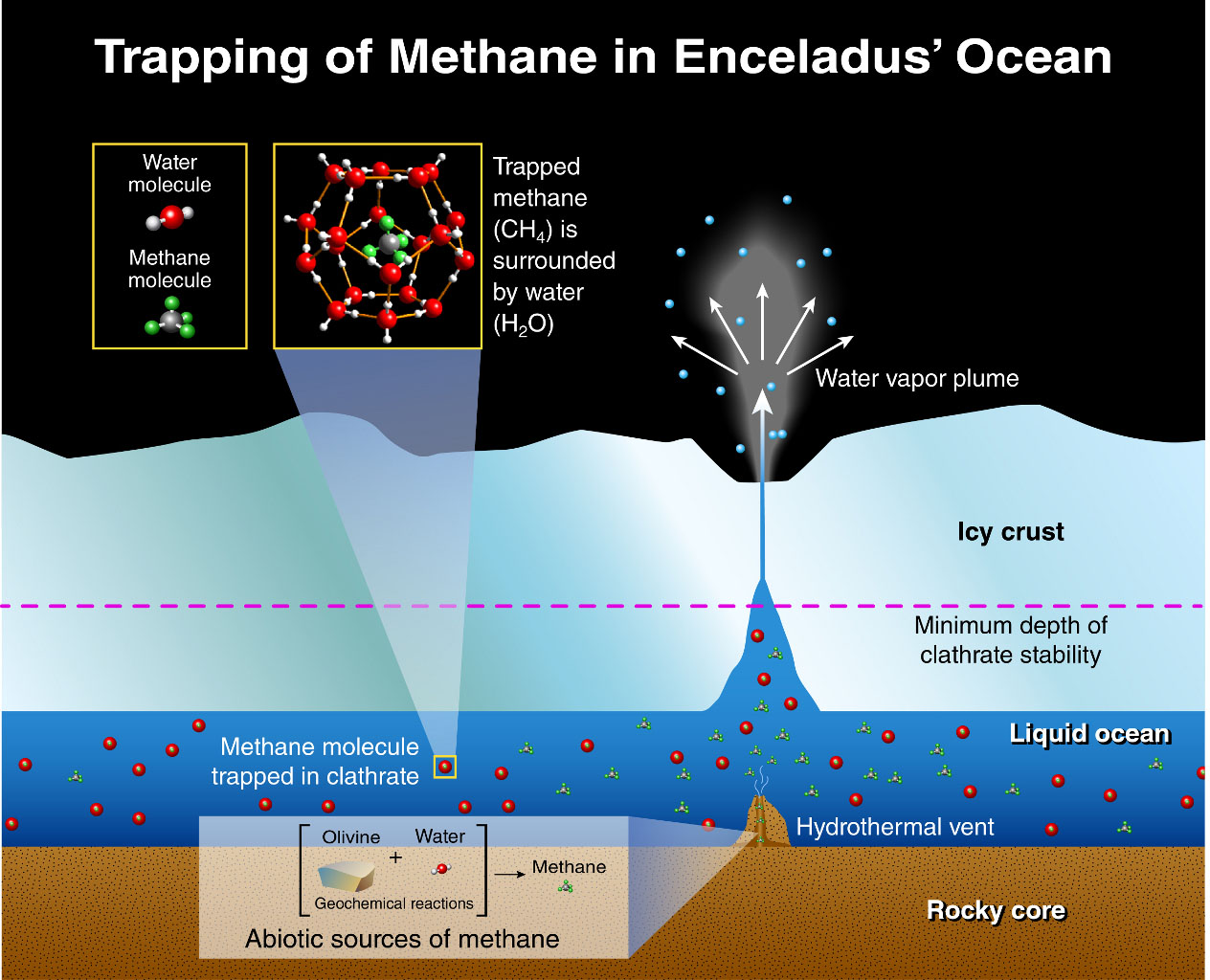
The team found that, at the high pressures expected in the moon's ocean, icy materials called clathrates could form that imprison methane molecules within a crystal structure of water ice. Their models indicate that this process is so efficient at depleting the ocean of methane that the researchers still needed an explanation for its abundance in the plume.
In one scenario, hydrothermal processes super-saturate the ocean with methane. This could occur if methane is produced faster than it is converted into clathrates. A second possibility is that methane clathrates from the ocean are dragged along into the erupting plumes and release their methane as they rise, like bubbles forming in a popped bottle of champagne.
The authors agree both scenarios are likely occurring to some degree, but they note that the presence of nanosilica grains, as documented by the other paper, favors the hydrothermal scenario.
"We didn't expect that our study of clathrates in the Enceladus ocean would lead us to the idea that methane is actively being produced by hydrothermal processes," said lead author Alexis Bouquet, a graduate student at the University of Texas at San Antonio. Bouquet worked with co-author Hunter Waite, who leads the Cassini Ion and Neutral Mass Spectrometer (INMS) team at Southwest Research Institute in San Antonio.
Cassini first revealed active geological processes on Enceladus in 2005 with evidence of an icy spray issuing from the moon's south polar region and higher-than-expected temperatures in the icy surface there. With its powerful suite of complementary science instruments, the mission soon revealed a towering plume of water ice and vapor, salts and organic materials that issues from relatively warm fractures on the wrinkled surface. Gravity science results published in 2014 strongly suggested the presence of a 6-mile- (10-kilometer-) deep ocean beneath an ice shell about 19 to 25 miles (30 to 40 kilometers) thick.
Tiny grains of rock detected by the international Cassini spacecraft orbiting Saturn point to hydrothermal activity on the seafloor of its icy moon Enceladus.
The finding adds to the tantalising possibility that the moon could contain environments suitable for living organisms.
Understanding the interior structure of 500 km-diameter Enceladus has been a top priority of the Cassini mission since plumes of ice and water vapour were discovered jetting from fractures at the moon’s south pole in 2005.
Ice particles in the plumes were found to be rich in sodium salt, implying that the water has been in contact with rock, and subsequent measurements of the moon’s gravitational field revealed a 10 km deep subsurface ocean at the south pole, below a 30–40 km thick ice crust.
Now, following an extensive, four-year study of data from the spacecraft, combined with computer simulations and laboratory experiments, scientists have been able to gain deeper insights into the chemical reactions taking place on the floor at the base of Enceladus’s ocean.
Using Cassini’s Cosmic Dust Analyser, scientists have discovered a population of tiny dust grains, just 2–8 nm in radius, in orbit around Saturn. They are rich in silicon, marking them out from the water-ice particles that dominate in the planet’s environment, including in its famous ring system.
They believe that these silicon-rich grains originate on the seafloor of Enceladus, where hydrothermal processes are at work. On the seafloor, hot water at a temperature of at least 90 degrees Celsius dissolves minerals from the moon’s rocky interior. The origin of this energy is not well understood, but likely includes a combination of tidal heating as Enceladus orbits Saturn, radioactive decay in the core and chemical reactions.
As the hot water travels upward, it comes into contact with cooler water, causing the minerals to condense out and form nano-grains of ‘silica’ floating in the water.
To avoid growing too large, these silica grains must spend a few months to several years at most rising from the seafloor to the surface of the ocean, before being incorporated into larger ice grains in the vents that connect the ocean to the surface of Enceladus. After being ejected into space via the moon’s geysers, the ice grains erode, liberating the tiny rocky inclusions subsequently detected by Cassini.
[...]


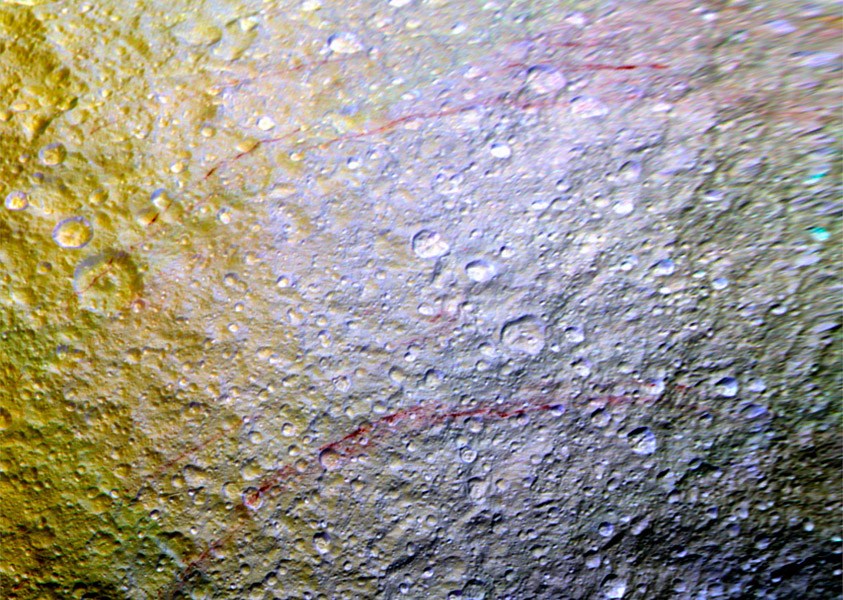

The Cassini mission to Saturn has returned its final close-up images of the gas giant's Dione moon.
The probe passed within 500km of the pockmarked surface on Monday - its fifth such encounter in the spacecraft's 11-year tour of the ringed planet.
Cassini is now engaged in a series of observational "lasts".
 ing Ocean in Saturn's Moon Enceladus" (emphasis mine)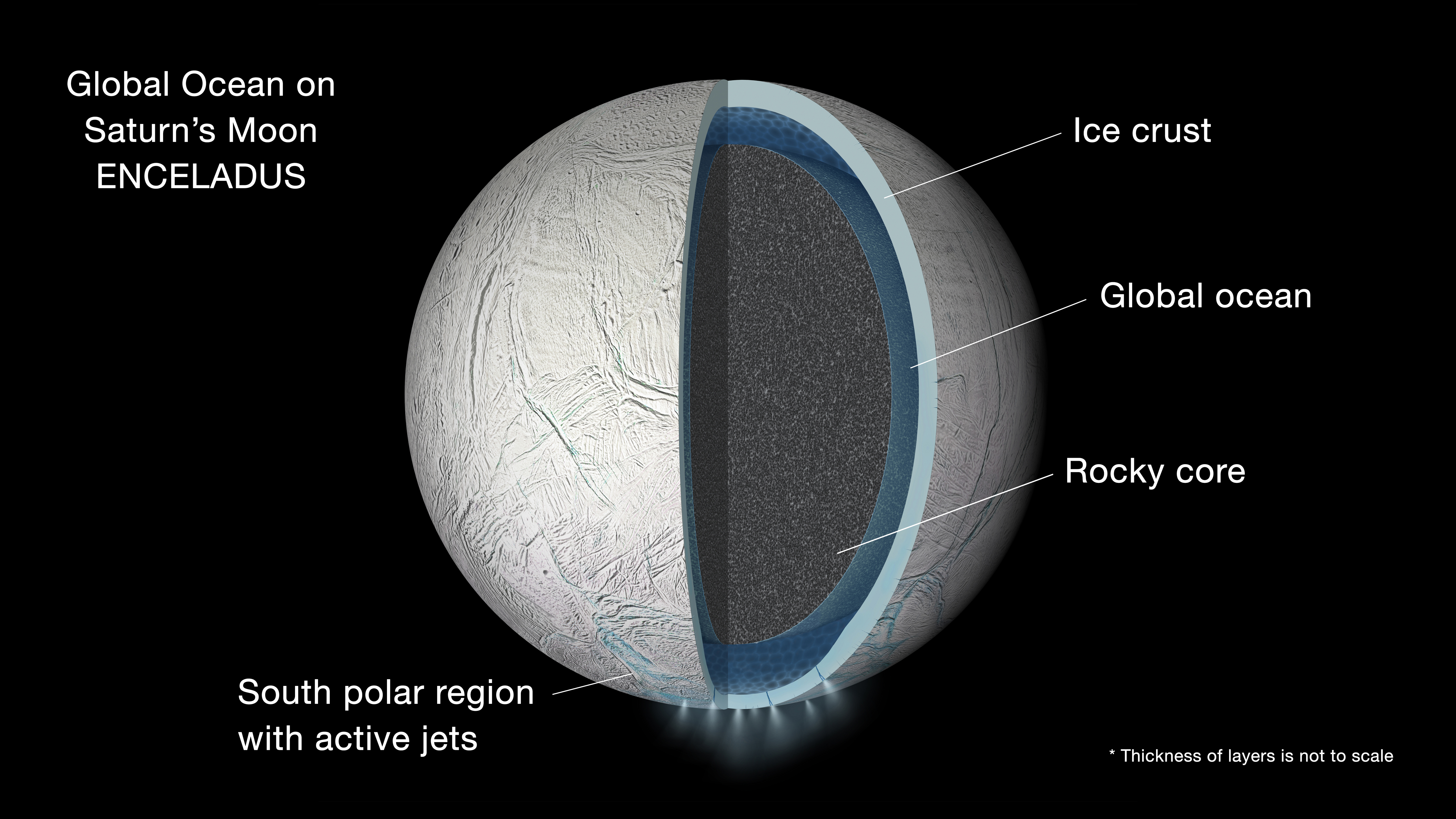
A global ocean lies beneath the icy crust of Saturn's geologically active moon Enceladus, according to new research using data from NASA's Cassini mission.
Researchers found the magnitude of the moon's very slight wobble, as it orbits Saturn, can only be accounted for if its outer ice shell is not frozen solid to its interior, meaning a global ocean must be present.
The finding implies the fine spray of water vapor, icy particles and simple organic molecules Cassini has observed coming from fractures near the moon's south pole is being fed by this vast liquid water reservoir. The research is presented in a paper published online this week in the journal Icarus.
Previous analysis of Cassini data suggested the presence of a lens-shaped body of water, or sea, underlying the moon's south polar region. However, gravity data collected during the spacecraft's several close passes over the south polar region lent support to the possibility the sea might be global. The new results -- derived using an independent line of evidence based on Cassini's images -- confirm this to be the case.
"This was a hard problem that required years of observations, and calculations involving a diverse collection of disciplines, but we are confident we finally got it right," said Peter Thomas, a Cassini imaging team member at Cornell University, Ithaca, New York, and lead author of the paper.
Cassini scientists analyzed more than seven years' worth of images of Enceladus taken by the spacecraft, which has been orbiting Saturn since mid-2004. They carefully mapped the positions of features on Enceladus -- mostly craters -- across hundreds of images, in order to measure changes in the moon's rotation with extreme precision.
As a result, they found Enceladus has a tiny, but measurable wobble as it orbits Saturn. Because the icy moon is not perfectly spherical -- and because it goes slightly faster and slower during different portions of its orbit around Saturn -- the giant planet subtly rocks Enceladus back and forth as it rotates.
The team plugged their measurement of the wobble, called a libration, into different models for how Enceladus might be arranged on the inside, including ones in which the moon was frozen from surface to core.
"If the surface and core were rigidly connected, the core would provide so much dead weight the wobble would be far smaller than we observe it to be," said Matthew Tiscareno, a Cassini participating scientist at the SETI Institute, Mountain View, California, and a co-author of the paper. "This proves that there must be a global layer of liquid separating the surface from the core."
The mechanisms that might have prevented Enceladus' ocean from freezing remain a mystery. Thomas and colleagues suggest a few ideas for future study that might help resolve the question, including the surprising possibility that tidal forces due to Saturn's gravity could be generating much more heat within Enceladus than previously thought.
"This is a major step beyond what we understood about this moon before, and it demonstrates the kind of deep-dive discoveries we can make with long-lived orbiter missions to other planets," said co-author Carolyn Porco, Cassini imaging team lead at Space Science Institute, Boulder, Colorado, and visiting scholar at the University of California, Berkeley. "Cassini has been exemplary in this regard."
The unfolding story of Enceladus has been one of the great triumphs of Cassini's long mission at Saturn. Scientists first detected signs of the moon's icy plume in early 2005, and followed up with a series of discoveries about the material gushing from warm fractures near its south pole. They announced strong evidence for a regional sea in 2014, and more recently, in 2015, they shared results that suggest hydrothermal activity is taking place on the ocean floor.
Cassini is scheduled to make a close flyby of Enceladus on Oct. 28, in the mission's deepest-ever dive through the moon's active plume of icy material. The spacecraft will pass a mere 30 miles (49 kilometers) above the moon's surface.

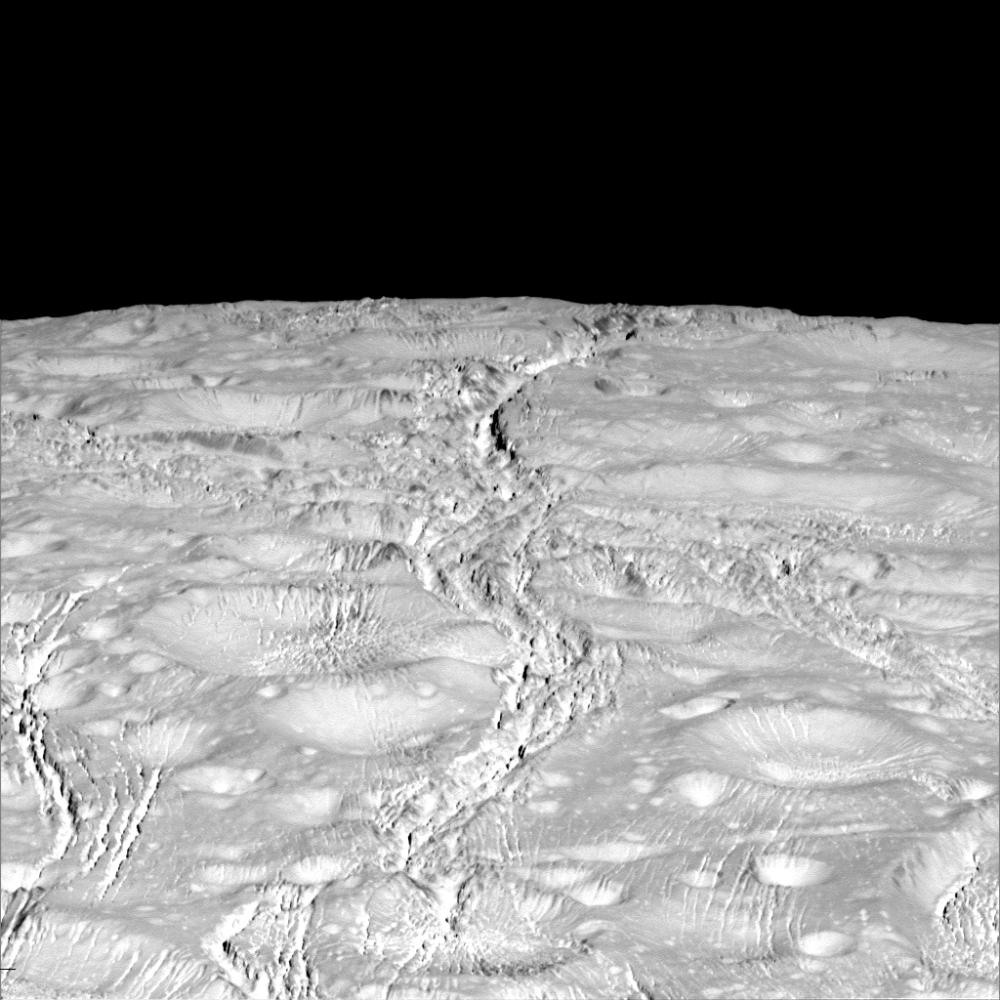
NASA's Cassini spacecraft zoomed by Saturn's icy moon Enceladus on Oct. 14, 2015, capturing this stunning image of the moon's north pole. A companion view from the wide-angle camera (PIA20010) shows a zoomed out view of the same region for context.
Scientists expected the north polar region of Enceladus to be heavily cratered, based on low-resolution images from the Voyager mission, but high-resolution Cassini images show a landscape of stark contrasts. Thin cracks cross over the pole -- the northernmost extent of a global system of such fractures. Before this Cassini flyby, scientists did not know if the fractures extended so far north on Enceladus...
Enceladus Flyby 'Rev 223'
NASA's Cassini spacecraft has begun returning its best-ever views of the northern extremes of Saturn's icy, ocean-bearing moon Enceladus. The spacecraft obtained the images during its Oct. 14 flyby, passing 1,142 miles (1,839 kilometers) above the moon's surface. Mission controllers say the spacecraft will continue transmitting images and other data from the encounter for the next several days.


Wow, that's at least two Hoth-like worlds in the Solar System. Amazing!
Now there is clear photographic evidence that Enceladus' north pole, too, displays interesting geologic activity.
All that is needed to find extraterrestrial life may be a relatively simple sample return.


Does Cassini have any instruments that can actually sample materials that contact the spacecraft like that? Or is this just a way of getting the remote sensors right up against the subject?


