
Hello all,
The most crazy idea popped into my mind as I was reading on various proposed NASA methods to send probes to asteroids and comets with very different orbits than Earth, making these kind of journeys extremely dV expensive, if probe were to match it's orbit with the target asteroid, instead of fly-by.
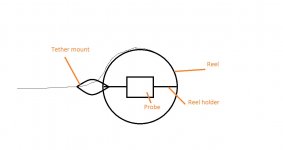
The idea is as follows. Probe flies by the target asteroid/comet within several kilometers, and as it does, it fires a harpoon with a flexible tether attached. Probe carries some significant length of the tether, maybe several hundred kilometers (should be quite possible with nowadays technology, lightweight nano-tubes, and similar). As soon as harpoon hits and digs a bit into the asteroid, probe engages brakes which stop the rate of tether cable release, therefore, negating the relative velocity between asteroid and the probe. When tether release is stopped, probe "reels in" the tether, pulling itself towards the asteroid at slow speed, and after it reaches it, it has just a small relative velocity to kill. Tether can then be released or used as an anchor for landing.
Problems I see with this idea are as follows:
1) Since initial relative velocity may be several km/s per second by the time of fly-by, the harpoon must withstand the impact, not breaking the tether, and securing itself firmly in asteroid/comet;
2) Should the harpoon fail to lock, or if it were to miss the target rock altogether, the mission is screwed for good;
3) Braking and reeling in should be done quickly and with considerable G forces, because every second means extra kilometers of tether to carry.
4) Due to the nature of this "elastic collision", the orbit of asteroid/comet would be changed to some extent - but then again, who cares?
What are your thoughts? How feasible is this idea with current technology? Are there more problems than I mentioned? I'm sure I'm not the first to think of this, but I couldn't find anything on google.
Your comments, please! :tiphat:
P.S. Made some math. If probe were to fly by with 3km/s relative velocity, and break at 100m/s (around 10 G's, something that current tech can still endure), it would take 30 seconds to do the braking, and the braking distance is 45km (of tether), also quite reasonable.
The most crazy idea popped into my mind as I was reading on various proposed NASA methods to send probes to asteroids and comets with very different orbits than Earth, making these kind of journeys extremely dV expensive, if probe were to match it's orbit with the target asteroid, instead of fly-by.
The idea is as follows. Probe flies by the target asteroid/comet within several kilometers, and as it does, it fires a harpoon with a flexible tether attached. Probe carries some significant length of the tether, maybe several hundred kilometers (should be quite possible with nowadays technology, lightweight nano-tubes, and similar). As soon as harpoon hits and digs a bit into the asteroid, probe engages brakes which stop the rate of tether cable release, therefore, negating the relative velocity between asteroid and the probe. When tether release is stopped, probe "reels in" the tether, pulling itself towards the asteroid at slow speed, and after it reaches it, it has just a small relative velocity to kill. Tether can then be released or used as an anchor for landing.
Problems I see with this idea are as follows:
1) Since initial relative velocity may be several km/s per second by the time of fly-by, the harpoon must withstand the impact, not breaking the tether, and securing itself firmly in asteroid/comet;
2) Should the harpoon fail to lock, or if it were to miss the target rock altogether, the mission is screwed for good;
3) Braking and reeling in should be done quickly and with considerable G forces, because every second means extra kilometers of tether to carry.
4) Due to the nature of this "elastic collision", the orbit of asteroid/comet would be changed to some extent - but then again, who cares?
What are your thoughts? How feasible is this idea with current technology? Are there more problems than I mentioned? I'm sure I'm not the first to think of this, but I couldn't find anything on google.
Your comments, please! :tiphat:
P.S. Made some math. If probe were to fly by with 3km/s relative velocity, and break at 100m/s (around 10 G's, something that current tech can still endure), it would take 30 seconds to do the braking, and the braking distance is 45km (of tether), also quite reasonable.
Last edited:




 .
.


