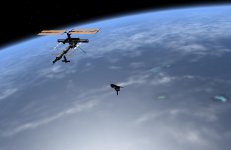
Continued from thread "Interesting Interplanetary Flights You've Made," since this isn't interplanetary.
Same here. I wasn't particularly shooting to duplicate their methods, just the result, but it would be nice to see how the pros did it. I did already know that they came at the target from behind and below, so I did it that way. It's pretty straightforward to do it with what Glynn Lunney called "direct ascent" (see below), as long as you have Orbit MFD's numbers for an initial fix, Sync Orbit MFD to monitor the range to target, and Surface HUD to monitor the approach angle. (Telescope MFD helps.) But that's still a little more God-in-the-box than what I'd like.
I got intrigued and did some more digging on the Internet yesterday and came up with a few things about Gemini rendezvous. One interesting resource is "Summary of Gemini Rendezvous Experience," a paper Glynn Lunney wrote for the AIAA:
http://www.klabs.org/history/papers/lunney_gemini_rendezvous.pdf
He describes three general rendezvous methods:
1) Direct ascent. Start from behind and below, simply "fly up to" the target, and stay below and behind the target all the way through the rendezvous.
2) Tangential. Set your apoapse at the target altitude, then use a series of prograde burns at successive apoapses to fine-tune as you close the distance between youiself and the target. Again, you're always behind the target this way.
3) Coelliptic. Start from behind and below. During the terminal approach phase, come up to the target's altitude, passing under the target and rendezvousing from **in front** of the target.
Lunney gives graphs of all three of these on page 2 of his paper (orbital motion is from right to left). Turns out that coelliptic is how Gemini and much of Apollo did it. I don't NASA's done it that way since the middle of Apollo, but I think I see why they were doing it that way -- it makes the star sightings simpler -- and I suspect the Shuttle astronauts are still trained in this in case they've gotta do a Gemini 12 style "bare bones" rendezvous.
Anyway, the more I look at this, the curiouser and curiouser I get. I'm gonna play around with some data and (1) see if my suspicions are correct, and if so (2) try to come up with some reasonably realistic Orbiter scenarios that could be done in a bare bones kind of way. Meanwhile, if anyone's already worked on this, or knows of other technical resources that could help me out, I'd appreciate hearing about it. Will check back in later.
SAM
That's how the Gemini crews did it. I'd like to have some of their notes.Lately I've been doing some stuff with orbital rendezvous, without the God-in-the-box showing where the satellite is; no F9, Docking HUD/MFD, etc. Basically using Orbit MFD's numbers to get a rough idea of where in the visual field the satellite is, finding it, and eyeballing your way in. <snyp>
Same here. I wasn't particularly shooting to duplicate their methods, just the result, but it would be nice to see how the pros did it. I did already know that they came at the target from behind and below, so I did it that way. It's pretty straightforward to do it with what Glynn Lunney called "direct ascent" (see below), as long as you have Orbit MFD's numbers for an initial fix, Sync Orbit MFD to monitor the range to target, and Surface HUD to monitor the approach angle. (Telescope MFD helps.) But that's still a little more God-in-the-box than what I'd like.
I got intrigued and did some more digging on the Internet yesterday and came up with a few things about Gemini rendezvous. One interesting resource is "Summary of Gemini Rendezvous Experience," a paper Glynn Lunney wrote for the AIAA:
http://www.klabs.org/history/papers/lunney_gemini_rendezvous.pdf
He describes three general rendezvous methods:
1) Direct ascent. Start from behind and below, simply "fly up to" the target, and stay below and behind the target all the way through the rendezvous.
2) Tangential. Set your apoapse at the target altitude, then use a series of prograde burns at successive apoapses to fine-tune as you close the distance between youiself and the target. Again, you're always behind the target this way.
3) Coelliptic. Start from behind and below. During the terminal approach phase, come up to the target's altitude, passing under the target and rendezvousing from **in front** of the target.
Lunney gives graphs of all three of these on page 2 of his paper (orbital motion is from right to left). Turns out that coelliptic is how Gemini and much of Apollo did it. I don't NASA's done it that way since the middle of Apollo, but I think I see why they were doing it that way -- it makes the star sightings simpler -- and I suspect the Shuttle astronauts are still trained in this in case they've gotta do a Gemini 12 style "bare bones" rendezvous.
Anyway, the more I look at this, the curiouser and curiouser I get. I'm gonna play around with some data and (1) see if my suspicions are correct, and if so (2) try to come up with some reasonably realistic Orbiter scenarios that could be done in a bare bones kind of way. Meanwhile, if anyone's already worked on this, or knows of other technical resources that could help me out, I'd appreciate hearing about it. Will check back in later.
SAM


 I'm sure you're right. My goal was to replicate that specific NASA trajectory and the straight-in result Armstrong described in section 3.2, so I considered that trajectory's parameters (130 degrees, 26 degrees, 15 miles) to be carved in stone and pretty much only "consulted Aldrin for advice" on how to calculate the MCCs. Whatever Aldrin considered desirable in his dissertation, ~8.5 degrees is what the initial pitch-down angle worked out to be for a direct trajectory to rendezvous, so I used that.
 impossible to get into that orbit! ... :compbash: ... and I suspect that even with that turned off, perturbation from the Sun and Moon still make it a challenge. I'll have to look at that further.