Computing position for orbital maneuver

simonpro

Beta Tester
Beta Tester
Joined
Feb 10, 2008
Messages
1,042
Reaction score
7
Points
0
Afternoon all. I'm trying to compute the position around my orbit (in cartesian coordinates, but orbital elements is acceptable as I can convert) where I should perform the following orbital correction.
Initial orbit and final orbit are the same in terms all but one of the orbital elements, they differ in that the final orbit should be offset in argument of periapsis:

Initial=i,e,a,w
Final=i,e,a,w+x

The other two orbital elements are inconsequential in terms of final values.

Anyone know how to calculate the position for the (impulsive) burn? I recon it should be pretty easy to figure out, but I just can't get it.:(
 
In other words you need to rotate the line of apsides and keep the other elements unchanged ?
Well, if you need to change it x degrees then make the burn x/2 degrees after or before passing through the periapis or apoapis. That's my first thought thinking about the final orbit being a mirror image of the initial. But I could be badly mistaking.


-----Posted Added-----


There is atleast one thing that is sure when making an impulsive maneuver. The initial source orbit and the target orbit must have atleast one common intersection or osculating point and that's where the maneuver can be made.


-----Posted Added-----


The above applies only in a single impulse orbit transfers, of course.
 
There is atleast one thing that is sure when making an impulsive maneuver. The initial source orbit and the target orbit must have atleast one common intersection or osculating point and that's where the maneuver can be made.

Yep, already knew that. It's finding where they intercept that is getting me. Guess I'm no good at traditional geometry ;)
 
True anomaly of the point of intersection would be 0 ± x/2 or PI ± x/2, where x is the required change of argument of periapis.
 
Under the Orbit Plane Changes of this page, it is explained how to change the longitude of ascending node, which may or may not do what you want. (guessing that you want to move the lat/long of the periapsis and nothing else, it might not be too helpful :P)

It also shows how to find the latitude and longitude of the intersection points. ;)
 
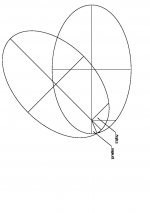
I find drawing it helps (see attached).

As jarmonik stated, the manoeuvre should be made at true anomoly = x/2. The angle between the two orbits at the intersection point will be 2*arccos(h/rv) from which you can determine your delta-V.
 

Attachments

  • Ellipses rotated 001.jpg
    Ellipses rotated 001.jpg
    46.7 KB · Views: 22
Thanks guys, I was calculating it from x instead of x/2, hence why nothing was working ;)

With a burn a burn at x/2 everything works out well, apart from simulink's fascination with choosing a rediculous stepsize..
 
Back
Top