Updates Dawn Mission News

The Planetary Society Blog: The Dawn spacecraft, modeled in an unlikely medium

plasticcanvas_dawn_1.jpg


plasticcanvas_dawn_labeled.jpg

:)
 
JPL: Vesta Likely Cold and Dark Enough for Ice

January 25, 2012

Though generally thought to be quite dry, roughly half of the giant asteroid Vesta is expected to be so cold and to receive so little sunlight that water ice could have survived there for billions of years, according to the first published models of Vesta's average global temperatures and illumination by the sun.

"Near the north and south poles, the conditions appear to be favorable for water ice to exist beneath the surface," says Timothy Stubbs of NASA's Goddard Space Flight Center in Greenbelt, Md., and the University of Maryland, Baltimore County. Stubbs and Yongli Wang of the Goddard Planetary Heliophysics Institute at the University of Maryland published the models in the January 2012 issue of the journal Icarus. The models are based on information from telescopes including NASA's Hubble Space Telescope.

Vesta, the second-most massive object in the asteroid belt between Mars and Jupiter, probably does not have any significant permanently shadowed craters where water ice could stay frozen on the surface all the time, not even in the roughly 300-mile-diameter (480-kilometer-diameter) crater near the south pole, the authors note. The asteroid isn't a good candidate for permanent shadowing because it is tilted on its axis at about 27 degrees, which is even greater than Earth's tilt of roughly 23 degrees. In contrast, the moon, which does have permanently shadowed craters, is tilted at only about 1.5 degrees. As a result of its large tilt, Vesta has seasons, and every part of the surface is expected to see the sun at some point during Vesta's year.

The presence or absence of water ice on Vesta tells scientists something about the tiny world's formation and evolution, its history of bombardment by comets and other objects, and its interaction with the space environment. Because similar processes are common to many other planetary bodies, including the moon, Mercury and other asteroids, learning more about these processes has fundamental implications for our understanding of the solar system as a whole. This kind of water ice is also potentially valuable as a resource for further exploration of the solar system.

Though temperatures on Vesta fluctuate during the year, the model predicts that the average annual temperature near Vesta's north and south poles is less than roughly minus 200 degrees Fahrenheit (145 kelvins). That is the critical average temperature below which water ice is thought to be able to survive in the top 10 feet or so (few meters) of the soil, which is called regolith.

Near Vesta's equator, however, the average yearly temperature is roughly minus 190 degrees Fahrenheit (150 kelvins), according to the new results. Based on previous modeling, that is expected to be high enough to prevent water from remaining within a few meters of the surface. This band of relatively warm temperatures extends from the equator to about 27 degrees north and south in latitude.

{...}
 
Universe Today: Asteroid Vesta Floats in Space in High Resolution 3-D

IOTD-139-full.jpg

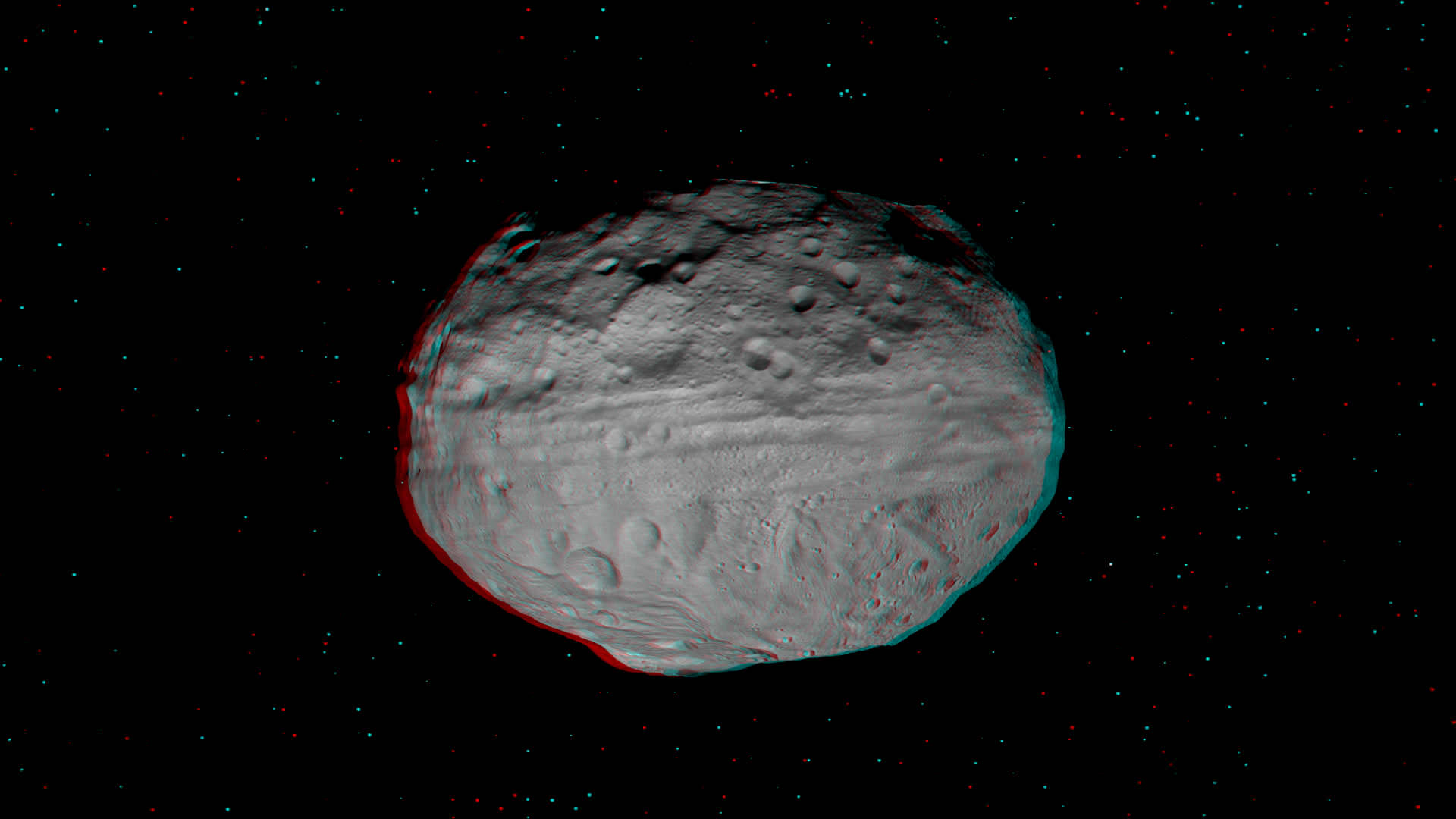
Vesta’s Eastern Hemisphere Floats in Space in 3-D
This anaglyph shows the varied topography of Vesta’s eastern hemisphere from craters in the north, the equatorial troughs and the huge mountain protruding out the Rheasilvia impact basin (lower left) at the South Pole.
Does water ice lurk beneath the South Pole ?
Credit: NASA/JPL-Caltech/UCLA/MPS/DLR/IDA.


IOTD-140-full.jpg

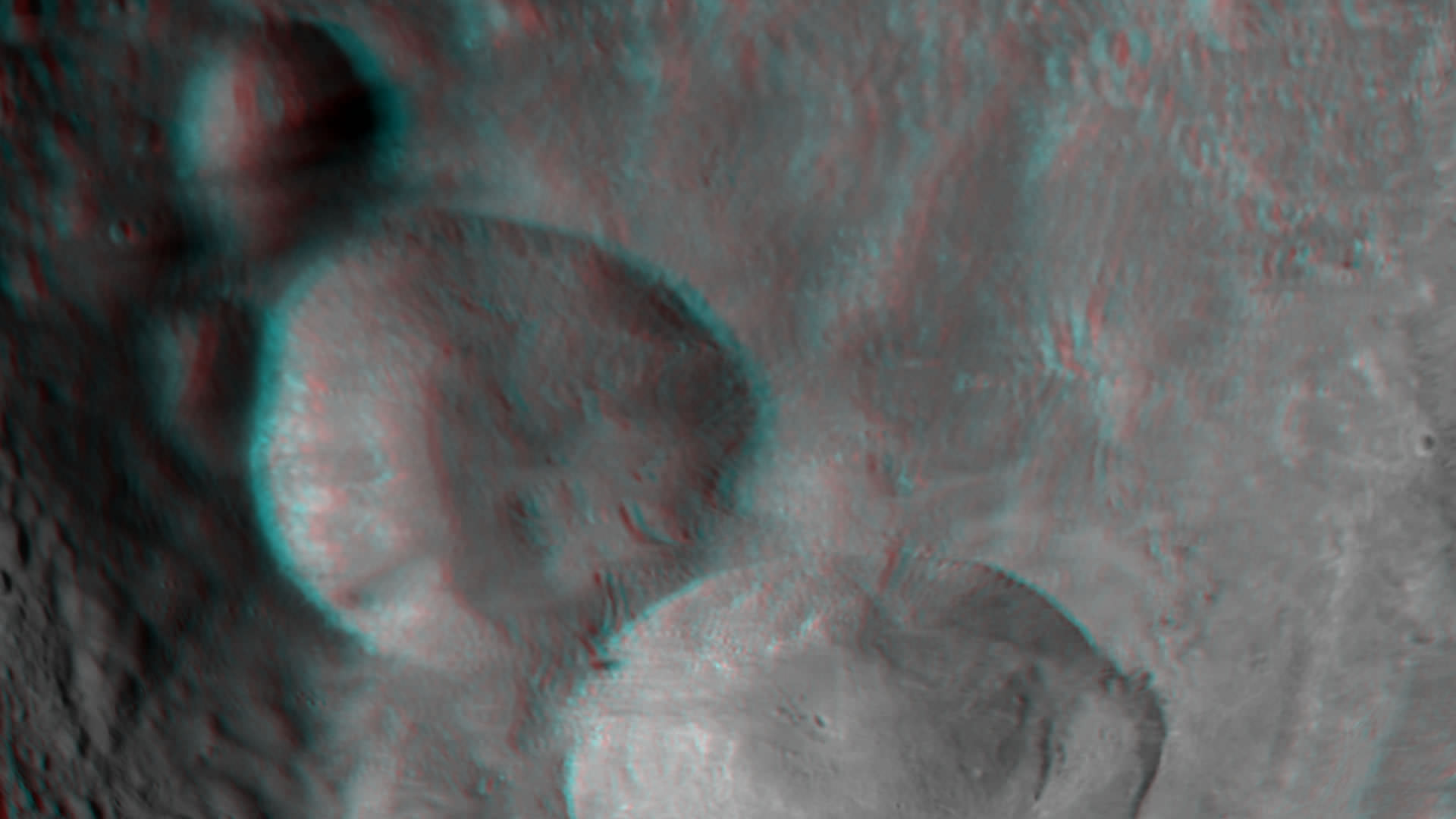
3-D image of Vesta’s “Snowman” craters
The three craters are named Minucia, Marcia and Calpurnia from top to bottom. They are 24 kilometers (15 miles), 53 kilometers (33 miles) and 63 kilometers (40 miles) in diameter, respectively. Image resolution is about 250 meters (820 feet) per pixel. Credit: NASA/JPL-Caltech/UCLA/MPS/DLR/IDA.


IOTD-141-full.jpg

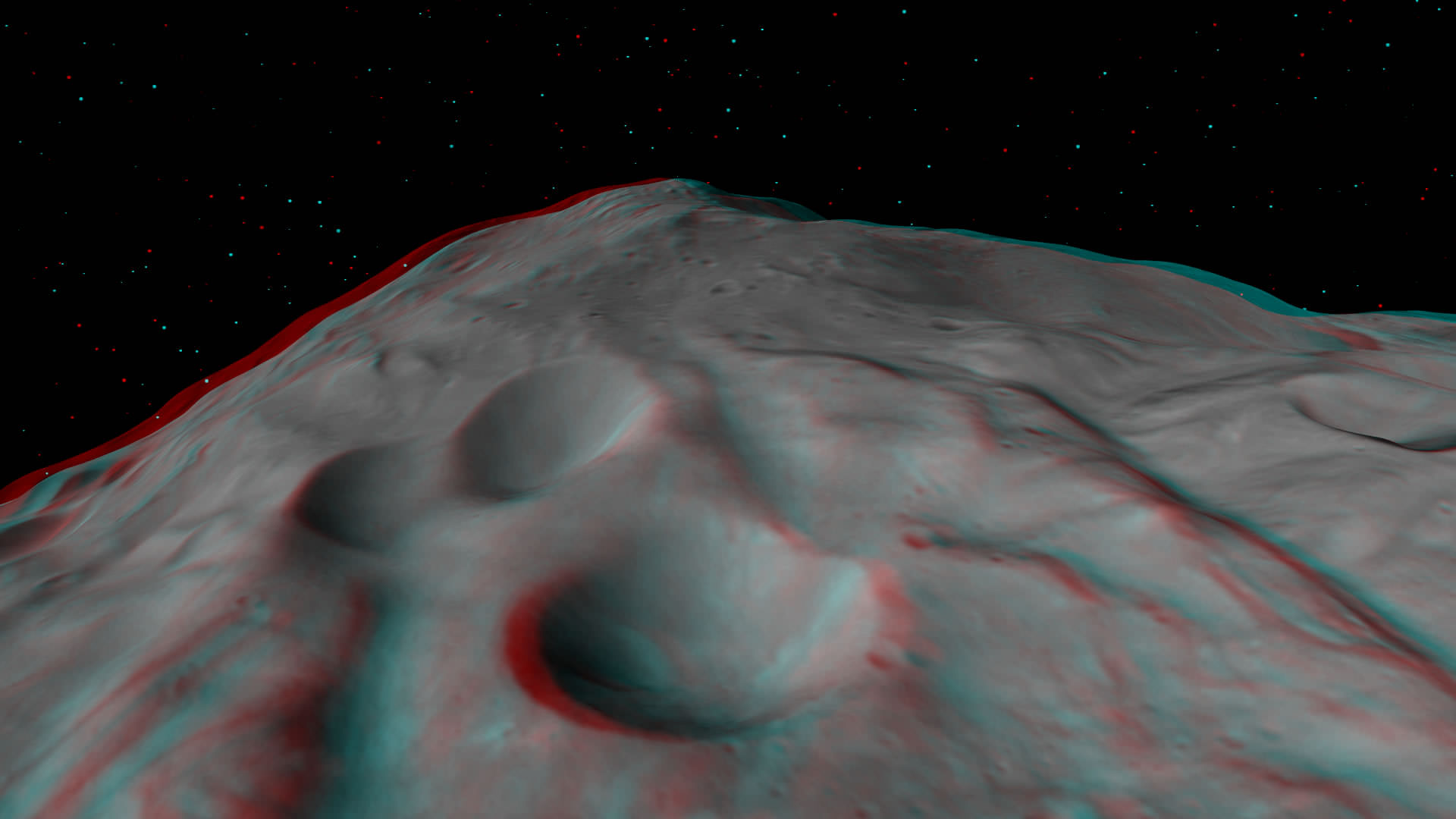
The Mount Everest of Vesta in 3-D
This anaglyph shows the central complex and huge mountain in Vesta’s Rheasilvia impact basin at the South Pole. Does water ice lurk beneath the South Pole ?
Credit: NASA/JPL-Caltech/UCLA/MPS/DLR/IDA.​
 
The Planetary Society Blog: More Dawn Vesta approach images: first color views

[table="width=500"]
dawn_vesta_approach_rc1_color-combined_2x.gif
|
dawn_vesta_approach_thru_rc1_cropped_flipped.gif


Dawn's first "rotation characterization" of Vesta, July 4, 2011
On July 4, 2011, Dawn performed its first "rotation characterization" of Vesta, watching the asteroid rotate underneath it while taking photos through all color filters. Dawn saw all longitudes of the asteroid, so the images could be used to make the first well-resolved color global map of Vesta.
Credit: NASA / JPL / UCLA / MPS / DLR / IDA / color animation by Emily Lakdawalla​
|
Dawn approaches Vesta, May 3 - June 30, 2011 (animation)
This animation comprises 236 photos taken by Dawn as it approached Vesta over two months from May 3 to June 30, 2011. It includes ten sets of optical navigation photos and one set of "rotation characterization" photos. The images have been enlarged by a factor of two.
Credit: NASA / JPL / UCLA / MPS / DLR / IDA / animation by Emily Lakdawalla​
[/table]​
 
Not much advantage to color pictures it seems =p
 
I assume we're looking at Vesta's south pole, here. If so, it seems to be tilted quite a bit. You can see that for a while, the mountain rotating around the pole leaves no shadow, but at other times, it creates a long shadow.
 
News Release: 2012-024

Vesta Likely Cold and Dark Enough for Ice

January 25, 2012 - PASADENA, Calif. -- Though generally thought to be quite dry, roughly half of the giant asteroid Vesta is expected to be so cold and to receive so little sunlight that water ice could have survived there for billions of years, according to the first published models of Vesta's average global temperatures and illumination by the sun.

"Near the north and south poles, the conditions appear to be favorable for water ice to exist beneath the surface," says Timothy Stubbs of NASA's Goddard Space Flight Center in Greenbelt, Md., and the University of Maryland, Baltimore County. Stubbs and Yongli Wang of the Goddard Planetary Heliophysics Institute at the University of Maryland published the models in the January 2012 issue of the journal Icarus. The models are based on information from telescopes including NASA's Hubble Space Telescope.

http://dawn.jpl.nasa.gov/feature_stories/cold_dark_vesta.asp

N.
 
Dawn can go from 0 to 60 in 4 days. Not bad at all..
 
Universe Today: Dawn gets Big Science Boost at Best Vesta Mapping Altitude


Vesta-from-Dawn-collage_Ken-Kremer.jpg

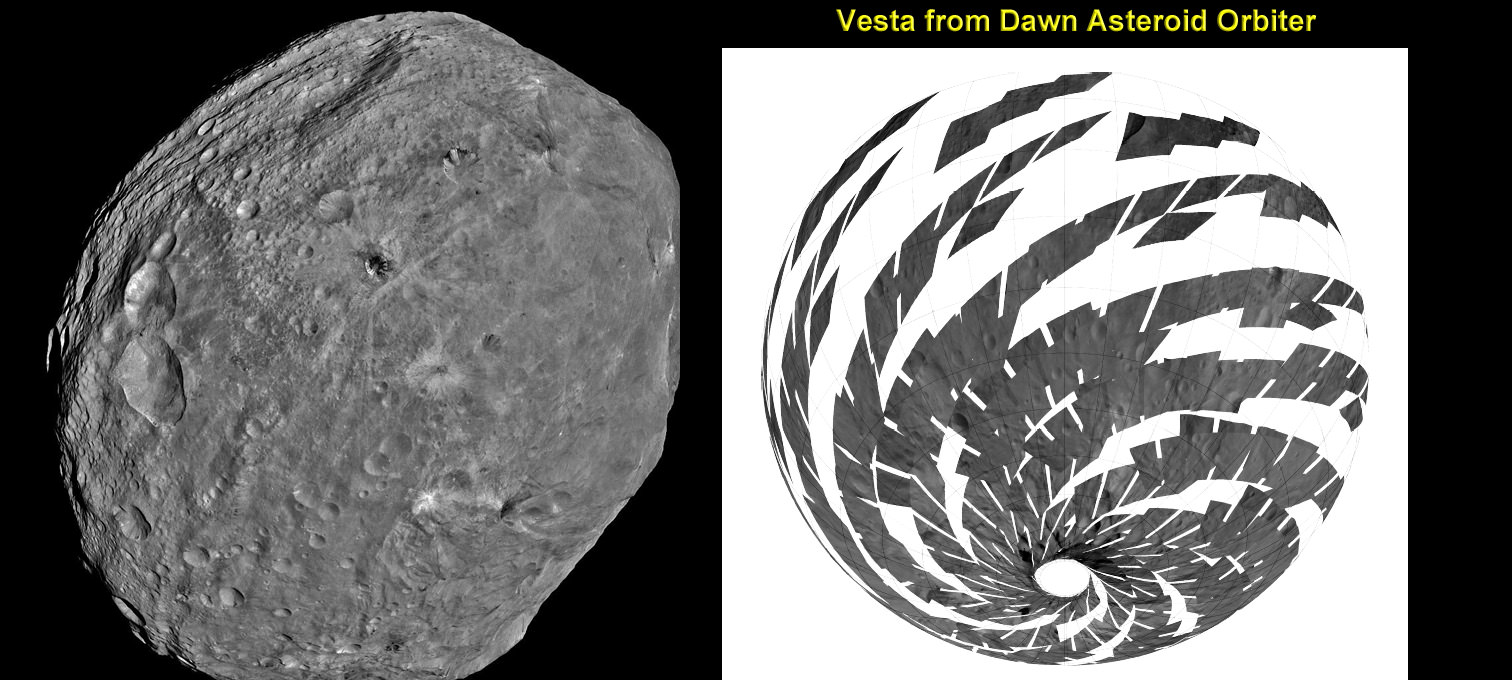
Vesta imaged by NASA’s Dawn Asteroid Orbiter
Dawn is currently at work at the Low Altitude Mapping Orbit (LAMO) acquiring new imagery and spectra of much higher resolution compared to these images acquired at higher altitudes and is also filling in gaps of surface data. The image from Dawn’s Framing Camera, at left, was taken on July 24 at a distance of 3,200 miles soon after achieving orbit around Vesta. The mosaic from Dawn’s Visible and infrared spectrometer (VIR), at right, was acquired from High-altitude mapping orbit (HAMO).
Credit: NASA/ JPL-Caltech/ UCLA/ ASI/ INAF/ IAPS. Collage: Ken Kremer​
 
NASA / NASA JPL:
Dawn Sees New Surface Features on Giant Asteroid

March 21, 2012

PASADENA, Calif. - NASA's Dawn spacecraft has revealed unexpected details on the surface of the giant asteroid Vesta. New images and data highlight the diversity of Vesta's surface and reveal unusual geologic features, some of which were never previously seen on asteroids.

These results were discussed today at the Lunar and Planetary Science Conference at The Woodlands, Texas.

[table="head;width=675"]{colsp=3}
Click on images for details​

||

Bright Rays from Canuleia Crater
In this image from NASA's Dawn spacecraft, bright material extends out from the crater Canuleia on Vesta.
Image credit: NASA/JPL-Caltech/UCLA/MPS/DLR/IDA/UMD​
|
Map of Bright Areas on Vesta
This mosaic depicts a portion of Vesta imaged by NASA's Dawn spacecraft where pockets of bright materials are visible.
Image credit: NASA/JPL-Caltech/UCLA/MPS/DLR/IDA/UMD​
|
Bright Material at Numisia Crater
This image from NASA's Dawn spacecraft shows the crater Numisia, located just south of the equator in the Numisia quadrangle on Vesta.
Image credit: NASA/JPL-Caltech/UCLA/MPS/DLR/IDA/UMD​

||

Bright Spots Near Marcia
Caption: Numerous small, bright spots appear on Vesta, as seen in this image from NASA's Dawn spacecraft.
Image credit: NASA/JPL-Caltech/UCLA/MPS/DLR/IDA/UMD​
|
Extremely Bright Area
This image from NASA's Dawn spacecraft shows the brightest area seen on Vesta so far.
Image credit: NASA/JPL-Caltech/UCLA/MPS/DLR/IDA/UMD​
|
Dark-Rayed Crater and Spots
This image of a dark-rayed impact crater and several dark spots was obtained by NASA's Dawn spacecraft.
Image credit: NASA/JPL-Caltech/UCLA/MPS/DLR/IDA/ASU​

||

Bright and Dark at West Rim of Marcia Crater
The interplay of bright and dark material at the rim of Marcia crater on Vesta is visible in this image mosaic taken by NASA's Dawn spacecraft.
Image credit: NASA/JPL-Caltech/UCLA/MPS/DLR/IDA/LPI/ASU​
|
Dark Materials at the Snowman
This mosaic from NASA's Dawn spacecraft shows dark material near a series of craters known as the "snowman" on Vesta.
Image credit: NASA/JPL-Caltech/UCLA/MPS/DLR/IDA/ASU​
|
Wall of Rheasilvia
This animation made from data obtained by NASA's Dawn spacecraft shows the topography of a portion of the wall and interior of the Rheasilvia impact basin (310 miles or 500 kilometers in diameter) in Vesta's south-polar region.
Image credit: NASA/JPL-Caltech/UCLA/MPS/DLR/IDA​

||

Close-up of Rheasilvia's Wall
This image from NASA's Dawn spacecraft shows a close-up view of the wall of the Rheasilvia impact basin on Vesta. Rheasilvia, which is 310 miles or 500 kilometers in diameter, dominates southern Vesta.
Image credit: NASA/JPL-Caltech/UCLA/MPS/DLR/IDA​
|
Layered Young Crater
This image from NASA's Dawn spacecraft shows a young crater on Vesta that is 9 miles (15 kilometers) in diameter. Layering is visible in the crater walls, as are large boulders that were thrown out in the material ejected from the impact.
Image credit: NASA/JPL-Caltech/UCLA/MPS/DLR/IDA​
|
Perspective View of Layered Young Crater
This image, made from data obtained by NASA's Dawn spacecraft, shows a perspective view of a layered young crater in the Rheasilvia basin at Vesta.
Image credit: NASA/JPL-Caltech/UCLA/MPS/DLR/IDA/PSI​

||

Flowing Material
This image, from NASA's Dawn spacecraft, shows rock material that has moved across the surface and flowed into a low area in the ridged floor of the Rheasilvia basin on Vesta.
Image credit: NASA/JPL-Caltech/UCLA/MPS/DLR/IDA​
|
Wall and Terrace at Marcia Crater
This image from NASA's Dawn spacecraft shows an interior wall and southern terrace of Marcia crater on Vesta.
Image credit: NASA/JPL-Caltech/UCLA/MPS/DLR/IDA​
|
Northern Shadow
This mosaic of the surface of Vesta was made from images obtained by NASA's Dawn spacecraft on Feb. 5, 2012, while the area was entirely in the sun's shadow.
Image credit: NASA/JPL-Caltech/UCLA/MPS/DLR/IDA/JHUAPL​
[/table]​


Vesta is one of the brightest objects in the solar system and the only asteroid in the so-called main belt between Mars and Jupiter visible to the naked eye from Earth. Dawn has found that some areas on Vesta can be nearly twice as bright as others, revealing clues about the asteroid's history.

"Our analysis finds this bright material originates from Vesta and has undergone little change since the formation of Vesta over 4 billion years ago," said Jian-Yang Li, a Dawn participating scientist at the University of Maryland, College Park. "We're eager to learn more about what minerals make up this material and how the present Vesta surface came to be."

Bright areas appear everywhere on Vesta but are most predominant in and around craters. The areas vary from several hundred feet to around 10 miles (16 kilometers) across. Rocks crashing into the surface of Vesta seem to have exposed and spread this bright material. This impact process may have mixed the bright material with darker surface material.

While scientists had seen some brightness variations in previous images of Vesta from NASA's Hubble Space Telescope, Dawn scientists also did not expect such a wide variety of distinct dark deposits across its surface. The dark materials on Vesta can appear dark gray, brown and red. They sometimes appear as small, well-defined deposits around impact craters. They also can appear as larger regional deposits, like those surrounding the impact craters scientists have nicknamed the "snowman."

"One of the surprises was the dark material is not randomly distributed," said David Williams, a Dawn participating scientist at Arizona State University, Tempe. "This suggests underlying geology determines where it occurs."

The dark materials seem to be related to impacts and their aftermath. Scientists theorize carbon-rich asteroids could have hit Vesta at speeds low enough to produce some of the smaller deposits without blasting away the surface.

Higher-speed asteroids also could have hit Vesta's surface and melted the volcanic basaltic crust, darkening existing surface material. That melted conglomeration appears in the walls and floors of impact craters, on hills and ridges, and underneath brighter, more recent material called ejecta, which is material thrown out from a space rock impact.

Vesta's dark materials suggest the giant asteroid may preserve ancient materials from the asteroid belt and beyond, possibly from the birth of the solar system.

"Some of these past collisions were so intense they melted the surface," said Brett Denevi, a Dawn participating scientist at the Johns Hopkins University Applied Physics Laboratory in Laurel, Md. "Dawn's ability to image the melt marks a unique find. Melting events like these were suspected, but never before seen on an asteroid."

Dawn launched in September 2007. It will reach its second destination, Ceres, in February 2015.

"Dawn's ambitious exploration of Vesta has been going beautifully," said Marc Rayman, Dawn chief engineer at NASA's Jet Propulsion Laboratory in Pasadena, Calif. "As we continue to gather a bounty of data, it is thrilling to reveal fascinating alien landscapes."

To view the new images, visit: http://www.nasa.gov/dawn and http://dawn.jpl.nasa.gov.

{...}


NASA Press Release: RELEASE : 12-091 - NASA's Dawn Sees New Surface Features on Giant Asteroid Vesta

SPACE.com: New Photos of Asteroid Vesta Reveal Surprisingly Bright Spots
 
The Planetary Society Blog: Dawn Journal: Saluting the Sun:

[table="width=400"]
vesta_dawn_crater-with-bright-dark-material-in-wall_IOTD-186_full.jpg


Dark and bright material in a crater wall
This Dawn image of Vesta shows part of a large crater that has an irregularly shaped, fresh rim. This crater is also distinctive because it has many outcrops of dark and bright material originating from its rim and from the interior slope of the crater. This bright and dark material then slumps down towards the center of the crater along the crater walls. These slumps of dark and bright material extend for up to 4 kilometers. The interior sides of this crater are dominated by the dark and bright material and have a mottled appearance. In contrast, the floor of this crater is more uniform in brightness and looks much less mottled. This image is located a few degrees south of the vestan equator and was obtained on January 24, 2012. The image has a resolution of about 25 meters per pixel and was acquired during the LAMO (low-altitude mapping orbit) phase of the mission.
Credit: NASA / JPL / UCLA / MPS / DLR / IDA​
[/table]​
 
NASA / NASA JPL:
Dawn Gets Extra Time to Explore Vesta

April 18, 2012

PASADENA, Calif. - NASA's Dawn mission has received official confirmation that 40 extra days have been added to its exploration of the giant asteroid Vesta, the second most massive object in the main asteroid belt. The mission extension allows Dawn to continue its scientific observations at Vesta until Aug. 26, while still arriving at the dwarf planet Ceres at the same originally scheduled target date in February 2015.

"We are leveraging our smooth and successful operations at Vesta to provide for even more scientific discoveries for NASA and the world." said Robert Mase, Dawn project manager based at NASA's Jet Propulsion Laboratory, Pasadena, Calif. "This extra time will allow us to extend our scientific investigation and learn more about this mysterious world."

The extension will not require any new funding, and will draw on financial reserves that have been carefully managed by the Dawn project. The flexibility provided by the spacecraft's use of efficient ion propulsion system allows it to maintain its originally planned Ceres arrival.

The extension allows for extra observations at Dawn's current low-altitude mapping orbit (average altitude 130 miles or 210 kilometers), which will now last until May 1. The additional time enables the gamma ray and neutron detector to build the best possible maps of the elemental composition of Vesta's surface and improve data for the gravity experiment, the two primary scientific investigations at the low-altitude orbit. The spacecraft's camera and spectrometer are also obtaining additional high-resolution images.

Additional time will also be spent in the planned second high-altitude mapping orbit later this summer. When Dawn arrived at Vesta in July 2011, much of the northern hemisphere was in shadow. But with the passage of time, more of that area will bask in sunshine.

"Dawn has beamed back to us such dazzling Vestan vistas that we are happy to stay a little longer and learn more about this special world," said Christopher Russell, Dawn's principal investigator at UCLA. "While we have this one-of-a-kind opportunity to orbit Vesta, we want to make the best and most complete datasets that we can."

{...}
 
NASA / NASA JPL:
Dawn Reveals Secrets of Giant Asteroid Vesta

April 24, 2012

PASADENA, Calif. - Findings from NASA's Dawn spacecraft reveal new details about the giant asteroid Vesta, including its varied surface composition, sharp temperature changes and clues to its internal structure. The findings were presented today at the European Geosciences Union meeting in Vienna, Austria, and will help scientists better understand the early solar system and processes that dominated its formation.

Images from Dawn's framing camera and visible and infrared mapping spectrometer, taken 420 miles (680 kilometers) and 130 miles (210 kilometers) above the surface of the asteroid, show a variety of surface mineral and rock patterns. Coded false-color images help scientists better understand Vesta's composition and enable them to identify material that was once molten below the asteroid's surface.

[table="head;width=450"]{colsp=2}
Click on images for details​

|

Aquilia Area in Color​
These composite images from the framing camera aboard NASA's Dawn spacecraft show three views of a terrain with ridges and grooves near Aquilia crater in the southern hemisphere of the giant asteroid Vesta.
Image credit: NASA/JPL-Caltech/UCLA/MPS/DLR/IDA​
|
Vibidia Crater in Color​
These composite images from the framing camera aboard NASA's Dawn spacecraft show three views of the comparatively fresh crater named Vibidia on the giant asteroid Vesta.
Image credit: NASA/JPL-Caltech/UCLA/MPS/DLR/IDA​

|

Tarpeia Crater, Close, Closer, Closest​
These images of Tarpeia crater, near the south pole of the giant asteroid Vesta, were obtained by the visible and infrared mapping spectrometer on NASA's Dawn spacecraft.
Image credit: NASA/JPL-Caltech/UCLA/INAF​
|
Tarpeia Temperature​
This colorized image from NASA's Dawn mission shows temperature variations at Tarpeia crater, near the south pole of the giant asteroid Vesta.
Image credit: NASA/JPL-Caltech/UCLA/INAF​

{colsp=2}

{colsp=2}
Shape and Gravity of Vesta's South Pole​
This set of images from NASA's Dawn mission shows topography of the southern hemisphere of the giant asteroid Vesta and a map of Vesta's gravity variations that have been adjusted to account for Vesta's shape.
Image credit: NASA/JPL-Caltech/UCLA/MPS/DLR/IDA​
[/table]​


Researchers also see breccias, which are rocks fused during impacts from space debris. Many of the materials seen by Dawn are composed of iron- and magnesium-rich minerals, which often are found in Earth's volcanic rocks. Images also reveal smooth pond-like deposits, which might have formed as fine dust created during impacts settled into low regions.

"Dawn now enables us to study the variety of rock mixtures making up Vesta's surface in great detail," said Harald Hiesinger, a Dawn participating scientist at Münster University in Germany. "The images suggest an amazing variety of processes that paint Vesta's surface."

At the Tarpeia crater near the south pole of the asteroid, Dawn imagery revealed bands of minerals that appear as brilliant layers on the crater's steep slopes. The exposed layering allows scientists to see farther back into the geological history of the giant asteroid.

The layers closer to the asteroid's surface bear evidence of contamination from space rocks bombarding Vesta. Layers below preserve more of their original characteristics. Frequent landslides on the slopes of the craters also have revealed other hidden mineral patterns.

"These results from Dawn suggest Vesta's 'skin' is constantly renewing," said Maria Cristina De Sanctis, lead of the visible and infrared mapping spectrometer team based at Italy's National Institute for Astrophysics in Rome.

Dawn has given scientists a near 3-D view into Vesta's internal structure. By making ultra-sensitive measurements of the asteroid's gravitational tug on the spacecraft, Dawn can detect unusual densities within its outer layers. Data now show an anomalous area near Vesta's south pole, suggesting denser material from a lower layer of Vesta has been exposed by the impact that created a feature called the Rheasilvia basin. The lighter, younger layers coating other parts of Vesta's surface have been blasted away in the basin.

Dawn obtained the highest-resolution surface temperature maps of any asteroid visited by a spacecraft. Data reveal temperatures can vary from as warm as minus 10 degrees Fahrenheit (minus 23 degrees Celsius) in the sunniest spots to as cold as minus 150 degrees Fahrenheit (minus 100 degrees Celsius) in the shadows. This is the lowest temperature measurable by Dawn's visible and infrared mapping spectrometer. These findings show the surface responds quickly to illumination with no mitigating effect of an atmosphere.

"After more than nine months at Vesta, Dawn's suite of instruments has enabled us to peel back the layers of mystery that have surrounded this giant asteroid since humankind first saw it as just a bright spot in the night sky," said Carol Raymond, Dawn deputy principal investigator at NASA's Jet Propulsion Laboratory in Pasadena, Calif. "We are closing in on the giant asteroid's secrets."

{...}


NASA Press Release: RELEASE : 12-134 - NASA Dawn Spacecraft Reveals Secrets of Giant Asteroid Vesta

Universe Today: Dawn Reveals More of Vesta’s Secrets
 
The Planetary Society Blog: Dawn Journal: Rising from a happily long LAMO:
{...}

Dawn is wrapping up a spectacularly rewarding phase of its mission of exploration. Since descending to its low-altitude mapping orbit (LAMO) in December, the stalwart probe has circled Vesta about 800 times and collected a truly outstanding trove of precious observations of the protoplanet. Having far exceeded the plans, expectations, and even hopes for what it would accomplish when LAMO began, the ambitious explorer is now ready to begin its ascent. On May 1, atop its familiar blue-green pillar of xenon ions, the craft will embark upon the six-week spiral to its second high-altitude mapping orbit.

{...}
 
Back
Top