Updates Dawn Mission News

Without spectral data, I don't dare to speculate ... but it looks to me that it might not seem so bright due to the angles of illumination and reflection... There seems to be awfully bright spots at the crater rim.

Another thing is how shallow the craters seem to be, compared to say those on the Moon... It might confirm that under the surface, it is composed of a material which would rebound more, or fill the craters back... say ... ice? :)

Good points.

Bob Clark
 
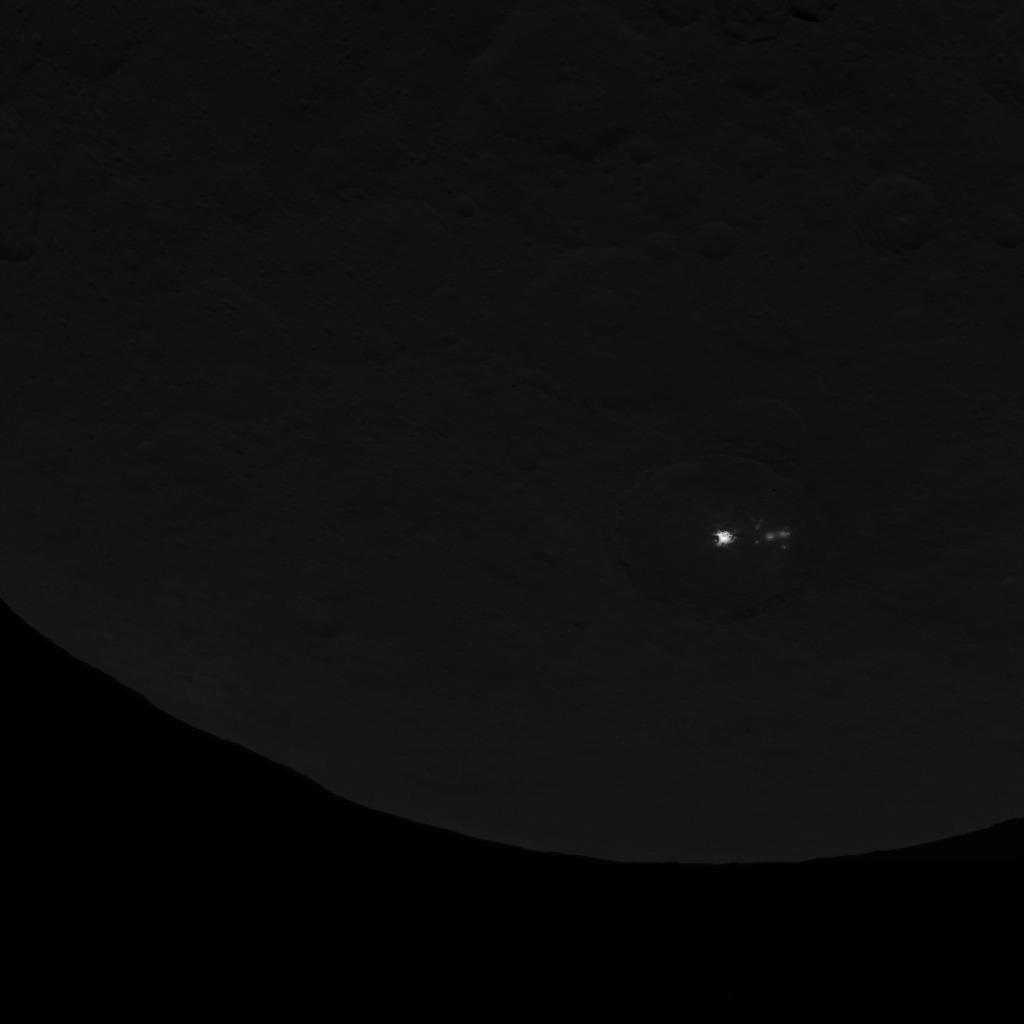
PIA19576.jpg


Bright stuff from an angle.

This image, taken by NASA's Dawn spacecraft, shows dwarf planet Ceres from an altitude of 2,700 miles (4,400 kilometers). The image, with a resolution of 1,400 feet (410 meters) per pixel, was taken on June 6, 2015.

http://dawn.jpl.nasa.gov/multimedia/images/image-detail.html?id=PIA19576
 
So...I guess they don't shine on the dark side too. Still, given how concentrated the lights are, they must be quite a view from the lower orbits.
 
Our Solar System just keeps getting more and more interesting:

NATURE | BREAKING NEWS
Mystery haze appears above Ceres' bright spots.
Discovery bolsters idea that intriguing marks are made of ice, not salt.
Alexandra Witze
21 July 2015
Ceres, the biggest asteroid in the Solar System, has a haze that appears occasionally in a crater above some of its mysterious white spots.
The phenomenon, observed by NASA's Dawn spacecraft, suggests that the bright spots “could be providing some atmosphere in this particular region of Ceres”, says Christopher Russell, a planetary scientist at the University of California, Los Angeles.

http://www.nature.com/news/mystery-...-bright-spots-1.18032?WT.mc_id=TWT_NatureNews

Bob Clark
 
Last edited:
The next survey mission, HAMO, at a closer distance to Ceres is scheduled to start at August 17th:

Dawn Journal | July 29
by Marc Rayman
The gradual descent from the second mapping orbit to the third will require 25 revolutions. The maneuvers will conclude in about two weeks. (As always, you can follow the progress with your correspondent’s frequent and succinct updates here.) As in each mapping orbit, following arrival, a few days will be required in order to prepare for a new round of intensive observations. That third observing campaign will begin on August 17 and last more than two months.
http://dawnblog.jpl.nasa.gov/2015/07/29/dawn-journal-july-29/


Bob Clark
 
Pyramid mountain and the white spots seem to be linealy distributed on some part? Alien abandoned base!!
 
It kind of looks like the rock formation from Close Encounters of the Third Kind.

It also reminds me of the Arthur C. Clark story "The Sentinel", upon which 2001: A Space Odyssey is based. In the short story, astronauts driving across the Moon spot a shiny object on a mountain which, when disturbed, sends out a signal to the aliens who planted it there.

iu
 
It kind of looks like the rock formation from Close Encounters of the Third Kind.

That would be Devils Tower.

It also reminds me of the Arthur C. Clark story "The Sentinel", upon which 2001: A Space Odyssey is based. In the short story, astronauts driving across the Moon spot a shiny object on a mountain which, when disturbed, sends out a signal to the aliens who planted it there.

Arthur C. Clarke expressed annoyance with that comparison between the two.
https://en.wikipedia.org/wiki/The_Sentinel_(short_story)

From the same Wiki article:

The story deals with the discovery of an artifact on Earth's Moon left behind eons ago by ancient aliens. The object is made of a polished mineral, is tetrahedral in shape, and is surrounded by a spherical forcefield. The narrator speculates at one point that the mysterious aliens who left this structure on the Moon may have used mechanisms belonging "to a technology that lies beyond our horizons, perhaps to the technology of para-physical forces."

The narrator speculates that for millions of years (evidenced by dust buildup around its forcefield) the artifact has been transmitting signals into deep space, but it ceases to transmit when, sometime later, it is destroyed "with the savage might of atomic power". The narrator hypothesizes that this "sentinel" was left on the moon as a "warning beacon" for possible intelligent and spacefaring species that might develop on Earth.
 
Arthur C. Clarke expressed annoyance with that comparison between the two.

I often ignore, or at least take with a grain of salt, an artist's commentary on their own work. I've read the short story, read 2001, and of course saw the film, and there's no doubt in my mind that that they are both spawned from the same basic idea. 2001 is just an altered take on it, expanded to novel length. Clark's novel-writing IMO was mediocre; his short story-writing was top notch. Kubrick's version of the 2001 story is much more engaging and mysterious to me.

Back on topic, this thing on Ceres is the kind of wonder Clark imagined us finding around the Solar System.
 
There's got to be a connection between the crater and mountain. It looks like the crater was excavated out and the material piled up next to it.

Never heard of a phenomenon like that on Earth. There are cases on the Earth, the Moon and Mars where a meteor impact causes a central peak on the inside of a crater but not beside it.


Bob Clark

---------- Post added at 06:25 PM ---------- Previous post was at 06:22 PM ----------

That would be Devils Tower.


Arthur C. Clarke expressed annoyance with that comparison between the two.
https://en.wikipedia.org/wiki/The_Sentinel_(short_story)

From the same Wiki article:


I'm sure if Kubrick had tried to make 2001 without referencing the story, Clarke would have been way more irritated with that.

Bob Clark :)

---------- Post added 08-30-15 at 12:00 PM ---------- Previous post was 08-29-15 at 06:25 PM ----------

The gif on this page shows more clearly there is a link between the crater and the mountain. But which came first the crater or the mountain?

Dawn Journal | August 21
by Marc Rayman
http://dawnblog.jpl.nasa.gov/2015/08/


Bob Clark
 
Last edited:
JPL: "Ceres' Bright Spots Seen in Striking New Detail"

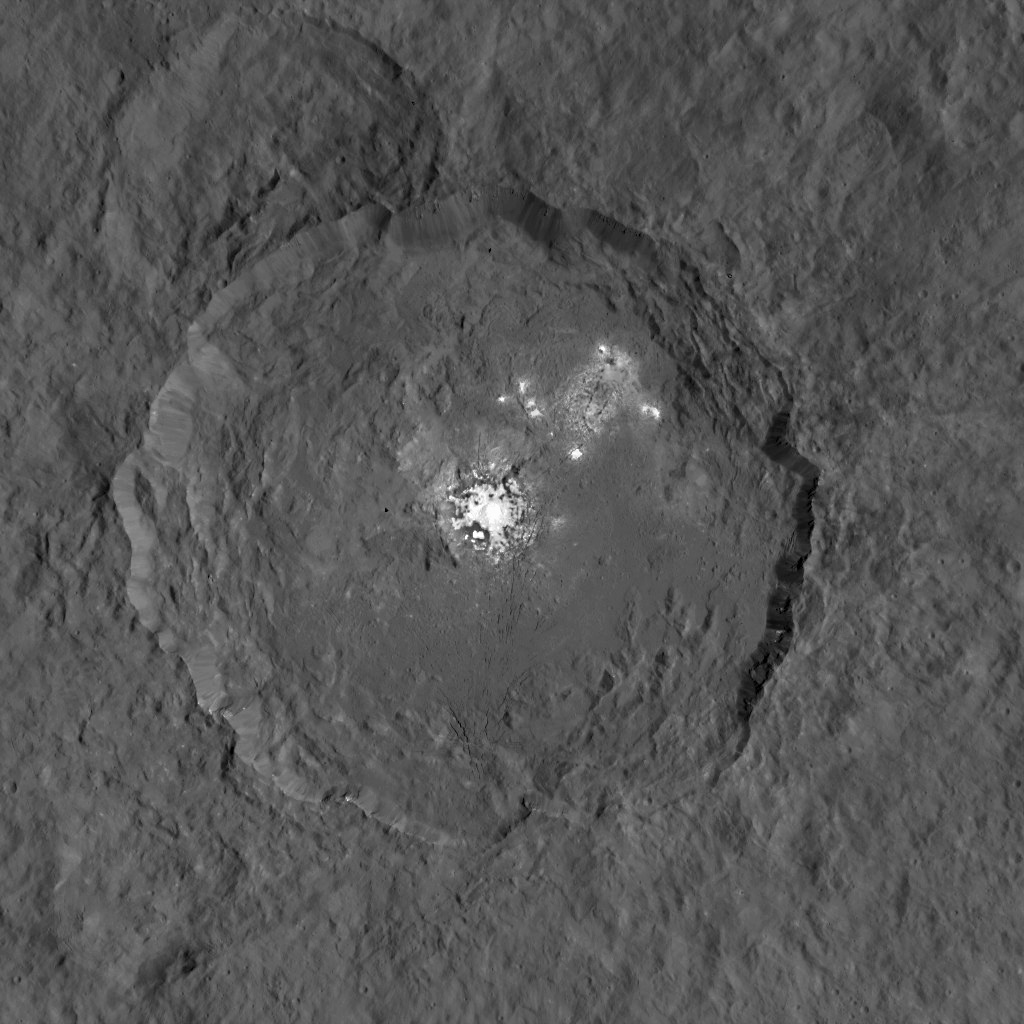
PIA19889_hires.jpg

The brightest spots on the dwarf planet Ceres gleam with mystery in new views delivered by NASA's Dawn spacecraft. These closest-yet views of Occator crater, with a resolution of 450 feet (140 meters) per pixel, give scientists a deeper perspective on these very unusual features.

The new up-close view of Occator crater from Dawn's current vantage point reveals better-defined shapes of the brightest, central spot and features on the crater floor. Because these spots are so much brighter than the rest of Ceres' surface, the Dawn team combined two different images into a single composite view -- one properly exposed for the bright spots, and one for the surrounding surface.

[...]

 
Looks almost like ruins of a base..... of course, it is just natural formations.
 
Back
Top