
You are using an out of date browser. It may not display this or other websites correctly.
You should upgrade or use an alternative browser.
You should upgrade or use an alternative browser.
Delta-V to Mars outside the launch windows?
- Thread starter RGClark
- Start date
I've now had a chance to run the problem through PyKEP:
For possible transfer times of less than 500 days, the best day to leave is 11 October, 2016; the transfer time to Mars is 273 days; the departure dV is 8.4 km/s; and (at a 50 km periapsis altitude at Mars) the periapsis velocity would be 10.2 km/s.
For possible transfer times of less than 500 days, the best day to leave is 11 October, 2016; the transfer time to Mars is 273 days; the departure dV is 8.4 km/s; and (at a 50 km periapsis altitude at Mars) the periapsis velocity would be 10.2 km/s.
Last edited:

RGClark
Mathematician
- Joined
- Jan 27, 2010
- Messages
- 1,635
- Reaction score
- 1
- Points
- 36
- Location
- Philadelphia
- Website
- exoscientist.blogspot.com
The launch window to Mars comes every two years where the delta-v to get there by a Hohmann trajectory is minimal. This year it was in March, when Exomars was launched. But you can still launch to Mars at different times. It just requires more delta-v.
SpaceX wants to decide on an initial mission for the Falcon Heavy, scheduled to launch at the end of this year:
SpaceX undecided on payload for first Falcon Heavy flight.
May 3, 2016 Stephen Clark
http://spaceflightnow.com/2016/05/03/spacex-undecided-on-payload-for-first-falcon-heavy-flight/
One possibility would be a lander mission to Phobos or Deimos. I calculated from a delta-v chart that it would be doable carrying a Dragon during the minimal delta-v window using an existing solid rocket upper stage for Earth escape. But that minimal delta-v launch window already passed in March.
How do you calculate the delta-v requirements during other times such as the end of the year?
The idea behind this post was that SpaceX was going to launch a Falcon Heavy flight to Mars outside the optimal launch window. However, now the plan will be to launch in 2018 which presumably will be within the optimal launch window.
So my proposed mission is still possible for this first FH launch, to do a fast flight to Mars, ca. 35 day duration, to demonstrate its feasibility for a fast manned mission. The delta-v needed for such a fast flight to Mars in 2018, a particularly close opposition, was discussed here:
Math needed for 5-week flight from Earth to Mars.
http://orbiter-forum.com/showthread.php?p=402496&postcount=17
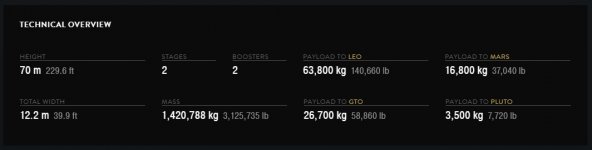
It's about 10 km/s. The updated specifications for the Falcon Heavy with the upgraded Merlin engines are on the SpaceX Falcon Heavy page.
I estimate we could get 2 to 3 metric tons as payload to Mars for the fast trip depending on whether we used for the in-space stage the small cryogenic Ariane 5 upper stage leaving from Trans Mars Insertion, or the larger Centaur leaving from geosynchronous transfer orbit.
We still have the problem of slowing down when the use such fast flight speeds which result in fast arrival speeds at Mars. Some preliminary calculations suggest it might work by plunging deep into the Martian atmosphere, skimming the tree-tops so to speak.
Bob Clark
Attachments
Last edited:
RGClark
Mathematician
- Joined
- Jan 27, 2010
- Messages
- 1,635
- Reaction score
- 1
- Points
- 36
- Location
- Philadelphia
- Website
- exoscientist.blogspot.com
Actually, while the Red Dragon mission on the Falcon Heavy is set for 2018, SpaceX plans for two prior FH test flights for the latter part of this year.
Elon has discussed testing recovery of the upper stage on these missions which will reduce payload. He has also discussed putting a "fun" payload on one of them, like his cheese wheel on the first Dragon test flight.
Still, if low cost in-space stages could be used for a flight to the Martian moons perhaps Elon could be convinced to make one or both of these first FH flights be to the moons of Mars. Note that key to Elon's plan for manned flights to Mars is getting the fuel for the return trip from Mars. Taking the fuel from the Martian moons would have advantages such as low gravity for getting the fuel to an orbiting propellant depot. Then these first flights to the Martian moons could serve as scout missions for water ice deposits. Plus, it could resolve the mystery of Phobos' origin, whose low density led to much speculation about it.
In the table provided by Keithth G in post #14, the launch dates from Sept. to Dec. 2017 have travel times to Mars in the range of 270 days. But being outside the optimal launch windows, they have large delta-v requirements. So my plan to test short flight times by high departure speeds wouldn't be very useful for these flights. That would have to be reserved for the optimal departure windows.
In the blog post "Low Cost Europa Lander Missions", I discussed some small in-space stages for a possible Europa mission.
Two stages discussed were the storable propellant stage Delta K and the Integrated Apogee Boost Subsystem (IABS) stage. The Delta K has a 6 mT propellant load, 0.95 mT dry mass, and 319 s Isp. The Integrated Apogee Boost Subsystem (IABS) stage is a small kick-stage used to put geosynchronous satellites in their final orbits. It has a 1.6 mT gross mass and .3 mT dry mass, for a 1.3 mT propellant mass, with a 312 s Isp.
Then for a small 1.5 mT robotic rover it could get this to:
319*9.81ln(1 + 6/(.95 + 1.6 +1.5)) +312*9.81ln(1 + 1.3/(.3 + 1.5)) = 4,500 m/s.
The latest specs on the Falcon Heavy give it a 16.8 mT payload to Mars transfer insertion. This is about a 3,800 m/s delta-v.
The Dec. 23, 2017 departure according to Keithth G's table takes 4,836.1 m/s for Earth departure and 2,451.5 m/s to match Phobos orbit at Mars, for a total of 7,287.6 m/s. Then to land on Phobos requires an additional 500 m/s, so all together 7,787.6 m/s, call it 7,800 m/s.
Then since the Falcon Heavy will already provide 3,800 m/s for Earth departure, only 4,000 m/s would have to be provided by our two in-space stages, which is within their capability with a 1.5 mT payload.
This 1.5 mT payload that could be landed on Phobos is so large we might even be able to include a solid rocket stage to return a sample from Phobos to Earth.
In regards to the cost, NASA wants a mission to Phobos so they may be willing to pay for the cost of the in-space stages.
Bob Clark
Elon has discussed testing recovery of the upper stage on these missions which will reduce payload. He has also discussed putting a "fun" payload on one of them, like his cheese wheel on the first Dragon test flight.
Still, if low cost in-space stages could be used for a flight to the Martian moons perhaps Elon could be convinced to make one or both of these first FH flights be to the moons of Mars. Note that key to Elon's plan for manned flights to Mars is getting the fuel for the return trip from Mars. Taking the fuel from the Martian moons would have advantages such as low gravity for getting the fuel to an orbiting propellant depot. Then these first flights to the Martian moons could serve as scout missions for water ice deposits. Plus, it could resolve the mystery of Phobos' origin, whose low density led to much speculation about it.
In the table provided by Keithth G in post #14, the launch dates from Sept. to Dec. 2017 have travel times to Mars in the range of 270 days. But being outside the optimal launch windows, they have large delta-v requirements. So my plan to test short flight times by high departure speeds wouldn't be very useful for these flights. That would have to be reserved for the optimal departure windows.
In the blog post "Low Cost Europa Lander Missions", I discussed some small in-space stages for a possible Europa mission.
Two stages discussed were the storable propellant stage Delta K and the Integrated Apogee Boost Subsystem (IABS) stage. The Delta K has a 6 mT propellant load, 0.95 mT dry mass, and 319 s Isp. The Integrated Apogee Boost Subsystem (IABS) stage is a small kick-stage used to put geosynchronous satellites in their final orbits. It has a 1.6 mT gross mass and .3 mT dry mass, for a 1.3 mT propellant mass, with a 312 s Isp.
Then for a small 1.5 mT robotic rover it could get this to:
319*9.81ln(1 + 6/(.95 + 1.6 +1.5)) +312*9.81ln(1 + 1.3/(.3 + 1.5)) = 4,500 m/s.
The latest specs on the Falcon Heavy give it a 16.8 mT payload to Mars transfer insertion. This is about a 3,800 m/s delta-v.
The Dec. 23, 2017 departure according to Keithth G's table takes 4,836.1 m/s for Earth departure and 2,451.5 m/s to match Phobos orbit at Mars, for a total of 7,287.6 m/s. Then to land on Phobos requires an additional 500 m/s, so all together 7,787.6 m/s, call it 7,800 m/s.
Then since the Falcon Heavy will already provide 3,800 m/s for Earth departure, only 4,000 m/s would have to be provided by our two in-space stages, which is within their capability with a 1.5 mT payload.
This 1.5 mT payload that could be landed on Phobos is so large we might even be able to include a solid rocket stage to return a sample from Phobos to Earth.
In regards to the cost, NASA wants a mission to Phobos so they may be willing to pay for the cost of the in-space stages.
Bob Clark
Last edited:
RGClark
Mathematician
- Joined
- Jan 27, 2010
- Messages
- 1,635
- Reaction score
- 1
- Points
- 36
- Location
- Philadelphia
- Website
- exoscientist.blogspot.com
If you just want the dV values (rather than the fun of figuring out how to calculate it) then Piper's "Trajectory Planner" is very useful:
Trajectory Planner
I'm trying out the "Trajectory Planner" now. I assume the "Departure deltaV" means the dV from just the position of the Earth's solar orbit, i.e., no consideration of a spacecrafts orbit around Earth, and "Arrival deltaV" means the dV to match Mars in it's position in solar orbit, not what it takes to put it in orbit around Mars.
So how do you find the delta-V needed to make the Mars transfer injection assuming the spacecraft is already in LEO?
Bob Clark

I'm trying out the "Trajectory Planner" now. I assume the "Departure deltaV" means the dV from just the position of the Earth's solar orbit, i.e., no consideration of a spacecrafts orbit around Earth, and "Arrival deltaV" means the dV to match Mars in it's position in solar orbit, not what it takes to put it in orbit around Mars.
So how do you find the delta-V needed to make the Mars transfer injection assuming the spacecraft is already in LEO?
Bob Clark
[math] \Delta V = \sqrt{V_{\infty}^2 + V_{esc}^2} - V_{orb} [/math]
where [math]V_{\infty}[/math] is the hyperbolic excess velocity (departure deltaV from trajectory planner).
[math]V_{esc}[/math] is the local escape velocity, aka the escape velocity for the parking orbit altitude.
[math]V_{esc} = \sqrt{\frac{2GM_{planet}}{R_{planet}+alt}}[/math]
where [math]G[/math] is the gravitational constant, [math]M_{planet}[/math] is the planet's mass, [math]R_{planet}[/math] is the planet's radius and [math]alt[/math] is the altitude of the parking orbit.
[math]V_{orb}[/math] is the parking orbit velocity.
[math] V_{orb} = \frac{V_{esc}}{\sqrt{2}}[/math]
Same applies for arrival. If you want to simply calculate the periapsis velocity and not the orbit insertion/injection dV, then don't use the [math]V_{orb}[/math] term.
Source: ORBITAL MECHANICS
Last edited:
RGClark
Mathematician
- Joined
- Jan 27, 2010
- Messages
- 1,635
- Reaction score
- 1
- Points
- 36
- Location
- Philadelphia
- Website
- exoscientist.blogspot.com
[math] \Delta V = \sqrt{V_{\infty}^2 + V_{esc}^2} - V_{orb} [/math]
where [math]V_{\infty}[/math] is the hyperbolic excess velocity (departure deltaV from trajectory planner).
[math]V_{esc}[/math] is the local escape velocity, aka the escape velocity for the parking orbit altitude.
[math]V_{esc} = \sqrt{\frac{2GM_{planet}}{R_{planet}+alt}}[/math]
where [math]G[/math] is the gravitational constant, [math]M_{planet}[/math] is the planet's mass, [math]R_{planet}[/math] is the planet's radius and [math]alt[/math] is the altitude of the parking orbit.
[math]V_{orb}[/math] is the parking orbit velocity.
[math] V_{orb} = \frac{V_{esc}}{\sqrt{2}}[/math]
Same applies for arrival. If you want to simply calculate the periapsis velocity and not the orbit insertion/injection dV, then don't use the [math]V_{orb}[/math] term.
Source: ORBITAL MECHANICS
Thanks for that. I was getting different numbers than in Keithth G's table in post #14. I suspected that was the answer.
Bob Clark
RGClark
Mathematician
- Joined
- Jan 27, 2010
- Messages
- 1,635
- Reaction score
- 1
- Points
- 36
- Location
- Philadelphia
- Website
- exoscientist.blogspot.com
Some suggestions for the test flights of the Falcon heavy:
Test flights of the Falcon Heavy for missions to the moons of Earth and Mars, Page 1.
http://exoscientist.blogspot.com/2017/05/test-flights-for-falcon-heavy-for.html
Bob Clark
Test flights of the Falcon Heavy for missions to the moons of Earth and Mars, Page 1.
http://exoscientist.blogspot.com/2017/05/test-flights-for-falcon-heavy-for.html
Bob Clark

HopDavid
Hop David
One possibility would be a lander mission to Phobos or Deimos. I calculated from a delta-v chart that it would be doable carrying a Dragon during the minimal delta-v window using an existing solid rocket upper stage for Earth escape. But that minimal delta-v launch window already passed in March.
For ballpark Hohmann numbers you could use the spreadsheet I used to make my Cosmic Train Schedule page.
Here's a screen capture for arrival to a Deimos orbit:

You can see insertion to this orbit takes about a 2 km/s periapsis burn.
Here's a capture orbit with Deimos at apoapsis

A 1 km/s periapsis burn plus about a .7 apoapsis circuralize burn gives about 1.7 km/s
How do you calculate the delta-v requirements during other times such as the end of the year?
Bob Clark
Here is another spreadsheet, NonHohmannEarthToMars.xlsx. Like the other spreadsheet I assume circular coplanar orbits.
The user can vary shape of transfer ellipse by inputing aphelion and aphelion. For example the typical Hohmann would have a 1 A.U. perihelion and a 1.52 A.U. aphelion.
Here's a screen capture when transfer orbit has a .9 A.U. perihelion and a 3 A.U. aphelion:

Underlined are numbers of interest: departure V infinity, arrival V infinity, and time of flight.
Off to the right on this spreadsheet the user can input the Mars orbit you wish to insert into and it will give the delta V.
RGClark
Mathematician
- Joined
- Jan 27, 2010
- Messages
- 1,635
- Reaction score
- 1
- Points
- 36
- Location
- Philadelphia
- Website
- exoscientist.blogspot.com
...
Here is another spreadsheet, NonHohmannEarthToMars.xlsx. Like the other spreadsheet I assume circular coplanar orbits.
The user can vary shape of transfer ellipse by inputing aphelion and aphelion. For example the typical Hohmann would have a 1 A.U. perihelion and a 1.52 A.U. aphelion.
Here's a screen capture when transfer orbit has a .9 A.U. perihelion and a 3 A.U. aphelion:
Underlined are numbers of interest: departure V infinity, arrival V infinity, and time of flight.
Off to the right on this spreadsheet the user can input the Mars orbit you wish to insert into and it will give the delta V.
Thanks for that. Other flights I wanted to calculate were fast trips to Mars and also Jupiter. These would be non-Hohmann transfer orbits, so your spreadsheets would be very helpful here.
Bob Clark
RGClark
Mathematician
- Joined
- Jan 27, 2010
- Messages
- 1,635
- Reaction score
- 1
- Points
- 36
- Location
- Philadelphia
- Website
- exoscientist.blogspot.com
Elon has said in the first Falcon Heavy test flight next year, he'll be launching the Tesla Roadster to Mars orbit:
SpaceX will try to launch Elon Musk’s Tesla Roadster on new heavy-lift rocket
December 2, 2017 Stephen Clark
https://spaceflightnow.com/2017/12/...usks-tesla-roadster-on-new-heavy-lift-rocket/
In my blog post "Test flights of the Falcon Heavy for missions to the moons of Earth and Mars, Page 1", I had to do a calculation outside the optimal 2018 launch window. This reduced the payload or necessitated doing an aerocapture at Mars.
Now the planned launch is in 2018 which will reduce the delta-v requirements. So it may be possible to do a direct, propulsive landing on Phobos without using aerocapture.
Bob Clark
SpaceX will try to launch Elon Musk’s Tesla Roadster on new heavy-lift rocket
December 2, 2017 Stephen Clark
https://spaceflightnow.com/2017/12/...usks-tesla-roadster-on-new-heavy-lift-rocket/
In my blog post "Test flights of the Falcon Heavy for missions to the moons of Earth and Mars, Page 1", I had to do a calculation outside the optimal 2018 launch window. This reduced the payload or necessitated doing an aerocapture at Mars.
Now the planned launch is in 2018 which will reduce the delta-v requirements. So it may be possible to do a direct, propulsive landing on Phobos without using aerocapture.
Bob Clark
Last edited:
Col_Klonk
Member
So.. he's sending a car to Mars.
Brilliant media thingy.. for those who are biting on everything Space-X does.
I mean .. really don't you have a life :rofl:
Look out the window .. that hole-in-the-wall just beyond your pc screen.
There's something real going on outside there - Go the the bar and drink beer, meet real people.
Talk to them about real realities
Talk to people who don't agree.. listen to them.. then make an 'informed decision'
You might be surprised and 'educated'
:hello:
---------- Post added at 12:21 AM ---------- Previous post was at 12:15 AM ----------
Most likely the same name as Doom's BFG :facepalm:
This guy is farking you all over big time...
Brilliant media thingy.. for those who are biting on everything Space-X does.
I mean .. really don't you have a life :rofl:
Look out the window .. that hole-in-the-wall just beyond your pc screen.
There's something real going on outside there - Go the the bar and drink beer, meet real people.
Talk to them about real realities
Talk to people who don't agree.. listen to them.. then make an 'informed decision'
You might be surprised and 'educated'
:hello:
---------- Post added at 12:21 AM ---------- Previous post was at 12:15 AM ----------
Musk announced in September his updated vision for settling Mars, and announced that SpaceX is working on a giant new rocket dubbed the BFR that could send cargo and crew ships to the red planet, or perhaps the moon if a lunar base becomes reality.
Most likely the same name as Doom's BFG :facepalm:
This guy is farking you all over big time...
Last edited:

- Joined
- Feb 6, 2008
- Messages
- 38,965
- Reaction score
- 3,937
- Points
- 203
- Location
- Wolfsburg
- Preferred Pronouns
- Sire
Well, its likely the best he can do with his cars. :rofl:
I don't want to imagine, how expensive it would have been to simply take a naked Dragon hull, install some scientific sensors in it, maybe selected partially by lottery and partially by "keeping CoG nice"... and make this the first launch of a Dragon-derived spacecraft near Mars... or somewhere else.
I don't want to imagine, how expensive it would have been to simply take a naked Dragon hull, install some scientific sensors in it, maybe selected partially by lottery and partially by "keeping CoG nice"... and make this the first launch of a Dragon-derived spacecraft near Mars... or somewhere else.
Similar threads


- Replies
- 0
- Views
- 5K

- Replies
- 3
- Views
- 2K


