Discrete-time Butterworth filter equation/algorithm required

tblaxland

O-F Administrator
Administrator
Addon Developer
Webmaster
Joined
Jan 1, 2008
Messages
7,325
Reaction score
31
Points
123
Location
Sydney, Australia
My Google-fu has failed me :(

I have a list of accelerations that have been sampled from an accelerometer at 100 Hz and I need to apply a 10 Hz low-pass 2-pole Butterworth filter to the data.

Can anyone recommend how I might do this? Can I stay in the time domain, since both the input and output series will be in the time domain?

Currently the data is in an Excel spreadsheet so it would be nice if there was a solution that would work in that environment.
 
Thanks, I had found those already. This one seemed exactly what I wanted...
dumbo2007;339449[url said:
http://www.linkedin.com/answers/technology/information-technology/computers-software/TCH_ITS_CMP/630387-2942440[/url]
...but when I used the site it linked to generate the co-efficients, I got rubbish answers. I'll experiment some more tomorrow and post back here.
 
As expected, the problem was between the chair and keyboard - I missed this line in the filter design:
Code:
gain at dc    :   mag = 1.482463775e+01
:facepalm: All sorted now.
 
Airplane, or the vertical type?

N.
 
Airplane, or the vertical type?
:facepalm: I should have known, this being a spaceflight forum and all...

This type:
Wiktionary said:
Noun
lift
3. (Australian, New Zealand, UK) Mechanical device for vertically transporting goods or people between floors in a building; an elevator.
The two terms are used pretty much interchangeably here.
 
Yea, you nearly get away with that;).
Why not use a "chubby-cheek" (chebyshev) and give them a Disney theme-park experience in the elevator?

N.
 
Why not use a "chubby-cheek" (chebyshev) and give them a Disney theme-park experience in the elevator?
That could be fun :hmm:

The main purpose of the low-pass filter is to remove noise from the accelerometers. 10 Hz 2-pole Butterworth is somewhat arbitrary, but it is what the standards committee settled on. We have enough arguments about what the data means without arguing about how it was collected and processed :lol:
 
That sounds like a fun job!
I remember a tv program about designing roller-coasters. They were using terms like "jounce", jolts and bounce I think. Very interesting what they were doing with the
motors and brakes.
I guess your project will be a lot smoother.

N.
 
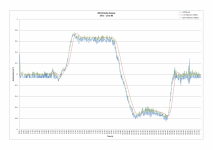
Some results from one of our tests, to round out the thread :):
2012-03-02_Acceleration_Filtering.png
 
Excellent.
Still think you should put a "Fun" button on the control-panel, maybe next to the "Random Floor or None?" selector.

N.
 
Back
Top