

- Joined
- Oct 30, 2009
- Messages
- 14,019
- Reaction score
- 4
- Points
- 0
A tiny second moon may once have orbited Earth before catastrophically slamming into the other one, a titanic clash that could explain why the two sides of the surviving lunar satellite are so different from each other, a new study suggests.
The second moon around Earth would have been about 750 miles (1,200 kilometers) wide and could have formed from the same collision between the planet and a Mars-sized object that scientists suspect helped create the moon we see in the sky today, astronomers said.
{...}
Now computer simulations hint a second moon essentially pancaked itself against its larger companion, broadly explaining the differences seen between the near and far sides.
Their calculations suggest this second moon would have formed at the same time as our moon. Scientists have suggested that our moon was born from massive amounts of debris left over from a giant impact Earth suffered from a Mars-size body early on in the history of the solar system. Spare rubble might also have coalesced into another companion moon, one just 4 percent its mass and about 750 miles wide, or one-third of our moon's diameter.
{...}
The researchers computed that this second moon could have stayed at a Trojan point for tens of millions of years. Eventually, however, this Trojan moon's orbit would have destabilized once our moon's orbit expanded far enough away from Earth.
The resulting collision would have been relatively slow at 4,500 to 6,700 miles per hour (7,200 to 10,800 kph), leading its matter to splatter itself across our moon as a thick extra layer of solid crust tens of miles thick instead of forming a crater.
(READ MORE AT SPACE.COM)
The new model can also explain compositional variations in the lunar crust. Nearside crust is rich in potassium, rare-earth elements, and phosphorus (collectively known as KREEP), and uranium and thorium. These elements are thought to have been the last of a once global magma ocean to crystallize into rock. In the simulations, the collision forces the KREEP-rich layer onto the opposite, nearside hemisphere, creating the dichotomy seen today.
There are many other plausible explanations for the contrasting hemispheres, though, ranging from the piling up of material from the impact that created the 2,500 kilometre-wide South Pole Aitken Basin on the far side of the Moon, to variations in tidal forces and internal heating and dynamics, and impact bombardment and shallow melting.
(READ MORE AT ASTRONOMY NOW)
Links:
The second moon around Earth would have been about 750 miles (1,200 kilometers) wide and could have formed from the same collision between the planet and a Mars-sized object that scientists suspect helped create the moon we see in the sky today, astronomers said.
{...}
Now computer simulations hint a second moon essentially pancaked itself against its larger companion, broadly explaining the differences seen between the near and far sides.
Their calculations suggest this second moon would have formed at the same time as our moon. Scientists have suggested that our moon was born from massive amounts of debris left over from a giant impact Earth suffered from a Mars-size body early on in the history of the solar system. Spare rubble might also have coalesced into another companion moon, one just 4 percent its mass and about 750 miles wide, or one-third of our moon's diameter.
{...}
The researchers computed that this second moon could have stayed at a Trojan point for tens of millions of years. Eventually, however, this Trojan moon's orbit would have destabilized once our moon's orbit expanded far enough away from Earth.
The resulting collision would have been relatively slow at 4,500 to 6,700 miles per hour (7,200 to 10,800 kph), leading its matter to splatter itself across our moon as a thick extra layer of solid crust tens of miles thick instead of forming a crater.
(READ MORE AT SPACE.COM)
The new model can also explain compositional variations in the lunar crust. Nearside crust is rich in potassium, rare-earth elements, and phosphorus (collectively known as KREEP), and uranium and thorium. These elements are thought to have been the last of a once global magma ocean to crystallize into rock. In the simulations, the collision forces the KREEP-rich layer onto the opposite, nearside hemisphere, creating the dichotomy seen today.
There are many other plausible explanations for the contrasting hemispheres, though, ranging from the piling up of material from the impact that created the 2,500 kilometre-wide South Pole Aitken Basin on the far side of the Moon, to variations in tidal forces and internal heating and dynamics, and impact bombardment and shallow melting.
(READ MORE AT ASTRONOMY NOW)
[table="width=400"]
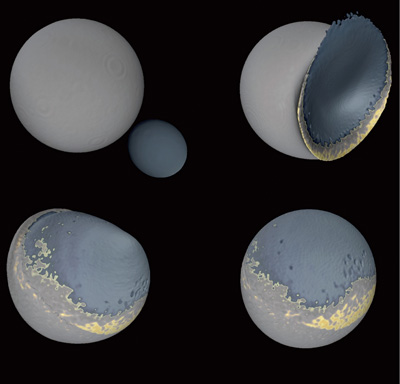
Four snapshots from the computer simulation of a collision between the moon and a smaller companion moon show most of the companion moon is accreted as a pancake-shaped layer, forming a mountainous region on one side of the moon.
Credit: M. Jutzi and E. Asphaug, Nature.
[/table]Links:
- University of California: 'Big splat' may explain moon's mountainous far side
- SPACE.com: Earth Had Two Moons That Crashed to Form One, Study Suggests
- Astronomy Now: Moon's mountains made from giant 'splat'
- PhysicsWorld.com: Trojan collision may have shaped the Moon
- NewScientist: Second moon's remains may cover lunar far side
- Nature News: Early Earth may have had two moons
- BBC News: Earth may once have had two moons


