News EgyptAir flight MS804 disappears from radar between Paris and Cairo

What I don't get is if it was an act of terrorism, why was the bomb (presumably) detonated so late in the flight? The plane would shortly land in Cairo, and was also over water. For a terrorist, the goal is to kill as many as possible, and I would therefore expect the person to detonate a bomb in the middle of the flight (if detonated by a pre set timer), and over land if detonated by an on board terrorist.
I also find it strange that nobody has taken responsibility for such an act ...
 
What I don't get is if it was an act of terrorism, why was the bomb (presumably) detonated so late in the flight? The plane would shortly land in Cairo, and was also over water. For a terrorist, the goal is to kill as many as possible, and I would therefore expect the person to detonate a bomb in the middle of the flight (if detonated by a pre set timer), and over land if detonated by an on board terrorist.
I also find it strange that nobody has taken responsibility for such an act ...

Not too strange. Usually such considerations are secondary to having any opportunity in first place. Also, you can't predict delays and you don't want to explode the bomb on the ground. And then it also depends on when the bomb was actually armed - if for example by pressure, this could be inaccurate depending on how "air tight" the containers have been.

So... yes, a lot of the usual rites of terrorism are missing. But there are also reasons to not exclude terrorism too soon.

For example, the plane was travelling the following routes on that day:

Cairo-Tunis-Cairo-Paris-... (-Cairo)

What if the bomb was placed in Tunis already and was supposed to explode in Paris?

For technical failures, it also happened at the completely wrong time - nothing was going on, the plane was flying at cruise altitude at cruise speed. No bad weather. Nothing that would cause any special stress on the aircraft. And for a suicide flight, it descended too fast - it must have been already badly damaged before.
 
Last edited:
What I don't get is if it was an act of terrorism, why was the bomb (presumably) detonated so late in the flight? The plane would shortly land in Cairo, and was also over water. For a terrorist, the goal is to kill as many as possible, and I would therefore expect the person to detonate a bomb in the middle of the flight (if detonated by a pre set timer), and over land if detonated by an on board terrorist.
I also find it strange that nobody has taken responsibility for such an act ...

You're piling speculation on top of speculation. There are so many possible causes besides a bomb, and even if it was a bomb, there are so many ways that could play out.
 
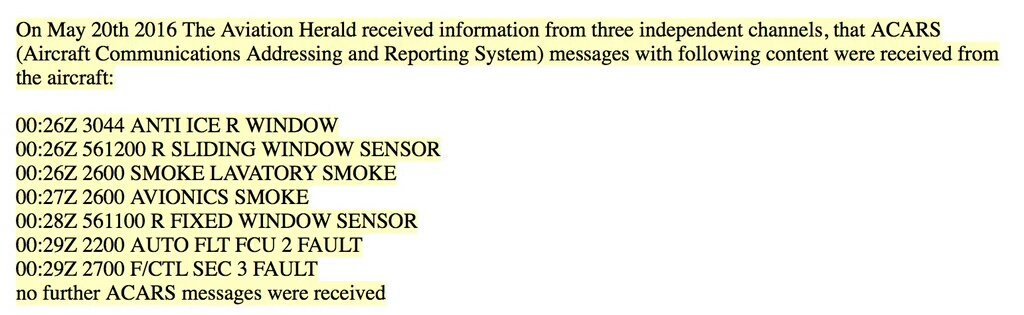
This is allegedly the ACARS transmission from the aircraft just before it vanished from radar.

Ci7K9IKWUAEyT-R.jpg
 
Cockpit avionics bay fire?
EDIT: Yeah, looks like that's what could have happened. Though the forward lav is on the LEFT side of the plane, and all the window alerts are from the RIGHT side... :hmm:
 
Last edited:
Cockpit avionics bay fire?
EDIT: Yeah, looks like that's what could have happened. Though the forward lav is on the LEFT side of the plane, and all the window alerts are from the RIGHT side... :hmm:
Well, it could be similar to what happened with Columbia when she broke up. Just right before the final LOS the mechanical systems officer in the MCC got erroneous data that the NLG and right MLG had been deployed despite all the problems were on the left wing. All just bad sensors as wiring was burned through.
 
Well, it could be similar to what happened with Columbia when she broke up. Just right before the final LOS the mechanical systems officer in the MCC got erroneous data that the NLG and right MLG had been deployed despite all the problems were on the left wing. All just bad sensors as wiring was burned through.

After giving it some thought and remembering my time working around A320s, I can totally understand the presence of smoke in the forward lav...

There's a pretty significant avionics bay under the flight deck floor, which (if memory serves) also somewhat underlays the forward lav, or at least has cable runs that go under it. So, a fire in that bay would result in smoke seeping up around the under-sink cabinets and into the lav itself.
 
This is allegedly the ACARS transmission from the aircraft just before it vanished from radar.

Ci7K9IKWUAEyT-R.jpg

Surprising that the sequence takes 3 minutes without any emergency call by the crew. I would have expected a more sudden sequence from first symptoms until power ceases.

Could it be caused by sabotage?
 
Surprising that the sequence takes 3 minutes without any emergency call by the crew. I would have expected a more sudden sequence from first symptoms until power ceases.

Could it be caused by sabotage?

Three minutes aren't much when trying to address a critical problem. How would an emergency call help the crew ?

EDIT: How high it is in a priority list ?
 
Three minutes aren't much when trying to address a critical problem. How would an emergency call help the crew ?

EDIT: How high it is in a priority list ?

Usually very high - "PAN-PAN, PAN-PAN, PAN-PAN" is among the first things you should do after preventing to directly crash into terrain. For example, you also need it to direct S&R efforts to you as soon as possible, especially over the ocean, where every minute counts, even if you perfectly ditched into the water.

---------- Post added at 12:13 PM ---------- Previous post was at 11:22 AM ----------

As comparison of the timelines, Swissair 111 had 16 minutes from first sign of a fire to the loss of signal, with crew in communication with the ground:

SWR111_flight_path.jpeg
 
My dad's wild speculation:

Window ices over, crew turns on anti-ice.

Anti-ice power circuit short circuits in avionics bay. Circuit breaker pops, resulting in first warning.

Crew resets breaker, resulting in fire in avionics bay due to short circuit.

Fire burns through wiring for right sliding window sensor.

Fire results in smoke alarms, and progresses through the avionics bay, causing other alarms and eventuality leading to loss of radio power. The lavatory smoke alarm comes first leading the crew to check for a passenger smoking in the lavatory first. By the time they know what's going on, they've lost radio and can't make a distress call.
 
Surprising that the sequence takes 3 minutes without any emergency call by the crew. I would have expected a more sudden sequence from first symptoms until power ceases.

Could it be caused by sabotage?

I was thinking this as well. 3 minutes is a very long time in the case of a problem unfolding but a very short time when your senses are heightened.

I'm assuming that everything on ACARS also appeared on the displays in front of the pilots I'd assume that they spent these three minutes discussing what they were seeing.

The question is, what caused it? My thoughts are towards and incendiary device in the avionics bay left there by a terrorist ground worker. A terrifying possibility.
 
My first thought on those alarms look like there is a short in a bundle of wires.

How would the aircraft react to a sudden change in thrust in one engine @FL370? I'd imagine that there wasn't a huge margin between cruise and stall speed, however this late in the flight the lighter fuel load would have improved on that. Maybe an uncommanded deployment of one reverser could catch out a crew that was troubleshooting a list of perplexing faults.
 
I'm assuming that everything on ACARS also appeared on the displays in front of the pilots I'd assume that they spent these three minutes discussing what they were seeing.

That's where my dad's speculation comes in: The first minute's worth of warnings were things for which a non-emergency cause could be imagined, and might have distracted the crew from the latter warnings.
 
I was thinking this as well. 3 minutes is a very long time in the case of a problem unfolding but a very short time when your senses are heightened.

Exactly. 3 minutes run out quickly if you are especially distracted by strange warnings that make no sense.

But 3 minutes is also a rapid propagation of a fire in an aircraft after the modifications that followed Swissair 111. The previously inflammable insulation materials had been replaced by flame-resistant materials.

I'm assuming that everything on ACARS also appeared on the displays in front of the pilots I'd assume that they spent these three minutes discussing what they were seeing.

ACARS shows a lot more than the pilots can see. But the smoke alerts should also appear visible and audible in the cockpit.

The question is, what caused it? My thoughts are towards and incendiary device in the avionics bay left there by a terrorist ground worker. A terrifying possibility.

I would also not exclude something in the cargo hold. But previous terror attacks had also been assisted already by workers in the airport, so it is not a new possibility. Just a lot more sophisticated than before. The forward avionics compartment can be accessed from the nose landing gear bay - even a blind passenger would be a possibly cause like that.
 
Last edited:
Back
Top