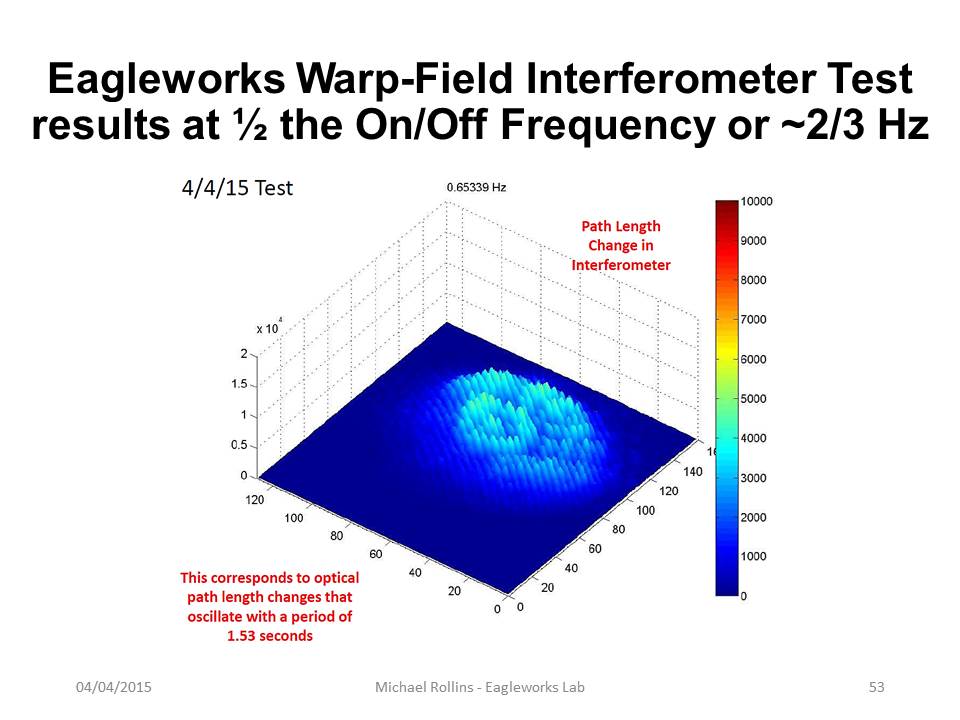
Problem is, at this point none of the alternate theories can explain why the Michelson interferometer is seeing length expansion inside the RF cavity. That effect is literally in the "should never happen" category. And it's on a different bench with a different test article.
Of course it's possible that this is another measurement error, but, from experience, there are too many "errors" here. Think about it this way: when building a test setup, either something moves when it shouldn't (causing a false positive) or does not move when it should (causing a false negative). (*) Let's say that probabilities of each type of mechanical error are equal, i.e. 50%. So if you have two unrelated test setups, testing for two different things, then probability of two false positives is 25%.
And that 25% is contingent on the assumption that both setups are faulty in the first place. These are lab professionals, not grad students, but let's conservatively assume that they get things right 50% of the time (**). So probability that the lab builds two faulty setups in the first place is 25%. (Again, note that these are completely different devices, so it's extremely unlikely that a bad assumption would be carried over from one experiment to another).
So the probability that these guys have measured both the force and the interference pattern due to their own errors is a whooping 6.25%. It's definitely still possible, of course, but it's the point where you should seriously start considering that the gizmo may be working after all.
The next logical step (outside of redoing interferometry in vacuum, but preparing that will take a few months) would be to build several different gizmos and test them comparatively. If some gizmos move faster, and some gizmos move slower, depending e.g. on the aspect ratio of the cavity, then the effect is definitely legit. If all gizmos move the same, then it's probably not legit.
These guys look like they know what they are doing, so they will probably deliver. Even if they ultimately deliver a null, it should at least be a very well supported null.
(*) And that is, of course, why ductape and WD40 are a must at every lab!
(**) That's very conservative, because a professional will make an effort to prove that the testbench itself is working correctly before running the actual test.