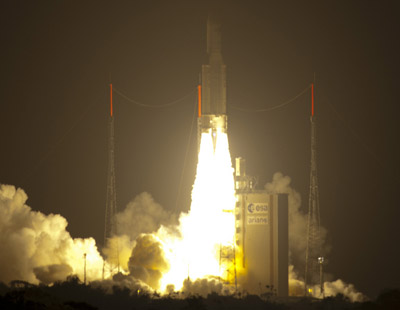
Updates ESA's ATV-2 "Johannes Kepler"

NASA via Twitter said:
If ATV launches Wednesday, STS-133 moves to Feb. 25. But a longer ATV slip beyond Friday results in STS-133 staying on Feb. 24.

So, technically, STS-133 is still Feb. 24th. It will only change if ATV goes tomorrow.
 
According to NASA via Twitter, ESA have decided to make the second launch attempt tomorrow (Wednesday) at 4:50:55 PM EST / 9:50:55 PM GMT.

NASA TV coverage will begin at 4:15 PM EST / 9:15 PM GMT.
 
Spaceflight Now: Mission Status Center:
1715 GMT (12:15 p.m. EST)

The weather forecast in Kourou this evening looks favorable for launch, but a NASA spokesperson says there is a 25 percent chance of lightning in the area that could prompt a delay.

The launch team is in a posture to conduct another launch attempt tomorrow should the need arise, according to NASA.
 
Now L-38 mins! :)

NASA via Twitter said:
If ATV-2 launches today, STS-133 launch will not necessarily slip as previously thought. Final decision Friday at Flight Readiness Review.
 
Live pictures from Kourou.

N.
 
8 mins, the tension kills :uhh:.
 
Liftoff !

---------- Post added at 09:49 PM ---------- Previous post was at 09:47 PM ----------

T+2 minutes : altitude 45 km, velocity 1.88 km/s

---------- Post added at 09:50 PM ---------- Previous post was at 09:49 PM ----------

Boosters separated, altitude over 100 km

---------- Post added at 09:51 PM ---------- Previous post was at 09:50 PM ----------

T+4 minutes : altitude 120 km, velocity 2.66 km/s

---------- Post added at 09:53 PM ---------- Previous post was at 09:51 PM ----------

T+6 minutes : altitude 138 km, velocity 3.9 km/s

Altitude is now decreasing slowly.

---------- Post added at 09:55 PM ---------- Previous post was at 09:53 PM ----------

T+ 8 minutes : altitude 131 km, velocity 5.9 km/s

---------- Post added at 09:56 PM ---------- Previous post was at 09:55 PM ----------

T+ 9 minutes : second stage separation, ignition 10 seconds later, velocity 7 km/s

---------- Post added at 09:58 PM ---------- Previous post was at 09:56 PM ----------

T+ 11 minutes, altitude 145 km, velocity 7.15 km/s

---------- Post added at 10:02 PM ---------- Previous post was at 09:58 PM ----------

T+ 15 minutes, altitude 145.8 km, velocity 7.43 km/s

---------- Post added at 10:05 PM ---------- Previous post was at 10:02 PM ----------

T+ 17 minutes 20 seconds, second stage extinction, altitude 145.8 km, velocity 7.43 km/s.

On orbit !! :thumbup:

Circularization burn in 42 minutes.

---------- Post added at 10:17 PM ---------- Previous post was at 10:05 PM ----------

T+ 30 minutes : altitude 148.2 km, velocity 7.56 km/s, all systems are green.
 
NASA TV Video: European Cargo Craft Launches to ISS.​
[ame="http://www.youtube.com/watch?v=-m0uuO4HBgY"]YouTube - European Cargo Craft Launches to ISS[/ame]
 
Hi there,
I hope this question is not too off topic.

Here's my question:
In all presentations/animations that are showing the deployment of the ATVs solar panes, two opponent panels are deployed together (Panel 1&3, followed by Panel 2&4).
Is this really done this way?
I would have expected the panes to be deployed one after the other...(Panel1, Panel 3, Panel 2, ...)
Does anybody have further information on this?
Just curious, ;)
Kuddel
 
ATV-2 is now on-orbit with all its solar panels deployed. Docking to the SM Aft port is expected on 24/02 at 3:45 PM GMT - about 6 hours before the scheduled launch of Discovery on STS-133! It will be decided whether to launch Discovery on the 24th, or whether to slip to the 25th and the FRR on Friday.

Hi-res launch photos are now online here.
 
Spaceflight Now :

16ariane_400310.jpg


200th Ariane blasts off

The Ariane 5 rocket with the European Space Agency's automated cargo freighter for the International Space Station launched at 2151 GMT (4:51 p.m. EST) today from the Guiana Space Center in South America. The rocket successfully deployed the 44,000-pound spacecraft about one hour later.
 
In all presentations/animations that are showing the deployment of the ATVs solar panes, two opponent panels are deployed together (Panel 1&3, followed by Panel 2&4).
Is this really done this way?
I would have expected the panes to be deployed one after the other...(Panel1, Panel 3, Panel 2, ...)
Does anybody have further information on this?

It is done that way for reducing the torques and forces produced by that. After all, you move a lot of mass away from the center of gravity. If you would just deploy one at a time, the ATV would start to tumble.

Not sure why they only deploy two at a time then, I suspect it is for detecting problems with the deployment better, since the deployment is completely mechanic.
 
Urwumpe said:
[...]since the deployment is completely mechanic.

Is that also the reason for the deployment taking almost 10 minutes? The ATV engineer in the commentary talked about a spring system and a "blade" but I did not get his message there completely.

@SiberianTiger: Awesome :D!
 
It is done that way for reducing the torques and forces produced by that. After all, you move a lot of mass away from the center of gravity. If you would just deploy one at a time, the ATV would start to tumble.
But shifting the CoG when you are not rotating does only apply a lateral shift of the "rest-body" to the opposite direction, right? Only translation, no rotation. I can see no force that is not running through the CoG that could create a rotation/torque.
So, I mean the CoG "stays on it's path", only the construction around shifts a bit:
(X marking the CoG)
Code:
                         +-----+
                      ## |     | ##
                      ## |  X  | ##
                      ## |  |  | ##
                         +- | -+
                            |
                            |
                            V


                   +-----+
                ## |     |     ###### ###### ######
                ## |     |--X--###### ###### ######
                ## |     |  |  ###### ###### ######
                   +-----+  |
                            |
                            |
                            V


                         +-----+
###### ###### ######     |     |     ###### ###### ######
###### ###### ######-----|  X  |-----###### ###### ######
###### ###### ######     |  |  |     ###### ###### ######
                         +- | -+
                            |
                            |
                            V
Nevertheless, when one has to use the thrusters when in "asymetric" state (2nd state in my example), then you will definitely introduce unintentional torques!
So to open the panels symetric is definitely a more save mode.:thumbup:

Now I am really curious about the spring/blade mechanics they use.

Thanks for ideas/insights/thoughts
Kuddel
 
Is that also the reason for the deployment taking almost 10 minutes? The ATV engineer in the commentary talked about a spring system and a "blade" but I did not get his message there completely.

Yes, that is essentially how it works. The panels are pretty much "tied" into launch configuration and the latch being destroyed by a pyro-cutter, some sort of a explosive guillotine.
 
From ISS On-Orbit Status Report for 17/02/2011.

FE-1 Alexander Kaleri & FE-5 Paolo Nespoli conducted a one-hour OBT (On Board Training) exercise simulating ATV-2 (Automated Transfer Vehicle-2) rendezvous & docking, including subsequent downlinking of the resulting simulation log files. A debrief tagup with ground specialists followed at ~5:45 PM GMT. [OBT objectives: Practice crew actions in the event of an off-nominal situation while monitoring rendezvous and docking, refresh rendezvous and docking monitoring skills, and practice crew interaction during rendezvous and docking monitoring.]

Launch of ATV Johannes Kepler:
Last evening (16/02), at Europe's Spaceport in Kourou, French Guiana an Ariane 5 launch vehicle carrying "Johannes Kepler", ESA's second ATV (Automated Transfer Vehicle), lifted off flawlessly at 9:50 PM GMT (6:50 PM local). About 64 minutes into flight, ATV-2 separated safely from the spent upper stage and then deployed its four solar wings, beginning early orbit operations for its climb to the ISS, adjusting its orbit with numerous thruster burns to rendezvous with the station for docking on Thursday, 24/02 (3:46 PM GMT). Weighing about 20 tons at launch, the unmanned supply ship will deliver critical supplies to the ISS (1600 kg dry cargo, 100 kg oxygen & 850 kg ISS refuel propellants propellant, plus 4534 kg propellant for reboost & attitude control). It will also reboost the station during its almost four-month mission. This launch marks the 200th flight of an Ariane vehicle since the debut of 24/12/1979. The total includes 11 flights of Ariane 1, 6 flights of Ariane 2, 11 flights of Ariane 3, 116 flights of Ariane 4 (from 1988 to 2003) and 56 flights of Ariane 5 (from 1996). Integration for the next ATV in line, named "Edoardo Amaldi", will be finished in Europe in August 2011, and production is under way for ATV-4 and -5. "Edoardo Amaldi" is planned for launch in about 12 months. The other two will follow by 2014. After "Johannes Kepler's" docking on 24/02, ISS will for the first time have all logistics vehicles of the international partnership docked at the same time: the US Shuttle, one Russian Progress cargo ship, two Russian Soyuz spacecraft, Japan's HTV, and Europe's ATV, truly a moment of historic significance.
 
But shifting the CoG when you are not rotating does only apply a lateral shift of the "rest-body" to the opposite direction, right? Only translation, no rotation. I can see no force that is not running through the CoG that could create a rotation/torque.
A line from the CoG of one panel, through the vehicle, to the CoG of its opposite panel, does not pass through the vehicle's CoG. When extending just one panel, the vehicle pushes on the panel, so the panel pushes on the vehicle. The force of the panel on the vehicle causes a torque about the CoG of the vehicle. You can see this by taking the cross product of the force from the panel with the vector from the vehicle's CoG to the panel attachment point. Having said that, the subsequent deceleration should apply the opposite torque (or a lower torque for a longer time).

Thinking about in terms of angular momentum, if the vehicle has zero angular momentum then that must be conserved. As the panel starts to move out from the vehicle, it has some angular momentum. The main body of the vehicle must counter-rotate to conserve the net angular momentum. When the panel stops extending the rotation should stop.
 
Last edited:
Higher Altitude Improves Station's Fuel Economy.

For most of the last decade, as astronauts and cosmonauts orbited the Earth aboard the International Space Station they were circling the globe at an altitude of approximately 220 statute miles, or about 350 kilometers.

When the European Space Agency’s resupply ship Johannes Kepler, known also as Automated Transfer Vehicle 2 (ATV2) arrives at the space station later this month, it will bring the fuel needed to boost the station to its normal planned altitude of 248 miles, or 400 kilometers.

The main benefit of raising the station’s altitude will be to cut the amount of fuel needed to keep it there by more than half.

“The key reason for moving to the higher altitude is to save propellant over the long term as we protect against increased solar activity, said Bill Spetch, of the space station program’s Systems Engineering, Analysis and Integration Office. “As solar activity rises, the atmospheric density in our altitude range increases causing increased drag on the vehicle. This in turn causes us to have to raise the orbit more often.”

Even though the space station orbits in what most people on Earth would consider to be the “vacuum of space,” there still are enough atmospheric molecules that contact the surfaces of its large solar array panels, truss structure backbone and pressurized modules to change its speed, or velocity, which is about 17,500 miles, or 28,000 kiliometers an hour. The station is so large (as big as a football field with the end zones included) that the cumulative effect of these tiny particles contacting its surfaces reduces its speed and causes a minute but continuous lowering of its altitude, or height above the Earth.

To fight this tendency, thrusters on the space station or visiting vehicles such as the space shuttle, Progress resupply vehicles or ATVs are fired periodically to “reboost” the station. These reboosts, however, come at the cost of fuel, or propellant, that must be launched from Earth at significant cost.

“The higher we fly, the less we have to reboost to maintain the orbit,” Spetch explained.

Raising the space station’s altitude means that visiting vehicles will not be able to carry as much cargo as they could if they were launching to the station at a lower altitude, but it also means that not as much of that cargo needs to be propellant.

Other considerations include the amount of orbital debris, or space junk, at these different altitudes, and the amount of solar and cosmic radiation to which astronauts and cosmonauts are exposed.

Crew exposure to radiation can be a long-term health issue for crew members, a subject that doctors and researchers are learning more about as each crew member lives and works aboard the station and increases the pool of information on this important topic for future space exploration beyond low-Earth orbit, where it will be an even bigger concern since Earth is protected from much of this cosmic radiation by the Van Allen Belts, which are outside the station’s orbit.

“What we are balancing against this increase in altitude is vehicle capabilities to get to that altitude, how much cargo they can deliver, crew radiation exposure and orbital debris risk,” Spetch said. “Essentially, we want to fly as low as we can support from a propellant resupply standpoint and that altitude increases with solar cycle activity. Also key to us being so low now was taking full advantage of the cargo delivered by space shuttles. Otherwise we would be flying slightly higher now.”

At its current altitude, the space station uses about 19,000 pounds of propellant a year to maintain a consistent orbit. At the new, slightly higher altitude, the station is expected to expend about 8,000 pounds of propellant a year. And that will translate to a significant amount of food, water, clothing, research instruments and samples, and spare parts that can be flown on the cargo vehicles that will keep the station operational until 2020 and beyond.

And all that will be made possible by the nearly 10,000 pounds (4,500 kilograms) of propellant that will be used by the Johannes Kepler’s thrusters to boost the space station to its new, normal altitude above the Earth. The reboosts will take place over the course of several months while ATV2 is docked to the aft port of the station’s Zvezda service module. Undocking is planned for early June.

 
Back
Top